 100% FREE ACCESS
9th Standard CBSE Syllabus & Materials
9th Standard CBSE
CBSE 9th Science Is matter around us pure? - New Model Questions Papers Study Material - QB365 Set A
NEW9th Standard CBSE
CBSE 9th Science Matter in our surroundings - New Model Questions Papers Study Material - QB365 Set A
NEW9th Standard CBSE
CBSE 9th Mathematics Heron's Formula Sample Question Papers Study Material - QB365 Set A
NEW9th Standard CBSE
CBSE 9th Mathematics Circles Sample Question Papers Study Material - QB365 Set A
NEW9th Standard CBSE
CBSE 9th Mathematics Quadrilaterals Sample Question Papers Study Material - QB365 Set A
NEW9th Standard CBSE
CBSE 9th Mathematics Triangles Sample Question Papers Study Material - QB365 Set A
Published on: 29/10/2025
Download CBSE Class 9th Standard CBSE Mathematics question papers, sample papers, important questions, and previous year solved papers in PDF format. Get free study materials, NCERT solutions, and exam preparation resources for Class 9th Standard CBSE Mathematics
Questions + Answers key
Take MCQ Mathematics Test
1.
The area of the four walls of a room is 80 cm2 and its height is 4 m. Then, the perimeter of the floor of the room is
16 m
5 m
20 m
10 m
2.
The area of the four walls of a room is 300 m2. Its length and height are 15 m and 6 m respectively. Find its breadth.
10 m
5 m
20 m
15 m
3.
The dimensions of a box are 1 m, 80 cm and 50 cm. The area of its four walls is
6000 cm2
12000 cm2
18000 cm2
24000 cm2
4.
A brick measures 25 cm \(\times\) 12 cm \(\times\) 10 cm. Its surface area is
670 cm2
1340 cm2
3000 cm2
1500 cm2
5.
The side of a cube is 1 cm. The total surface area of the figure formed by joining two such cubes is
2(2 + 1 + 2) cm2
2(2 + 2 + 2) cm2
2(1 + 1 + 1) cm2
2(1 + 1 + 2) cm2
6.
The lateral surface area of a cuboid of length l, breadth b and height h is
2(lb + bh + hl)
2(l + b)h
lbh
none of these.
7.
If the edges of a cuboid are l, b and h respectively, then the total surface area of the cuboid is
2(lb + bh + hl)
lbh
2(l + b)h
none of these.
8.
The lateral surface area of a cube of side a is
4a2
6a2
3a2
2a2.
9.
The total surface area of a cube of side a is
4a2
6a2
3a2
8a2.
10.
The number of edges of a cube are
6
8
12
16.
11.
Identify the wrong statement of the following:
A square can be drawn on our notebook.
A circle can be drawn on the blackboard.
A rectangle can be drawn on a piece of paper.
A triangle cannot be drawn on a wall.
12.
Which of the following is a solid figure?
Circle
Cylinder
Square
Rectangle.
13.
Which of the following is a plane figure?
Cone
Square
Cylinder
Cube.
14.
There exists a pair of straight lines that are everywhere equidistant from one another' is a direct consequence of Euclid's
first postulate
second postulate
third postulate
fifth postulate
15.
John Playfair was a
french mathematician
Scottish mathematician
Indian mathematician
Egyptian mathematician
16.
Two interesting lines cannot be parallel to the same line, is started in the form of:
an axiom
a definition
a postulate
a proof
17.
If the point P lies in between M and N, and C is mid point of MP, then:
MC + PN + = MN
MP + CP = MN
MC + CN + MN
CP + CN = MN
18.
Given four points such that no three of them are collinear, then the number of lines that can be drawn through them is:
2 lines
4 lines
6 lines
8 lines
19.
Which one of the following statements is true?
Only one line can pass through a single point.
Three are an infinite number lines which pass through two distinct points.
two distinct lines cannot have more than one point in common.
If two circles are equal, then their radii are not equal.
20.
Select the wrong statement:
only one line can be pass through a single point.
Only one line can pass through two distinct points.
A terminated line can be produced indefinitely on both the sides.
if two circles are equal, then their radii are equal.
21.
Which of the following statement is incorrect?
A line segment has defined length
Three line are concurrent id and only if they have a common point
two lines drawn in a plane always intersected at a point
One and only one line can be drawn passing through a given point parallel to a given line
22.
The things which are double of same thing are:
equal
halves of same thing
unequal
double of the same thing
23.
The thing which coincide with one another are:
equal
unequal
half of some thinf
triple of one another
24.
Euclid stated that things which are equal to the same thing are equal to one another in the form of:
an axiom
a definition
a postulate
a proof
25.
The things which coincide with one another are:
equal to one another
un equal
double of same thing
triple of same thing
26.
Euclid stated that all right angles are equal to each other in the form of
an axiom
a definition
a postulate
a proof
27.
A proof is required for:
postulate
aximo
theorem
definition
28.
'Lines are parallel if they do not intersect' is stated in the form of:
an axiom
a definition
a postulate
a proof
29.
Two planes intersect each other to form a:
plane
Point
straight line
angle
30.
The number of line segments determined by three collinear points is:
two
Three
Only one
Four
31.
The number of lines that can pass through a given point is:
two
none
only one
infinite many
32.
How many numbers of lines do pass through two distinct points?
1
2
3
4
33.
Number of dimension(s) a surface:
0
1
2
3
34.
Pythagoras was a student of
Thales
Euclid
both (a) and (b)
Archimedes
35.
Euclid belonged to the country
Babylonia
Egypt
Greek
india
36.
In ancient India, alters with combination of shapes like rectangles, triangles and trapeziums were used for
public workship
household rituals
both (a) and (b)
none of the above
37.
In ancient India, the shapes of altars used for household rituals were
squares and circles
triangles and rectangles
trapeziums and phyramids
rectangles and squares
38.
In Indus Valley Civilisation (about 300 b.C), The brick used for construction work were having dimension in the ration
1 : 3 : 4
4 : 2 : 1
4 : 4 : 1
4 : 3 : 2
39.
The radii of two right circular cylinders are in the ratio 2:3 and their heights are in the ratio 5:4, then the ratio of their volumes will be _______________
40.
Two cylinders have bases of same size. The diameter of each is 7 cm. If one of the cylinder is 10 cm high and the other is 20 cm high, then the ratio of their volumes is _________________
41.
Find the volume of a right circular cone with radius 6 cm and height 7 cm.
42.
How many faces does a right circular cylinder have?
43.
The diameter of a football is five times the diameter of a criket ball. Ratio of surface areas of football and criket ball is _____________
44.
Find the amount of water displaced by a solid spherical ball of diameter 4.2 cm, when it is completely immersed in water.
45.
If the number of square centimetres in the surface area of a shpere is equal to the number of cubic cm in its volume. find the diameter of the sphere?
46.
Compute the curved surface area of a hemishpere whose diameter is 14 cm.
47.
Calculate the volume of a cuboid whose dimensions are 3.6 cm, 8.2 am and 11 cm.
48.
Find the capacity of a tank of demensions 8 am \(\times\)6 cm \(\times\)2.5 cm.
49.
How can we identify parallel lines?
50.
Write the number of dimension(s) of a surface.
51.
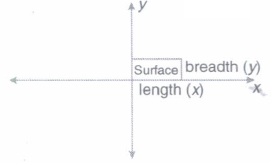
What is a surface?
52.
Give any one example of a geometrical line from your surroundings.
53.
What is a straight line?
54.
How many lines can be passed through two distinct points?
55.
Explain when a system of axioms is called consistent.
56.
Express in variables the things which are double of the same thing.
57.
What does a theorem require?
1.
Required number \(=\frac { 60\times 30\times 30 }{ 15\times 6\times 4 } =150\)
2.
Number of cubes = \(\frac { { \left( 20 \right) }^{ 3 } }{ { \left( 5 \right) }^{ 3 } } =64\)
3.
(c)
18000 cm2
4.
\(\frac { 2 }{ 3 } \times \left( 6\times 5\times 4 \right) 80{ m }^{ 3 }\)
5.
v = 5 \(\times\) (6 \(\times\) 2 \(\times\) 1.5)
6.
Volume = 15 \(\times\) 10 \(\times\) 8 = 1200 cm3
7.
Length of the rod \(=\sqrt { { \left( 10 \right) }^{ 2 }+{ \left( 10 \right) }^{ 2 }+{ \left( 5 \right) }^{ 2 } } \)
8.
(a)
4a2
9.
(b)
6a2
10.
(c)
12
11.
(d)
A triangle cannot be drawn on a wall.
12.
(b)
Cylinder
13.
(b)
Square
14.
(d)
fifth postulate
15.
(b)
Scottish mathematician
16.
(c)
a postulate
17.
(c)
MC + CN + MN
18.
(c)
6 lines
19.
(c)
two distinct lines cannot have more than one point in common.
20.
(a)
only one line can be pass through a single point.
21.
(c)
two lines drawn in a plane always intersected at a point
22.
(a)
equal
23.
(a)
equal
24.
(a)
an axiom
25.
(a)
equal to one another
26.
(a)
an axiom
27.
(c)
theorem
28.
(a)
an axiom
29.
(c)
straight line
30.
(b)
Three
31.
(d)
infinite many
32.
(a)
1
33.
(c)
2
34.
(a)
Thales
35.
(c)
Greek
36.
(a)
public workship
37.
(a)
squares and circles
38.
(b)
4 : 2 : 1
39.
()
Let radii of cylinders be 2x and 3x and heights be 5y and 3y respectively.
\(\therefore\) Ratio of volumes = \(\frac { \pi { (2x) }^{ 2 }\times 5y }{ \pi { (3x) }^{ 2 }\times 3y } \)
\(=\frac { { 4x }^{ 2 }\times 5 }{ { 9x }^{ 2 }\times 3 } \)
= 20:27.
40.
()
Let r denotes the radius of both cylinders and l and h be their heights respectively.
Ratio of their volumes = \(\frac { \pi { r }^{ 2 }h }{ \pi { r }^{ 2 }h' } =\frac { h }{ h' } =\frac { 10 }{ 20 } \)
= 1 : 2.
41.
()
Volume of right circular cone = \(\frac { 1 }{ 3 } \pi { r }^{ 2 }h\)
\(=\frac { 1 }{ 3 } \times \frac { 22 }{ 7 } \times { (6) }^{ 2 }\times 7=\frac { 1 }{ 3 } \times \frac { 22 }{ 7 } \times 36\times 7\)
= 264 cm3.
42.
()
3
43.
()
Given, diameter of football = 5 \(\times\) diameter of cricket ball
If r denotes radius of a football and r' that of a criket ball, then we have
2r = 5\(\times\)(2r')
\(\frac { 2r }{ 2r' } =5\)
or \(\frac { r }{ r' } =5\)
Now, ratio of surface areas\(=\frac { 4\pi { r }^{ 2 } }{ 4\pi { (r') }^{ 2 } } ={ \left( \frac { r }{ r' } \right) }^{ 2 }=\frac { 25 }{ 1 } \)
= 25 : 1
44.
()
Amount of water displaced = Volume of solid spherical ball
\(\therefore \ Volume\ of\ solid\ spherical\ ball=\frac { 4 }{ 3 } \pi { r }^{ 3 }\)
\(r=\frac { 4.2 }{ 2 } =2.1\) (given)
\(\therefore\) Volume of solid sperical ball=\(\frac { 4 }{ 3 } \pi ({ 2.1) }^{ 3 }\)
\(=\frac { 4 }{ 3 } \times \frac { 22 }{ 7 } \times { (2.1) }^{ 3 }\quad { cm }^{ 3 }\)
\(=\frac { 38808 }{ 1000 } litre\)
\(\therefore\) Amount of water displaced = 38808 litre (\(\because\)1 litre = 1000 cm3)
45.
()
Given, Area of Sphere=Volume of sphere
\(4\pi { r }^{ 2 }=\frac { 4 }{ 3 } \pi { r }^{ 3 }\)
where r is the radius of sphere
\(\Rightarrow\) r = 3 cm [on solving]
\(\therefore\) Diameter = 2r = 6 cm.
46.
()
Given diameter of hemisphere = 14 cm
\(\therefore\) radius = 7 cm
\(\therefore\) Curved surface area = 2\(\pi\)r2
\(=2\times \frac { 22 }{ 7 } \times 7\times 7\)
= 308 cm2
47.
()
Volume of cuboid = length\(\times\)breadth\(\times\)height
= 3.6\(\times\)8.2\(\times\)11
= 324.72 cm3.
48.
()
Capacity of the tank = 120 cm3
Capacity of the tank = length\(\times\)breadth\(\times\)height
= 8 cm\(\times\)6 cm\(\times\)2.5 cm
= 120 cm3
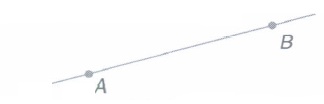
49.
()
Lines are parallel if they do not intersect on being extended.
For example:
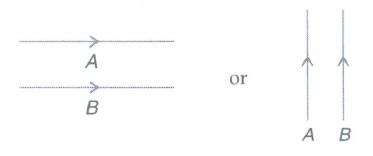
Lines A and B are parallel lines.
50.
()
Dimension of surface= Length and Breadth (which is 2)
51.
()
A surface is that which has length and breadth.
52.
()
Meeting place of two walls.
53.
()
Two planes intersect each other to form a straight line.
54.
()
Only one line passes through two distinct points.
55.
()
A system of axioms is called consistent, when it is impossible to deduce from these axioms, a statement that contradicts any axiom or previously proved statement.
56.
()
Let, First thing = x
Second thing = y
then, x = 2y
57.
()
Theorem requires a proof.

9th Standard CBSE Syllabus & Materials
9th Standard CBSE
CBSE 9th Mathematics Lines and Angles Sample Question Papers Study Material - QB365 Set A
NEW9th Standard CBSE
CBSE 9th Mathematics Introduction to Euclid's Geometry Sample Question Papers Study Material - QB365 Set A
NEW9th Standard CBSE
CBSE 9th Mathematics Linear Equations in Two Variables Sample Question Papers Study Material - QB365 Set A
NEW9th Standard CBSE
CBSE 9th Mathematics Coordinate Geometry Sample Question Papers Study Material - QB365 Set A



NCERT Books

Syllabus

Exam Pattern

Sample Question Papers

Previous year Question Papers

Important Notes

MCQ Practice test

NCERT Exemplers

Case study Questions

Image Based Questions

Passage based Questions

HOT Questions

Value Based Questions

Model Questions Papers
NCERT ( Book Back ) Questions

Assertion and Reason
Important Questions And Answers

CBSE 9th Standard CBSE Subjects
CBSE Standards