 100% FREE ACCESS
10th Standard Syllabus & Materials
10th Standard
TN 10th English Prose - 4 - The Attic Important Questions And Answers Study Material - QB365 Set A
NEW10th Standard
TN 10th English Supplementary - 3 - The Story of Mulan Important Questions And Answers Study Material - QB365 Set A
NEW10th Standard
TN 10th English Poem - 3 - I am Every Woman Important Questions And Answers Study Material - QB365 Set A
NEW10th Standard
TN 10th English Prose - 3 - Empowered Women Navigating The World Important Questions And Answers Study Material - QB365 Set A
NEW10th Standard
TN 10th English Supplementary - 2 - Zigzag Important Questions And Answers Study Material - QB365 Set A
NEW10th Standard
TN 10th English Poem - 2 - The Grumble Family Important Questions And Answers Study Material - QB365 Set A
Published on: 26/08/2026
Download Tamil Nadu 10th Standard Maths question papers, model tests, one-mark questions, important questions, and public exam papers in PDF format. Free study materials and answer keys for TN State Board students.
Questions + Answers key
Take MCQ Maths Test
1.
Graph the following linear function \(y=\frac{1}{2} x\). Identify the constant of variation and verify it with the graph. Also
(i) find y when x = 9
(ii) find x when y = 7.5.
2.
Construct a △PQR which the base PQ = 4.5 cm, ∠R = 35oand the median RG from R to PG is 6 cm
3.
In a class of 50 students, 28 opted for NCC, 30 opted for NSS and 18 opted both NCC and NSS. One of the students is selected at random. Find the probability that
(i) The student opted for NCC but not NSS.
(ii) The student opted for NSS but not NCC.
(iii) The student opted for exactly one of them.
4.
Three fair coins are tossed together. Find the probability of getting
(i) all heads
(ii) atleast one tail
(iii) at most one head
(iv) at most two tails
5.
Two unbiased dice are rolled once. Find the probability of getting
(i) a doublet (equal numbers on both dice)
(ii) the product as a prime number
(iii) the sum as a prime number
(iv) the sum as 1
6.
Two dice are rolled. Find the probability that the sum of outcomes is (i) equal to 4 (ii) greater than 10 (iii) less than 13.
7.
A bag contains 5 blue balls and 4 green balls. A ball is drawn at random from the bag. Find the probability that the ball drawn is (i) blue (ii) not blue.
8.
If A and B are two mutually exclusive events of a random experiment and P(not A) = 0.45, P(A U B) = 0.65, then find P(B).
9.
A and B are two events such that, P(A) = 0.42, P(B) = 0.48, P(A ∩ B) = 0.16. Find (i) P(not A) (ii) P(not B) (iii) P(A or B)
10.
If P(A) = \(\frac{2}{3}\), P(B) = \(\frac{2}{5}\), P(A U B) = \(\frac{1}{3}\) then find P(A ∩ B).
11.
If P(A) = 0.37, P(B).= 0.42, P(A∩B) = 0.09 then find P(AUB).
12.
A coin is tossed thrice. What is the probability of getting two consecutive tails?
13.
What is the probability that a leap year selected at random will contain 53 saturdays. (Hint: 366 = 52 x 7 + 2)
14.
Two coins are tossed together. What is the probability of getting different faces on the coins?
1.
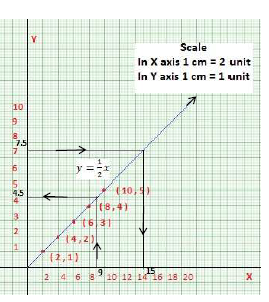
1.Table :
| x | 2 | 4 | 6 | 8 | 10 |
| y | 1 | 2 | 3 | 4 | 5 |
2.Variation :
Direct Variation
3. Equation
y = kx
\(k=\frac{y}{x}=\frac{1}{2}=\frac{2}{4}=\ldots . . \frac{1}{2}\)
\(y=\frac{1}{2} x\)
4. Points :
(2,1),(4,2),(6,3),(8,4),(1,5)
5. Solution
From the graph
(i) If x = 9 then, y = 4.5
(ii) if y = 7.5 then, x = 15
2.
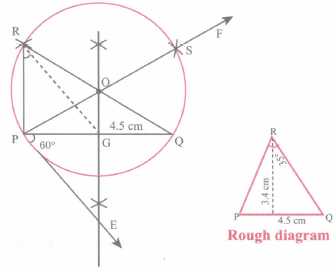
Construction:
Step (1) Draw a line segment PQ = 4.5 cm
Step (2) At P, draw PE such that \(\angle QPE={ 35 }^{ 0 }\)
Step (3) At P, draw PF such that \(\angle EPF={ 90 }^{ 0 }\)
Step (4) Draw \(\bot \) bisector to PQ which intersects PF at O.
Step (5) With O centre OP as radius draw a circle.
Step (6) From G, marked arcs of radius 6 cm on the circle marked them as R and S.
Step (7) Joined PR and RQ. Then \(\triangle\)PQR is the required triangle
Step (8) \(\triangle\)PQS is the required triangle
3.
Total number of students n(S) = 50.
Let A and B be the events of students opted for NCC and NSS respectively.
n(A) = 28, n(B) = 30, n(A⋂B) = 18
P(A) = \(\frac { n(A) }{ n(S) } =\frac { 28 }{ 50 } \)
P(B) = \(\frac { n(B) }{ n(S) } =\frac { 30 }{ 50 } \)
P(A∩B) = \(\frac { n(A\cap B) }{ n(S) } =\frac { 18 }{ 50 } \)
(i) Probability of the students opted for NCC but not NSS
P(A ∩ \(\bar { B } \)) = P(A) - P(A ∩ B) = \(\frac { 28 }{ 50 } -\frac { 18 }{ 50 } =\frac { 1 }{ 5 } \)
(ii) Probability of the students opted for NSS but not NCC.
P(A ∩ \(\bar { B } \)) = P(B) - P(A ∩ B) = \(\frac { 30 }{ 50 } -\frac { 18 }{ 50 } =\frac { 6 }{ 25 } \)
(iii) Probability of the students opted for exactly one of them
= P[(A ∩ \(\bar { B } \)) U (\(\bar { A } \) ∩ B)]
= P(A ∩ \(\bar { B } \)) + P(\(\bar { A } \) ∩ B) =\(\frac { 1 }{ 5 } +\frac { 6 }{ 25 } =\frac { 11 }{ 25 } \)
(Note that (A ∩ \(\bar { B } \)),(\(\bar { A } \) ∩ B) are mutually exclusive events)
4.
When three fair coins are tossed together, the sample space
S = {(HHH), (THH), (HTH),(HHT), (TTH), (THT), (HTT), (TTT)}
N(s) = 8
(i) Let A be the event of getting all heads
A = {HHH}
n(A) = 1
\(P(A)=\frac{n(A)}{n(S)}=\frac{1}{8}\)
(ii) Let B be the event of getting atleast one tail
B = {HHT, HTH, HTT, THH, THT, TTH, TTT}
n(B) = 7
\(\mathrm{P}(\mathrm{B})=\frac{n(B)}{n(S)}=\frac{7}{8}\)
(iii) Let C be the event of getting at most one head
C = {HTT, THT, TTH, TTT}
n(C) = 4
\(\mathrm{P}(\mathrm{C})=\frac{n(C)}{n(S)}=\frac{4}{8}=\frac{1}{2}\)
(iv) Let D be the event of getting at most two tails
P = {HHH, HHT, HTH, HTT, THH, THT, TTH}
n(D) = 7
\(\mathrm{P}(\mathrm{D})=\frac{n(D)}{n(S)}=\frac{7}{8}\)
5.
When two unbiased dice are rolled, the Sample Space
s = {(1, 1) (1, 2) (r,3) (1,4) (1,5) (1,6)
(2, 1) (2,2) (2, 3) (2, 4) (2,5) (6, 6)
(3, 1) (3,2) (3, 3) (3, 4) (3, 5) (3, 6)
(4, 1) (4,2) (4,3) (4,4) (4, 5) (4,6)
(5, 1) (5,2) (5,3) (5,4) (5,5) (6,6)
(6, 1) (6,2) (6, 3) (6,4) (6, 5) (6, 6)}
n(S) = 36
(i) Let A be the event of getting a doublet
A = {( 1, 1) (2,2) (3,3) (4, 4) (5, 5) (6, 6)}
n(A) = 6
\(\mathrm{P}(\mathrm{A})=\frac{n(A)}{n(S)}=\frac{6}{36}=\frac{1}{6}\)
(ii) Let B be the event of getting the product as a prime number.
B = {(1,2) (1,3) (1, 5) (2,1) (3, 1) (5, 1)}
n(B) = 6
\(P(B)=\frac{6}{36}=\frac{1}{6}\)
(iii) Let C be the event of getting the sum as a prime number.
c = {(1, 1) ( 1, 2) (1, 4) ( 1, 6) (2, 1) (2, 3) (2, 5) (3,2) (3, 4) (4, 1) (4,3) (5,2) (5,6) (6, 1) (6,5)}
n(C) = 15
\(\mathrm{P}(\mathrm{C})=\frac{n(C)}{n(S)}=\frac{15}{36}=\frac{5}{12}\)
(iv) Let D be the event of getting the sum as 1. Since it is an impossible event.
n(D) = 0 and P(D) = g
6.
When we roll two dice, the sample space is given by
S = \(\{ (1,1),(1,2),(1,3),(1,4),(1,5),(1,6)\\ (2,1),(2,2),(2,3),(2,4),(2,5),(2,6)\\ (3,1),(3,2),(3,3),(3,4),(3,5),(3,6)\\ (4,1),(4,2),(4,3),(4,4),(4,5),(4,6)\\ (5,1),(5,2),(5,3),(5,4),(5,5),(5,6)\\ (6,1),(6,2),(6,3),(6,4),(6,5),(6,6)\} \)
n(S) = 36
(i) Let A be the event of getting the sum of outcome values equal to 4.
Then A = {(1, 3),(2, 2),(3, 1)}; n(A) = 3.
Probability of getting the sum of outcomes equal to 4 is P(A) = \(\frac { n(A) }{ n(S) } =\frac { 3 }{ 36 } =\frac { 1 }{ 12 } \)
(ii) Let B be the event of getting the sum of outcome values greater than 10.
Then B = {(5,6),(6,5),(6,6)}; n(B) = 3
Probability of getting the sum of outcomes greater than 10 is P(B) = \(\frac { n(B) }{ n(S) } =\frac { 3 }{ 36 } =\frac { 1 }{ 12 } \)
(iii) Let C be the event of getting the sum of outcomes less than 13. Here all the outcomes have the sum value less than 13. Hence C = S
Therefore, n(C) = n(S) = 36
Probability of getting the sum value less than 13 is P(C) = \(\frac { n(C) }{ n(S) } =\frac { 36 }{ 36 } \) = 1
7.
Total number of possible outcomes n(S) = 5 + 4 = 9
(i) Let A be the event of getting a blue ball.
Number of favourable outcomes for the event A. Therefore, n(A) = 5
Probability that the ball drawn is blue. Therefore, P(A) = \(\frac { n(A) }{ n(S) } =\frac { 5 }{ 9 } \)
(ii) \(\bar { A } \) will be the event of not getting a blue ball. So P(\(\bar { A } \)) = 1 - P(A) = \(1-\frac { 5 }{ 9 } =\frac { 4 }{ 9 } \).
8.
Since A and B are mutually exclusive events
\(\mathrm{P}(A \cap B)=0\)
P(not A) = 0.45
P(A) = 1 - P(not A)
P(A) = 1 - 0.45 = 0.55
\(\mathrm{P}(A \cup B)=\mathrm{P}(\mathrm{A})+\mathrm{P}(\mathrm{B})-\mathrm{P}(A \cap B)\)
0.65 = 0.55 + P(B) - 0
P(B) = 0.65 - 0.55 = 0.1
9.
(i) Given P(A) = 0.42
P(not A) = 1 - P(A)
\(\mathrm{P}(\bar{A})=1-0.42=0.58\)
(ii) Given P(B) = 0.48
P(not B) = 1 - P(B)
\(\mathrm{P}(\bar{B})=1-0.48=0.52\)
(iii) P(A or B) = \(P(A \cup B)\)
\(=\mathrm{P}(\mathrm{A})+\mathrm{P}(\mathrm{B})-\mathrm{P}(A \cap B)\)
= 0.42 + 0.48 - 015
= 0.90 - 0.16
P(A or B) = 0.74
10.
\(
\mathrm{P}(A \cup B) =\mathrm{P}(\mathrm{A})+\mathrm{P}(\mathrm{B})-\mathrm{P}(A \cap B)
\)
\(\frac{1}{3} =\frac{2}{3}+\frac{2}{5}-\mathrm{P}(A \cap B)
\)
\(\mathrm{P}(A \cap B) =\frac{2}{3}+\frac{2}{5}-\frac{1}{3}
\)
\(\mathrm{P}(A \cap B) =\frac{10+6-5}{15}=\frac{16-5}{15}=\frac{11}{15}
\)
11.
P(A) = 0.37, P(B) = 0.42, P(A∩B) = 0.09
P(AUB) = P(A) + P(B) - P(A∩B)
P(AUB) = 0.37 + 0.42 - 0.09 = 0.7
12.
When a coin is tossed thrice, the outcome will be
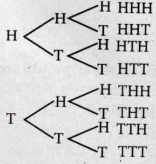
The sample space s = {(HHH), (THH), (HTH), (HHT), (HTT), (THT), (TTH), (TTT)}
n(S) = 3
Let A be the event of getting two consecutive tails
4 = {HTT, TTH, TTT}
n(A) = 3
\(\Rightarrow P=\frac { n\left\{ F \right\} }{ n\{ O\} } =\frac { 3 }{ 8 } \)
Probability of getting two consecutive tails = \(\frac{3}{8}\)
13.
leap year has 366 days. So it has 52 full weeks and 2 days. 52 Saturdays must be in 52 full weeks.
The possible chances for the remaining two days will be the sample space.
S = {(Sun-Mon, Mon-Tue, Tue-Wed, Wed-Thu, Thu-Fri, Fri-Sat, Sat-Sun)}
n(S) = 7
Let A be the event of getting 53rd Saturday.
Then A = {Fri-Sat, Sat-Sun}; n(A) = 2
Probability of getting 53 Saturdays in a leap year is P(A0 = \(\frac { n(A) }{ n(S) } =\frac { 2 }{ 7 } \).
14.
When two coins are tossed together, the sample space is
S = {HH, HT, TH, TT} n(S) = 4
Let A be the event of getting different faces on the coins.
A = {HT, TH}; n(A) = 2
Probability of getting different faces on the coins is P(A) = \(\frac { n(A) }{ n(S) } =\frac { 2 }{ 4 } =\frac { 1 }{ 2 } \).
10th Standard Syllabus & Materials
10th Standard
TN 10th English Prose - 2 - The Night the Ghost Got in Important Questions And Answers Study Material - QB365 Set A
NEW10th Standard
TN 10th English Supplementary - 1 - The Tempest Important Questions And Answers Study Material - QB365 Set A
NEW10th Standard
TN 10th English Poem - 1 - Life Important Questions And Answers Study Material - QB365 Set A
NEW10th Standard
TN 10th English Prose - 1 - His First Flight Important Questions And Answers Study Material - QB365 Set A

Tamilnadu Stateboard 10th Standard Subjects
Tamilnadu Stateboard Standards