 100% FREE ACCESS
10th Standard Syllabus & Materials
10th Standard
TN 10th English Prose - 4 - The Attic Important Questions And Answers Study Material - QB365 Set A
NEW10th Standard
TN 10th English Supplementary - 3 - The Story of Mulan Important Questions And Answers Study Material - QB365 Set A
NEW10th Standard
TN 10th English Poem - 3 - I am Every Woman Important Questions And Answers Study Material - QB365 Set A
NEW10th Standard
TN 10th English Prose - 3 - Empowered Women Navigating The World Important Questions And Answers Study Material - QB365 Set A
NEW10th Standard
TN 10th English Supplementary - 2 - Zigzag Important Questions And Answers Study Material - QB365 Set A
NEW10th Standard
TN 10th English Poem - 2 - The Grumble Family Important Questions And Answers Study Material - QB365 Set A

Published on: 26/08/2026
Download Tamil Nadu 10th Standard Social Science question papers, model tests, one-mark questions, important questions, and public exam papers in PDF format. Free study materials and answer keys for TN State Board students.
Questions + Answers key
Take MCQ Social Science Test
1.
The concept of constitution first originated in _________________.
2.
The new state of Albania was created according to the Treaty of____________signed in May 1913
3.
Japan forced a war on China in the year_________
4.
Boers were also known as ________________.
5.
The founder of the Social Democratic Party was ______________ .
6.
We borrowed the Fundamental Duties from the
American Constitution
Canadian Constitution
Russian Constitution
Irish Constitution
7.
Which of the following sequences in right regarding the Preamble?
Republic, democratic, secular,socialist, sovereign
Sovereign, socialist, secular, reputblic, democratic
Sovereign, republic, secular, socialist, democratic
Sovereign, socialist, secular, democratic, republic
8.
The Palk Strait and Gulf of Mannar separates India from ______________
Goa
West Bengal
Sri Lanka
Maldives
9.
____________was a powerful country in the south west of Europe in the first half of the eighteenth Century.
Turkey
Albania
Croatia
Crypts
10.
In England, the ______________ party was defeated in the general elections of 1931.
Labour
Republican
Socialist
Communist
11.
Which country was expelled from the League of Nations for attacking Finland?
Germany
Russia
Italy
France
12.
Which country emerged as the strongest in East Asia towards the close of nineteenth century?
China
Japan
Korea
Mongolia
13.
What were the three major empires shattered by the end of First World War
Germany, Austria Hungary, and the Ottomans
Germany, Austria-Hungary, and Russia
Spain, Portugal and Italy
Germany, Austria-Hungary, Italy
14.
1 | Treaty of Brest Litovsk | - | versailles |
|---|---|---|---|
2 | Jingoism | - | Turkey |
3 | Kemal Pasha | - | Russia with Germany |
4 | Emden | - | England |
5 | Hall of Mirrors | - | Madras |
15.
What are the methods of calculating Gross Domestic Product? and explain its.
16.
Briefly explain various terms associated with measuring of national income.
17.
Explain the salient features of the Constitution of India.
18.
Discuss the main causes of the First World War.
19.
Assertion (A): In the Boer war camps, shortage of food, medical and sanitary facilities caused the death of 26,000 people.
Reason (R) : There were clashes among the people in the camp.
Codes:
(a) Both A and R are correct
(b) A is right but R has no relevance to A
(c) A is right but R is not the correct explanation
(d) R is right but A is wrong.
20.
The Himalayas are called young fold mountains.
21.
Western Ghats and Eastern Ghats.
22.
The Himalayan rivers and Peninsular rivers.
23.
CHOOSE THE ODD MAN OUT.
Ganga
Yamuna
Brahamaputra
Indus
24.
CHOOSE THE ODD MAN OUT.
Maharadi
Kaveri
Krishna
Tapti
25.
Mark the following in the outline map of India
Major Mountain Ranges :
1. Karakoram
2. Ladakh
3. Zaskar
4. Aravalli
5. Western Ghats
6. Eastern Ghats
1.
U.S.A
2.
London
3.
1894
4.
Afrikaners
5.
Ferdinand Lassalle
6.
(c)
Russian Constitution
7.
(d)
Sovereign, socialist, secular, democratic, republic
8.
(c)
Sri Lanka
9.
(a)
Turkey
10.
(a)
Labour
11.
(b)
Russia
12.
(b)
Japan
13.
(a)
Germany, Austria Hungary, and the Ottomans
14.
1 | Treaty of Brest Litovsk | - | Russia with Germany |
|---|---|---|---|
2 | Jingoism | - | England |
3 | Kemal Pasha | - | Turkey |
4 | Emden | - | Madras |
5 | Hall of Mirrors | - | versailles |
15.
Methods of calculating GDP are as follows :
(i) Expenditure Approach :
(1) In this method, the GDP is measured by adding the expenditure on all the final goods and services produced in the country during a specified period.
(2) GDP(Y) = C + I + G + X - M
(ii) The Income Approach :
(1) This method looks at GDP from the perspective of the earnings of the men and women who are involved in producing the goods and services.
(2) The income approach to measuring GDP (Y) is
Y = Wages + Rent + Interest + Profit
(iii) Value Added Approach:
(1) In the value added approach the value added by each intermediate good is summed to estimate the value of the final good.
(2) The sum of the value added by all the intermediate goods used in production equals to the total value of the final goods produced in the economy.
(3) For example: A cup of tea served to you in a hotel is a "final good".
(4) The goods used to produce it, tea powder, milk and sugar are "intermediate goods" since they form a part of the final goods, the cup of tea.
(5) One way to measure the market value of the cup of tea is to add the value produced by each intermediate good used, to produce it. Each intermediate good, the tea powder, milk and sugar, adds value to the final output, the cup of tea.
16.
Various terms associated with measuring of National Income are as follows :
(i) Gross National Product (GNP):
(1) Gross National Product is the total value of goods and services produced and income received in a year by domestic residents of a country.
(2) It incudes, profits earned from capital invested abroad.
(3) GNP = C + I + G + (X - M) + NFIA
C = Consumption
I = Investment
G = Government Expenditure
X - M = Export - Import
NFIA = Net Factor Income from Abroad
(ii) Gross Domestic Product (GDP):
Gross Domestic Product is the total value of output of goods and services produced by the factors of production within the geographical boundaries of the country.
(iii) Net National Product (NNP):
(1) Net National Product is arrived by making some adjustment with regard to depreciation that is we arrive the NNP by deducting the value of depreciation from Gross National Product.
(2) NNP = GNP – Depreciation
(iv) Net Domestic Product (NDP) :
(1) Net Domestic Product is a part of Gross Domestic Product.
(2) NDP is obtained from the Gross Domestic Product by deducting the Quantum of tear and wear expenses (Depreciation).
(3) NDP = GDP - Depreciation
(v) Per Capita Income (PCI) :
(1) Per Capita Income or output per person is an indicator that shows the living standard of people in a country.
(2) It is obtained by dividing the National income by the population of a country.
PCI = National Income / Population.
(vi) Personal Income(PI) :
(1) Personal Income is the total money income received by individuals and households of a country from all possible sources before direct taxes.
(vii) Disposable Income(DI) :
(1) Disposable income means actual income which can be spent on consumption by individuals and families.
(2) It can be expressed as,
(3) DPI = PI - Direct taxes
(From consumption approach DI = Consumption Expenditures + Savings)
17.
Salient features of Indian Constitution
(i) It is the lengthiest of all the written constitutions of the world.
(ii) It has borrowed most of its provisions from the constitutions of various countries.
(iii) It is partly rigid and partly flexible.
(iv) It establishes a federal system of government.
(v) It makes India a secular state.
(vi) It provides an independent judiciary.
(vii) It introduces Universal Adult Franchise and accords the right to vote to all citizens above 18 years of age without any discrimination.
18.
European Alliances and Counter - Alliances:
(i) In 1900 five of the European Great Powers i were divided into two armed camps
(ii) One camp consisted of the Central Powers Germany, Austria-Hungary and Italy.
(iii) Under the guidance of Bismarck, they had formed the Triple Alliance in 1882
(iv) The other camp consisted of France and Russia.
(v) The Anglo-Japanese Alliance prompted France to seek an alliance with Britain. Which resulted in the Entente Cordiale (1904).
(vi) Britain subsequently reached agreement with Russia and formed the Triple Entente (1907) of Britain, France and Russia.
Violent Forms of Nationalism :
(i) With the growth of nationalism, the attitude of "my country right or wrong I support it" developed.
(ii) England's jingoism, France's chauvinism and Germany's Kultur were militant forms of nationalism, contributing decisively to the outbreak of War.
Aggressive Attitude of German Emperor:
(i) Emperor Kaiser Wilhelm II of Germany was ruthlessly assertive and aggressive.
(ii) Napoleon's defeat at Trafalgar (1805), Germany's aggressive diplomacy and rapid building of naval bases convinced Britain that a German navy could be directed only against her
(iii) Therefore, Britain embarked on a naval race, which heightened the tension between the two powers
Hostility of France towards Germany:
(i) France and Germany were old rivals. Bitter memories of the defeat of 1871 and loss of Alsace and Lorraine to Germany rankled in the minds of the French.
(ii) German interference in Morocco added to the bitterness
Imperial Power Politics in the Balkans :
(i) The Young Turk Revolution of 1908, Austria and Russia resumed their activities in the Balkans.
(ii) Austria announced the annexation of Bosnia and Herzegovina.
(iii) Austria's action aroused intense opposition from serbia. Germany firmly supported Austria.
(iv) The enmity between Austria and Serbia led to the outbreak of war in 1914.
The Balkan Wars :
(i) Turkey was a powerful country in the south west of Europe in the first half of eighteenth century.
(ii) Both the Turks and their subjects of different nationalities in the Balkans experienced rising tensions and conflicts
(iii) There were rivalries among Greece, Serbia, Bulgaria and later Montenegro for the control of it. In March 1912 they formed the Balkan League
(iv) The Second Balkan War ended with the signing of the Treaty of Bucharest in August 1913
Immediate Cause:
(i) The climax to these events in the Balkans occurred in Sarajevo in Bosnia.
(ii) On 28 June 1914 the Archduke Francis Ferdinand, heir to Francis Joseph, Emperor of Austria-Hungary, was assassinated by Princip, a Bosnian Serb
(iii) Austria saw in this an opportunity to eliminate Serbia as an independent state.
(iv) The German violation of Belgian neutrality forced Britain to enter war.
19.
(c) A is right but R is not the correct explanation
20.
(i) The Himalayas are called young fold mountains because they have been formed only a few million years ago, and also they were formed because of the folding of the earth crust due to tectonic activity.
(ii) Himalayas have parallel ranges, sharp pointed peaks and steep slopes indicating that they are young fold mountains.
21.
S.No. | Western Ghats | Eastern Ghats |
|---|---|---|
1. | The Western Ghats forms the western edge of the Peninsular Plateau. | The Eastern Ghats form the eastern edge of the Peninsular Plateau. |
2. | It runs parallel to the Arabian Sea coast. | It runs parallel to the Bay of Bengal Coast. |
3. | These are continuous mountain ranges. | These are discontinuous mountain ranges |
4. | Anaimudi is a sort of tri-junction of the Anaimalai range, the cardamom hills and the Palani hills | These join the Western Ghats at the Nilgiri hills bordering Karnataka and TamilNadu. |
22.
S.No. | The Himalayan Rivers | The Peninsular Rivers |
|---|---|---|
1. | These rivers originate from the Himalayas. | Most of these originate from the Western Ghats. |
2. | They flow in North India. | They flow in South India. |
3. | They are long and wide. | They are very short and narrow. |
4. | They are perennial in nature. | They are non perennial in nature and are seasonal |
5. | They are useful for irrigation and navigation. | They are useful for generating Hydro Power. |
6. | Their middle and lower courses are navigable. | They are not useful for navigation. |
23.
(d)
Indus
24.
(d)
Tapti
25.
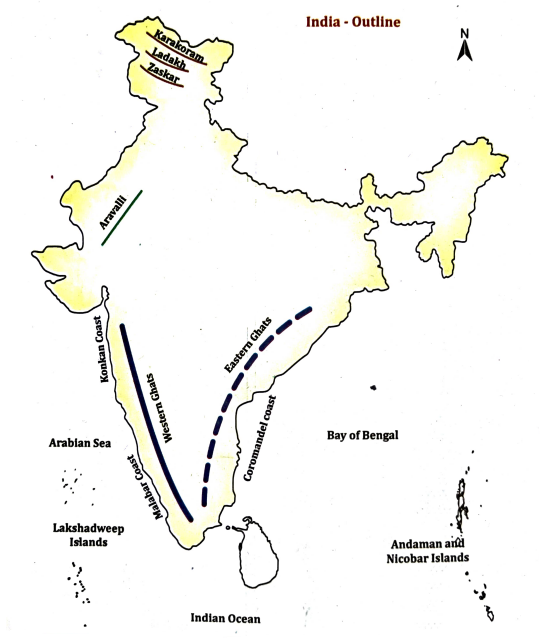

10th Standard Syllabus & Materials
10th Standard
TN 10th English Prose - 2 - The Night the Ghost Got in Important Questions And Answers Study Material - QB365 Set A
NEW10th Standard
TN 10th English Supplementary - 1 - The Tempest Important Questions And Answers Study Material - QB365 Set A
NEW10th Standard
TN 10th English Poem - 1 - Life Important Questions And Answers Study Material - QB365 Set A
NEW10th Standard
TN 10th English Prose - 1 - His First Flight Important Questions And Answers Study Material - QB365 Set A



Tamilnadu Stateboard 10th Standard Subjects
Tamilnadu Stateboard Standards