
 100% FREE ACCESS
11th Standard Syllabus & Materials
11th Standard
TN 11th Tamil இயற்கை வேளாண்மை,சுற்றுச்சூழல் -செய்யுள் - மனோன்மணீயம் Important Questions And Answers Study Material - QB365 Set A
NEW11th Standard
TN 11th Tamil என்னுயிர் என்பேன் -துணைப்பாடம் - இசைத்தமிழர் இருவர் Important Questions And Answers Study Material - QB365 Set A
NEW11th Standard
TN 11th Tamil மொழி கலை -செய்யுள் - ஒவ்வொரு புல்லையும் Important Questions And Answers Study Material - QB365 Set A
NEW11th Standard
TN 11th Tamil பீடு பெற நில் - இலக்கணம் - பகுபத உறுப்புகள் Important Questions And Answers Study Material - QB365 Set A
NEW11th Standard
TN 11th Tamil பீடு பெற நில் - துணைப்பாடம் - வாடிவாசல் Important Questions And Answers Study Material - QB365 Set A
NEW11th Standard
TN 11th Tamil பீடு பெற நில் - செய்யுள் - குறுந்தொகை Important Questions And Answers Study Material - QB365 Set A

Published on: 24/08/2026
Download Tamil Nadu 11th Standard Accountancy question papers, model tests, one-mark questions, important questions, and public exam papers in PDF format. Free study materials and answer keys for TN State Board students.
Questions + Answers key
Take MCQ Accountancy Test
1.
Balance as per cash book is Rs. 2,000. Bank charge of Rs. 50 debited by the bank is not yet shown in the cash book. What is the bank statement balance now?
Rs. 1,950 credit balance
Rs. 1,950 debit balance
Rs. 2,050 debit balance
Rs. 2,050 credit balance
2.
A bank reconciliation statement is prepared to know the causes for the difference between:
The balance as per the cash column of the cash book and bank column of the cash book.
The balance as per the cash column of the cash book and bank statement
The balance as per the bank column of the cash book and the bank statement.
The balance as per petty cash book and the cash book
3.
A bank reconciliation statement is prepared with the help of ______.
Bank statement
Cash book
Bank statement and bank column of the cash book
Petty cash book
4.
Real account deals with
Individual persons
Expenses and losses
Assets
Incomes and gains
5.
A firm has assets of Rs.1,00,000 and the external liabilities of Rs.60,000. Its capital would be
Rs.1,60,000
Rs.60,000
Rs.1,00,000
Rs.40,000
6.
Small payments are recorded in a book called_____.
Cash book
Purchase book
Bills payable book
Petty cash book
7.
The balance in the petty cash book is_____.
An expense
A profit
An asset
A liability
8.
When a firm maintains a simple cash book, it need not maintain_______.
Sales account in the ledger
Purchases account in the ledger
Capital account in the ledger
Cash account in the ledger
9.
Closing entries are recorded in _____
Cash book
Ledger
Journal proper
Purchases book
10.
Purchase returns book is used to record_____
returns of goods to the supplier for which cash is not received immediately
returns of assets to the supplier for which cash is not received immediately
returns of assets to the supplier for which cash is received immediately
None of the above
11.
A periodic total of the purchases book is posted to the _______
debit side of the purchases account
debit side of the sales account
credit side of the purchases account
credit side of the sales account
12.
13.
Which of the following is/are the objective(s) of preparing trial balance?
Serving as the summary of all the ledger accounts
Helping in the preparation of final accounts
Examining arithmetical accuracy of accounts
a, b and c
14.
Trial balance is a_____
Statement
Account
Ledger
Journal
15.
If the total of the debit side of an account exceeds the total of its credit side, it means
Credit Balance
Debit Balance
Nil Balance
Debit and Credit Balance
16.
The process of finding the net amount from the totals of debit and credit columns in a ledger is known as
Casting
Posting
Journalising
Balancing
17.
In India, Accounting Standards are issued by
Reserve Bank of India
The Cost and Management Accountants of India
Supreme Court of India
The Institute of Chartered Accountants of India
18.
The rule of stock valuation 'cost price or realisable value' whichever is lower is based on the accounting principle of :
Materiality
Money measurement
Conservatism
Accrual
19.
Which one of the following is not a main objective of Accounting?
Systematic recording of transactions
Ascertainment of the profitability of the business
Ascertainment of the Financial position of the business
Solving tax disputes with tax authorities
20.
The root of financial accounting system is ______.
Social accounting
Stewardship accounting
Management accounting
Responsibility accounting
21.
Mention the subsidiary books in which the following transactions are recorded.
(i) Sale of goods for cash
(ii) Sale of goods on credit
(iii) Purchases of goods on credit
(iv) Asset purchased as credit.
22.
From the following particulars prepare a bank reconciliation statement of Jayakumar as
on 31st December, 2016.
(a) Balance as per cash book Rs. 7,130
(b) Cheque deposited but not cleared Rs. 1,000
(c) A customer has deposited Rs. 800 into the bank directly
23.
What is trade discount?
24.
State the accounting rule for nominal account
25.
What is journal proper ?
26.
What are the methods of preparation of trial balance?
27.
What is a ledger?
28.
What is "Full Disclosure Principle" of accounting?
29.
Who are the parties interested in accounting information?
30.
List any two functions of accounting.
31.
Prepare a sales account from the following transactions:
| 2018 Jan 1 | Sold goods to Saranya for cash | Rs. 8,000 |
| 4 | Sold goods to Kaviya and cheque received | Rs. 5,000 |
| 11 | 20 Sold goods to Ranjith on credit | Rs. 16,000 |
32.
What is meant by the term "cheque not yet presented?"
33.
Write the advantages of maintaining petty cash book?
34.
State the principles of double entry system of book keeping.
35.
Write short notes on :
(a) Endorsement of a bill and
(b) Discounting of a bill
36.
Explain the procedure for balancing a ledger account.
37.
What are the limitations of trial balance?
38.
Write a brief note on Accounting Standards.
39.
What is matching concept? Why should a business concern follow this concept?
40.
Explain the meaning of accounting.
41.
Enter the following transactions in a cash book with cash and discount columns:
| 2017 | Particulars | Rs |
|---|---|---|
| Jan.1 | Cash in hand | 11,500 |
| Jan.5 | Paid to Ramanathan by depositing in cash deposit machine | 300 |
| Discount allowed by him | 10 | |
| Jan. 8 | Purchased goods for cash | 400 |
| Jan. 10 | Cash received from Rajagopal | 980 |
| Discount allowed | 20 | |
| Jan. 15 | Sold goods for cash | 400 |
| Jan. 21 | Paid cash to Shanthi | 295 |
| Discount received | 5 | |
| Jan.25 | Paid wages by cash | 50 |
| Jan.31 | Paid to Sanjeev Rs.390 in full settlement of his account | 400 |
42.
From the following information, prepare the necessary subsidiary books for Nalanda Book Stores.
| 2017 Dec. 1 | Bought from M/s. Umadevi on credit |
| 100 copies Business Statistics Book @ Rs. 80 each | |
| 100 copies Accountancy Book @ Rs. 150 each | |
| Dec. 7 | Sold to Sridevi & Co., on credit |
| 240 copies Business Statistics @ Rs. 90 each | |
| 250 copies Accountancy books @ Rs. 170 each | |
| Dec. 10 | Bought from Subha & Co., |
| 40 Copies Economics books @ Rs. 80 each | |
| Less: 15% Trade Discount | |
| Dec. 15 | Returned to Mis. Vma Devi 10 copies of damaged Accountancy book for which cash is not received |
| Dec. 18 | Sold to Gupta Bros., on credit |
| 200 copies of Economics book @ Rs. 95 each | |
| Dec. 26 | Returned 6 copies of Economics books to Subha & Co., |
43.
Prepare analytical petty cash book from the following particulars under imprest system:
| Rs | ||
|---|---|---|
| 2017 July 1 | Received advance from cashier | 2,000 |
| 7 | Paid for writing pads and registers | 100 |
| 8 | Purchased white paperss | 50 |
| 10 | Paid auto charges | 200 |
| 15 | Paid wages | 300 |
| 18 | Postal charges | 100 |
| 21 | Purchased stationery | 450 |
| 23 | Tea expenses | 60 |
| 25 | Paid for speed post | 150 |
| 27 | Refreshment expenses | 250 |
| 31 | Paid for carriage | 150 |
44.
Prepare bank reconciliation statement from the following data and find out the balance as per cash book as on 31st March, 2018.
| Particulars | Rs |
|---|---|
| (i) Bank balance as per bank statement | 15,000 |
| (ii) Cheques issued but not yet presented for payment | 2,500 |
| (iii) Bank charges not recorded in the cash book | 250 |
| (iv) Interest charged by bank not recorded in the cash book | 500 |
| (v) Bank paid insurance premium as per standing instruction but not recorded in the cash book | 300 |
| (vi) Cheques deposited but not yet credited | 900 |
45.
From the following information, prepare bank reconciliation statement as on 31st December, 2017 to find out the balance as per bank statement.
| Particulars | Rs |
|---|---|
| (i) Bank overdraft as per cash book | 20,000 |
| (ii) Cheques deposited but not yet credited | 4,000 |
| (iii) Cheque issued but not yet presented for payment | 1,000 |
| (iv) Rent collected by the bank as per standing instruction | 500 |
| (v) Interest on overdraft debited by bank | 2,000 |
| (vi) Amount wrongly debited by bank | 300 |
| (vii) Cheque issued on 30th December 2017 dishonoured by the bank | 5,000 |
| (viii) A customer's cheque deposited in the bank dishonoured by bank not recorded in the book | 2,000 |
46.
Enter the following transactions in the books of Ganesan and post them into ledger.
| 2017 Oct | Rs. | |
| 1 | Started business with cash | 25,000 |
| 5 | Deposited into bank | 12,500 |
| 10 | Purchased furniture and payment by cheque | 2,000 |
| 15 | Goods purchased for cash | 5,000 |
| 19 | Sold goods to Vasu on credit | 4,000 |
| 22 | Goods worth Rs.500 taken for personal use |
47.
Give journal entries and post them to cash account.
| 2016 June | Rs. | |
| 1 | Commenced business with cash | 1,10,000 |
| 10 | Introduced additional capital | 50,000 |
| 28 | Withdrawn for personal use | 20,000 |
48.
The following balances are extracted from the books of Ravichandran on 31st December, 2016. Prepare the trial balance.
| Particulars | Rs | Particulars | Rs |
|---|---|---|---|
| Capital | 1,50,000 | Sales | 75,000 |
| Debtors | 22,800 | Return inwards | 1,000 |
| Rent received | 500 | Discount allowed | 800 |
| Bank overdraft | 3,100 | Discount received | 1,000 |
| Creditors | 5,500 | Wages | 2,900 |
| Premises | 1,46,000 | Salaries | 3,500 |
| Opening Stock | 10,000 | Commission paid | 1,100 |
| Purchases | 45,000 | General expenses | 2,000 |
49.
Mary is a rice dealer having business for more than 5 years. Pass journal entries in her books for the period of March, 2018.
| March | Rs | |
|---|---|---|
| 1 | Cement bags bought on credit from Sibi | 20,000 |
| 2 | Electricity charges paid through net banking | 500 |
| 3 | Returned goods bought from Sibi | 5000 |
| 4 | Cement bags taken for personal use | 1,000 |
| 5 | Advertisement expenses paid | 2,000 |
| 6 | Goods sold to Mano | 20,000 |
| 7 | Goods returned by Mano | 5,000 |
| 8 | Payment received from Mano through NEFT |
50.
Prepare Purchases book and Sales book in the books of Santhosh Textiles Ltd., from the following transactions given for April 2017.
| 2017 April 1 | Purchased goods from Prasad, Kancheepuram on credit |
| 100 meters Silk @ Rs. 450 per meter | |
| 75 meters Velvet @ Rs. 180 per meter | |
| April 10 | Sold goods to Rathinam, Chennai on credit |
| 60 meters Silk @ Rs. 490 per meter | |
| 50 meters Velvet @ Rs. 210 per meter | |
| April 18 | Nathan & Sons purchased from us on credit |
| 100 meters Silk @ Rs. 510 per meter | |
| April 20 | Purchased goods from Hari Ram & Sons, Madurai on credit |
| 50 rolls kada cloth @ Rs. 730 per roll | |
| 80 rolls cotton cloth @ Rs. 650 per roll | |
| April 24 | Purchased from Mohan, Karur for cash |
| Shirting cloth @ Rs. 7,000 | |
| Sarees @ Rs. 25,000 |
51.
Following is the trial balance of Sudhir Chaudhary as on 31.03.2017.
| Rs | Rs | ||
| Capital | 10,00,000 | Debtors | 9,64,000 |
| Plant and Machinery | 13,40,000 | Creditors | 5,30,000 |
| Furniture | 2,40,000 | Rent | 1,92,000 |
| Cash in hand | 60,000 | General expenses | 14,000 |
| Bank overdraft | 78,000 | Discount allowed | 2,000 |
| Purchases | 22,70,000 | Sales return | 6,000 |
| Sales | 34,80,000 |
52.
Enter the following transactions in the journal of Manohar who is dealing in textiles
| 2018 March | Rs. | |
|---|---|---|
| 1 | Manohar started business with cash | 60,000 |
| 2 | Purchased furniture for cash | 10,000 |
| 3 | Bought goods for cash | 25,000 |
| 6 | Bought goods from Kamalesh on credit | 15,000 |
| 8 | Sold goods for cash | 28,000 |
| 10 | Sold goods to Hari on credit | 10,000 |
| 14 | Paid Kamalesh | 12,000 |
| 18 | Paid rent | 500 |
| 25 | Received from Hari | 8,000 |
| 28 | Withdrew cash for personal use | 4,000 |
53.
54.
Discuss briefly the branches of accounting.
1.
(a)
Rs. 1,950 credit balance
2.
(c)
The balance as per the bank column of the cash book and the bank statement.
3.
(c)
Bank statement and bank column of the cash book
4.
(c)
Assets
5.
(d)
Rs.40,000
6.
(d)
Petty cash book
7.
(c)
An asset
8.
(d)
Cash account in the ledger
9.
(c)
Journal proper
10.
(a)
returns of goods to the supplier for which cash is not received immediately
11.
(a)
debit side of the purchases account
12.
(c)
13.
(d)
a, b and c
14.
(a)
Statement
15.
(b)
Debit Balance
16.
(d)
Balancing
17.
(d)
The Institute of Chartered Accountants of India
18.
(c)
Conservatism
19.
(d)
Solving tax disputes with tax authorities
20.
(b)
Stewardship accounting
21.
22.
23.
(i) Trade discount is a deduction given by the supplier to the buyer on the list price or catalogue price of the goods
(ii) It is given as a trade practice or when goods are purchased in large quantities. It is shown as a deduction in the invoice.
(iii) Trade discount is not recorded in the books of accounts. Only the net amount is recorded.
24.
'Debit all expenses and losses and Credit all incomes and gains'. For nominal accounts, the rule is debit all expenses and losses and credit all incomes and gains
25.
Journal Proper is a residuary book which contains record of transactions which do not find a place in the subsidiary books such as cash book, purchases book, sales book, purchases returns book, sales returns book, bills receivable book and bills payable book.
26.
A trial balance can be prepared in the following methods.
(i) Total Method
(ii) Balance Method.
(iii) Total and Balance Method
27.
(i) Ledger is known as Principal book of accounts because it is very useful for a business enterprise.
(ii) It is a book which contains all sets of accounts, namely, personal, real and nominal accounts
(iii) Account-wise balance can be determined from the ledger.
(iv) The ledger accounts are opened or maintained based on journal entries passed.
28.
(i) The accounts must disclose all material information.
(ii) The Accounting reports should disclose full and fair information to the related parties.
(iii) The financial position and performance should be disclosed very honestly to all the users.
29.
There are several persons who need the accounting information for various purposes. They can be classified into two.
(i) Internal users :
1. Owners
2. Management
3. Employees
(ii) External users :
1. Creditors and Financial institutions
2. Investors
3. Customers
4. General public
5. Tax authorities and regulatory bodies
6. Government
7. Researchers
30.
(i) Measurement :
1. The main function of accounting is to keep systematic record of business transactions, post them to the ledger and ultimately to prepare the final accounts.
2. It also shows the current financial position of the business enterprises.
(ii) Comparison :
1. Accounting helps to compare the actual performance with the planned performance.
2. It is also possible to compare with the accounting policies.
31.
| Date | Particulars | J.F | Amount | Date | Particulars | J.F | Amount |
|---|---|---|---|---|---|---|---|
| 2018 Jan 31 | To Balance c/d | 29,000 | 2018 Jan 1 | By Cash A/c | 8,000 | ||
| 4 | By Bank A/c | 85,000 | |||||
| 11 | By Jaya A/c | 16,000 | |||||
| 29,000 | 29,000 | ||||||
| 2018 Feb 1 | By Balance b/d | 29,000 |
32.
(i) When the cheques are issued by the business, it is immediately entered on the credit side of the cash book by the business.
(ii) But, this may not be entered in the bank statement on the same day.
(iii) It will be entered in the bank statement only after it is presented with the bank.
(iv) It is also known as an outstanding cheque.
33.
Following are the advantages of maintaining petty cash book:
(i) There can be better control over petty payments.
(ii) There is saving of time of the main cashier.
(iii) Cash book is not loaded with many petty payments.
(iv) Posting of entries from main cash book and petty cash book is comparatively easy.
34.
Following are the principles of double entry system:
(i) In every business transaction, there are two aspects
(ii) The two aspects involved are the benefit or value receiving aspect and benefit or value giving aspect.
(iii) These two aspects involve minimum two accounts; at least one debit and at least one credit.
(iv) For every debit, there is a corresponding and equivalent credit. If one account is debited the other account must be credited.
35.
(a) Endorsement of a bill :
(i) Endorsement means signing on the face or back of a bill for the purpose of transferring the title of the bill to another person. The person who endorses is called the "Endorser".
(ii) The person to whom a bill is endorsed is called the "Endorsee". The Endorsee is entitled to collect the money.
(b) Discounting of a bill :
(i) When the holder of a bill is in need of money before the due date of a bill, he can convert it into cash by discounting the bill with his banker. This process is referred to as the discounting of bill.
(i) The banker deducts a small amount of the bill which is called discount and pays the balance in cash immediately to the holder of the-bill.
36.
(i) The debit and credit columns of an account are to be totalled separately.
(ii) The difference between the two totals is to be ascertained.
(iii) The difference is to be placed in the amount column of the side having lesser total. 'Balance c/d' is to be entered in the particulars column against the difference and in the date column the last day of the accounting period is entered.
(iv) Now both the debit and credit columns are to be total and the totals will be equal. The totals of both sides are to be recorded in the same line horizontally.
(v) The total is to be distinguished from other figures by drawing lines above and below the amount.
(vi) The difference has to be brought down to the opposite side below the total.
(vii) 'Balance b/d' is to be entered in the particulars column against the difference brought down and in the date column, the first day of the next accounting period is entered.
(viii) If the total on the debit side of an account is higher, the balancing figure is debit balance and if the credit side of an account has higher total, the balancing figure is credit balance. If the two sides are equal, that account will show nil balance.
37.
The following are the limitations of trial balance.
(i) It is possible to prepare trial balance of an organisation, only if the double entry system is followed.
(ii) Even if some transactions are omitted, the trial balance will tally.
(iii) Trial Balance may tally even though errors are committed in the books of account.
(iv) If trial balance is not prepared in a systematic way, the final accounts prepared on the basis of trial balance may not depict the actual state of affairs of the concern.
(v) Agreement of trial balance is not a conclusive proof of the arithmetical accuracy of entries made in the accounting records.
38.
(i) Accounting Standards provide the framework and norms so that the financial statements of different enterprises become comparable.
(ii) It becomes necessary to standardise the accounting principles and policies to ensure consistency, comparability, adequacy and reliability of financial reporting.
(iii) Accounting standards in India are issued by the Institute of Chartered Accountants of India (lCAI).
Definition:
In the words of Kohler, "Accounting standards are codes of conduct imposed by customs, law or professional bodies for the benefit of public accountants and accountants generally".
39.
(i) According to this concept, revenues during an accounting period are matched with expenses incurred during that period to earn the revenue during that period.
(ii) This concept is based on accrual concept and periodicity concept.
(iii) Periodicity concept fixes the time frame for measuring performance and determining financial status.
(iv) All expenses paid during the period are not considered, but only the expenses related to the accounting period are considered.
40.
(i) Accounting is the systematic process of identifying, measuring, recording, classifying, summarising, interpreting and communicating financial information.
(ii) Accounting gives information on :
1. the resources available
2. how the available resources have been employed and
3. the results achieved by their use.
(iii) The profit earned or loss incurred during the accounting period, value and nature of assets, liabilities, and capital can be ascertained from the information recorded in accounts.
41.
| Date | Receipts | L.F | Amount Rs | Date | Payments | L.F | Amount Rs | ||
|---|---|---|---|---|---|---|---|---|---|
| Discount | Cash | Discount | Cash | ||||||
| 2017 | 2017 | ||||||||
| Jan.1 | To Balance b/d | 11,500 | Jan.5 | By Ramanathan A/c | 10 | 300 | |||
| 10 | To Rajagopal Alc | 20 | 980 | 8 | By Purchases A/c | 400 | |||
| 15 | To SalesAlc | 400 | 21 | By Shanthi A/c | 5 | 295 | |||
| 25 | ByWages A/c | 50 | |||||||
| 31 | By Sanjeev A/c | 10 | 390 | ||||||
| 31 | By Balance c/d | 11,445 | |||||||
| 20 | 12,880 | 25 | 12,800 | ||||||
| Feb. 1 | To Balance b/d | 11,445 | |||||||
Note: Discount column is not to be balanced.
42.
| Date | Particulars | Inward Invoice No. | L.F | Amount | |
|---|---|---|---|---|---|
| Details (Rs) | Total (Rs) | ||||
| 2017 Dec 1 | M/s. Umadevi 100 copies Business statistics Book @ Rs. 80 each 100 copies Accountancy Book @ 150 each |
8,000 15,000 |
23,000 |
||
| Dec 10 | Subha & Co., 40 copies Economics book @ 80 each Less : Trade Discount @ 15% |
3,200 480 |
2,720 | ||
| Purchases A/c Dr. | 25,720 | ||||
| Date | Particulars | Inward Invoice No. | L.F | Amount | Remarks | |
|---|---|---|---|---|---|---|
| Details (Rs) | Total (Rs) | |||||
| 2017 Dec 15 | M/s. Umadevi 10 copies of Accountancy book @ Rs. 150 each |
1,500 | Damaged | |||
| Dec 26 | Subha & Co., 6 Copies of Economis @ Rs. 80 each Less; 15% Trade Discount |
480 72 |
408 | |||
| Purchases return A/c Cr. | 1,908 | |||||
| Date | Particulars | Id Invoice No. | L.F | Amount | |
|---|---|---|---|---|---|
| Details (Rs) | Total (Rs) | ||||
| 2017 Dec 7 | Sridevi & Co. 240 copies Business Statistics @ Rs. 90 each 250 copies Accountancy books @ Rs. 170 each |
21,600 42,500 |
64,100 | ||
| Dec 18 | Gupta Bros., 200 copies Economics books @ Rs. 95 each |
19,000 | |||
| Sales A/c Cr. | 83,100 | ||||
43.
| Receipts ( Rs) | C.B.F.N. | Date | Particulars | V.N. | Total payment (Rs) | Printing & Stationery (Rs) | Conveyance (Rs) | Wages (Rs) | Postage and telegrams (Rs) | Carriage (Rs) | Sundries (Rs) | L.F. | Personal Accounts (Rs) |
|---|---|---|---|---|---|---|---|---|---|---|---|---|---|
| 2017July | |||||||||||||
| 2,000 | 1 | To Cash | |||||||||||
| 7 | By Writing pads and registers | 100 | 100 | ||||||||||
| 8 | By White papers | 50 | 50 | ||||||||||
| 10 | By Auto charges | 200 | 200 | ||||||||||
| 15 | By Wages | 300 | 300 | ||||||||||
| 18 | By Postal charges | 100 | 100 | ||||||||||
| 21 | By Stationery | 450 | 450 | ||||||||||
| 23 | By Tea expenses | 60 | 60 | ||||||||||
| 25 | By Speed Post | 150 | 150 | ||||||||||
| 27 | By Refreshment Expenses | 250 | 250 | ||||||||||
| 31 | By Carriage | 150 | 150 | ||||||||||
| 1,810 | 600 | 200 | 300 | 250 | 150 | 310 | |||||||
| 31 | By Balance c/d | 190 | |||||||||||
| 2,000 | 2,000 | ||||||||||||
| 190 | Aug 1 | To Balance b/d To Cash |
|||||||||||
| 1810 |
44.
| Particulars | Amount Rs |
Amount Rs |
|---|---|---|
| Bank balance as per bank statement | 15,000 | |
| Add: Bank charges not recorded in the cash book | 250 | |
| Interest charged by bank | 500 | |
| Bank paid Insurance Premium | 300 | |
| Cheques deposited but not yet credited | 900 | 1,950 |
| 16,950 | ||
| Less: Cheques issued but not yet presented | 2,500 | |
| Balance as per Cashbook | 14,450 |
45.
| Particulars | Amount Rs |
Amount Rs |
|---|---|---|
| Bank overdraft as per cash book | 20,000 | |
| Add: Cheque deposited but not yet credited | 4,000 | |
| Interest on overdraft | 2,000 | |
| Amount wrongly debited by bank | 300 | |
| Cheque deposited but dishonoured | 2,000 | 8,300 |
| 28,300 | ||
| Less: Cheques issued but not yet credited | 1,000 | |
| Rent collected by bank | 500 | |
| Cheque issued but dishonoured | 5,000 | 6,500 |
| Overdraft as per bank statement | 21,800 |
46.
| Date | Particulars | L.F. | Debit Rs | Credit Rs |
|---|---|---|---|---|
| 2017 Oct. 1 | Cash A/c Dr. To Capital A/c (Amount invested in business) |
25,000 | 25,000 |
|
| 5 | Bank A/c Dr. To Cash A/c (Cash paid into Bank) |
12,500 | 12,500 |
|
| 10 | Furniture A/c Dr. To Bank A/c (Furniture purchased by cheque) |
2,000 | 2,000 |
|
| 15 | Purchases A/c Dr. To Cash A/c (Cash purchases) |
5,000 | 5,000 |
|
| 19 | Vasu A/c Dr. To Sales A/c (Credit sales) |
4,000 | 4,000 |
|
| 22 | Drawings A/c Dr. To Purchases A/c (For goods withdrawn for personal use) |
500 | 500 |
| Date | Particulars | J.F. | Amount Rs | Date | Particulars | J.F. | Amount Rs |
|---|---|---|---|---|---|---|---|
| 2017 Oct. 1 | To Capital A/c | 25,000 | 2017 Oct. 5 | By Bank A/c | 12,500 | ||
| 15 | By Purchases A/c | 5,000 | |||||
| 31 | By Balance c/d | 7,500 | |||||
| 25,000 | 25,000 | ||||||
| 2017 Nov. 1 | To Balance bld | 7,500 |
| Date | Particulars | J.F. | Amount Rs | Date | Particulars | J.F. | Amount Rs |
|---|---|---|---|---|---|---|---|
| 2017 Oct. 31 | To Balance c/d | 25,000 | 2017 Oct. 1 | By Cash A/c | 25,000 | ||
| 25,000 | 25,000 | ||||||
| 2017 Nov. 1 | By Balance b/d | 25,000 |
| Date | Particulars | J.F. | Amount Rs | Date | Particulars | J.F. | Amount Rs |
|---|---|---|---|---|---|---|---|
| 2017 Oct. 5 | To Cash A/c | 12,500 | 2017 Oct. 10 | By Furniture A/c | 2,000 | ||
| 31 | By Balance c/d | 10,500 | |||||
| 12,500 | 12,500 | ||||||
| 2017 Nov. 1 | To Balance b/d | 10,500 |
| Date | Particulars | J.F. | Amount Rs | Date | Particulars | J.F. | Amount Rs |
|---|---|---|---|---|---|---|---|
| 2017 Oct. 10 | To Bank A/c | 2,000 | 2017 Oct. 31 | By Balance c/d | 2,000 | ||
| 2,000 | 2,000 | ||||||
| 2017 Nov. 1 | To Balance b/d | 2,000 |
| Date | Particulars | J.F. | Amount Rs | Date | Particulars | J.F. | Amount Rs |
|---|---|---|---|---|---|---|---|
| 2017 Oct. 15 | To Cash A/c | 5,000 | 2017 Oct. 22 | By Purchases A/c | 500 | ||
| 31 | By Balance c/d | 4,500 | |||||
| 5,000 | 5,000 | ||||||
| 2017 Nov. 1 | To Balance b/d | 4,500 |
| Date | Particulars | J.F. | Amount Rs | Date | Particulars | J.F. | Amount Rs |
|---|---|---|---|---|---|---|---|
| 2017 Oct. 19 | To Sales A/c | 4,000 | 2017 Oct. 31 | By Balance c/d | 4,000 | ||
| 4,000 | 4,000 | ||||||
| 2017 Nov. 1 | To Balance b/d | 4,000 |
| Date | Particulars | J.F. | Amount Rs | Date | Particulars | J.F. | Amount Rs |
|---|---|---|---|---|---|---|---|
| 2017 Oct. 31 | To Balance c/d | 4,000 | 2017 Oct. 19 | By Vasu A/c | 4,000 | ||
| 4,000 | 4,000 | ||||||
| 2017 Nov. 1 | By Balance b/d | 4,000 |
| Date | Particulars | J.F. | Amount Rs | Date | Particulars | J.F. | Amount Rs |
|---|---|---|---|---|---|---|---|
| 2017 Oct. 22 | To Purchases A/c | 500 | 2017 Oct. 31 | By Balance c/d | 500 | ||
| 500 | 500 | ||||||
| 2017 Nov. 1 | To Balance b/d | 500 |
47.
| Date | Particulars | L.F. | Debit Rs. | Credit Rs. |
|---|---|---|---|---|
| 2016 June 1 | Cash A/c Dr. To Capital A/c (Commenced business with cash) |
1,10,000 | 1,10,000 | |
| 10 | Cash A/c Dr. To Capital A/c |
50,000 | 50,000 | |
| 28 | Drawings A/c To Cash A/c (withdrawn for personal use) |
20,000 | 20,000 |
| Date | Particulars | J.F. | Amount Rs. | Date | Particulars | J.F. | Amount Rs. |
|---|---|---|---|---|---|---|---|
| 2016 June 1 | To Capital A/c | 1,10,000 | 2016 June 28 | By Drawings A/c | 20,000 | ||
| 10 | To Capital A/c | 50,000 | 30 | By Balance c/d | 1,40,000 | ||
| 1,60,000 | 1,60,000 | ||||||
| 2016 July 1 | To Balance b/d | 1,40,000 |
48.
| S.No | Name of account | L.F. | Debit balance Rs |
Credit balance Rs |
|---|---|---|---|---|
| 1. | Capital | 1,50,000 | ||
| 2. | Debtors | 22,800 | ||
| 3. | Rent received | 500 | ||
| 4. | Bank overdraft | 3,100 | ||
| 5. | Creditors | 5,500 | ||
| 6. | Premises | 1,46,000 | ||
| 7. | Opening Stock | 10,000 | ||
| 8. | Purchases | 45,000 | ||
| 9. | Sales | 75,000 | ||
| 10. | Return inwards | 1,000 | ||
| 11. | Discount allowed | 800 | ||
| 12. | Discount received | 1,000 | ||
| 13. | Wages | 2,900 | ||
| 14. | Salaries | 3,500 | ||
| 15. | Commission paid | 1,100 | ||
| 16. | General expenses | 2,000 | ||
| Total | 2,35,100 | 2,35,100 |
49.
| Date | Particulars | L.F | Debit Rs | Credit Rs | |
|---|---|---|---|---|---|
| 2018 March 1 | Cement bags A/c | Dr | 20,000 | ||
| To Sibi A/c | 20,000 | ||||
| (Cement bags bought on credit) | |||||
| 2 | Electricity charges A/c | Dr | 500 | ||
| To Bank A/c | 500 | ||||
| (Electricity charged paid by net banking) | |||||
| 3 | Sibi A/c | Dr | 5,000 | ||
| To Purchases return A/c | 5,000 | ||||
| (Goods returned to Sibi) | |||||
| 4 | Drawings A/c | Dr | 1,000 | ||
| To Purchases A/c | 1,000 | ||||
| (Being goods taken for personal use) | |||||
| 5 | Advertisements expenses A/c | Dr | 2,000 | ||
| To Cash A/c | 2,000 | ||||
| (Advertisement expenses paid) | |||||
| 6 | Mano A/c | Dr | 20,000 | ||
| To Sales A/c | 20,000 | ||||
| (Credit sales) | |||||
| 7 | Sales return A/c | Dr | 5,000 | ||
| To Mono A/c | 5,000 | ||||
| (Goods returned to Mano) | |||||
| 8 | Bank A/c | Dr | 15,000 | ||
| To Mano A/c | 15,000 | ||||
| (Payment received from Mano through NEFT) |
50.
| Date |
Particulars |
Inward Invoice No. |
L.F. |
Amount | |
| Details (Rs) | Total (Rs) | ||||
| 2017 April 1 | Prasad | ||||
| 100 meters silk @ Rs. 450 | 45,000 | ||||
| 75 meters velvet @ Rs. 180 | 13,500 | ||||
| April 20 | Hari Ram & Sons | ||||
| 50 rolls kada cloth @ Rs. 730 | 36,500 | ||||
| 80 rolls cotton cloth @ Rs. 650 | 52.000 | 88,500 | |||
| Purchases A/c Dr. | 1,47,000 | ||||
Note: The transaction of Cash sales on April 24 should not be recorded in this book.
| Date |
Particulars |
Outward Invoice No. |
L.F |
Amount | |
| Details (Rs) | Total (Rs) | ||||
| 2017 April 10 | Rathinam | ||||
| 60 meters silk @ Rs. 490 | 29,400 | ||||
| 50 meters velvet @ Rs. 210 | 10,500 | ||||
| Sales to Rathinam | 39,000 | ||||
| April 18 | Nathan & Sons | ||||
| 100 meters silk @ Rs. 510 | 51,000 | ||||
| Sales A/c Cr. | 90,900 | ||||
51.
| S.No | Name of account | L.F | Debit balance Rs |
Credit balance Rs |
| 1 | Capital | 10,00,000 | ||
| 2 | Plant and Machinery | 13,40,000 | ||
| 3 | Furniture | 2,40,000 | ||
| 4 | Cash in hand | 60,000 | ||
| 5 | Bank overdraft | 78,000 | ||
| 6 | Purchases | 22,70,000 | ||
| 7 | Sales | 34,80,000 | ||
| 8 | Debtors | 9,64,000 | ||
| 9 | Creditors | 5,30,000 | ||
| 10 | Rent | 1,92,000 | ||
| 11 | General expenses | 14,000 | ||
| 12 | Discount allowed | 2,000 | ||
| 13 | Sales return | 6,000 | ||
| Total | 50,88,000 | 50,88,000 |
52.
| Date | Particulars | L.F. | Debit Rs. | Credit Rs. |
|---|---|---|---|---|
| 2018 March 1 | Cash A/c Dr. To Manohar's capital A/c (Account invested in business) |
60,000 | 60,000 | |
| 2 | Furniture A/c Dr. To Cash A/c (Furniture bought for cash) |
10,000 | 10,000 | |
| 3 | Purchases A/c Dr. To Cash A/c (Goods purchased by cash) |
25,000 | 25,000 | |
| 6 | Purchases A/c Dr. To Kamalesh A/c (Credit purchases) |
15,000 | 15,000 | |
| 8 | Cash A/c Dr. To Sales A/c (Credit sales) |
28,000 | 28,000 | |
| 10 | Hari A/c Dr. To Sales A/c (Credit sales) |
10,000 | 10,000 | |
| 14 | Kamalesh A/c Dr. To Cash A/c (Cash paid) |
12,000 | 12,000 | |
| 18 | Rent A/c Dr. To Cash A/c (Rent paid) |
500 | 500 | |
| 25 | Cash A/c Dr. To Hari's A/c (Cash received) |
8,000 | 8,000 | |
| 28 | Drawings A/c Dr. To Cash A/c (Withdrawn for personal use) |
4,000 | 4,000 |
53.
54.
The various branches of accounting are
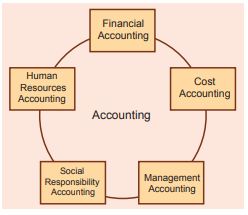
(i) Financial Accounting :
1. It involves recording of financial transactions and events.
2. It provides financial information to the users for taking decisions.
3. It ends up with the preparation of trading and profit and loss account and balance sheet,
(ii) Cost Accounting :
It involves the collection, recording, classification and appropriate allocation of expenditure for the determination of the costs of products or services and for the presentation of data for the purposes of cost control and managerial decision making.
(iii) Management Accounting :
It is concerned with the presentation of accounting information in such a way as to assist management in decision making and in the day - to - day operations of an enterprise.
(iv) Social Responsibility Accounting :
It is concerned with presentation of accounting information from the view point of the society by showing the social costs and social benefits.
(v) Human Resource Accounting :
It is concerned with identification, quantification, and reporting of investments made in human resources of an enterprise.

11th Standard Syllabus & Materials
11th Standard
TN 11th Tamil பீடு பெற நில் - செய்யுள் - காவடிச்சிந்து Important Questions And Answers Study Material - QB365 Set A
NEW11th Standard
TN 11th Tamil பீடு பெற நில் - உரைநடை - மலை இடப்பெயர்கள் : ஓர் ஆய்வு Important Questions And Answers Study Material - QB365 Set A
NEW11th Standard
TN 11th Tamil மாமழை போற்றுதும் - துணைப்பாடம் - யானை டாக்டர் Important Questions And Answers Study Material - QB365 Set A
NEW11th Standard
TN 11th Tamil மாமழை போற்றுதும் - செய்யுள் - ஐங்குறுநூறு Important Questions And Answers Study Material - QB365 Set A



Tamilnadu Stateboard 11th Standard Subjects

Maths

Commerce

Economics

Biology

Business Maths and Statistics
Accountancy

Computer Science

Physics

Chemistry
Maths
Biology
Economics
Physics
Chemistry

History
Business Maths and Statistics

Computer Science
Accountancy

Computer Applications
History
Computer Technology
Commerce
Computer Applications
Computer Technology

Tamil

English

French
Tamilnadu Stateboard Standards


