
 100% FREE ACCESS
11th Standard Syllabus & Materials
11th Standard
TN 11th Tamil இயற்கை வேளாண்மை,சுற்றுச்சூழல் -செய்யுள் - மனோன்மணீயம் Important Questions And Answers Study Material - QB365 Set A
NEW11th Standard
TN 11th Tamil என்னுயிர் என்பேன் -துணைப்பாடம் - இசைத்தமிழர் இருவர் Important Questions And Answers Study Material - QB365 Set A
NEW11th Standard
TN 11th Tamil மொழி கலை -செய்யுள் - ஒவ்வொரு புல்லையும் Important Questions And Answers Study Material - QB365 Set A
NEW11th Standard
TN 11th Tamil பீடு பெற நில் - இலக்கணம் - பகுபத உறுப்புகள் Important Questions And Answers Study Material - QB365 Set A
NEW11th Standard
TN 11th Tamil பீடு பெற நில் - துணைப்பாடம் - வாடிவாசல் Important Questions And Answers Study Material - QB365 Set A
NEW11th Standard
TN 11th Tamil பீடு பெற நில் - செய்யுள் - குறுந்தொகை Important Questions And Answers Study Material - QB365 Set A

Published on: 24/08/2026
Download Tamil Nadu 11th Standard Biology question papers, model tests, one-mark questions, important questions, and public exam papers in PDF format. Free study materials and answer keys for TN State Board students.
Questions + Answers key
Take MCQ Biology Test
1.
Watson and Crick model of DNA double helix is _____form.
A
C
H
B
2.
The net charge of Zwitter ion is_____.
Zero
Positive
Negative
100
3.
________ is the powerful growth inhibitor
Ethanol
Cytokinins
ABA
Auxin
4.
The compound which links glycolysis and Krebs cycle is _______.
Succinic acid
Pyruvic acid
Acetyl CoA
Citric acid
5.
6.
The element which is not remobilized?
Phosphorous
Potassium
Calcium
Nitrogen
7.
What type of transpiration is possible in the xerophyte Opuntia?
Stomatal
Lenticular
Cuticular
All the above
8.
Grafting is successful in dicots but not in monocots because the dicots have _______.
Vascular bundles arranged in a ring
Cambium for secondary growth
Vessels with elements arranged end to end
Cork cambium
9.
10.
The correct sequence in cell cycle is ______.
S-M-G1-G2
S-G1-G2-M
G1-S-G2-M
M-G-G2-S
11.
Define – Enzymes.
12.
13.
Plant A in a nutrient medium shows whiptail disease. Plant B in a nutrient medium shows a little leaf disease. Identify mineral deficiency of plant A and B?
14.
Why is that in certain plants deficiency symptoms appear first in younger parts of the plants while in others, they do so in mature organs?
15.
The nitrogen is present in the atmosphere in huge amount but higher plants fail to utilize it. Why?
16.
What are the parameters which control water potential?
17.
18.
Write any three significance of mitosis.
19.
Write the properties of Water.
20.
Write the physiological effects of Cytokinins.
21.
Respiratory quotient is zero in succulent plants. Why?
22.
Write the role of nitrogenase enzyme in nitrogen fixation?
23.
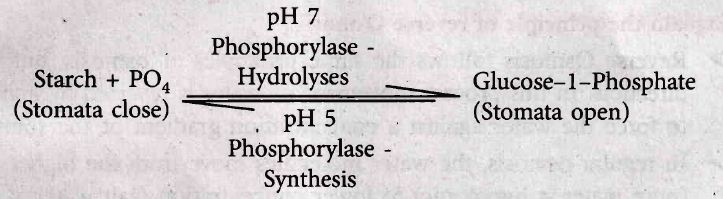
How phosphorylase enzyme open the stomata in starch sugar interconversion theory?
24.
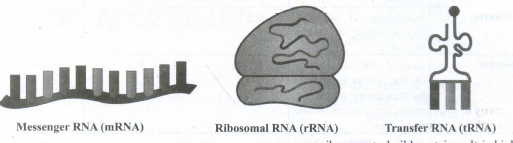
Describe the types of RNA.
25.
Given an account of G0 phase.
26.
Differentiate between mitosis and meiosis.
27.
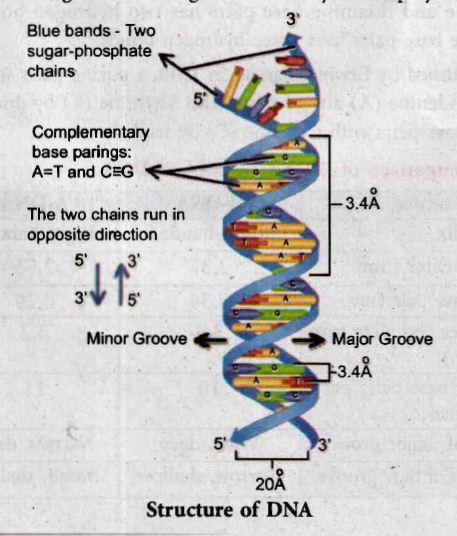
Explain the structure of DNA
28.
29.
30.
1.
(d)
B
2.
(a)
Zero
3.
(c)
ABA
4.
(c)
Acetyl CoA
5.
(c)
6.
(c)
Calcium
7.
(c)
Cuticular
8.
(b)
Cambium for secondary growth
9.
(c)
10.
(c)
G1-S-G2-M
11.
Enzymes are globular proteins that catalyse the thousands of metabolic reactions taking place within cells and organism.
12.
13.
(i) Mineral deficiency of plant A is due to Molybdenum
(ii) Mineral deficiency of plant B is due to Zinc
14.
This is due to the immobile nature of minerals, Eg: Calcium.
15.
(i) Yes. Nitrogen cannot be directly absorbed by plants but they are essential for normal growth and functioning of a plant. Hence they are fixed by bacteria and some fungi.
(ii) It can be utilised only in the form of nitrates (NO3-) and nitrites (NO2-).
16.
(1) Water potential \(\left(\Psi_{\mathrm{W}}\right)\) can be determined by,
(i) Solute concentration or Solute Potential \(\left(\Psi_{\mathrm{S}}\right)\)
(ii) Pressure potential \(\left(\Psi_{\mathrm{P}}\right)\)
(2) By correlating two factors, water potential is written as,
(3) Water potential = Solute potential + Pressure potential
(4) \(\Psi_{W}=\Psi_{S}+\Psi_{P}\)
17.
18.
1. Genetic stability - Daughter cells are genetically identical to parent cells.
2. Growth - As multicellular organisms grow, the number of cells making up their tissue increases. The new cells must be identical to the existing ones.
3. Repair of tissues - Damaged cells must be replaced by identical new cells by mitosis.
19.
Properties of Water
(i) Adhesion and cohesion property
(ii) High latent heat of vapori sation
(iii) High melting and boiling point
(iv) Universal solvent
(v) Specific heat capacity
20.
Physiological effect:
1) Cytokinin promotes cell division in the presence of auxin (IAA).
2) Induces cell enlargement associated with IAA and gibberellins
3) Cytokinin can break the dormancy of certain light-sensitive seeds like tobacco and induces seed germination.
4) Cytokinin promotes the growth of lateral bud in the presence of apical bud.
5) Application of cytokinin delays the process of aging by nutrient mobilization.
6) It is known as Richmond Lang effect.
7) Cytokinin
(i) increases rate protein synthesis
(ii) induces the formation of inter-fascicular cambium
(iii) overcomes apical dominance
(iv) induces formation of new leaves, chloroplast and lateral shoots.
8) Plants accumulate solutes very actively with the help of cytokinins.
21.
Because carbohydrates are partially oxidised to organic acid, particularly malic acid without corresponding release of CO2 but O2 is consumed. Hence the RQ value will be zero.
\(\underset { Glucose }{ 2{ C }_{ 6 }{ H }_{ 12 }{ O }_{ 6 }+3{ O }_{ 2 }\rightarrow } \underset { malic\quad acid }{ 3{ C }_{ 4 }{ H }_{ 6 }{ O }_{ 5 }+3{ H }_{ 2 }O+Energy } \)
RQ of glucose in succulents = \(\frac { Zero \ molecule \ of \ { CO }_{ 2 } }{ 3 \ molecules \ of \ { CO }_{ 2 } } \) = 0 (Zero)
22.
(i) Nitrogen fixation process requires Nitrogenase enzyme complex, Minerals (Mo, Fe and S), anaerobic condition, ATP, electron and glucose 6 phosphate as H+ donor.
(ii) Nitrogenase enzyme is active only in anaerobic condition.
(iii) To create this anaerobic condition a pigment known as leghaemoglobin is synthesized in the nodules which acts as oxygen scavenger and removes the oxygen.
23.
1. The discovery of enzyme phosphorylase in guard cells by Hanes (1940) greatly supports the starch-sugar interconversion theory.
2. The enzyme phosphorylase hydrolyses starch into sugar and high pH followed by endosmosis and the opening of stomata during light. The vice versa takes place during the night.
24.
Ribonucleic acid (RNA): Ribonucleic acid (RNA) is a polymeric molecule essential in various biological roles in coding, decoding, regulation and expression of genes. RNA is single stranded and is unstable when compared to DNA.
Types of RNA:
1. mRNA (messenger RNA) - Single stranded, carries a copy of instructions for assembling amino acids into proteins. It is very unstable and comprises 5% of total RNA polymer. Prokaryotic mRNA (Polycistronic) carry coding sequences for many polypeptides. Eukaryotic mRNA (Monocistronic) contains information for only one polypeptide.
2. tRNA (transfer RNA) - Translates the code from mRNA and transfers amino acids to the ribosome to build proteins. It is highly folded into an elaborate 3D structure and comprises about 15% of total RNA. It is also called as soluble RNA.
3. rRNA (ribosomal RNA) - Single stranded, metabolically stable, make up the two subunits of ribosomes. It constitutes 80% of the total RNA. It is a polymer with varied length from 120 - 3000 nucleotides and gives ribosomes their shape. Genes for rRNA are highly conserved and employed for phylogenetic studies.
25.
(i) Some cells exit G1 and enters a quiescent stage called G0, where the cell remains metabolically active without proliferation.
(ii) Cells can exist for long periods in G0 phase. In G0 cells cease growth with reduced rate of RNA and protein synthesis.
(iii) The G0 phase is not permanent. Mature neuron and skeletal muscle cell remain permanently in G0.
(iv) Many cells in animals remains in G0 unless called on to proliferate by appropriate growth factors or other extracellular signals. G0 cells are not dormant.
26.
Difference between Mitosis and Meiosis:
| S.No | Mitosis | Meiosis |
| 1. | One division | Two divisions |
| 2. | Number of Chromosomes remains the same | Number of Chromosomes is halved |
| 3. | Homologous Chromosomes line up separately on the metaphase plate | Homologous Chromosomes line up in pairs at the metaphase plate |
| 4. | Homologous Chromosome do not pair up | Homologous Chromosome pair up to form bivalent |
| 5. | Chiasmata do not form and crossing over never occurs | Chiasmata form and crossing over occurs |
| 6. | Daughter cells are genetically identical | Daughter cells are genetically different from the parent cells |
| 7. | Two daughter cells are formed | Four daughter cells are formed |
27.
(i) Watson and Crick shared the Nobel Prize in 1962 for their discovery, along with Maurice Wilkins, who had produced the crystallographic data supporting the model. Rosalind Franklin (1920-1958) had earlier produced the first clear crystallographic evidence for a helical structure.
(ii) James Watson and Francis Crick of Cavendish laboratory in Cambridge built a scale model of double helical structure of DNA which is the most prevalent form of DNA, the B-DNA. This is the secondary structure of DNA.
(iii) As proposed by James Watson and Francis Crick, DNA consists of right handed double helix with 2 helical polynucleotide chains that are coiled around a common axis to form right handed B form of DNA.
(iv) The coils are held together by hydrogen bonds which occur between complementary pairs of nitrogenous bases.
(v) The sugar is called 2'-deoxyribose because there is no hydroxyl at position 2'.
(vi) Adenine and thiamine base pairs has two hydrogen bonds while guanine and cytosine base pairs have three hydrogen bonds.
(vii) As published by Erwin Chargaff in 1949, a purine pairs with pyrimidine and vice versa. Adenine (A) always pairs with Thymine (T) by double bond and Guanine (G) always pairs with Cytosine (C) by triple bond.
28.
29.
30.

11th Standard Syllabus & Materials
11th Standard
TN 11th Tamil பீடு பெற நில் - செய்யுள் - காவடிச்சிந்து Important Questions And Answers Study Material - QB365 Set A
NEW11th Standard
TN 11th Tamil பீடு பெற நில் - உரைநடை - மலை இடப்பெயர்கள் : ஓர் ஆய்வு Important Questions And Answers Study Material - QB365 Set A
NEW11th Standard
TN 11th Tamil மாமழை போற்றுதும் - துணைப்பாடம் - யானை டாக்டர் Important Questions And Answers Study Material - QB365 Set A
NEW11th Standard
TN 11th Tamil மாமழை போற்றுதும் - செய்யுள் - ஐங்குறுநூறு Important Questions And Answers Study Material - QB365 Set A



Tamilnadu Stateboard 11th Standard Subjects

Maths

Commerce

Economics
Biology

Business Maths and Statistics

Accountancy

Computer Science

Physics

Chemistry
Maths
Biology
Economics
Physics
Chemistry

History
Business Maths and Statistics

Computer Science
Accountancy

Computer Applications
History
Computer Technology
Commerce
Computer Applications
Computer Technology

Tamil

English

French
Tamilnadu Stateboard Standards


