
 100% FREE ACCESS
11th Standard Syllabus & Materials
11th Standard
TN 11th Tamil இயற்கை வேளாண்மை,சுற்றுச்சூழல் -செய்யுள் - மனோன்மணீயம் Important Questions And Answers Study Material - QB365 Set A
NEW11th Standard
TN 11th Tamil என்னுயிர் என்பேன் -துணைப்பாடம் - இசைத்தமிழர் இருவர் Important Questions And Answers Study Material - QB365 Set A
NEW11th Standard
TN 11th Tamil மொழி கலை -செய்யுள் - ஒவ்வொரு புல்லையும் Important Questions And Answers Study Material - QB365 Set A
NEW11th Standard
TN 11th Tamil பீடு பெற நில் - இலக்கணம் - பகுபத உறுப்புகள் Important Questions And Answers Study Material - QB365 Set A
NEW11th Standard
TN 11th Tamil பீடு பெற நில் - துணைப்பாடம் - வாடிவாசல் Important Questions And Answers Study Material - QB365 Set A
NEW11th Standard
TN 11th Tamil பீடு பெற நில் - செய்யுள் - குறுந்தொகை Important Questions And Answers Study Material - QB365 Set A

Published on: 24/08/2026
Download Tamil Nadu 11th Standard Business Maths and Statistics question papers, model tests, one-mark questions, important questions, and public exam papers in PDF format. Free study materials and answer keys for TN State Board students.
Questions + Answers key
Take MCQ Business Maths and Statistics Test
1.
The following data relate to advertisement expenditure(in lakh of rupees) and their corresponding sales( in crores of rupees)
| Advertisement expenditure | 40 | 50 | 38 | 60 | 65 | 50 | 35 |
| Sales | 38 | 60 | 55 | 70 | 60 | 48 | 30 |
Estimate the sales corresponding to advertising expenditure of Rs. 30 lakh.
2.
The heights ( in cm.) of a group of fathers and sons are given below
| Heights of fathers: | 158 | 166 | 163 | 165 | 167 | 170 | 167 | 172 | 177 | 181 |
| Heights of Sons: | 163 | 158 | 167 | 170 | 160 | 180 | 170 | 175 | 172 | 175 |
Find the lines of regression and estimate the height of son when the height of the father is 164 cm.
3.
A random sample of recent repair jobs was selected and estimated cost and actual cost were recorded.
| Estimated cost | 300 | 450 | 800 | 250 | 500 | 975 | 475 | 400 |
| Actual cost | 273 | 486 | 734 | 297 | 631 | 872 | 396 | 457 |
Calculate the value of spearman’s correlation coefficient.
4.
Calculate correlation coefficient for the following data.
| X | 25 | 18 | 21 | 24 | 27 | 30 | 36 | 39 | 42 | 48 |
| Y | 26 | 35 | 48 | 28 | 20 | 36 | 25 | 40 | 43 | 39 |
5.
Solve the following linear programming problem graphically.
Maximise Z = 4x1 + x2 subject to the constraints x1 + x2 ≤ 50; 3x1 + x2 ≤ 90 and x1 ≥ 0, x2 ≥ 0.
6.
A Project has the following time schedule
| Activity | 1-2 | 1-6 | 2-3 | 2-4 | 3-5 | 4-5 | 6-7 | 5-8 | 7-8 |
| Duration(in days) | 7 | 6 | 14 | 5 | 11 | 7 | 11 | 4 | 18 |
Construct the network and calculate the earliest start time, earliest finish time, latest start time and latest finish time of each activity and determine the Critical path of the project and duration to complete the project.
7.
A project schedule has the following characteristics
| Activity | 1-2 | 1-3 | 2-4 | 3-4 | 3-5 | 4-9 | 5-6 | 5-7 | 6-8 | 7-8 | 8-10 | 9-10 |
| Time | 4 | 1 | 1 | 1 | 6 | 5 | 4 | 8 | 1 | 2 | 5 | 7 |
Construct the network and calculate the earliest start time, earliest finish time, latest start time and latest finish time of each activity and determine the Critical path of the project and duration to complete the project.
8.
By the principle of mathematical induction, prove the following.
32n-1 is a divisible by 8, for all \(n\in N\) .
9.
By the principle of mathematical induction, prove the following.
13 + 23 + 33 + ....... + n3 = \(\frac { { n }^{ 2 }(n+1)^{ 2 } }{ 4 } \) for all \(n\in N\).
10.
Find the equation of the circle passing through the points (0, 1) , (4 ,3) and (1, -1).
11.
12.
Scatter diagram of the variate values (X,Y) give the idea about ________.
functional relationship
regression model
distribution of errors
no relation
13.
The regression coefficient of Y on X ________.
bxy =\(\frac { N\Sigma dxdy-(\Sigma dx)(\Sigma dy) }{ N\Sigma dy^{ 2 }-(\Sigma dy)^{ 2 } } \)
byx =\(\frac { N\Sigma dxdy-(\Sigma dx)(\Sigma dy) }{ N\Sigma dy^{ 2 }-(\Sigma dy)^{ 2 } } \)
byx =\(\frac { N\Sigma dxdy-(\Sigma dx)(\Sigma dy) }{ N\Sigma dx^{ 2 }-(\Sigma dx)^{ 2 } } \)
bxy =\(\frac { N\Sigma xy-(\Sigma x)(\Sigma y) }{ \sqrt { N\Sigma { x }^{ 2 }-(\Sigma x)^{ 2 }\times \sqrt { N\Sigma { y }^{ 2 }-(\Sigma y)^{ 2 } } } } \)
14.
From the following data, N = 11, ΣX = 117, ΣY = 260, ΣX2 = 1313, ΣY2 = 6580, ΣXY = 2827 the correlation coefficient is ________.
0.3566
-0.3566
0
0.4566
15.
Correlation co-efficient lies between ______.
0 to ∞
-1 to +1
-1 to 0
-1 to ∞
16.
If the values of two variables move in same direction then the correlation is said to be ______.
Negative
positive
Perfect positive
No correlation
17.
Given an L.P.P maximize Z = 2x1 + 3x2 subject to the constrains x1 + x2 ≤ 1, 5x1 + 5x2 ≥ 0 and x1 ≥ 0, x2 ≥ 0 using graphical method, we observe ______.
No feasible solution
unique optimum solution
multiple optimum solution
none of these
18.
Which of the following is not correct?
Objective that we aim to maximize or minimize
Constraints that we need to specify
Decision variables that we need to determine
Decision variables are to be unrestricted
19.
In the given graph the coordinates of M1 are
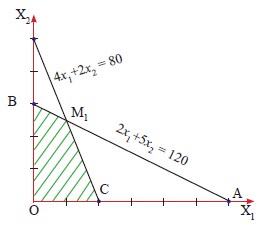
x1 = 5, x2 = 30
x1 = 20, x2 = 16
x1 = 10, x2 = 20
x1 = 20, x2 = 30
20.
Maximize: z = 3x1 + 4x2 subject to 2x1 + x2 ≤ 40, 2x1+ 5x2 ≤ 180, x1, x2 ≥ 0. In the LPP, which one of the following is feasible corner point?
x1 = 18, x2 = 24
x1 = 15, x2 = 30
x1 = 2.5, x2 = 35
x1 = 20.5, x2 = 19
1.
| X | Y | dx = X-48 | dy = Y-52 | dx2 | dy2 | dx dy |
|---|---|---|---|---|---|---|
| 40 | 38 | -8 | -14 | 64 | 196 | 112 |
| 50 | 60 | 2 | 8 | 4 | 64 | 16 |
| 38 | 55 | -10 | 3 | 100 | 9 | -30 |
| 60 | 70 | 12 | 18 | 144 | 324 | 216 |
| 65 | 60 | 17 | 8 | 289 | 64 | 136 |
| 50 | 48 | 2 | -4 | 4 | 16 | -8 |
| 35 | 30 | -13 | -22 | 169 | 484 | 286 |
| \(\Sigma X\) = 338 | \(\Sigma Y\) = 361 | \(\Sigma dx\) = 2 | \(\Sigma dy\) = -3 | \(\Sigma dx^2\) = 774 | \(\Sigma dy^2\) = 1157 | \(\Sigma dxdy\) = 728 |
\(\bar{X} =\frac{\Sigma X}{N}=\frac{338}{7}=48.29 \)
\(\bar{Y} =\frac{\Sigma Y}{N}=\frac{361}{7}=51.57 \)
\(b_{y x} =\frac{N \Sigma d x d y-\Sigma d x \Sigma d y}{N \Sigma d x^2-(\Sigma d x)^2} \)
\(=\frac{7(728)+6}{7(774)-4} \)
\(=\frac{5102}{5414}=0.942\)
Regression equation of Y on X is
\(Y-\overset{-}{Y}=b_{yx}(X-\overset{-}{X})\)
Y - 51.57 = 0.942(X - 48.29)
Y = 0.942X - 45.49 + 51.57
= 0.942X + 6.08
Y = 0.942(30) + 6.08
Y = 34.34 (In Crores of rupees)
2.
| X | Y | dx = X-168 | dy = Y-169 | dx2 | dy2 | dxdy |
|---|---|---|---|---|---|---|
| 158 | 163 | -10 | -6 | 100 | 36 | 60 |
| 166 | 158 | -2 | -11 | 4 | 121 | 22 |
| 163 | 167 | -5 | -2 | 25 | 4 | 10 |
| 165 | 170 | -3 | 1 | 9 | 1 | -3 |
| 167 | 160 | -1 | 9 | 1 | 81 | -9 |
| 170 | 180 | 2 | 11 | 4 | 121 | 22 |
| 167 | 170 | -1 | 1 | 1 | 1 | -1 |
| 172 | 175 | 4 | 6 | 16 | 36 | 24 |
| 177 | 172 | 9 | 3 | 25 | 9 | 27 |
| 181 | 175 | 13 | 6 | 169 | 36 | 78 |
| \(\Sigma X\) = 1686 | \(\Sigma Y\) = 1690 | \(\Sigma dx\) = 6 | \(\Sigma dy\) = 0 | \(\Sigma dx^2\) = 410 | \(\Sigma dy^2\)= 446 | \(\Sigma dxdy\) = 248 |
\(\bar{X} =\frac{\Sigma X}{N}=\frac{1686}{10}=168.6 \)
\(\bar{Y} =\frac{\Sigma Y}{N}=\frac{1690}{10}=169 \)
\(b_{x y} =\frac{N \Sigma d x d y-(\Sigma d x)(\Sigma d x)}{N \Sigma d y^2-(\Sigma d y)^2} \)
\(=\frac{10(248)-0}{10(446)-0}=\frac{248}{446}=0.556 \)
\(b_{y x} =\frac{N \Sigma d x d y-(\Sigma d x)(\Sigma d y)}{N \Sigma d x^2-(\Sigma d x)^2} \)
\(=\frac{2480}{4100-36}=\frac{2480}{4064}=0.6102\)
Regression equation of X on Y
\(X-\bar{X}=b_{x y}(Y-\bar{Y}) \)
X - 168.6 = 0.556(Y - 169)
X = 0.556 Y + 168.6-93.964
X = 0.556 Y + 74.64
Regression equation of Y on X
\(Y-\bar{Y}=b_{y x}(X-\bar{X}) \)
Y - 169 = 0.6102(X - 168.6)
Y = 0.6102 X - 102.8 + 169
Y = 0.6102X + 66.12
If X = 164
Y= 100.07 + 66.12
= 166.19
Height of son is 166.19
3.
| X | Y | Rx | Ry | d=Rx-Ry | d2 |
| 300 | 273 | 2 | 1 | 1 | 1 |
| 450 | 486 | 4 | 5 | -1 | 1 |
| 800 | 734 | 7 | 7 | 0 | 0 |
| 250 | 297 | 1 | 2 | -1 | 1 |
| 500 | 631 | 6 | 6 | 0 | 0 |
| 975 | 872 | 8 | 8 | 0 | 0 |
| 475 | 396 | 5 | 3 | 2 | 4 |
| 400 | 457 | 3 | 4 | -1 | 1 |
| \(\sum\)d2 = 8 |
\(\rho =1-\frac{6 \Sigma d^2}{n\left(n^2-1\right)} \)
\(=1-\frac{6(8)}{8(63)} \)
= 1-0.0952
= 0.905
4.
| X | Y | x2 | y2 | xy |
| 25 | 26 | 625 | 676 | 650 |
| 18 | 35 | 324 | 1225 | 630 |
| 21 | 48 | 441 | 2304 | 1008 |
| 24 | 28 | 576 | 784 | 672 |
| 27 | 20 | 729 | 400 | 540 |
| 30 | 36 | 900 | 1296 | 1080 |
| 36 | 25 | 1296 | 625 | 900 |
| 39 | 40 | 1521 | 1600 | 1560 |
| 42 | 43 | 1764 | 1849 | 1806 |
| 48 | 39 | 2304 | 1521 | 1872 |
| \(\sum\)X = 310 | \(\sum\)Y = 340 | \(\sum\)X2 = 10480 | \(\sum\)Y2 = 12280 | \(\sum\)XY = 10718 |
\(r(x, y)=\frac{N \Sigma X Y-\left(\sum X\right)\left(\sum Y\right)}{\sqrt{N \Sigma X^2-(\Sigma Y)^2} \sqrt{N \Sigma Y^2-(\Sigma Y)^2}} \)
\(=\frac{10(10718)-(310)(340)}{\sqrt{10(10480)-(310)^2} \sqrt{10(12280)-(340)^2}} \)
\(=\frac{107180-105400}{\sqrt{104800-96100} \sqrt{122800-115600}} \)
\(=\frac{1780}{\sqrt{8700 \times 7200}}=\frac{1780}{7914.54}=0.2249\)
5.
First we have to find the feasible region using the given conditions.
Since both the decision variables x1 and x2 are non-negative, the solution lies in the first quadrant write all the inequalities of the constraints in the form of equations.
∴ We have the lines \(x_1+x_2 \leq 50; 3 x_1+x_2 \leq 90\)
x1 + x2 = 50 is a line passing through the points (0,50) and (50,0).
[(0,50) is obtained by taking x1 = 0 in x1 + x2 = 50, (50,0) is obtained by taking x2 = 0 in \(\left.x_1+x_2=50\right]\)
Any point lying on or below the line x1 + x2 = 50. Satisfies the constraint \(x_1+x_2 \leq 50\)
We follow the same steps for the following
x1 + x2 = 50
| x1 | 0 | 50 |
| x2 | 50 | 0 |
\({ 3x }_{ 1 }+{ x }_{ 2 }=90\)
| x1 | 0 | 30 |
| x2 | 90 | 0 |
Now we draw the graph
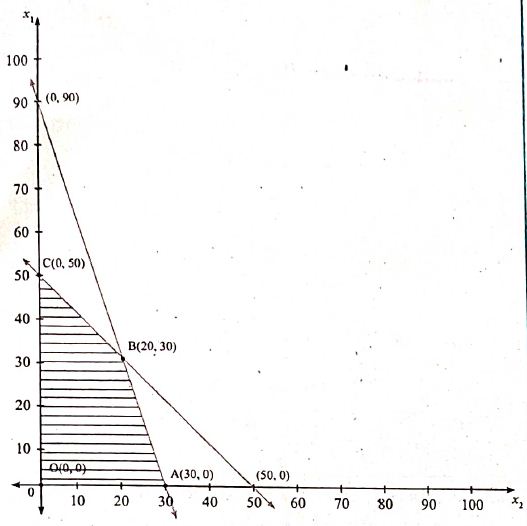
The feasible region satisfying all the conditions is OABC. The co-ordinates of the points are O(0,0), A(30, 0), B(20,30), C(0,50).
| Corner points | \( Z=4{ x }_{ 1 }+{ x }_{ 2 }\) |
| O(0,0) | 0 |
| A(30,0) | 120 |
| B(20,30) | 80 + 30 = 110 |
| C(0,50) | 50 |
Optimal solution is at A(30,0)
x1 = 30, x2 = 0 and Zmax = 120.
Verification
\(3 x_1+x_2 =90 \)
\(x_1+x_2 =50 \)
\(2 x_1 =40 \)
\(x_1 =20 x_2 =50-20=30 \)
B(20,30)
6.
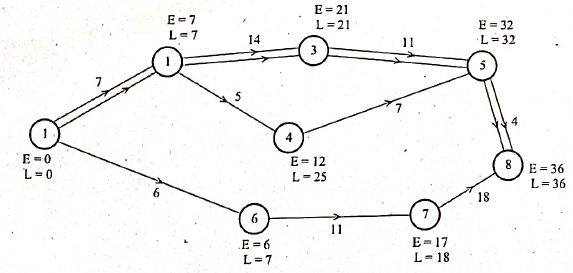
| E1 = 0 | L8 = 35 |
| E2 = 0 + 7 + 7 | L7 = 35 - 18 - 17 |
| E3 = 7 + 14 = 21 | L6 = 18 - 11 = 7 |
| E4 = 7 + 5 = 12 | L5 = 36 - 4 = 32 |
| E5 = max of {21 + 11, 12 + 7} = 32 | L4 = 32 - 7 = 25 |
| E6 = 0 + 6 = 6 | L3 = 32 - 11 = 21 |
| E7 = 6 + 11 = 17 | L2 = min of {21 - 14, 25 - 5} = 7 |
| E8 = max of {32 + 4, 17 + 18) = 36 | L1 = 7 - 7 = 0 |
| Activity | Duration tij | EST | EFT = EST + Tij | LST = LFT - tij | LFT |
|---|---|---|---|---|---|
| 1-2 | 7 | 0 | 7 | 0 | 7 |
| 1-6 | 6 | 0 | 6 | 6 | 7 |
| 2-3 | 14 | 7 | 21 | 7 | 21 |
| 2-4 | 5 | 7 | 12 | 20 | 25 |
| 3 -5 | 11 | 21 | 32 | 21 | 32 |
| 4 - 5 | 7 | 12 | 19 | 7 | 14 |
| 6 - 7 | 11 | 6 | 17 | 7 | 18 |
| 5- 8 | 4 | 32 | 36 | 32 | 36 |
| 7 - 8 | 19 | 17 | 36 | 17 | 36 |
Since EFT and LFT are same in 1 - 2, 2 - 3, 3 - 5 and 5 -8, The critical path is 1 - 2 - 3 - 5 - 8 and the duration of time is 36 days.
7.
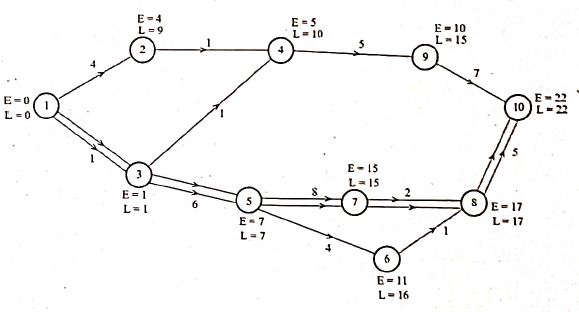
| E1 = 0 | L10 = 22 |
| E2 = 0 + 4 = 4 | L9 = 22 - 7 = 15 |
| E3 = 0 + 1 = 1 | L8 = 22 - 5 = 17 |
| E4 = Max of {4 + 1, 1 + 1} = 5 | L7 = 17 - 2 = 15 |
| E5 = 1 + 6 = 7 | L6 = 17 - 1 = 16 |
| L5 = Min of {16-4, 15-8} = 7 | |
| E6 = 7 + 4 = 11 | L4 = 15 - 5 = 10 |
| E8 = Max of {15 + 2, 11 + 1}= 17 | L3 = Min of {10-1, 7-6] = 1 |
| E9 = 5 + 5 = 10 | L2 = 10 - 1 = 9 |
| E10 = Max of {10 + 7, 17 + 5} = 22 | L1 = 0 |
| Activity | Duration tij | EST | EFT = EST + Tij | LST = LFT - tij | LFT |
|---|---|---|---|---|---|
| 1-2 | 4 | 0 | 4 | 9-4 = 5 | 9 |
| 1-3 | 1 | 0 | 1 | 1-1 = 0 | 1 |
| 2-4 | 1 | 4 | 5 | 10-1 = 9 | 10 |
| 3-4 | 1 | 1 | 2 | 10-1 = 9 | 10 |
| 3-5 | 6 | 1 | 7 | 7-6 = 1 | 7 |
| 4-9 | 5 | 5 | 10 | 15-5 = 10 | 15 |
| 5-6 | 4 | 7 | 11 | 16-4 = 12 | 16 |
| 5-7 | 8 | 7 | 15 | 15-8 = 7 | 15 |
| 6-8 | 1 | 11 | 12 | 17-1 = 16 | 17 |
| 7-8 | 2 | 15 | 17 | 17-2 = 15 | 17 |
| 8-10 | 5 | 17 | 22 | 22-5 = 17 | 22 |
| 9-10 | 7 | 10 | 17 | 22-7 = 15 | 22 |
Since EFT and LFT is same on 1 - 3, 3 - 5, 5 -7 and 7 - 8 and 8 -10 the critical path is 1- 3 - 5 -7 - 8 - 10 and the duration is 22 time units.
8.
Let P (n) denote the statement. 32n - 1 is a divisible by 8
Step-1: Put n = 1
∴ P(1) : 32 - 1 = 9 - 1 = 8 is divisible by 8
∴ P(1) is true.
Step-2: Let us assume that P(k) is true.
∴ 32k - 1 is divisible by 8
⇒ 32k - 1 = 8C (where C is a constant)
⇒ 32k = 8C + 1 ....(1)
Step-3:
To prove that P(k + 1) is true
P(k + 1):32 (k + 1) - 1
= 32k + 2 - 1 = 32k .32 - 1
= (8 m + 1) . 9 - 1
= 8 m . 9 + 9 - 1
= 8 m . 9 + 8
= 8 (9 m + 1)
which is divisible by 8.
∴ P (k + I) is true whenever P( k) is true.
∴ p(n) is true for all \(n\in N\).
9.
Let P (n) denote the statement 13 + 23 + 33 + ....... + n3 = \(\frac { { n }^{ 2 }(n+1)^{ 2 } }{ 4 } \)
Put n = 1
LHS = 13 = 1
\(=\frac { 1^2(2)^2 }{ 4 } \Rightarrow 1\)
LHS = RHS
\(\therefore\) P (1) is true
Let us assume that P(k) is true
p(k) : 13 + 23 + ..... + k3 = \(\frac { { k }^{ 2 }(k+1)^{ 2 } }{ 4 } \)
To prove that P(k+1) IS true
p(k) : 13 + 23 + ..... + k3 + (k + 1)3
\(=P(k)+(k+1)^3\)
= \(\frac { { k }^{ 2 }(k+1)^{ 2 } }{ 4 } +(k+1)^{ 3 }\)
\(=\frac{k^2(k+1)^2+4(k+1)^3}{4}\)
\(=\frac{(k+1)^2\left(k^2+4(k+1)\right)}{4}\)
\(=\frac{(k+1)^2\left(k^2+4 k+4\right)}{4}=\frac{(k+1)^2(k+2)^2}{4}\)
∴ p(k + 1) is true if P(k) is true.
∴ p(n) is true for all \(n\in N\)
10.
Equation of the circle be x2 + y2 + 2gx + 2fy + c = 0 ..(1)
It passes through (0, 1)
0 + 1 + 0 + 2f + c = 0 \(\Rightarrow \) 2f + c = -1 ..(2)
The circle passes through (4, 3)
16 + 9 + 8g + 6f + c = 0 \(\Rightarrow \) 8g + 6f + c = -25 ...(3)
The circle passes through (1,-1)
1 + 1 + 2g - 2f + c = 0 \(\Rightarrow \) 2g - 2f + c = -2 ....(4)
Solving (1), (2) and (3) we get
c = 1 \(\Rightarrow\) g = -5/2 \(\Rightarrow\) f = -1
Equation of circle is
x2 + y2 + 2 \(\left( -\frac { 5 }{ 2 } \right) \)x + 2(-1)y + 1 = 0
x2 + y2 - 5x - 2y + 1 = 0
11.
(b)
12.
(a)
functional relationship
13.
(c)
byx =\(\frac { N\Sigma dxdy-(\Sigma dx)(\Sigma dy) }{ N\Sigma dx^{ 2 }-(\Sigma dx)^{ 2 } } \)
14.
\(r =\frac{11(2827)-(117)(260)}{\sqrt{11(1313)-(117)^2} \sqrt{11(6580)-(260)^2}} \)
\(=\frac{31097-30420}{\sqrt{754 \times 4780}}=0.3566\)
15.
(b)
-1 to +1
16.
(b)
positive
17.
Since there is no common area between the lines x1 + x2 ≤ 1 and 5x1 + 5x2 ≥ 0
18.
(d)
Decision variables are to be unrestricted
19.
(c)
x1 = 10, x2 = 20
20.
Since x1 = 2.5, x2 = 35 satisfies all the Constraints

11th Standard Syllabus & Materials
11th Standard
TN 11th Tamil பீடு பெற நில் - செய்யுள் - காவடிச்சிந்து Important Questions And Answers Study Material - QB365 Set A
NEW11th Standard
TN 11th Tamil பீடு பெற நில் - உரைநடை - மலை இடப்பெயர்கள் : ஓர் ஆய்வு Important Questions And Answers Study Material - QB365 Set A
NEW11th Standard
TN 11th Tamil மாமழை போற்றுதும் - துணைப்பாடம் - யானை டாக்டர் Important Questions And Answers Study Material - QB365 Set A
NEW11th Standard
TN 11th Tamil மாமழை போற்றுதும் - செய்யுள் - ஐங்குறுநூறு Important Questions And Answers Study Material - QB365 Set A



Tamilnadu Stateboard 11th Standard Subjects

Maths

Commerce

Economics

Biology
Business Maths and Statistics

Accountancy

Computer Science

Physics

Chemistry
Maths
Biology
Economics
Physics
Chemistry

History
Business Maths and Statistics

Computer Science
Accountancy

Computer Applications
History
Computer Technology
Commerce
Computer Applications
Computer Technology

Tamil

English

French
Tamilnadu Stateboard Standards


