
11th Standard Syllabus & Materials
11th Standard
TN 11th English Supplementary - 3 - The First Patient (Play) Sample Question Papers Study Material - QB365 Set A
NEW11th Standard
TN 11th English Prose - 3 - Forgetting Sample Question Papers Study Material - QB365 Set A
NEW11th Standard
TN 11th English Prose - 2 - The Queen of Boxing Sample Question Papers Study Material - QB365 Set A
NEW11th Standard
TN 11th English Poem - 1 - Once Upon A Time Sample Question Papers Study Material - QB365 Set A
NEW11th Standard
TN 11th English Prose - 1 - The Portrait of a Lady Sample Question Papers Study Material - QB365 Set A
NEW11th Standard
TN 11th Computer Applications Tamil Computing Sample Question Papers Study Material - QB365 Set A

Published on: 24/08/2026
Download Tamil Nadu 11th Standard Economics question papers, model tests, one-mark questions, important questions, and public exam papers in PDF format. Free study materials and answer keys for TN State Board students.
Questions + Answers key
Take MCQ Economics Test
1.
Given potential price is Rs. 250 and the actual price is Rs. 200. Find the consumer surplus.
375
175
200
50
2.
When marginal utility reaches zero, the total utility will be
Minimum
Maximum
Zero
Negative
3.
The chief exponent of the cardinal utility approach was
J.R. Hicks
R.G.D. Allen
Marshall
Stigler
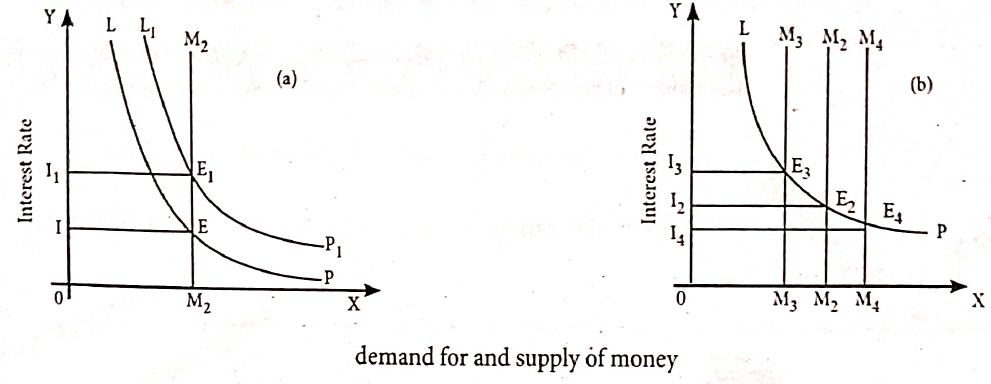
4.
Product obtained from additional factors of production is termed as
Marginal product
Total product
Average product
Annual product
5.
In monopoly, MR curve lies below ____________
TR
MC
AR
AC
6.
Profit of a firm is obtained when __________.
TR < TC
TR - MC
TR > TC
TR = TC
7.
A firm under monopoly can earn ________ in the short run
Normal profit
Loss
Super normal profit
More loss
8.
9.
Innovation Theory of profit was given by
Hawley
Schumpeter
Keynes
Knight
10.
Long-run average cost curve is also called as _____ curve.
demand
planning
production
sales
11.
The equilibrium price is the price at which
Everything is sold
Buyers spend their money
Quantity demanded equals quantity supplied
Excess demand is zero
12.
The basic problem studied in Economics is
Unlimited wants
Unlimited means
Scarcity
Strategy to meet all our wants
13.
According to the Loanable Funds Theory, supply of loanable funds is equal to
S + BC + DH + DI
I + DS + DH + BM
S + DS + BM + DI
S + BM + DH + DS
14.
Amartya Kumar Sen received the Nobel Prize in Economics in the year
1998
2000
2008
2010
15.
Identify the formula of estimating average variable cost.
TC/Q
TVC/Q
TFC/Q
TAC/Q
16.
Formula for calculating AP is
\(\frac { \Delta TP }{ N } \)
\(\frac { \Delta TP }{ \Delta N } \)
\(\frac { TP }{ MP } \)
\(\frac { TP }{ N } \)
17.
18.
19.
Theory of distribution is popularly known as,
Theory of product-pricing
Theory of factor-pricing
Theory of wages
Theory of interest
20.
'Economics is a study of mankind in the ordinary business of life' - It is the statement of
Adam Smith
Lionel Robbins
Alfred Marshall
Samuelson
21.
Mention the classifications of wants
22.
What are the reasons for upward sloping supply curve?
23.
24.
Draw demand curve of a firm for the following:
(a) Perfect competition, (b) Monopoly
25.
Name any two types of utility.
26.
27.
Distinguish between real and money wages.
28.
Define Revenue.
29.
30.
State any two features of developed economy.
31.
32.
What are the functions of Entrepreneur?
33.
34.
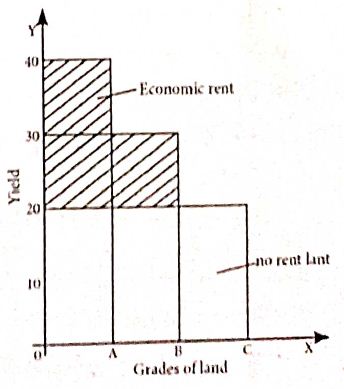
Distinguish between rent and quasi-rent.
35.
What are the motives of demand for money?
36.
Differentiate between 'firm' and 'industry'.
37.
Distinguish between microeconomics and macroeconomics.
38.
What are the crucial decisions involved in 'what to produce'?
39.
State the relationship between AC and MC.
40.
41.
42.
43.
44.
45.
46.
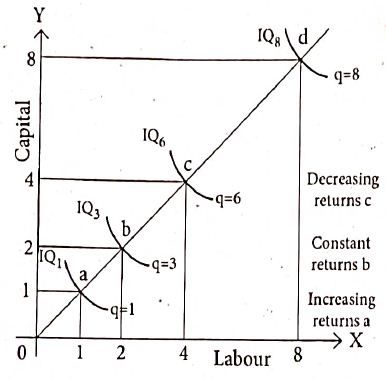
List out the properties of iso-quants with the help of diagrams.
47.
Explain basic problems of the economy with the help of production possibility curve.
48.
Compare and contrast various definitions of Economics.
49.
50.
Bring out the features of perfect competition.
51.
Bring out the relationship between AR and MR curves under various price conditions.
52.
If total cost = 10+ Q3, find out AC, AVC, TFC, AFC when Q = 5.
53.
Write a brief note on the Gandhian economic ideas.
54.
Explain the strong features of Indian economy.
1.
(d)
50
2.
(b)
Maximum
3.
(c)
Marshall
4.
(a)
Marginal product
5.
(c)
AR
6.
(c)
TR > TC
7.
(c)
Super normal profit
8.
(a)
9.
(b)
Schumpeter
10.
(b)
planning
11.
(c)
Quantity demanded equals quantity supplied
12.
(c)
Scarcity
13.
(a)
S + BC + DH + DI
14.
(a)
1998
15.
(b)
TVC/Q
16.
(d)
\(\frac { TP }{ N } \)
17.
(c)
18.
(b)
19.
(b)
Theory of factor-pricing
20.
(c)
Alfred Marshall
21.
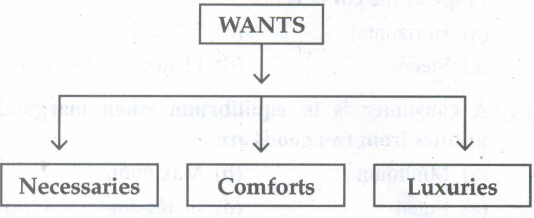
22.
(i) Firms will supply less at lower prices and more at higher prices.
(ii) As price of the commodity increases, the amount supplied also increases.
(iii) So, supply curve has a positive slope from left to right.
23.
24.
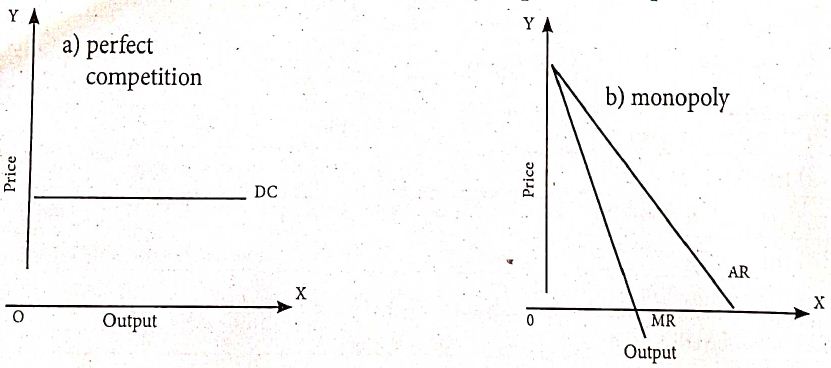
25.
(i) Form utility
(ii) Time utility
(iii) Place utility
(iv) Service utility
(v) Possession utility
(vi) Knowledge utility
26.
27.
(i) Nominal or money wages are the wages paid in terms of money.
(ii) Real wages are the wages paid in terms of goods & services.
28.
The amount of money that a producer receives in exchange for the sale of goods is revenue.
29.
30.
High national income, per capita, standard of living, level of technology, industrialization, consumption level, level of urbanisation. (any two)
31.
32.
Initiation: He considers the situation and availability of resources and plans the process of production.
Innovation: He introduces new methods in the production process.
Co-ordination: He uses a particular combination of the factors of production.
Control, direction & supervision: He directs the factors to get better results and supervises for the efficient functioning of all factors.
Risk taking, uncertainty bearing: Risk is insured, uncertainties cannot be insured.
33.
34.
| SI.No | Rent | Quasi Rent |
|---|---|---|
| 1 | Rent accrues to land | Quasi - Rent accrues to man made appliances |
| 2 | The supply of land is fixed forever. | The supply of man made appliances is fixed for a short period only. |
| 3 | It enters into price. | It does not enter into price. |
| 4 | It is temporary. |
35.
Transaction motive:
(i) The desire of the people to hold cash for the current transactions.
(ii) The amount kept for this motive depends on the income. Mt = f(y)
Precautionary motive:
(i) The desire of the people to hold cash to meet unexpected expenditure such as sickness, accidents.
(ii) The amount for this purpose depends on income. Mp = f(y)
Speculative motive:
(i) The desire of the people to hold cash in order to take advantage of the future changes in price of bonds and securities.
(ii) The amount for this purpose depends on the rate of interest. Ms = f(i)
36.
Firm : A single production unit in an industry, producing a large or a small amount of the commodity. (eg) Hamam, Lux are 2 firms.
Industry : A group of firms producing the same product. (eg) soap industry.
37.
| S.No | Micro Economics | Macro Economics |
| 1 | Micro Economics is that branch of economics which deals with the economic decision-making of individual economic agents such as the producer, the consumer etc. | Macro Economics is that branch of economics which deals with aggregates and averages of the entire economy. E.g., aggregate output, national income, aggregate savings and investment, etc. |
| 2 | It takes into account small components of the whole economy. | It takes into consideration the economy of the country as a whole. |
| 3 | It deals with the process of price determination in case of individual products and factors of production. | It deals with general price-level in any economy |
| 4 | It is known as price theory | It is also known as the income theory. |
| 5 | It is concerned with the optimization goals of individual consumers and producers | It is concerned with the optimization of the growth process of the entire economy. |
38.
(i) Whether to produce more of food, or clothing or housing or luxury goods.
(ii) Whether to produce more agricultural or industrial goods and services.
(iii) Whether to use more resources in education and health or military services.
(iv) Whether to have more consumption goods or investment goods.
(v) Whether to spend more on basic education or higher education.
39.
When AC is falling, MC remains below AC.
When AC becomes constant MC becomes equal to it.
When AC starts increasing MC is above the AC
MC always cuts AC at its minimum point from below.
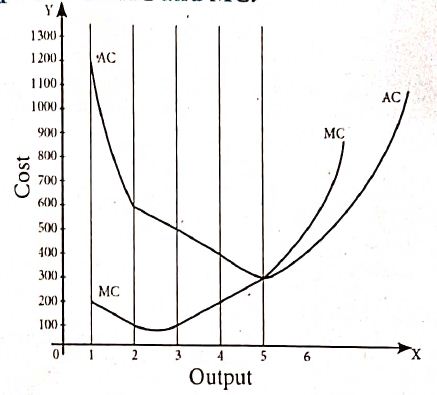
40.
41.
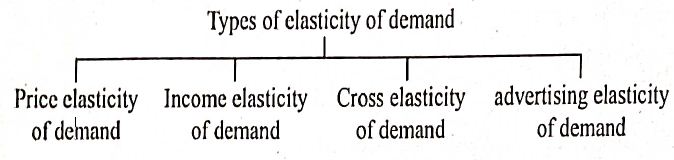
.JPG)
42.
.JPG)
.JPG)
43.
44.
45.
46.
Iso and quant are derived from the Greek language, meaning 'equal' and 'quantity'.
Definition:
Isoquant curve is a locus of points representing various combinations of two inputs capital and labour yielding the same output. It is also called equal product curve or product indifference curve.
Properties:
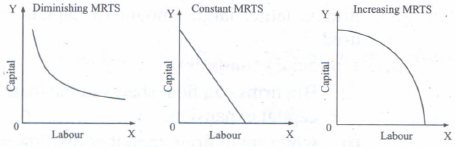
1. The isoquant curve has negative slope:
(i) Capital is being substituted by labour.
(ii) Isoquant has negative slope because of diminishing MRTS.
(iii) Constant MRTS (straight line) and increasing MRTS (concave) are also possible.
(iv) It depends on the nature of isoquant curve
2. Isoquant curve is convex to origin:
The capital substituted per unit of labour goes on decreasing so the isoquant is convex to the origin.
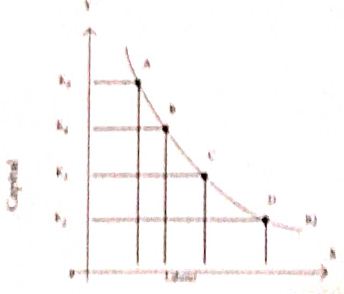
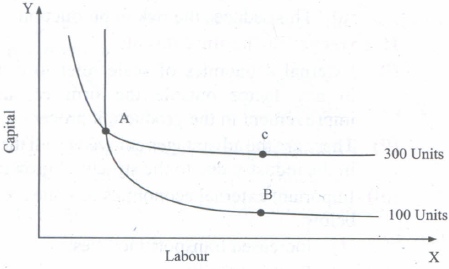
3. Isoquant curves cannot intersect each other:
Point A lies on IQ1 and IQ2, Point C lies on IQ2, showing higher output Point B
lies on IQ1, showing lower output. C = A, B = A But C > B.
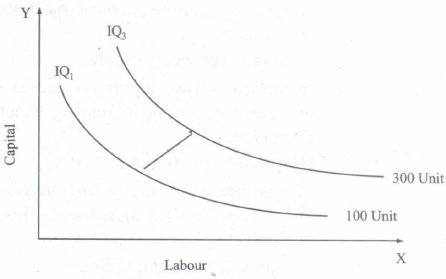
4. Upper isoquant curve represents a higher level of output:
Higher IQ2 shows higher output 200 units. Lower IQ1 shows lower output 100 units. IQ2 means the use of more sectors than IQ1. Arrow shows increase in output with a right and upward shift of an isoquant curve.
5. Isoquant curve does not touch either x axis or y axis:
In IQ2 only capital is used and in IQ1 only labour is used.
.JPG)
Conclusion:
These are the properties of isoquant curves.
47.
The Problem of Choice:
(i) The problem of choice arises because of limited resources and unlimited wants, may relate to the allocation of resources between the goods for higher income group and the lower income group and the goods for defense and the civilians.
(ii) Since PPC is the locus of the combination of the goods the problem of choice will not arises when we choose any point on PPC.
The notion of scarcity:
(i) Every economy has scarce resources which can produce only limited amount of output even with the help of best technology.
(ii) PPC reflects the constraints imposed by the element of economic scarcity.
The solution of central problems:
(i) The solution of problem of what to produce involves the decision regarding the choice of location on the PPC.
(ii) Any point inside PPC indicates that the economy is using inefficient methods of production and inefficient combination of resources.
Conclusion:
(i) Thus the basic problems of the economy are solved with the help of PPC.
48.
| Wealth | Welfare | Scarcity | Growth |
| Adam Smith classical era. |
Alfred Marshall- neo classical era. |
Lionel Robbins new age. |
Paul Samuelson modern age. |
| An Inquiry into nature and causes of Wealth of Nations (1776). |
Principles of |
An Essay on the nature and Significance of Economic Science (1932). |
Economics studies how men and society choose with or without the use of money, to employ scarce productive resources which could have alternative uses, to produce various commodities over time and distribute them for consumption now and in the future among various people and groups of society. |
| Economics is the science of wealth. | Economics is a study of mankind in the ordinary business of life, it examines that part of individual and social action which is most closely connected with the attainment and with the use of material requisites of well being. It studies wealth and man. |
Economics is a science which studies human behaviour as a relationship between ends and scarce means which have alternative uses. |
Economics deals with how the society uses the limited resources for alternative uses. |
| Deals with only the goods which are scarce and have money value |
wealth and welfare of man is important. | Human behaviour regarding choice is important. |
It covers production, distribution and consumption. |
| Deals with consumption, production, exchange, distribution of wealth. |
Only material welfare is considered, differentiates between material and immaterial things. |
Economic problem arises because of scarcity of resources. |
Economics is a social science. |
| By introducing welfare, economics becomes inexact. |
Ethical aspects are not considered so Economics is exact |
||
| Welfare definition makes Economics classificatory. | Economics is a positive science. |
||
| Economics is a science of individual behaviour. |
|||
| Both material and immaterial activities are considered. |
49.
50.
Large number of buyers and sellers:
(i) Since there are large number of buyers and sellers each individual buyer or seller buys or sells a very very small quantity of the product found in the market.
(ii) So he has no power to fix the price of the product.
(iii) He is only a price taker.
Homogenous product & uniform price:
(i) All the units of the product are perfectly substitutable - they are of the same size, shape, colour, quality.
(ii) So a uniform price prevails in the market.
Free entry and exit:
(i) In the short run, the very efficient producer can produce the product at a very low cost & earn super normal profit.
(ii) This attracts new firms to enter.
(iii) When there are more firms, supply increases, so price falls.
(iv) Inefficient producer faces loss & so quits the market.
Absence of transport cost:
The prevalence of the uniform price is also due to the absence of the transport cost.
Perfect knowledge of the market:
(i) All buyers and sellers have a thorough knowledge of the quality of the product, prevailing price.
No government intervention:
(i) No government regulation on supply of raw materials & in price determination.
51.
| Q | Price Rs | TR | AR | MR |
| 1 | 5 | 5 | 5 | 5 |
| 2 | 5 | 10 | 5 | 5 |
| 3 | 5 | 15 | 5 | 5 |
| 4 | 5 | 20 | 5 | 5 |
| 5 | 5 | 25 | 5 | 5 |
| 6 | 5 | 30 | 5 | 5 |
.JPG)
\(A R=\frac{T R}{Q}\)
\( M R=T R_{n}-T R_{n-1}\)
Constant AR & MR (fixed price)
When price remains constant, MR is also constant and AR / MR curves coincide.
Declining AR and MR
When a firm sells large quantities at lower prices both AR & MR will fall but the fall in MR will be steeper than the fall in AR.
| Q | AR | TR | MR |
| 1 | 10 | 10 | 10 |
| 2 | 9 | 18 | 8 |
| 3 | 8 | 24 | 6 |
| 4 | 7 | 28 | 4 |
| 5 | 6 | 30 | 2 |
| 6 | 5 | 30 | 0 |
| 7 | 4 | 28 | -2 |
.JPG)
(i) MR is lower than AR.
(ii) Both AR and MR slope downwards.
(iii) MR divides the distance between AR curve and axis into 2 equal parts.
(iv) The decline in AR need not be a straight line or linear.
(v) If the prices are declining with the increase in quantity sold, the AR can be nonlinear, taking a shape of concave or convex to the origin.
52.
\(\text { TC }=10+Q^{3} \)
\(A C=\frac{10}{Q}+\frac{Q^{3}}{Q}=\frac{10}{Q}+Q^{2}=\frac{10}{5}+5^{2}=2+25=27 \)
\(\text {AVC }=\frac{Q^{3}}{Q}=Q^{2}=5^{2}=25 \)
\(\text {TFC }=10 \)
\(\text {AFC }=\frac{10}{\mathrm{Q}}=\frac{10}{5}=2 \)
\(Ans; \mathrm{AC}=27 ; \quad \mathrm{AVC}=25 ; \quad \mathrm{TFC}=10 ; \quad \mathrm{AFC}=2.\)
53.
Introduction:
(i) Gandhian economics is based on ethical foundations.
(ii) He wrote, "Economics that hurts the moral well-being of an individual or a nation is immoral and so sinful".
Village republics:
(i) To Gandhi, India lives in villages.
(ii) He was interested in developing the villages as self-sufficient units.
(iii) He opposed extensive use of machinery, urbanization and industrialization.
On machinery:
(i) Gandhi described machinery as 'Great sin'.
(ii) It is an evil and would finally end.
Industrialism:
(i) Gandhi considered industrialism as a curse on mankind and would exploit the nation.
Decentralization:
(i) He favoured production in the people's homes at a large number of places on a small scale.
Village Sarvodaya:
(i) He suggested the development of self-sufficient, self-dependent villages.
Bread labour:
(i) Gandhi realised the dignity of human labour. He believed that man should eat his bread by the sweat of his brow. Bread labour or body labour meant manual labour.
Doctrine of trusteeship:
(i) Trusteeship provides a means of transforming the present capitalist order of society into an egalitarian one.
(ii) But India today has casino and crony capitalism.
On the food problem:
(i) Gandhi was against food controls.
(ii) Such controls created artificial scarcity. Today, India tops in the world with large production of fruits, vegetables, milk, egg, meat etc.
On Population:
(i) Gandhi opposed population control through contraceptives.
(ii) He favoured birth control through Brahmacharya or self-control.
(iii) This is the remedy to over population.
On prohibition:
(i) Gandhi advocated total prohibition, regarded use of liquor as a disease.
(ii) But today many states depend on revenue from liquor sales.
Conclusion: If Gandhi's ideas are followed, India will soon become a developed nation.
54.
Introduction:
Indian economy is the seventh largest economy of the world. Its features are:
Mixed economy:
(i) In India private and public sectors co-exist.
(ii) Some fundamental and heavy industries are under public sector.
(iii) Due to liberalization private sector's importance has increased.
Agriculture:
(i) 60 % of Indians depend on agriculture for their livelihood.
(ii) 17 % of GDP is got from agricultural sector.
(iii) Green revolution and inventions in biotechnology have made agriculture self sufficient.
(iv) The export of fruits, vegetables, spices, tobacco, animal skin, vegetable oils also add to foreign exchange earning.
An emerging market:
(i) India has emerged as a vibrant economy sustaining stable GDP growth rate even when there was global downtrend.
(ii) This has attracted foreign capital through FDI and FII.
(iii) India is in the 7th position in terms of nominal GDP and 3rd in terms of purchasing power parity.
(iv) India is one among the G20 countries.
Fast growing economy:
(i) With a growth rate of 7.1% in GDP India is the world's fastest growing economy in 2016-17 next to China.
Fast growing service sector:
(i) There has been growth in technical sectors like Information Technology, BPO.
(ii) These emerging services have helped the country to go global.
Large domestic consumption:
(i) The standard of living has improved a lot. There is rapid increase in domestic consumption.
Rapid growth of urban areas:
(i) There has been a rapid growth of urban areas in India after Independence. Improved connectivity in transport and communication, education and health have speeded up urbanization.
Stable macroeconomy:
(i) India is one of the most stable economies of the world.
(ii) The current year's economic survey represents the Indian economy to be a "heaven of macroeconomic stability, resilience and optimism".
Demographic dividend:
(i) The human capital is young.
(ii) They are young, skilled and trained enough to maximize growth.
(iii) This has invited foreign investments and outsourcing opportunities.

11th Standard Syllabus & Materials
11th Standard
TN 11th Computer Applications Computer Ethics and Cyber Security Sample Question Papers Study Material - QB365 Set A
NEW11th Standard
TN 11th Computer Applications JavaScript Functions Sample Question Papers Study Material - QB365 Set A
NEW11th Standard
TN 11th Computer Applications Control Structure in JavaScript Sample Question Papers Study Material - QB365 Set A
NEW11th Standard
TN 11th Computer Applications Introduction to JavaScript Sample Question Papers Study Material - QB365 Set A



Tamilnadu Stateboard 11th Standard Subjects

Maths

Commerce
Economics

Biology

Business Maths and Statistics

Accountancy

Computer Science

Physics

Chemistry
Maths
Biology
Economics
Physics
Chemistry

History
Business Maths and Statistics

Computer Science
Accountancy

Computer Applications
History
Computer Technology
Commerce
Computer Applications
Computer Technology

Tamil

English

French
Tamilnadu Stateboard Standards


