
 100% FREE ACCESS
11th Standard Syllabus & Materials
11th Standard
TN 11th Tamil இயற்கை வேளாண்மை,சுற்றுச்சூழல் -செய்யுள் - மனோன்மணீயம் Important Questions And Answers Study Material - QB365 Set A
NEW11th Standard
TN 11th Tamil என்னுயிர் என்பேன் -துணைப்பாடம் - இசைத்தமிழர் இருவர் Important Questions And Answers Study Material - QB365 Set A
NEW11th Standard
TN 11th Tamil மொழி கலை -செய்யுள் - ஒவ்வொரு புல்லையும் Important Questions And Answers Study Material - QB365 Set A
NEW11th Standard
TN 11th Tamil பீடு பெற நில் - இலக்கணம் - பகுபத உறுப்புகள் Important Questions And Answers Study Material - QB365 Set A
NEW11th Standard
TN 11th Tamil பீடு பெற நில் - துணைப்பாடம் - வாடிவாசல் Important Questions And Answers Study Material - QB365 Set A
NEW11th Standard
TN 11th Tamil பீடு பெற நில் - செய்யுள் - குறுந்தொகை Important Questions And Answers Study Material - QB365 Set A

Published on: 24/08/2026
Download Tamil Nadu 11th Standard Economics question papers, model tests, one-mark questions, important questions, and public exam papers in PDF format. Free study materials and answer keys for TN State Board students.
Questions + Answers key
Take MCQ Economics Test
1.
2.
According to the Loanable Funds Theory, supply of loanable funds is equal to
S + BC + DH + DI
I + DS + DH + BM
S + DS + BM + DI
S + BM + DH + DS
3.
4.
Thiruvalluvar's economic ideas mainly dealt with
Wealth
Poverty is the curse in the society
Agriculture
All of them
5.
The problem studied by Ambedkar in the context of Indian Economy is ______________
Small land holdings and their remedies
Problem of Indian Currency
Economics of socialism
All of them
6.
7.
A scientific study of the characteristics of population is _____
Topography
Demography
Geography
Philosophy
8.
Which one of the following is a developed nations?
Mexico
Ghana
France
Sri Lanka
9.
The concept of 'Quasi-Rent' is associated with
Ricardo
Keynes
Walker
Marshall
10.
Theory of distribution is popularly known as,
Theory of product-pricing
Theory of factor-pricing
Theory of wages
Theory of interest
11.
12.
Distinguish between real and money wages.
13.
Define 'Rent'.
14.
Mention the types of distribution.
15.
Give a short note on Sen's 'Choice of Technique'.
16.
Write the short note on natural resources.
17.
State any two features of developed economy.
18.
Describe briefly the Innovation Theory of Profit.
19.
Briefly explain the Subsistence Theory of Wages.
20.
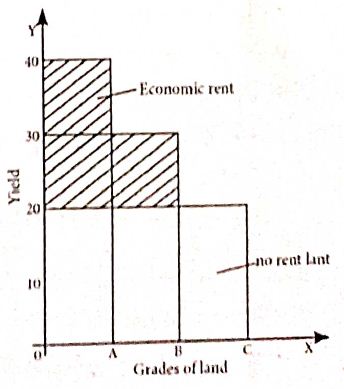
Distinguish between rent and quasi-rent.
21.
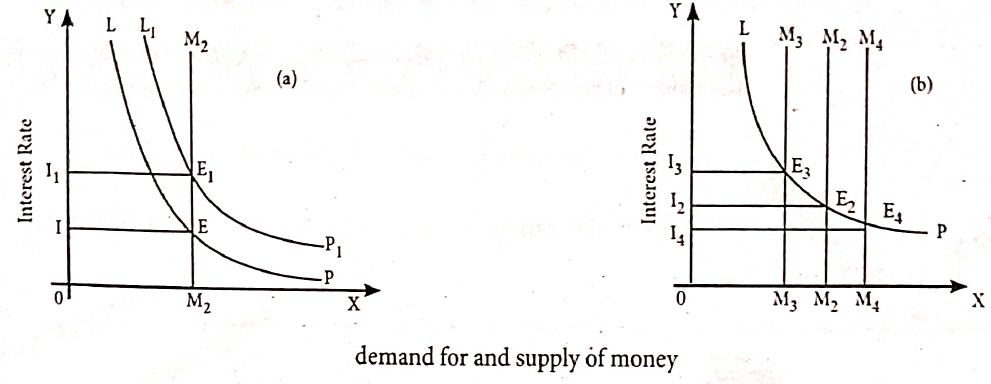
What are the motives of demand for money?
22.
Explain social infrastructure.
23.
Write the V.K.R.V. Rao's contribution on macroeconomics.
24.
25.
Define Economic Development.
26.
27.
28.
Explain the Marginal Productivity Theory of Distribution.
29.
Write a brief note on the Gandhian economic ideas.
30.
Write the importance of mineral resources in India.
31.
Explain the strong features of Indian economy.
1.
(a)
2.
(a)
S + BC + DH + DI
3.
(b)
4.
(d)
All of them
5.
(b)
Problem of Indian Currency
6.
(c)
7.
(b)
Demography
8.
(c)
France
9.
(d)
Marshall
10.
(b)
Theory of factor-pricing
11.
12.
(i) Nominal or money wages are the wages paid in terms of money.
(ii) Real wages are the wages paid in terms of goods & services.
13.
Rent is that portion of the produce of the earth which is paid to the landlord for the use of the original and indestructible powers of the soil" David Ricardo.
14.
Personal distribution - the distribution of national income among individuals.
Functional distribution - the distribution of income among four factors of production.
15.
Sen's 'Choice of Technique' was a research work where he argued that in a labour surplus economy, generation of employment cannot be increased at the initial stage by the adoption of capital-intensive technique.
16.
(i) Any stock or reserve that can be drawn from nature is a Natural Resource.
(ii) The major natural resources are land, forest, water.
17.
High national income, per capita, standard of living, level of technology, industrialization, consumption level, level of urbanisation. (any two)
18.
(i) According to Schumpeter profit is the reward for innovation.
(ii) Innovation means invention put into commercial practice.
(iii) Innovation may consist of introduction of a new product or a new method of production or opening a new market or discovery of new raw materials or reorganisation of an industry.
(iv) The cost of production decreases and so profit increases.
(v) Innovation should be done continuously.
19.
(i) Wage is equal to the subsistence level of the labourer ie the minimum amount of food, clothing & shelter which workers & their family require for existence
(ii) If workers are paid higher wages than the subsistence level, the workers would be better off & so population increases.
(iii) So wages come down & vice versa.
(iv) So wages should not be above or below the subsistence level of the labourer.
20.
| SI.No | Rent | Quasi Rent |
|---|---|---|
| 1 | Rent accrues to land | Quasi - Rent accrues to man made appliances |
| 2 | The supply of land is fixed forever. | The supply of man made appliances is fixed for a short period only. |
| 3 | It enters into price. | It does not enter into price. |
| 4 | It is temporary. |
21.
Transaction motive:
(i) The desire of the people to hold cash for the current transactions.
(ii) The amount kept for this motive depends on the income. Mt = f(y)
Precautionary motive:
(i) The desire of the people to hold cash to meet unexpected expenditure such as sickness, accidents.
(ii) The amount for this purpose depends on income. Mp = f(y)
Speculative motive:
(i) The desire of the people to hold cash in order to take advantage of the future changes in price of bonds and securities.
(ii) The amount for this purpose depends on the rate of interest. Ms = f(i)
22.
Social infrastructure refers to those structures which improve the quality of manpower and contribute indirectly towards the growth of an economy.
Education:
(i) Education is in Concurrent List.
(ii) The Ministry of Human Resource Development decides the education budget and education policy.
(iii) India follows a six-level system - nursery, primary, secondary, higher secondary, graduation and post-graduation.
(iv) We have the 10 +2 pattern.
(v) The education department consists of schools, colleges and universities imparting education to all.
(vi) Though the budget share of education is 3% of GDP yet the per pupil expenditure for school students is the lowest.
Health:
(i) Health is a state-government responsibility.
(ii) The Central Council of Health and Welfare formulates various health care projects.
(iii) India has the ayurvedic medicine, unani, homeopathy, allopathy and yoga.
(iv) Medical practicing needs a licensing from the Ministry of Health. All medical systems now are under one ministry viz AYUSH.
(v) Health status is better in Kerala but generally India's health status is not satisfactory
23.
Rao's examination of the "interrelation between investment, income and multiplier in an under developed economy" (1952) was his major contribution to macroeconomic theory.
24.
25.
It refers to an improvement in citizens' quality of life and well-being of a country which is measured by per capita income along with several other development indicators like Human Development Index, Physical Quality of Life Index and Gross National Happiness Index.
26.
27.
28.
Introduction:
(i) Marginal productivity theory of distribution was developed by Clark, Wicksteed and Walras.
(ii) This theory explains how the prices of various factors of production are determined.
Assumptions
(i) All the factors of production are homogeneous, can be substituted for each other and are perfectly mobile.
(ii) There is perfect competition in the factor & product market.
(iii) There is full employment with no technological change.
(iv) The theory is applicable only in long run.
(vi) The entrepreneurs aim at profit maximisation.
(vii) There is no government intervention in fixing the price of a factor.
Explanation:
(i) The reward for any factor of production is equal to the marginal productivity of that factor.
(ii) The greater the productivity of a factor higher will be its reward.
(iii) The price of a factor of production depends upon its productivity.
(vi) The price will be equal to marginal revenue product of that factor.
(v) Under certain conditions, the price of a factor will be equal to both the average and marginal products of that factor.
Marginal productivity under perfect competition:
.JPG)
(i) fig (a) x axis represents factor units.
(ii) y axis shows factor price & revenue.
MRP = Marginal revenue product curve.
ARP = Average revenue product curve.
AFC = Average factor cost curve.
MFC = Marginal factor cost curve.
(iii) AFC is horizontal & MFC coincides with it.
(iv) The firm is in equilibrium (maximum profit) when MFC = MRP at Q by employing ON units of factors & paying (OP price or NQ) where MFC = MRP = ARP.
(v) The price paid to the factor NQ is equal to MRP (NQ) and ARP (NQ) beyond Q no employer will employ factors because after that point, the price paid to the factor is more than MRP and ARP.
Marginal productivity under Imperfect competition:
.JPG)
(i) fig(b) AFC represents the price paid to the factors. It increases as the number of factors demanded by the employer increases.
(ii) As AFC rises, MFC lies above AFC. It represents the MC paid to the factors.
(iii) At the point Q, MFC = MRP, where the employer attains his maximum profit and so he stops employment of the factors at the point.
(iv) But the AC paid is NRSO and AR is NQ or OP
(v) Total revenue is NQPO.
(vi) Exploitation per unit of factor is RQQ
(vii) But the total number of factors is ON. Thus the total exploitation of factor by the employer is RQ XSR = PQRS (shaded area).
Criticisms:
(i) Factors of production are not homogeneous.
(ii) They cannot be substituted for each other.
(iii) It cannot be applied in the short run.
Conclusion:
This theory is also called "General Theory of Distribution" or "National Dividend Theory of distribution".
29.
Introduction:
(i) Gandhian economics is based on ethical foundations.
(ii) He wrote, "Economics that hurts the moral well-being of an individual or a nation is immoral and so sinful".
Village republics:
(i) To Gandhi, India lives in villages.
(ii) He was interested in developing the villages as self-sufficient units.
(iii) He opposed extensive use of machinery, urbanization and industrialization.
On machinery:
(i) Gandhi described machinery as 'Great sin'.
(ii) It is an evil and would finally end.
Industrialism:
(i) Gandhi considered industrialism as a curse on mankind and would exploit the nation.
Decentralization:
(i) He favoured production in the people's homes at a large number of places on a small scale.
Village Sarvodaya:
(i) He suggested the development of self-sufficient, self-dependent villages.
Bread labour:
(i) Gandhi realised the dignity of human labour. He believed that man should eat his bread by the sweat of his brow. Bread labour or body labour meant manual labour.
Doctrine of trusteeship:
(i) Trusteeship provides a means of transforming the present capitalist order of society into an egalitarian one.
(ii) But India today has casino and crony capitalism.
On the food problem:
(i) Gandhi was against food controls.
(ii) Such controls created artificial scarcity. Today, India tops in the world with large production of fruits, vegetables, milk, egg, meat etc.
On Population:
(i) Gandhi opposed population control through contraceptives.
(ii) He favoured birth control through Brahmacharya or self-control.
(iii) This is the remedy to over population.
On prohibition:
(i) Gandhi advocated total prohibition, regarded use of liquor as a disease.
(ii) But today many states depend on revenue from liquor sales.
Conclusion: If Gandhi's ideas are followed, India will soon become a developed nation.
30.
Introduction:
Mineral resources are valuable natural resources that play an important role in the economic development of India. Important minerals found in India include iron ore, coal, lignite, bauxite, mica, crude oil, gold, and diamonds.
1. Iron Ore
India has abundant reserves of high-quality iron ore. It is the basic raw material for the iron and steel industry. Major iron ore producing states are Odisha, Chhattisgarh, Karnataka, Jharkhand, and Goa.
2. Coal and Lignite
Coal is the most important source of commercial energy in India. It is used for electricity generation and industrial purposes. Major coal-producing states include Jharkhand, Odisha, Chhattisgarh, West Bengal, and Madhya Pradesh.
3. Bauxite
Bauxite is the chief ore of aluminium. Aluminium is widely used in transport, construction, and electrical industries. Odisha is the leading producer of bauxite in India.
4. Mica
Mica is a good insulator and heat-resistant mineral. It is used in electrical and electronic industries. India is one of the leading producers of mica.
5. Crude Oil
Crude oil is an important source of energy. It is used to produce petrol, diesel, kerosene, and other petroleum products. Major oil-producing areas are Assam, Gujarat, and offshore regions.
6. Gold and Diamonds
Gold and diamonds have high commercial value. They support the jewellery industry and contribute to exports.
Conclusion:
Mineral resources are essential for industrial development, energy production, employment generation, and economic growth. Therefore, they are a valuable asset for India's development.
31.
Introduction:
Indian economy is the seventh largest economy of the world. Its features are:
Mixed economy:
(i) In India private and public sectors co-exist.
(ii) Some fundamental and heavy industries are under public sector.
(iii) Due to liberalization private sector's importance has increased.
Agriculture:
(i) 60 % of Indians depend on agriculture for their livelihood.
(ii) 17 % of GDP is got from agricultural sector.
(iii) Green revolution and inventions in biotechnology have made agriculture self sufficient.
(iv) The export of fruits, vegetables, spices, tobacco, animal skin, vegetable oils also add to foreign exchange earning.
An emerging market:
(i) India has emerged as a vibrant economy sustaining stable GDP growth rate even when there was global downtrend.
(ii) This has attracted foreign capital through FDI and FII.
(iii) India is in the 7th position in terms of nominal GDP and 3rd in terms of purchasing power parity.
(iv) India is one among the G20 countries.
Fast growing economy:
(i) With a growth rate of 7.1% in GDP India is the world's fastest growing economy in 2016-17 next to China.
Fast growing service sector:
(i) There has been growth in technical sectors like Information Technology, BPO.
(ii) These emerging services have helped the country to go global.
Large domestic consumption:
(i) The standard of living has improved a lot. There is rapid increase in domestic consumption.
Rapid growth of urban areas:
(i) There has been a rapid growth of urban areas in India after Independence. Improved connectivity in transport and communication, education and health have speeded up urbanization.
Stable macroeconomy:
(i) India is one of the most stable economies of the world.
(ii) The current year's economic survey represents the Indian economy to be a "heaven of macroeconomic stability, resilience and optimism".
Demographic dividend:
(i) The human capital is young.
(ii) They are young, skilled and trained enough to maximize growth.
(iii) This has invited foreign investments and outsourcing opportunities.

11th Standard Syllabus & Materials
11th Standard
TN 11th Tamil பீடு பெற நில் - செய்யுள் - காவடிச்சிந்து Important Questions And Answers Study Material - QB365 Set A
NEW11th Standard
TN 11th Tamil பீடு பெற நில் - உரைநடை - மலை இடப்பெயர்கள் : ஓர் ஆய்வு Important Questions And Answers Study Material - QB365 Set A
NEW11th Standard
TN 11th Tamil மாமழை போற்றுதும் - துணைப்பாடம் - யானை டாக்டர் Important Questions And Answers Study Material - QB365 Set A
NEW11th Standard
TN 11th Tamil மாமழை போற்றுதும் - செய்யுள் - ஐங்குறுநூறு Important Questions And Answers Study Material - QB365 Set A



Tamilnadu Stateboard 11th Standard Subjects

Maths

Commerce
Economics

Biology

Business Maths and Statistics

Accountancy

Computer Science

Physics

Chemistry
Maths
Biology
Economics
Physics
Chemistry

History
Business Maths and Statistics

Computer Science
Accountancy

Computer Applications
History
Computer Technology
Commerce
Computer Applications
Computer Technology

Tamil

English

French
Tamilnadu Stateboard Standards


