
 100% FREE ACCESS
11th Standard Syllabus & Materials
11th Standard
TN 11th Tamil இயற்கை வேளாண்மை,சுற்றுச்சூழல் -செய்யுள் - மனோன்மணீயம் Important Questions And Answers Study Material - QB365 Set A
NEW11th Standard
TN 11th Tamil என்னுயிர் என்பேன் -துணைப்பாடம் - இசைத்தமிழர் இருவர் Important Questions And Answers Study Material - QB365 Set A
NEW11th Standard
TN 11th Tamil மொழி கலை -செய்யுள் - ஒவ்வொரு புல்லையும் Important Questions And Answers Study Material - QB365 Set A
NEW11th Standard
TN 11th Tamil பீடு பெற நில் - இலக்கணம் - பகுபத உறுப்புகள் Important Questions And Answers Study Material - QB365 Set A
NEW11th Standard
TN 11th Tamil பீடு பெற நில் - துணைப்பாடம் - வாடிவாசல் Important Questions And Answers Study Material - QB365 Set A
NEW11th Standard
TN 11th Tamil பீடு பெற நில் - செய்யுள் - குறுந்தொகை Important Questions And Answers Study Material - QB365 Set A

Published on: 24/08/2026
Download Tamil Nadu 11th Standard Maths question papers, model tests, one-mark questions, important questions, and public exam papers in PDF format. Free study materials and answer keys for TN State Board students.
Questions + Answers key
Take MCQ Maths Test
1.
In \(\triangle\)ABC; we have
\((i) \tan \frac{A-B}{2}=\frac{a-b}{a+b} \cot \frac{C}{2} \)
\((ii) \tan \frac{B-C}{2}=\frac{b-c}{b+c} \cot \frac{A}{2} \)
\((iii) \tan \frac{C-A}{2}=\frac{c-a}{c+a} \cot \frac{B}{2}\)
2.
Show that \(\cot { \left( 7\frac { 1° }{ 2 } \right) } =\sqrt { 2 } +\sqrt { 3 } +\sqrt { 4 } +\sqrt { 6 } \)
3.
If \(\theta +\phi =\alpha\) and \(tan\theta=k\ \tan\ \phi \) then prove that \(\sin { \left( \theta -\phi \right) } =\frac { k-1 }{ k+1 } \sin { \alpha } \).
4.
If x cos \(\theta\) = y cos \(\left( \theta +\frac { 2\pi }{ 3 } \right) \) = z cos \(\left( \theta +\frac { 4\pi }{ 3 } \right) \), find the value of xy + yz + zx.
5.
If A + B + C = 1800, prove that sin2 A + sin2 B + sin2 C = 2 + 2cos A cos B cos C
6.
Show that \(cot(A+{ 15 }^{ 0 })-tan(A-{ 15 }^{ 0 })=\frac { 4cos2A }{ 1+2sin2A } \)
7.
If sin \(\theta\) + cos \(\theta\) = m, show that cos6\(\theta\) + sin6\(\theta\) = \(\frac { 4-3({ m }^{ 2 }-1)^{ 2 } }{ 4 } \), where m2 \(\le \) 2
8.
Find all the angles between 0o and 360o which satisfy the equation \(\sin ^{ 2 }{ \theta } =\frac { 3 }{ 4 } \)
9.
Solve the following equations for which lies in the interval 00 ≤ θ < 3600.
sin4x = sin2x
10.
If \(\cos { \theta } =\frac { 1 }{ 2 } \left( a+\frac { 1 }{ a } \right) \), show that \(\cos {3\theta } =\frac { 1 }{ 2 } \left( { a }^{ 3 }+\frac { 1 }{ { a }^{ 3 } } \right) \)
11.
\(\left( \frac { 5 }{ 7 } ,\frac { 2\sqrt { 6 } }{ 7 } \right) \) is a point on the terminal side of an angle \(\theta\) in standard position. Determine the six trigonometric function values of angle \(\theta\)
12.
In a circular of diameter 40 cm, a chord is of length 20 cm. Find the length of the minor arc of the chord?
13.
14.
Prove that \(sinx+sin2x+sin3x=sin2x(1+2cosx)\)
15.
Eliminate θ from a cosθ = b and c sin θ = d, where a, b, c, d are constants.
16.
Express each of the following as a sum or difference. sin 4x cos 2x
17.
Find the values of cos 2A, A lies in the first quadrant, when sin A = \(\frac{4}{5}\)
18.
Show that tan (45o + A) = \(\frac { 1+\tan { A } }{ 1-\tan { A } } \)
19.
Express each of the following angles in radian measure
1500
20.
Find the value of cos 105o
21.
sin2 \((22{1\over 2}^o)\) is ____________
\({\sqrt{2-\sqrt{2}}}\over2\)
\({2\sqrt{2}-1\over 4\sqrt{2}}\)
\({\sqrt{2-\sqrt{2}\over 2}}\)
none of these
22.
If sin α + cos α = b, then sin 2α is equal to
b2- 1, if b ≤\(\sqrt { 2 } \)
b2- 1, if b >\(\sqrt { 2 } \)
b2-1, if b ≥ 1
b2- 1, if b ≥\(\sqrt { 2 } \)
23.
The triangle of maximum area with constant perimeter 12m
is an equilateral triangle with side 4m
is an isosceles triangle with sides 2m, 5m, 5m
is a triangle with sides 3m, 4m, 5m
Does not exist
24.
If f(ፀ) = |sin ፀ| + |cos ፀ|, ፀ\(\in \)R, then f(ፀ) is in the interval
[0, 2]
[1,\(\sqrt { 2 } \)]
[1, 2]
[0, 1]
25.
If cos pፀ + cos qፀ = 0 and if p ≠ q, then ፀ is equal to (n is any integer)
\(\frac { \pi (3n+1) }{ p-q } \)
\(\frac { \pi (2n+1) }{ p\pm q } \)
\(\frac { \pi (n\pm 1) }{ p\pm q } \)
\(\frac { \pi (n+2) }{ p+q } \)
26.
\(\frac { sin(A-B) }{ cosAcosB } +\frac { sin(B-C) }{ cosBcosC } +\frac { sin(C-A) }{ cosCcosA } \) is
sin A + sin B + sin C
1
0
cos A + cos B + cos C
27.
cos 2ፀ cos 2ф + sin2(ፀ - ф) - sin2(ፀ + ф) is equal to
sin2(ፀ+\(\phi \))
cos2(ፀ+\(\phi \))
sin2(ፀ-\(\phi \))
cos2(ፀ-\(\phi \))
28.
cos10 + cos20 + cos30 +: : : + cos1790 =
0
1
-1
89
29.
If tan400 = λ, then \(\frac { tan{ 140 }^{ 0 }-tan{ 130 }^{ 0 } }{ 1+tan{ 140 }^{ 0 }.tan{ 130 }^{ 0 } } \) =
\(\frac { 1-\lambda ^{ 2 } }{ \lambda } \)
\(\frac { 1+{ \lambda }^{ 2 } }{ \lambda } \)
\(\frac { 1+{ \lambda }^{ 2 } }{ 2\lambda } \)
\(\frac { 1-{ \lambda }^{ 2 } }{ 2\lambda } \)
30.
The maximum value of 4sin2x + 3 cos2x + \(sin\frac { x }{ 2 } +cos\frac { x }{ 2 } \) is
\(4 + \sqrt{2}\)
\(3+ \sqrt{2}\)
9
4
1.
We know the sine formula \( \frac{a}{\sin A}=\frac{b}{\sin B}=\frac{c}{\sin C}=2 R \)
Now, \( \frac{a-b}{a+b} \cot \frac{C}{2}=\frac{2 R \sin A-2 R \sin B}{2 R \sin A+2 R \sin B} \cot \frac{C}{2} \)
\( =\frac{\sin A-\sin B}{\sin A+\sin B} \cot \frac{C}{2} \)
\(=\frac{2 \cos \frac{A+B}{2} \sin \frac{A-B}{2}}{2 \sin \frac{A+B}{2} \cos \frac{A-B}{2} \cot \frac{C}{2}} \)
\(=\cot \frac{A+B}{2} \tan \frac{A-B}{2} \cot \frac{C}{2} \)
\(=\cot \left(90^{\circ}-\frac{C}{2}\right) \tan \frac{A-B}{2} \cot \frac{C}{2} \)
\(=\tan \frac{C}{2} \tan \frac{A-B}{2} \cot \frac{C}{2}=\tan \frac{A-B}{2} \)
2.
LHS = \(cot{ \left( 7\frac { 1 }{ 2 } \right) }^{ ° }\)
= \(\frac { cos{ 7\frac { 1 }{ 2 } }^{ ° } }{ sin{ 7\frac { 1 }{ 2 } }^{ ° } } \)
Multiplying the numerator and denominator by 2sin(\({ 7\frac { 1 }{ 2 } }^{ ° }\))
\(\frac { 2sin{ 7\frac { 1 }{ 2 } }^{ ° }cos{ 7\frac { 1 }{ 2 } }^{ ° } }{ 2{ sin }^{ 2 }{ 7\frac { 1 }{ 2 } }^{ ° } } =\frac { sin15° }{ 1-cos15° } \)
\(\frac { sin\left( 45-30° \right) }{ 1-cos\left( 45-30° \right) } =\frac { sin45cos30-cos45°sin30° }{ 1-\left( cos45°cos30°+sin45sin30 \right) } \)
= \(\frac { \frac { 1 }{ \sqrt { 2 } } .\frac { \sqrt { 3 } }{ 2 } -\frac { 1 }{ \sqrt { 2 } } .\frac { 1 }{ 2 } }{ 1-\left( \frac { 1 }{ 2 } .\frac { \sqrt { 3 } }{ 2 } +\frac { 1 }{ \sqrt { 2 } } .\frac { 1 }{ 2 } \right) } =\frac { \sqrt { 3 } -1 }{ 2\sqrt { 2 } } /1-\left( \frac { \sqrt { 3 } +1 }{ 2\sqrt { 2 } } \right) \)
= \(\frac { \sqrt { 3 } -1 }{ 2\sqrt { 2 } } \times \frac { 2\sqrt { 2 } }{ 2\sqrt { 2 } -\sqrt { 3 } -1 } =\frac { \sqrt { 3 } -1 }{ 2\sqrt { 2 } -\sqrt { 3 } -1 } \)
= \(\frac { \sqrt { 3 } -1 }{ 2\sqrt { 2 } -\sqrt { 3 } -1 } \times \frac { 2\sqrt { 2 } +\sqrt { 3 } +1 }{ 2\sqrt { 2 } +\sqrt { 3 } +1 } \)
\(\frac { \left( \sqrt { 3 } -1 \right) \left( 2\sqrt { 2 } +\sqrt { 3 } +1 \right) }{ { \left( 2\sqrt { 2 } \right) }^{ 2 }-{ \left( \sqrt { 3 } +1 \right) }^{ 2 } } =\frac { 2\sqrt { 6 } +3-2\sqrt { 3 } -\sqrt { 3 } -1 }{ 8-\left( 1+3+2\sqrt { 3 } \right) } \)
= \(\frac { 2\sqrt { 6 } +2-2\sqrt { 2 } }{ 4-2\sqrt { 3 } } =\frac { \sqrt { 6 } +1-\sqrt { 2 } }{ 2-\sqrt { 3 } } \times \frac { 2+\sqrt { 3 } }{ 2+\sqrt { 3 } } \)
= \(\frac { 2\sqrt { 6 } +2-2\sqrt { 2 } +\sqrt { 18 } +\sqrt { 3 } -\sqrt { 6 } }{ 4-2\sqrt { 3 } } =\frac { \sqrt { 6 } +1-\sqrt { 2 } }{ 2-\sqrt { 3 } } \times \frac { 2+\sqrt { 3 } }{ 2+\sqrt { 3 } } \)
= \(\frac { 2\sqrt { 6 } +2-2\sqrt { 2 } +\sqrt { 18 } +\sqrt { 3 } -\sqrt { 6 } }{ 4-3 } =2\sqrt { 6 } +2-2\sqrt { 2 } +3\sqrt { 2 } +\sqrt { 3 } -\sqrt { 6 } \)
= \(\sqrt { 6 } +\sqrt { 3 } +2-2\sqrt { 2 } +3\sqrt { 2 } =\sqrt { 6 } +\sqrt { 3 } +2+2\sqrt { 2 } \)
= \(\sqrt { 2 } +\sqrt { 3 } +\sqrt { 4 } +\sqrt { 6 } \) = RHS
Hence proved.
3.
Given θ + Φ = \(\alpha\) and tan θ = k tan Φ
an θ = k tan Φ
\(\frac { tan\theta }{ tan\phi } =k\Rightarrow \frac { sin\theta cos\phi }{ cos\theta .sin\phi } =\frac { k }{ 1 } \)
⇒ \(\frac { sin\theta cos\phi }{ cos\theta .sin\phi } =\frac { k }{ 1 } \)
(By componendo and dividends)
⇒ \(\frac { sin\theta cos\phi -cos\theta sin\phi }{ cos\theta .sin\phi +cos\theta sin\phi } =\frac { k-1 }{ k+1 } \)
⇒ \(\frac { sin\left( \theta -\phi \right) }{ sin\left( \theta +\phi \right) } =\frac { k-1 }{ k+1 } \)
⇒ \(\frac { sin\left( \theta -\phi \right) }{ sin\alpha } =\frac { k-1 }{ k+1 } \)
⇒ \(sin\left( \theta -\phi \right) =\frac { k-1 }{ k+1 } sin\alpha \)
4.
Let x cosθ = \(y\quad cos\left( θ+2\frac { \pi }{ 3 } \right) =z\quad cos\left( θ+2\frac { \pi }{ 3 } \right) =\lambda \)
\(\frac { \lambda }{ x } =cos\theta ,\frac { \lambda }{ y } =cos\left( θ+2\frac { \pi }{ 3 } \right) \quad \)and \(\frac { \lambda }{ z } =cos\left( θ+4\frac { \pi }{ 3 } \right) \)
\(\frac { \lambda }{ x } +\frac { \lambda }{ y } +\frac { \lambda }{ z } =cos\theta +cos\left( θ+2\frac { \pi }{ 3 } \right) +cos\left( θ+4\frac { \pi }{ 3 } \right) \)
= cos θ + cos(120 + θ) + cos(240 + θ)
= cos θ + cos120 cos θ - sin 120 sin θ + cos 240 cos θ - sin 240 sin θ
= cos θ - cos 60 cos θ - sin 60 sin θ - sin 30 cos θ + cos 30 sin θ
= cos θ - \(\frac{1}{2}cosθ-\frac{\sqrt{3}}{2}sinθ-\frac{1}{2}cosθ+\frac{\sqrt{3}}{2}sinθ\)
= cos θ - \(\frac{1}{2}cosθ-\frac{1}{2}cosθ\)
= cos θ - cos θ = 0
\(\therefore \ \lambda =\left( \frac { 1 }{ x } +\frac { 1 }{ y } +\frac { 1 }{ z } \right) =0\Rightarrow \lambda \left( \frac { yz+xz+xy }{ xyz } \right) =0\)
⇒ xy + yz + zx = 0
5.
LHS = sin2 A + sin2 B + sin2C
= \(\frac { 1 }{ 2 } \left[ 2{ sin }^{ 2 }A+2{ sin }^{ 2 }B+2{ sin }^{ 2 }C \right] \)
= \(\frac { 1 }{ 2 } \left[ \left( 1-cos2A \right) +\left( 1-cos2B \right) +\left( 1-cos2C \right) \right] \)
= \(\frac { 1 }{ 2 } \left[ 3-\left( cos2A+cos2B+cos2C \right) \right] \)
= \(\frac { 1 }{ 2 } \left[ 3-\left( 2cos\left( \frac { 2A+2B }{ 2 } \right) .cos\left( \frac { 2A-2B }{ 2 } \right) +cos2c \right) \right] \)
= \(\frac { 3 }{ 2 } -\left[ cos\left( A+B \right) cos\left( A-B \right) \right] -\frac { 1 }{ 2 } cos2C\)
= \(\frac { 3 }{ 2 } -\left[ cos\left( 180-C \right) cos\left( A-B \right) \right] -\frac { 1 }{ 2 } \left( 2{ cos }^{ 2 }C-1 \right) \)
= \(\frac { 3 }{ 2 } +\left[ cosC\quad cos\left( A-B \right) \right] -{ cos }^{ 2 }C+\frac { 1 }{ 2 } \)
= \(\frac { 3 }{ 2 } +\frac { 1 }{ 2 } +cosC\left[ cos\left( A-B \right) -cosC \right] \)
= 2 + cosC[cos(A-B) + cos(A+B)]
= 2 + cosC[cos(A-B) + cos(A+B)]
= 2 + cos C.2cos A cos B
= 2 + 2cos A cos B cos C
= RHS
Hence proved.
6.
\(LHS=cot(A+{ 15 }^{ 0 })-tan(A-{ 15 }^{ 0 })\)
\(=\frac { cos(A+15) }{ sin(A+15) } -\frac { sin(A-15) }{ cos(A-15) } \)
\(=\frac { cos(A+15)cos(A-15)-sin(A-15)sin(A+15) }{ sin(A+15).cos(A-15) } \)
\(=\frac { { cos }^{ 2 }A-{ sin }^{ 2 }15\left[ { sin }^{ 2 }A-{ sin }^{ 2 }{ 15 }^{ 0 } \right] }{ \frac { 1 }{ 2 } \left[ sin(A+15+A-15)+sin(A+15-A+15) \right] } \)
\(\left[ \because cos(A+B)cos(A-B)={ cos }^{ 2 }A-{ sin }^{ 2 }Bsin(A+B)sin(A-B)={ sin }^{ 2 }A-{ sin }^{ 2 }B\quad and sinAcosB=\frac { 1 }{ 2 } (sin(A+B)+sin(A-B)) \right] \)
\(=\frac { 2\left[ { cos }^{ 2 }A-{ sin }^{ 2 }15-{ sin }^{ 2 }A+{ sin }^{ 2 }{ 15 }^{ 0 } \right] }{ sin(2A)+sin({ 30 }^{ 0 }) } \quad \left[ \because cos2A={ cos }^{ 2 }A-{ sin }^{ 2 }B \right] \)
\(=\frac { 2\left( { cos }^{ 2 }A-{ sin }^{ 2 }A \right) }{ sin2A+\frac { 1 }{ 2 } } =\frac { 2,cos2A\times 2 }{ 2sin2A+1 } \)
\(=\frac { 4cos2A }{ 1+2sin2A } =RHS\)
7.
Given sin θ + cos θ = m
LHS = cos6 θ + sin6θ
= (cos2θ)3+ (sin2 θ)3
= (cos2θ + sin2θ)(cos4θ - cos2θ sin2θ + sin4θ)
= 1(cos4θ - cos2θ sin2θ + sin4θ)
= (cos2θ)2+ (sin2θ)2 - cos2θsin2θ
= (cos2θ)2+ (sin2θ)2- cos2θ sin2θ
= 1 - 3 sin2\(\theta\) cos2\(\theta\) ....(1)
RHS = \(\frac { 4-3{ \left( { m }^{ 2 }-1 \right) }^{ 2 } }{ 4 } \)
= \(\frac { 4-3{ \left[ { \left( sin\theta +cos\theta \right) }^{ 2 }-1 \right] }^{ 2 } }{ 4 } =\frac { 4-3\left[ { sin }^{ 2 }\theta +{ cos }^{ 2 }\theta +2sin\theta cos\theta -1 \right] }{ 4 } \)
= \(\frac { 4-12{ sin }^{ 2 }\theta { cos }^{ 2 }\theta }{ 4 } =\frac { 4 }{ 4 } -\frac { 12 }{ 4 } { sin }^{ 2 }\theta { cos }^{ 2 }\theta \)
= 1 - 3 sin2\(\theta\) cos2\(\theta\) ...(2)
From (1) and (2), LHS = RHS
8.
Given \(\sin ^{ 2 }{ \theta } =\frac { 3 }{ 5 } \)
\(\Rightarrow \sin { \theta } =\pm \frac { \sqrt { 3 } }{ 2 } \)
\(\Rightarrow \sin { \theta } =\frac { \sqrt { 3 } }{ 2 } or\quad \sin { \theta } =\frac { -\sqrt { 3 } }{ 2 } \)
\(\Rightarrow \sin { \theta } =\sin { { 60 }^{ o } } \quad or\quad \sin { \theta } =-\sin { { 60 }^{ o } } \)
\(\Rightarrow \sin { \theta } =\sin { { 60 }^{ o } } \quad or\quad \theta =180-{ 60 }^{ o }\)
\(\\ \Rightarrow \theta ={ 60 }^{ o }or\quad \theta ={ 120 }^{ o }\)
9.
sin4x - sin2x = 0
sin2x(sin2x - 1) = 0
sin2x = 0 or sin2x = 1
sin x = 0 or sin x = ±1
sin x = 0
x = 0, π
sin x = sin(90°)
x = 90° = \(\frac{\pi}{2}\)
sin x = -1
sin x = -sin(\(\frac{\pi}{2}\))
sin x = sin\((\pi+\frac{\pi}{2})\)
sin x = sin(\(\frac{3\pi}{2}\))
x = \(\frac{3\pi}{2}\)
From (1), (2) and (3), the values of x are 0°(\(\frac{\pi}{2}\)),\(\frac{3\pi}{2}\) ,π
10.
Given \(cos\theta =\frac { 1 }{ 2 } \left( a+\frac { 1 }{ a } \right) \)
LHS = cos 3θ = 4cos3θ-3cosθ
= \(4\left[ \frac { 1 }{ 2 } { \left( a+\frac { 1 }{ a } \right) }^{ 3 } \right] -3.\frac { 1 }{ 2 } \left( a+\frac { 1 }{ a } \right) \)
= \(4\left( \frac { 1 }{ 8 } \left( { a }^{ 3 }+{ 3a }^{ 2 }\left( \frac { 1 }{ a } \right) +3a\left( \frac { 1 }{ { a }^{ 2 } } \right) +\left( \frac { 1 }{ { a }^{ 3 } } \right) \right) \right) -\frac { 3 }{ 2 } \left( a+\frac { 1 }{ a } \right) \)
= \(\frac { 1 }{ 2 } \left( { a }^{ 3 }+3a+\frac { 3 }{ a } +\frac { 1 }{ { a }^{ 3 } } \right) -\frac { 3 }{ 2 } \left( a+\frac { 1 }{ a } \right) =\frac { 1 }{ 2 } \left( { a }^{ 3 }+\frac { 1 }{ a } \right) +\frac { 1 }{ 2 } \left( 3a+\frac { 3 }{ a } \right) -\frac { 3 }{ 2 } \left( a+\frac { 1 }{ a } \right) \)
= \(\frac { 1 }{ 2 } \left( { a }^{ 3 }+\frac { 1 }{ { a }^{ 3 } } \right) +\frac { 3 }{ 2 } \left( a+\frac { 1 }{ a } \right) -\frac { 3 }{ 2 } \left( a+\frac { 1 }{ a } \right) \)
\(\frac { 1 }{ 2 } \left( { a }^{ 3 }+\frac { 1 }{ { a }^{ 3 } } \right) \) = RHS
Hence proved.
11.
Since B\(\left( \frac { 5 }{ 7 } ,\frac { 2\sqrt { 6 } }{ 7 } \right) \) is the point on the terminal side of an angle θ
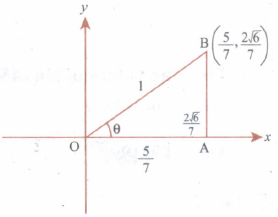
OB2 = OA2 + AB2
= \((\frac{5}{7})^2+(\frac{2\sqrt{6}}{7})^2=\frac{25}{49}+\frac{24}{49}=\frac{49}{49}=1\)
ஃ ⇒ OB = 1
sin θ = \(\frac{opp}{hyp}=\frac{AB}{OB}=\frac{2\sqrt{6}}{7}\) , cos θ = \(\frac{adj}{hyp}=\frac{OA}{OB}=\frac{5}{7}\)
tan θ = \(\frac{opp}{adj}=\frac{\frac{2\sqrt{6}}{7}}{\frac{5}{7}}=\frac{2\sqrt{6}}{7}\times\frac{7}{5}=\frac{2\sqrt{6}}{5}\)
tan θ = \(\frac{\frac{2\sqrt{6}}{7}}{\frac{5}{7}}=\frac{2\sqrt{6}}{7}\times\frac{7}{5}=\frac{2\sqrt{6}}{5}\)
cot θ = \(\frac{5}{2\sqrt{6}}\)
cosec θ = \(\frac{1}{sinθ}=\frac{7}{2\sqrt{6}}\) ; sec θ = \(\frac{1}{cosθ}=\frac{7}{5}\)
and cot θ = \(\frac{1}{tanθ}=\frac{5}{2\sqrt{6}}\)
12.
Given diameter of the circle is 40 cm
r = 20cm
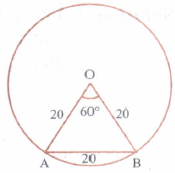
Let AB = 20 cm be a chord of the circle
Since OA = OB = AB = 20 cm, ΔAOB is equilateral
ஃ θ = ㄥAOB = 60°= 60 \(\times\) \(\frac{\pi}{180}=\frac{\pi}{3}\) radians
Let I be the length of the minor arc of the chord AB.
Then θ = \(\frac{l}{r}\) ⇒ l = rθ ⇒ l = 20(\(\frac{\pi}{3}\))
l = \(\frac{20\pi}{3}\) cm = 20 \(\times\) \(\frac{22}{7}\times\frac{1}{3}\) = 20.95 cm (app)
13.
14.
LHS = sin x + sin 2x + sin 3x
= (sin x + sin 3x) + sin 2x
\(=2sin\left( \frac { x+3x }{ 2 } \right) cos\left( \frac { x-3x }{ 2 } \right) +sin2x\)
= 2sin 2x.cos(-x) + sin 2x
= 2sin 2x + cos x + sin 2x
= sin 2x(1 + 2cos x) = RHS
15.
Squaring and adding ac cos θ = bc and ac sin θ = ad,
we get a2c2 = b2c2 + a2d2
16.
sin 4x cos 2x = \(\frac{1}{2}\) [sin (4x + 2x) + sin (4x - 2x)]
= \(\frac{1}{2}\) [sin 6x + sin 2x]
17.
Given sin A = \(\frac{4}{5}\)
cos 2A = 1 - 2 sin2 A = 1 - 2 \({ \left( \frac { 4 }{ 5 } \right) }^{ 2 }\)
= 1 - 2 \(( \frac { 16 }{ 25 } )=1-\frac{32}{25}=\frac{25-32}{25}=\frac{-7}{25} \)
18.
tan (45o + A) = \(\frac { 1+\tan { A } }{ 1-\tan { A } } \)
LHS = tan (45o + A) = \(\frac { \tan { { 45 }^{ o } } +\tan { A } }{ 1+\tan { { 45 }^{ o } } .A\tan { } } =\frac { 1+\tan { A } }{ 1-\tan { A } } \) = RHS
Hence proved.
19.
1500
1500 = 150 \(\times\) \(\frac { \pi }{ 180 } =\frac { 5\pi }{ 6 } \)
20.
cos 105o = cos (60 + 45)
= cos 60 cos 45 - sin 60 sin 45
= \(\frac { 1 }{ 2 } .\frac { 1 }{ \sqrt { 2 } } -\frac { \sqrt { 3 } }{ 2 } .\frac { 1 }{ \sqrt { 2 } } =\frac { 1-\sqrt { 3 } }{ 2\sqrt { 2 } } \)
21.
(b)
\({2\sqrt{2}-1\over 4\sqrt{2}}\)
22.
\(\sin \alpha+\cos \alpha=b \Rightarrow(\sin \alpha+\cos \alpha)^{2} =b^{2} \)
\(\sin ^{2} \alpha+\cos ^{2} \alpha+2 \sin \alpha \cos \alpha =b^{2} \)
\(\sin 2 \alpha =b^{2}-1 \)
Since \(-1<\sin 2 \alpha \leq 1 \)
\(-1 \leq \mathrm{b}^{2}-1 \leq 1 \)
\(\mathrm{~b}^{2}-1 \leq 1 \)
\(\mathrm{~b}^{2} \leq 2 \)
\(\text { This is possible if } \mathrm{b} \leq \sqrt{2}\)
\(\sin 2 \alpha=b^{2}-1, \text { if } b \leq \sqrt{2}\)
23.
\(3 \mathrm{a}=12 \Rightarrow \mathrm{a}=4\)
Maximum area is obtained when it is an equilateral triangle with side 4 m each
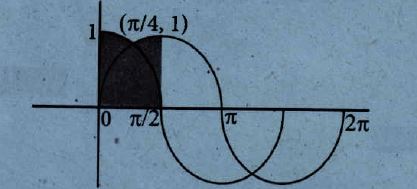
24.
\(\text { It lies in } \frac{1}{\sqrt{2}}+\frac{1}{\sqrt{2}} \text { and } 0+1\)
\(=\sqrt{2} \text { and } 1=[1, \sqrt{2}]\)
25.
\(\cos p \theta+\cos q \theta=0 \)
\(2 \cos \left(\frac{p+q}{2}\right) \theta \cdot \cos \left(\frac{p-q}{2}\right) \theta=0 \)
\(\Rightarrow 2 \cos \left(\frac{p+q}{2}\right) \theta=0 \)
\(\cos \left(\frac{\mathrm{p}-\mathrm{q}}{2}\right) \theta=0\)
\(\text { Principal angle is } \pi / 2\)
\(\therefore\left(\frac{p+q}{2}\right) \theta =n \pi \pm \pi / 2 \)
\(\Rightarrow(p+q) \cdot \theta =2 n \pi \pm \pi \)
\(\theta =\frac{\pi(2 n \pm 1)}{p+q} \)
\(\text { Similarly, } \theta=\frac{\pi(2 n \pm 1)}{p-q}\)
26.
\(\frac{\sin (A-B)}{\cos A \cos B} =\frac{\sin A \cos B-\cos A \sin B}{\cos A \cos B} \)
\(=\tan A-\tan B \)
\(\text { L.H.S } =\tan A-\tan B+\tan B-\tan C+\tan C-\tan A=0\)
27.
\(\cos 2 \theta \cos 2 \phi+\sin ^{2}(\theta-\phi)-\sin ^{2}(\theta+\phi) \)
\(=\cos 2 \theta \cos 2 \phi+\frac{1}{2}-\frac{1}{2} \cos (2 \theta-2 \phi)-\frac{1}{2}+\frac{1}{2} \cos (2 \theta+2 \phi) \)
\(=\cos 2 \theta \cos 2 \phi+\frac{1}{2}[\cos (2 \theta+2 \phi)-\cos (2 \theta-2 \phi)] \)
\(=\cos 2 \theta \cos 2 \phi-\sin 2 \theta \cos 2 \phi \)
\(=\cos (2 \theta+2 \phi) \)
\(=\cos 2(\theta+\phi) \)
28.
\(\cos 1^{\circ}+\cos 2^{\circ}+\cos 3^{\circ}+\ldots \ldots \ldots+\cos 179^{\circ} \)
\(=\left(\cos 1^{\circ}+\cos 179^{\circ}\right)+\left(\cos 2^{\circ}+\cos 178^{\circ}\right)+ ...\)
\(=2 \cos 90^{\circ} \cos 89^{\circ}+2 \cos 90^{\circ} \cos 80^{\circ}+\ldots \ldots . \)
\(=0+0+0 \ldots \ldots=0 \)
29.
\(\frac{\tan 140^{\circ}-\tan 130^{\circ}}{1+\tan 140^{\circ} \tan 130^{\circ}} =\tan \left(140^{\circ}-130^{\circ}\right) \)
\(=\tan 10^{\circ} \ldots \ldots(1) \)
\(\tan 40^{\circ} =\lambda \)
\(\tan 80^{\circ}=\frac{2 \tan 40^{\circ}}{1-\tan ^{2} 40^{\circ}} =\frac{2 \lambda}{1-\lambda^{2}} \)
\(\tan \left(90^{\circ}-10^{\circ}\right) =\frac{2 \lambda}{1-\lambda^{2}} \)
\(\cot 10^{\circ} =\frac{2 \lambda}{1-\lambda^{2}} \)
\(\Rightarrow \tan 10^{\circ} =\frac{1-\lambda^{2}}{2 \lambda} \)
\(\frac{\tan 140^{\circ}-\tan 130^{\circ}}{1+\tan 140^{\circ} \tan 130^{\circ}} \)
\(=\frac{1-\lambda^{2}}{2 \lambda}\)
30.
\(4 \sin ^{2} x+3 \cos ^{2} x+\sin \frac{x}{2}+\cos \frac{x}{2} \)
\(=3\left(\sin ^{2} x+\cos ^{2} x\right)+\sin ^{2} x+\sin \frac{x}{2}+\cos \frac{x}{2} \)
\(=3+\sin ^{2} x+\sin \frac{x}{2}+\cos \frac{x}{2} \)
\(\text { Maximum of } \sin x=1\)
\(\text { Maximum value of } \sin ^{2} x=1\)
\(\text { Maximum value of } \sin \frac{x}{2} \text { occurs where } x=45^{\circ}\)
\(\text { Maximum value is } 3+1+\frac{1}{\sqrt{2}}+\frac{1}{\sqrt{2}}=4+\frac{2}{\sqrt{2}}=4+\sqrt{2}\)

11th Standard Syllabus & Materials
11th Standard
TN 11th Tamil பீடு பெற நில் - செய்யுள் - காவடிச்சிந்து Important Questions And Answers Study Material - QB365 Set A
NEW11th Standard
TN 11th Tamil பீடு பெற நில் - உரைநடை - மலை இடப்பெயர்கள் : ஓர் ஆய்வு Important Questions And Answers Study Material - QB365 Set A
NEW11th Standard
TN 11th Tamil மாமழை போற்றுதும் - துணைப்பாடம் - யானை டாக்டர் Important Questions And Answers Study Material - QB365 Set A
NEW11th Standard
TN 11th Tamil மாமழை போற்றுதும் - செய்யுள் - ஐங்குறுநூறு Important Questions And Answers Study Material - QB365 Set A



Tamilnadu Stateboard 11th Standard Subjects
Maths

Commerce

Economics

Biology

Business Maths and Statistics

Accountancy

Computer Science

Physics

Chemistry
Maths
Biology
Economics
Physics
Chemistry

History
Business Maths and Statistics

Computer Science
Accountancy

Computer Applications
History
Computer Technology
Commerce
Computer Applications
Computer Technology

Tamil

English

French
Tamilnadu Stateboard Standards


