
 100% FREE ACCESS
11th Standard Syllabus & Materials
11th Standard
TN 11th Tamil இயற்கை வேளாண்மை,சுற்றுச்சூழல் -செய்யுள் - மனோன்மணீயம் Important Questions And Answers Study Material - QB365 Set A
NEW11th Standard
TN 11th Tamil என்னுயிர் என்பேன் -துணைப்பாடம் - இசைத்தமிழர் இருவர் Important Questions And Answers Study Material - QB365 Set A
NEW11th Standard
TN 11th Tamil மொழி கலை -செய்யுள் - ஒவ்வொரு புல்லையும் Important Questions And Answers Study Material - QB365 Set A
NEW11th Standard
TN 11th Tamil பீடு பெற நில் - இலக்கணம் - பகுபத உறுப்புகள் Important Questions And Answers Study Material - QB365 Set A
NEW11th Standard
TN 11th Tamil பீடு பெற நில் - துணைப்பாடம் - வாடிவாசல் Important Questions And Answers Study Material - QB365 Set A
NEW11th Standard
TN 11th Tamil பீடு பெற நில் - செய்யுள் - குறுந்தொகை Important Questions And Answers Study Material - QB365 Set A

Published on: 24/08/2026
Download Tamil Nadu 11th Standard Physics question papers, model tests, one-mark questions, important questions, and public exam papers in PDF format. Free study materials and answer keys for TN State Board students.
Questions + Answers key
Take MCQ Physics Test
1.
The numerical ratio of displacement to distance is ______________.
<1
=1
>1
≤1
2.
Two objects are projected at angles 30° and 60° respectively with respect to the horizontal direction. The range of two objects are denoted as R30° and R30°. Choose the correct relation from the following
R30° = R60°
R30° = 4R60°
R30° =\(\frac{R_{60°}}{2}\)
R30° = 2R60°
3.
If an object is thrown vertically up with the initial speed u from the ground, then the time taken by the object to return back to ground is
\(\frac{u^2}{2g}\)
\(\frac{u^2}{g}\)
\(\frac{u}{2g}\)
\(\frac{2u}{g}\)
4.
If one object is dropped vertically downward and another object is thrown horizontally from the same height, then the ratio of vertical distance covered by both objects at any instant t is
1
2
4
0.5
5.
If the velocity is \(\overrightarrow { v } =2\hat { i } +{ t }^{ 2 }\hat { j } -9\overrightarrow { k } \), then the magnitude of acceleration at t = 0.5s is
1 ms-2
2 ms-2
zero
-1 ms-2
6.
Which one of the following Cartesian coordinate systems is not followed in physics?
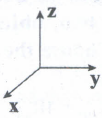
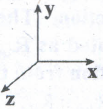
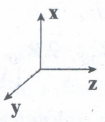
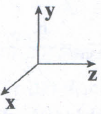
7.
Suppose an object is thrown with initial speed 10 ms-1 at an angle \(\frac{\pi}{4}\) with the horizontal, what is the range covered? Suppose the same object is thrown similarly in the Moon, will there be any change in the range? If yes, what is the change? (The acceleration due to gravity in the Moon \(g_{moon}=\frac{1}{6}g\)).
8.
Write down the kinematic equations for angular motion.
9.
Define angular displacement and angular velocity.
10.
Define velocity and speed
11.
A object is thrown with initial speed 5 ms-1 with an angle of projection 30o. What is the height and range reached by the particle?
12.
How long will a boy sitting near the window of a train travelling at 36 km h-1 see a train passing by in the opposite direction with a speed of 18 km h-1. The length of the slow moving train is 90 m.
13.
What is non uniform circular motion?
14.
Derive the expression for total acceleration in the non uniform circular motion.
15.
16.
Derive the equation of motion, range and maximum height reached by the particle thrown at an oblique angle \(\theta\) with respect to the horizontal direction.
1.
(d)
≤1
2.
Range is same for the angle if projection \(\theta \text { and } 90-\theta\)
3.
\(\text {Time of flight }=\frac{2 u}{g}\)
4.
For a free falling body, initial vertical downward velocity = 0
For a body thrown horizontally with a velocity, initial vertical downward velocity = 0
Since both having same initial vertical downward velocity they cover equal vertical distance at any instant
5.
\(\vec{v}=2 \hat{l}+t^{2} \hat{j}-9 \vec{k}\)
\(\vec{a}=\frac{d \vec{v}}{d t}=2 t \hat{j}\)
\(\text { When } t=0.5 \mathrm{~s}\)
\(a=1 \mathrm{~ms}^{-2}\)
6.
Answers (a), (b) and (c) are all anticlockwiseand answer (d) alone is in the clockwise direction
7.
In projectile motion, the range of particle is given by,
\(R=\frac{u^2sin\ 2\theta}{g}\)
\(\theta=\frac{\pi}{4}\ u=v_0=10\ ms^{-1}\)
\(\therefore\ R_{earth}=\frac{(10)^2\sin\frac{\pi}{2}}{9.8}=\frac{100}{9.8}\)
Rearth = 10.20 m (Approximately 10 m)
If the same object is thrown in the Moon, the range will increase because in the Moon, the acceleration due to gravity is smaller than g on Earth,
\(g_{moon}=\frac{g}{6}\)
\(R_{moon}=\frac{u^2sin2\theta}{g_{moon}}=\frac{v_0^2sin2\theta}{\frac{g}{6}}\)
\(\therefore\ R_{moon}=6\times10.24=61.22m\) (Approximately 60 m)
The range attained on the Moon is approximately six times that on Earth.
8.
| 1. \(\omega ={ \omega }_{ 0 }+\alpha t\) | \(\omega \) = Final angular velocity |
| 2. \(\theta ={ \omega }_{ 0 }t+\frac { 1 }{ 2 } { \alpha t }^{ 2 }\) | \({ \omega }_{ 0 }\) = initial angular velocity |
| 3. \({ \omega }^{ 2 }={ \omega }_{ 0 }^{ 2 }+2\alpha \theta \) | \(\theta \) = Angular displacement |
| 4. \(\theta =\frac { \left( { \omega }_{ 0 }+\omega \right) t }{ 2 } \) | \(\alpha \) = angular acceleration t = time |
9.
Angular displacement: While a particle is revolving around a point in a circular path, the angle described by the particle about the axis of rotation (or at the centre of the circle) in a given time is called angular displacement. Its unit is radian.
Angular velocity: The rate of change of angular displacement is called angular velocity. Its unit is rad s-1
\(\omega =\frac { d\theta }{ dt } \)
10.
Velocity:
Velocity is equal to the rate of change of position vector with respect to time.
It is a vector quantity \(\overrightarrow{v}=\frac{d\overrightarrow{r}}{dt}\)
Speed:
The magnitude of velocity is called speed and is given by \(v= \sqrt{v^2_x+v^2_y+v^2_z}\). It is a positive scalar.
11.
\(u =5 m s^{-1} \)
\(\theta =30^{\circ} \)
\(h_{\max } =\frac{u^{2} \sin ^{2} \theta}{2 g}=\frac{25 \times\left(\frac{1}{2}\right)^{2}}{2 \times 9.8}=0.318 \mathrm{~m} \)
\(\text { Range } =\frac{u^{2} \sin 2 \theta}{g}=\frac{25 \times \sqrt{3}}{9.8 \times 2}=2.21 \mathrm{~m}\)
12.
The relative velocity of the slow-moving train with respect to the boy is = (36 + 18) km h-1
= 54 km h-1 54 =\(\times \frac { 5 }{ 18 } \) ms-1 =15 ms-1
Since the boy will watch the full length of the other train, to find the time taken to watch the full train:
We have,
15=\(\frac { 90 }{ t } \) or t=\(\frac { 90 }{ 15 } \) = 6s
13.
When a point object is moving on a circular path if the velocity of the object changes both in speed (magnitude) and direction the motion is said to be non uniform circular motion.
14.
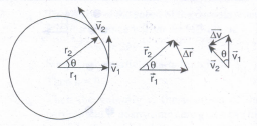
Consider a non uniform circular motion of a point object moving on a circular path of radius r with a velocity v. In a non uniform circular motion the magnitude of the velocity (speed) is not constant. Whenever the speed is not same in circular motion, the object will have both centripetal and tangential acceleration as shown in the figure.
The resultant acceleration is obtained by vector sum of centripetal and tangential acceleration. Since the centripetal acceleration is \(\frac{v^2}{r}\) the magnitude of the resultant acceleration is given by \(a_R =\sqrt{a^2_t+(\frac{v^2}{r})}^2\)
The resultant acceleration makes an angle 0 with the radius vector as shown in the figure. The angle is given by \(tan \ \theta=\frac{a_t}{({v^2}/{r})}\)
15.
16.
Consider an object thrown with initial velocity \(\overrightarrow{u}\) at an angle \(\theta\) with the horizontal.
Then,
\(\overrightarrow{u}=u,\overrightarrow{i}+u,\overrightarrow{j}\)
where ux =u cos \(\theta\) is the horizontal component and uy = u sin \(\theta\) the vertical component of velocity.
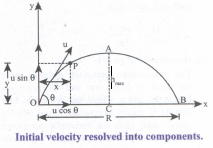
Since the acceleration due to gravity acts in the direction opposite to the direction of vertical component uy, this component will gradually reduce to zero at the maximum height of the projectile. At this maximum height, the same gravitational force will push the projectile to move downward and fall to the ground.
But, there is no acceleration along the x direction throughout the motion. So, the horizontal component of velocity (ux = u cos \(\theta\)) remains the same till the object reaches the ground.
After anytime t, the velocity along horizontal motion
vx = ux + axt = ux = u cos\(\theta\) [∴ ax = 0]
The horizontal distance travelled by projectile in time t is
sx = \({u}_{x}t+{{1}\over{2}}a_n{t}^{2}\)
[∴ sx = x and an = 0]
∴ t = \(\frac{x}{u \cos \theta} \) ......(1)
For the vertical motion the velocity after time t is vy = uy + ayt
vy = u sin \(\theta\) - gt........(2)
(∴ ug = u sin \(\theta\) and ay = - g)
The vertical distance travelled by the projectile in the same time r is
sy = \({u}_{y}t{{1}\over{2}}{a}_{y}{t}^{2}\)
y = sin \(\theta\ t-{{1}\over{2}}{gt}^{2}\)
(Here, (Here, sy = y, uy = u sin \(\theta\) and ay = - g)
Substitute the value of t from equation (1) in equation (3), we have
\(y=u\ \sin\theta{{x}\over{u\ \cos\ \theta}}-{{1}\over{2}}g{{x^2}\over{u^2{cos}^{2}\theta}}\)
\(y=x\ \tan\theta-{{1}\over{2}}g{{x^2}\over{u^2{cos}^{1}\theta}}\)
Thus the path followed by the projectile is an inverted parabola.
2. Maximum height: The maximum vertical distance travelled by the projectile during its journey is called maximum height.
For the vertical part of the motion. \({v}_{y}^{2}={u}_{y}^{2}+2{a}_{y}s\)
Here, uy = u sin \(\theta\), ay = -g, S = hmax and at the maximum height vy = 0.
Hence,
∴ 0 = u2 sin2 = 2ghmax
\({h}_{max}={{{u}^{2}{sin}^{2}\theta}\over{2g}}\)
3. Horizontal Range (R): The maximum horizontal distance between the point of projection and the point on the horizontal plane where the projectile hits the ground is called horizontal range (R).
Range R = Horizontal component of velocity x time of flight
= u cos \(\theta\times{T}_{f}\)
\(R=u\ \cos\theta\times{{2u\ \sin\theta}\over{g}}={{2{u}^{2}\sin\theta\cos\theta}\over{}g}\) \([\therefore T_f=\frac {2u\ sin \theta}{g}]\)
\(\therefore\ R={{u^2\sin 2\theta}\over{g}}\)

11th Standard Syllabus & Materials
11th Standard
TN 11th Tamil பீடு பெற நில் - செய்யுள் - காவடிச்சிந்து Important Questions And Answers Study Material - QB365 Set A
NEW11th Standard
TN 11th Tamil பீடு பெற நில் - உரைநடை - மலை இடப்பெயர்கள் : ஓர் ஆய்வு Important Questions And Answers Study Material - QB365 Set A
NEW11th Standard
TN 11th Tamil மாமழை போற்றுதும் - துணைப்பாடம் - யானை டாக்டர் Important Questions And Answers Study Material - QB365 Set A
NEW11th Standard
TN 11th Tamil மாமழை போற்றுதும் - செய்யுள் - ஐங்குறுநூறு Important Questions And Answers Study Material - QB365 Set A



Tamilnadu Stateboard 11th Standard Subjects

Maths

Commerce

Economics

Biology

Business Maths and Statistics

Accountancy

Computer Science
Physics

Chemistry
Maths
Biology
Economics
Physics
Chemistry

History
Business Maths and Statistics

Computer Science
Accountancy

Computer Applications
History
Computer Technology
Commerce
Computer Applications
Computer Technology

Tamil

English

French
Tamilnadu Stateboard Standards


