
 100% FREE ACCESS
11th Standard Syllabus & Materials
11th Standard
TN 11th Tamil இயற்கை வேளாண்மை,சுற்றுச்சூழல் -செய்யுள் - மனோன்மணீயம் Important Questions And Answers Study Material - QB365 Set A
NEW11th Standard
TN 11th Tamil என்னுயிர் என்பேன் -துணைப்பாடம் - இசைத்தமிழர் இருவர் Important Questions And Answers Study Material - QB365 Set A
NEW11th Standard
TN 11th Tamil மொழி கலை -செய்யுள் - ஒவ்வொரு புல்லையும் Important Questions And Answers Study Material - QB365 Set A
NEW11th Standard
TN 11th Tamil பீடு பெற நில் - இலக்கணம் - பகுபத உறுப்புகள் Important Questions And Answers Study Material - QB365 Set A
NEW11th Standard
TN 11th Tamil பீடு பெற நில் - துணைப்பாடம் - வாடிவாசல் Important Questions And Answers Study Material - QB365 Set A
NEW11th Standard
TN 11th Tamil பீடு பெற நில் - செய்யுள் - குறுந்தொகை Important Questions And Answers Study Material - QB365 Set A

Published on: 24/08/2026
Download Tamil Nadu 11th Standard Physics question papers, model tests, one-mark questions, important questions, and public exam papers in PDF format. Free study materials and answer keys for TN State Board students.
Questions + Answers key
Take MCQ Physics Test
1.
The centrifugal force appears to exist
only in inertial frames
only in rotating frames
in any accelerated frame
both in inertial and non-inertial frames
2.
3.
An object of mass m begins to move on the plane inclined at an angle θ. The coefficient of static friction of inclined surface is μs. The maximum static friction experienced by the mass is
mg
μs mg
μs mg sin ፀ
μs mg cos ፀ
4.
5.
Explain the similarities and differences of centripetal and centrifugal forces.
6.
Explain various types of friction. Suggest a few methods to reduce friction.
7.
If a stone of mass 0.25 kg tied to a string executes uniform circular motion with a speed of 2 m s-1 of radius 3 m, what is the magnitude of tensional force acting on the stone?
8.
Consider a circular road of radius 20 meter banked at an angle of 15 degree. With what speed a car has to move on the turn so that it will have safe turn?
9.
Under what condition will a car skid on a leveled circular road?
10.
What are inertial frames?
11.
State the empirical laws of static and kinetic friction.
12.
Describe the method of measuring angle of repose.
1.
(b)
only in rotating frames
2.
(a)
3.
(d)
μs mg cos ፀ
4.
5.
| Centripetal | Centrifugal forces |
| It is a real force which is exerted on the body by the external agencies like gravitational force, tension in the string, normal force etc |
It is a pseudo force or fictitious force which cannot arise from gravitational force, tension. force, normal force etc |
| Acts in both inertial and non-inertial frames | Acts only in rotating frames (non-inertial frame) |
| It acts towards the axis of rotation or center of the circle in Circular motion |
It acts outwards from the axis of rotation or radially outwards from the center of the circular motion |
| \(\left| { F }_{ cp } \right| =m{ \omega }^{ 2 }r=\frac { { mv }^{ 2 } }{ r } \) | \(\left| { F }_{ cf } \right| =m{ \omega }^{ 2 }r=\frac { { mv }^{ 2 } }{ r } \) |
| Real force and has real effects | Pseudo force but has real effects |
| Origin of centripetal force is interaction between two objects |
Origin of centrifugal force is inertia. It does not arise from interaction. |
| In inertial frames centripetal force has to be included when free body diagrams are drawn |
In inertial frames there is no centrifugal force. In rotating frames, both centripetal and centrifugal force have to be included when free body diagrams are drawn. |
6.
Static friction: The opposing force that comes into play when one body tends to move over the surface of another, but the actual motion has yet not started is called static friction.
Limiting friction: If the applied force is increased the force of static friction also increases. If the applied force exceeds a certain (maximum) value, the body starts moving. This maximum value of static friction up to which body does not move is called limiting friction.
Kinetic or dynamic friction: If the applied force is increased further and sets the body in motion, the friction opposing the motion is called kinetic friction.
We can reduce friction
(1) By polishing.
(2) By lubrication.
(3) By proper selection of material.
(4) By streamlining the shape of the body.
(5) By using ball bearing.
7.
\(F_{cp}=\frac{mv^2}{r}\)
\(F_{cp}=\frac{\frac{1}{4} \times(2)^2}{3}=0.333 \ N\)
8.
v =\(\sqrt { (rg\quad tan\theta ) } =\sqrt { 20\times 9.8\times tan{ 15 }^{ 0 } } =\sqrt { 20\times 9.8\times 0.26 } \) = 7.1 ms-1
The safe speed for the car on this road is 7.1 ms-1
9.
In a leveled circular road, skidding mainly depends on the coefficient of static friction \({ \mu }_{ s }\). The coefficient of static friction depends on the nature of the surface which has a maximum limiting value. If the speed of car exceeds this safe speed, then it starts to skid outward but frictional force comes into effect and provides an additional centripetal force to prevent the outward skidding.
\(tan \ \theta> { \mu }_{ s }\)
When the tangent of the angle of banking is greater than the coefficient of friction, skidding occurs.
10.
(a) A frame of reference which is at rest or which is moving with a uniform velocity along a straight line is called an inertial frame of reference.
(b) In the inertial frame of reference Newton's laws of motion holds good.
Example: The lift at rest, lift moving (up or down) with constant velocity, car moving with constant velocity on a straight road.
11.
Limiting static/kinetic friction between any pair of dry unlubricated surfaces is independent of apparent area in contact.
Limiting static/kinetic friction between any pair of unlubricated surfaces depends on nature of material of the surfaces in contact.
Limiting static/kinetic friction between any pair of dry unlubricated surfaces is directly proportional to the normal reaction.
Static Friction: If Fs is static friction and R (N) is a normal reaction
Then
Fs ∝ R
∴ Fs = μsR
μs = coefficient of static friction.
∴ μs = \(\frac{F_s}{R}\)
The coefficient of static friction is defined as the ratio of the static friction to normal reaction
Kinetic friction: If Fs is static friction and R (N) is a normal reaction
Then
Fk ∝ R
∴ Fk = μsR
μk = coefficient of static friction.
∴ μk = \(\frac{F_k}{R}\)
The coefficient of kinetic friction is defined as the ratio of the kinetic friction to normal reaction
12.
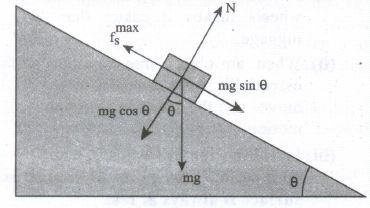
Consider an inclined plane on which an object is placed as shown in the figure, Let the angle which this plane makes with the horizontal be ፀ. For small angle of ፀ, the object may not slide down. As ፀ is increased, for a particular value of ፀ, the object begins to slide down. This value is called angle of repose. Hence, the angle of repose is the angle of the inclined plane with the horizontal such that an object placed on it begins to slide.

11th Standard Syllabus & Materials
11th Standard
TN 11th Tamil பீடு பெற நில் - செய்யுள் - காவடிச்சிந்து Important Questions And Answers Study Material - QB365 Set A
NEW11th Standard
TN 11th Tamil பீடு பெற நில் - உரைநடை - மலை இடப்பெயர்கள் : ஓர் ஆய்வு Important Questions And Answers Study Material - QB365 Set A
NEW11th Standard
TN 11th Tamil மாமழை போற்றுதும் - துணைப்பாடம் - யானை டாக்டர் Important Questions And Answers Study Material - QB365 Set A
NEW11th Standard
TN 11th Tamil மாமழை போற்றுதும் - செய்யுள் - ஐங்குறுநூறு Important Questions And Answers Study Material - QB365 Set A



Tamilnadu Stateboard 11th Standard Subjects

Maths

Commerce

Economics

Biology

Business Maths and Statistics

Accountancy

Computer Science
Physics

Chemistry
Maths
Biology
Economics
Physics
Chemistry

History
Business Maths and Statistics

Computer Science
Accountancy

Computer Applications
History
Computer Technology
Commerce
Computer Applications
Computer Technology

Tamil

English

French
Tamilnadu Stateboard Standards


