10th Standard Syllabus & Materials
10th Standard
TN 10th Tamil நாகரிகம், நாடு, சமூகம் - கவிதை பேழை (செய்யுள்) -முத்தொள்ளாயிரம் Sample Question Papers Study Material - QB365 Set A
NEW10th Standard
TN 10th Tamil அறம்,தத்துவம், சிந்தனைகவிதை பேழை (செய்யுள்) -அக்கறை Sample Question Papers Study Material - QB365 Set A
NEW10th Standard
TN 10th Tamil உயிரின்ஓசை - துணைப்பாடம் -பிருமம் Sample Question Papers Study Material - QB365 Set A
NEW10th Standard
TN 10th Tamil அறம், தத்துவம், சிந்தனை - கவிதை பேழை (செய்யுள்) -தேம்பாவணி * Sample Question Papers Study Material - QB365 Set A
NEW10th Standard
TN 10th Tamil கலை, அழகியல், புதுமை - உரைநடை உலகம் -பன்முகக் கலைஞர் Sample Question Papers Study Material - QB365 Set A
NEW10th Standard
TN 10th Tamil மணற்கேணி - இலக்கணம் - இலக்கணம் -பொது Sample Question Papers Study Material - QB365 Set A
Published on: 19/10/2025
Download Tamil Nadu 10th Standard Science question papers, model tests, one-mark questions, important questions, and public exam papers in PDF format. Free study materials and answer keys for TN State Board students.
Questions + Answers key
Take MCQ Science Test
1.
The loss of one or more chromosome in a ploidy is called_____________.
Tetraploidy
Aneuploidy
Euploidy
Polyploidy
2.
The _____________ units form the backbone of the DNA.
5 Carbon sugar
Phosphate
Nitrogenous bases
Sugar phosphate
3.
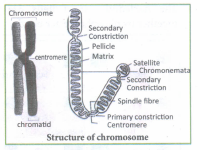
The region of the chromosome where the spindle fibres get attached during cell division
Chromomere
Centrosome
Centromere
Chromonema
4.
The miracle rice which saved millions of lives and celebrated its 50th birthday is _______.
IR 8
IR 24
Atomita 2
Ponni
5.
Pusa Komal is a disease resistant variety of _________.
sugarcane
rice
cow pea
maize
6.
7.
Paleontologists deal with
Embryological evidences
Fossil evidences
Vestigial organ evidences
All the above
8.
Biogenetic law states that ___________
Ontogeny and phylogeny go together
Ontogeny recapitulates phylogeny
Phylogeny recapitulates ontogeny
There is no relationship between phylogeny and ontogeny
9.
Define dihybrid cross.
10.
What are living fossils?
11.
Name the conditions when both the alleles are identical.
12.
State the importance of biofertiliser.
13.
Name the types of stem cells.
14.
Define genetic engineering.
15.
Give the name of wheat variety having higher dietary fibre and protein.
16.
What is the study of fossils called?
17.
Which organism is considered to be the fossil bird?
18.
Explain Use and Disuse theory.
19.
20.
A pure tall plant (TT) is crossed with pure dwarf plant (tt), What would be the F1 and F2 generations? Explain.
21.
Why did Mendel select pea plant for his experiments?
22.
Differentiate between outbreeding and inbreeding.
23.
Distinguish between
a. somatic gene therapy and germ line gene therapy
b. undifferentiated cells and differentiated cells.
24.
How can you determine the age of the fossils?
25.
Define Ethnobotany and write its importance.
26.
How is the structure of DNA organised? What is the biological significance of DNA?
27.
Explain with an example the inheritance of dihybrid cross. How is it different from monohybrid cross?
28.
Discuss the importance of biotechnology in the field of medicine.
29.
How do you differentiate homologous organs from analogous organs?
1.
(b)
Aneuploidy
2.
(d)
Sugar phosphate
3.
(c)
Centromere
4.
(a)
IR 8
5.
(c)
cow pea
6.
(b)
7.
(b)
Fossil evidences
8.
(b)
Ontogeny recapitulates phylogeny
9.
Dihybrid cross involves the inheritance of two pairs of contrasting characteristics (or contrasting traits) at the same time.
For example the cross between round-yellow (RRYY) seeds and wrinkled-green seeds (rryy).
10.
These are living organisms that are similar in appearance to their fossilized distant ancestors and, usually have no extinct close features. E.g: Ginko biloba.
11.
The both alleles are identical in homozygous condition.
12.
i) They are eco-friendly.
ii) They do not cause pollution like artificial fertilizers.
iii) Help to safeguard natural resourses.
13.
Embryonic stem cells, Adult stem cell or somatic stem cell.
14.
Genetic engineering is the manipulation and transfer of genes from one organism to another organism to create a new DNA called as recombinant DNA (rDNA)
15.
Atlas 66 is a protein rich wheat variety having higher dietary fibre and protein.
16.
Palaeontology.
17.
Archaeopteryx.
18.
Use and disuse theory
(i) Lamarck's Use and Disuse theory states that if an organ is used constantly, the organ develops well and gets strengthened.
(ii) When an organ is not used for a long time, it gradually degenerates.
(iii) The ancestors of Giraffe were provided with short neck and short forelimbs.
(iv) Due to shortage of grass, they were forced to feed on leaves from trees. The continuous stretching of their neck and forelimbs resulted in the development of long neck and long forelimbs which is an example for constant use of an organ.
(v) The degenerated wing of Kiwi is an example for organ of disuse.
19.
20.
Parental generation:
i) Pure breeding tall plant and a pure breeding dwarf plant (tt).
F1 generation:
i) Plants raised from the seeds of pure breeding parental cross in F1 generation were tall and monohybrids.
F2 generation:
i) Selfing of the F1 monohybrids resulted in tall and dwarf plants respectively in the ratio of 3:1.
ii) The actual number of tall and dwarf plants obtained by Mendel was 787 tall and 277 dwarf.
iii) External expression of a particular trait is known as phenotype. So the phenotypic ratio is 3:1.
In the F2 generation 3 different types were obtained:
i) Tall Homozygous - TT (Pure) - 1.
ii) Tall Heterozygous - Tt - 2.
iii) Dwarf Homozygous - tt -1.
So the genotypic ratio 1:2:1.
(A genotype is the genetic expression of an organism).
21.
(i) Pea plant is naturally self-pollinating and so is very easy to raise pure breeding individuals.
(ii) It has a short life span as it is an annual and so it was possible to follow several generations.
(iii) It is easy to cross-pollinate.
(iv) It has deeply defined contrasting characters.
(v) The flowers are bisexual.
22.
| S.No. |
Outbreeding |
Inbreeding |
|---|---|---|
| i. | Cross between two different species (unrelated) with desirable features of economic value are mated. | Mating of closely related animals within the same breed for about 4 - 6 generations. |
| ii. | It is the breeding of unrelated animals. The offsprings formed are called hybrids. | Superior males and superior females of the same breed are identified and mated in pairs. |
| iii. | The hybrids are stronger and vigorous than their parents. E.g: Mule | It helps in the accumulation of superior genes and elimination of genes which are undesirable. E.g: Hisardale. |
23.
a. Somatic gene therapy and germ line gene therapy
| S.No. |
Somatic gene therapy |
Germline gene therapy |
|---|---|---|
| (i) | Somatic gene therapy is the replacement of defective gene in somatic cells. | Germ line gene therapy is replacement of defective gene in germ cell. |
b. Undifferentiated cells and differentiated cells:
| S.No. |
Undifferentiated Cells |
Differentiated cells |
|---|---|---|
| (i) | Undifferentiated cells continuously proliferate throughout the life time of the organism. E.g: Umbilical cord |
Differentiated cells some are unable to proliferate. E.g: Pancreatic cells to secrete insulin. |
24.
(i) The age of fossils is determined by radioactive elements present in it.
(ii) They may be carbon, uranium, lead or potassium.
(iii) It is used in paleobotany and anthropology for determining the age of human fossils and manuscripts.
25.
(i) Ethnobotany is the study of a region's plants and their practical uses through the traditional knowledge of the local culture of people.
Importance of Ethnobotany :
(i) It provides traditional uses of plant.
(ii) It gives information about certain unknown and known useful plants.
(iii) The ethnomedicinal data will serve as a useful source of information for the chemists, pharmacologists and practitioners of herbal medicine.
(iv) Tribal communities utilize ethnomedicinal plant and prepare medicine to cure many diseases.
26.
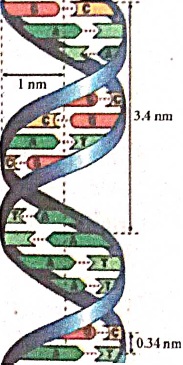
DNA is a large molecule consisting of millions of nucleotides. Hence, it is also called a polynucleotide. Each nucleotide consists of three components.
(i) A sugar molecules - Deoxyribose sugar.
(ii) A nitrogenous base.
There are two types of nitrogenous bases in DNA.
They are
(a) Purines (Adenine and Guanine)
(b) Pyrimidines (Cytosine and Thymine)
(iii) A phosphate group
Nucleoside and Nucleotide:
Nucleoside = Nitrogen base + Sugar
Nucleotide = Nucleoside + Phosphate
The nucleotides are formed according to the purines and pyrimidines present in them.
Watson and Crick model of DNA:
(i) DNA molecule consists of two polynucleotide chains.
(ii) These chains form a double helix structure with two strands which run anti-parallel to one another.
(iii) Nitrogenous bases in the centre are linked to sugar-phosphate units which form the backbone of the DNA.
(iv) Pairing between the nitrogenous bases is very specific and is always between purine and pyrimidine linked by hydrogen bonds.
a) Adenine (A) links Thymine (T) with two hydrogen bonds (A = T)
b) Cytosine (C) links Guanine (G) with three hydrogen bonds( C ≡ G) This is called complementary base pairing.
(v) Hydrogen bonds between the nitrogenous bases make the DNA molecule stable.
(vi) Each turn of the double helix is 34 Ao (3.4 nm). There are ten base pairs in a complete turn.
(vii) The nucleotides in a helix are joined together by phosphodiester bonds.
Significance of DNA:
(i) DNA is responsible for the transmission of hereditary information from one generation to next generation.
(ii) It contains information required for the formation of proteins.
(iii) It controls the developmental process and life activities of an organism.
27.
(i) Dihybrid cross involves the inheritance of two pairs of contrasting characteristics (or contrasting traits) at the same time.
(ii) The two pairs of contrasting characteristics chosen by Mendel were shape and colour of seeds: round-yellow seeds and wrinkled-green seeds.
(iii) Mendel crossed pea plants having round - yellow seeds with pea plants having wrinkled green seeds.
Mendel made the following observations:
(i) Mendel first crossed pure breeding pea plants having round-yellow seeds with pure breeding pea plants having wrinkled green seeds and found that only round yellow seeds were produced in the first generation (F1).
(ii) No wrinkled-green seeds were obtained in the F1 generation.
(iii) From this it was concluded that round shape and yellow colour of the seeds were dominant traits over the wrinkled shape and green color of the seeds.
(iv) When the hybrids of F1 generation pea plants having round-yellow seeds were cross-breed by self pollination, then four types of seeds having different combinations of shape and colour were obtained in second generation or F2 generation.
(v) They were round-yellow, round-green, wrinkled yellow and wrinkled-green seeds.
(vi) The ratio of each phenotype (or appearance) of seeds in the F2 generation is 9:3:3:1. This is known as the Dihybrid ratio.
(vii) From the above results it can be concluded that the factors for each character or trait remain independent and maintain their identity in the gametes.
(viii) The factors are independent to each other and pass to the offsprings (through gametes).
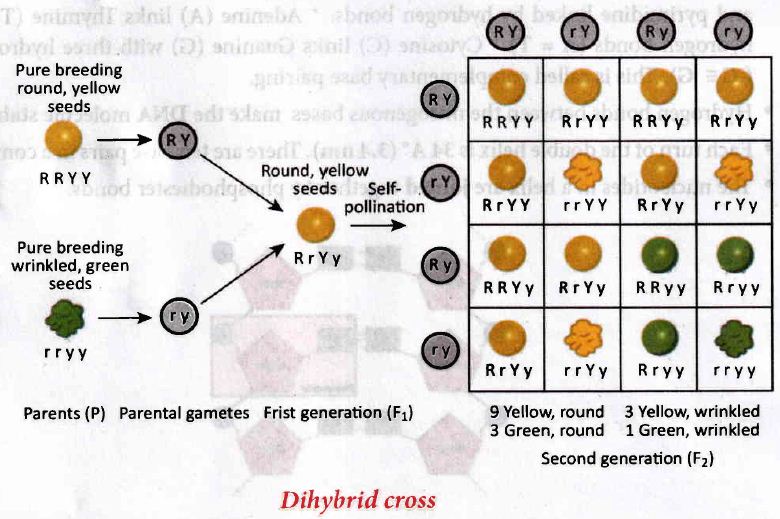
Results of a Dihybrid Cross:
(i) Mendel got the following results from his dihybrid cross.
Four Types of Plants:
(i) A dihybrid cross produced four types of F2 offsprings in the ratio of 9 with two dominant traits, 3 with one dominant trait and one recessive trait, 3 with another dominant trait and
another recessive trait and 1 with two recessive traits.
New Combination:
(i) Two new combinations of traits with round green and wrinkled yellow had appeared in the dihybrid cross (F2 generation).
| Monohybrid Cross | Dihybrid Cross |
| Cross involving inheritance of only one pair of contrasting character. |
Cross involves the inheritance of two pair of contrasting character. |
| E.g. Stem length | E.g. seed shape and seed colour |
28.
(i) Insulin used in the treatment of diabetes.
(ii) Human growth hormone used for treating children with growth deficiencies.
(iii) Blood clotting factors are developed to treat haemophilia.
(iv) Tissue plasminogen activator is used to dissolve blood clots and prevent heart attack.
(v) Development of vaccines against various diseases like Hepatitis B and rabies.
29.
| S.No | Homologous organs | Analogous organs |
| (i) | The homologous organs are those which have been inherited from common ancestors with similar developmental pattern in embryos. |
The analogous organs look similar and perform similar function but they have different origin and developmental pattern. |
| (ii) | The fore limbs of mammals are homologous structures. | The wings of a bird, wings of a bat wings of an insect are similar. |
| (iii) | The mode of development and basic structure of bone is similar. |
The development is similar, but their bone structures are different. |

10th Standard Syllabus & Materials
10th Standard
TN 10th Tamil கூட்டாஞ்சோறு - இலக்கணம் - தொகைநிலை தொடர்கள் Sample Question Papers Study Material - QB365 Set A
NEW10th Standard
TN 10th Tamil பண்பாடு - கவிதை பேழை (செய்யுள்) -முத்துக்குமாரசாமி பிள்ளைத்தமிழ் Sample Question Papers Study Material - QB365 Set A
NEW10th Standard
TN 10th Tamil உயிரின்ஓசை - இலக்கணம் - தொகாநிலை தொடர் Sample Question Papers Study Material - QB365 Set A
NEW10th Standard
TN 10th Tamil இயற்கை, சுற்றுசூழல், அறிவியல் - கவிதை பேழை (செய்யுள்) -மேகம் Sample Question Papers Study Material - QB365 Set A



Tamilnadu Stateboard 10th Standard Subjects
Tamilnadu Stateboard Standards