
12th Standard CBSE Syllabus & Materials
12th Standard CBSE
CBSE 12th Biology Sexual Reproduction in Flowering Plants Assertion and Reason Study Material - QB365 Set D
NEW12th Standard CBSE
CBSE 12th Biology Sexual Reproduction in Flowering Plants Assertion and Reason Study Material - QB365 Set C
NEW12th Standard CBSE
CBSE 12th Biology Sexual Reproduction in Flowering Plants Assertion and Reason Study Material - QB365 Set B
NEW12th Standard CBSE
CBSE 12th Biology Sexual Reproduction in Flowering Plants Assertion and Reason Study Material - QB365 Set A
NEW12th Standard CBSE
CBSE 12th Standard Biology Sexual Reproduction in Flowering Plants Sample Question Papers Study Material - QB365 Set 1
NEW12th Standard CBSE
CBSE 12th Chemistry d- and f- Block Elements Important Questions And Answers Study Material - QB365 Set B

Published on: 25/10/2025
Download CBSE Class 12th Standard CBSE Maths question papers, sample papers, important questions, and previous year solved papers in PDF format. Get free study materials, NCERT solutions, and exam preparation resources for Class 12th Standard CBSE Maths
Questions + Answers key
Take MCQ Maths Test
SECTION-B
This section has 5 Very Short Answer questions of 2 marks each.
1.
Evaluate \(\begin{vmatrix} sin\quad 30^{ o } & cos\quad 30^{ o } \\ -sin\quad 60^{ o } & cos\quad 60^{ o } \end{vmatrix}\)
2.
Evaluate the integral: \(\int {e^{2x}\ -\ e^{-2x}\over e^{2x}+e^{-2x}}dx\)
3.
Is matrix \(A=\left[ \begin{matrix} 0 & -1 & 2 \\ 1 & 0 & -3 \\ -2 & 3 & 0 \end{matrix} \right] \) symmetric or skew symmetric? Give reasons.
4.
Given P(A) = 0.4, P(B) = 0.7 and P(B/A) = 0.6, Find \(P(A\cup B)\)
5.
If \(f(x)=\left[\begin{array}{ccc}\cos x & -\sin x & 0 \\ \sin x & \cos x & 0 \\ 0 & 0 & 1\end{array}\right]\), then show that \(f(x) f(y)=f(x+y)\) .
6.
Examine the consistency of the system of equations. x + 3y = 5 and 2x + 6y = 8.
7.
A speaks truth in 70% cases and B speaks truth in 85% cases. The probability that they speak the same fact
SECTION- D
This section has 4 Long Answer questions of 5 marks each.
8.
Two institutions decided to award their employees for the three values of resourcefulness, competence and determination in the form of prizes at the rate Rs. x, Rs. y and Rs. z respectively per person. The first institution decided to award respectively 4, 3 and 2 employees with a total prize money Rs. 37,000 and the second institution decided to award respectively 5, 3 and 4 employees with a total prize money of Rs. 47,000. If all the three prizes per person together amount to Rs. 12,000, then using matrix method find the value of x, y and z. What values are described in this question?
9.
An amount of Rs. 6500 is invested in three investments at the rate of 6%, 8% and 9% per annum respectively.The total annual income is Rs. 4800.The income from the third instalment is Rs.600 more than the income from the second investment.
(i) Represent the above situation by matrix equation and form linear equations using matrix multiplication.
(ii) Is it possible to solve the system of equations, so obtained, using matrices?
(iii) A company invites investments.It promises to return double the money after a period of 3 years.Will you like to invest in the company
10.
Suppose a girl throws a die. If she gets a 5 or 6, she tosses a coin three times and notes the number of heads. If she gets 1, 2, 3 or 4, she tosses a coin once and notes whether a head or tail is obtained. If she obtained exactly one head, then what. is the probability that she threw 1, 2, 3 or 4 with the die?
11.
Solve the following Linear Programming Problem graphically:
Maximise Z = 70x + 40y
subject to constraints
\(3 x+2 y \leq 9,3 x+y \leq 9 \text { and } x \geq 0, y \geq 0\)
12.
If \(f(\alpha)=\left[\begin{array}{ccc}\cos \alpha & -\sin \alpha & 0 \\ \sin \alpha & \cos \alpha & 0 \\ 0 & 0 & 1\end{array}\right]\), prove that \(f(\alpha) \cdot f(-\beta)=f(\alpha-\beta)\)
13.
An insurance company insured 2000 scooter drivers, 4000 car drivers and 6000 truck drivers, the probability of their meeting an accident respectively are 0.01, 0.03 and 0.15. One of the insured persons meets with an accident. What is the probability that he is a car driver?
SECTION- C
This section has 6 Short Answer questions of 3 marks each.
14.
A card from a pack of 52 cards is lost. From the remaining cards of the pack, two cards are drawn at random and are found to both diamonds. Find the probability of the lost card being a diamond.
15.
Find the co - factors of the elements of the determinant: \(\left| \begin{matrix} 2 & -3 & 5 \\ 6 & 0 & 4 \\ 1 & 5 & -7 \end{matrix} \right| \) and verify that a11 A31 + a12 A32 + a13 A33 = 0.
16.
Find x and y, if \(2\begin{bmatrix} 1 & 3 \\ 0 & x \end{bmatrix}+\begin{bmatrix} y & 0 \\ 1 & 2 \end{bmatrix}=\begin{bmatrix} 5 & 6 \\ 1 & 8 \end{bmatrix}.\)
17.
If \(\left[ \begin{matrix} 2x & 3 \end{matrix} \right] \begin{bmatrix} 1 & 2 \\ -3 & 0 \end{bmatrix}\left[ \begin{matrix} x \\ 8 \end{matrix} \right] =0\) find the value of 'x'.
18.
A die is thrown three times. Events A and B are defined as below:
A: 4 on the third throw
B: 6 on the first and 5 on the second throw.
Find the probability of A,given that B has already occured.
19.
Solve the following linear programming problem graphically:
Minimise Z = 200 x + 500 y
subject to the constraints
\(x+2y\ge 10,\)
\(3x+4y\le 24,\)
\(x\ge 0,y\ge 0.\)
20.
Given that the events A and B are such that P(A) = \(\frac { 1 }{ 2 } \), \(P(A\cup B)=\frac { 3 }{ 5 } \) and P(B) = p. Find p if they are
(i) mutually exclusive
(ii) independent.
21.
Find the integral: \(\int { \sec { x } } (\sec { x } +\tan { x } )dx\)
22.
Maximize Z=3x+4y subject to the constraints:
\(x+2y\le 8,3x+2y\le 12,x\ge 0,y\ge 0.\)
SECTION-A
This section has 20 multiple choice questions of 1 mark each.
23.
If A is a square matrix such that A²=A, then (I + A)² – 3A is
I
2A
3I
A
24.
Let A be a square matrix of order 2 × 2, then |KA| is equal to
K|A|
K²|A|
K3|A|
2K|A|
25.
Given ∫ 2x dx = f(x) + C, then f(x) is
2x
2x loge2
\(\frac { { 2 }^{ x } }{ { log }_{ e }2 } \)
\(\frac { { 2 }^{ x } }{ { log }_{ e }2 } \)
26.
If A = \(\begin{bmatrix} \alpha & \beta \\ \gamma & -\alpha \end{bmatrix}\) is such that A² = I, then
1 + α² + βγ = 0
1 - α² + βγ = 0
1 - α² - βγ = 0
1 + α² - βγ = 0
27.
If A is an invertible matrix of order 2, then det (A–1) is equal to
det (A)
\(\frac{1}{det(A)}\)
1
0
28.
\(\int { \frac { { sin }^{ 2 }x-{ cos }^{ 2 }x }{ { sin }^{ 2 }x{ cos }^{ 2 }x } } \)dx is equal to
tan x + cot x + C
tan x + cosec x + C
– tan x + cot x + C
tan x + sec x + C
29.
The probability of obtaining an even prime number on each die, when a pair of dice is rolled is _____.
0
\(\frac13\)
\(\frac{1}{12}\)
\(\frac{1}{36}\)
30.
In a box containing 100 bulbs, 10 are defective. The probability that out of a sample of 5 bulbs, none is defective is
10–1
\({ \left( \frac { 1 }{ 2 } \right) }^{ 5 }\)
\({ \left( \frac { 9 }{ 2 } \right) }^{ 5 }\)
\(\frac { 9 }{ 10 } \)
31.
[5] is a scalar matrix of order
2
5
0
1
32.
\(\int { \frac { { x }^{ 4 }-2x }{ { x }^{ 3 } } } dx=\)
\(\frac { { x }^{ 2 } }{ 2 } +\frac { 2 }{ x } +C\), where C is the constant of integration
\(\frac { { x }^{ 2 } }{ 2 } +2x +C\), where C is the constant of integration
\(\frac { { x }^{ 2 } }{ 2 } -\frac { 2 }{ x } +C\), where C is the constant of integration
\(\frac { { x }^{ 2 } }{ 2 } +2x +C\), where C is the constant of integration
33.
Evaluate ∫4 dx
4 + c
4x
4x + c
4x2 + c
34.
The common region determined by all the constraints including non-negative constraints x, y ≥ 0 of a linear programming problem is called the ………
Bounded region
Simple region
Infeasible region
Feasible region
35.
If A and B are two matrices of the order \(3 \times m\) and \(3 \times n\) respectively and m=n, then the order of the matrix \((5 A-2 B)\) is
m x 3
3 x 3
m x n
3 x n
36.
If area of a triangle is 35 sq. units with vertices (2, - 6), (5, 4) and (k, 4),then k is
12
-2
-12, -2
12, -2
37.
The linear programming problem minimize Z = 3x + 2y subject to constraints \(x+y \geq 8\) ,\(3 x+5 y \leq 15, x \geq 0\) and \(y \geq 0\) has
one solution
no feasible solution
two solutions
infinitely many solutions
38.
The maximum value of z= 4x + 3y, if the feasible region for an LPP is as shown below, is
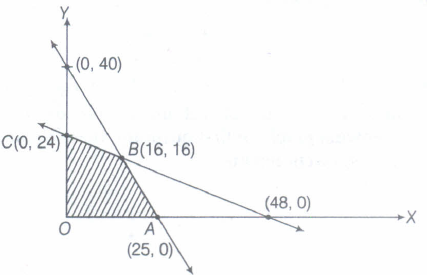
112
100
72
110
39.
If P(A) = 0.3, P(B) = 0.5 and P(A/B) = 0.4, then P(B/A) is
\(-\frac{2}{3}\)
\(\frac{2}{3}\)
\(\frac{3}{5}\)
none of these
40.
If \(A=\left[\begin{array}{lll}a & 0 & 0 \\ 0 & a & 0 \\ 0 & 0 & a\end{array}\right]\), then \(\operatorname{det}(\operatorname{adj} A)\) equals
\(a^{27}\)
\(a^9\)
\(a^6\)
\(a^2\)
SECTION- E
In this section there are 3 case study questions of 4 marks each.
41.
A company produces three products every day. Their production on certain day is 45 tons. It is found that the production of third product exceeds the production of first product by 8 tons while the total production of first and third product is twice the production of second product.
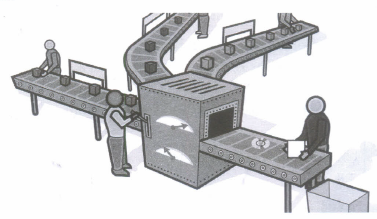
Using the concepts of matrices and determinants, answer the following questions.
(i) If x, y and z respectively denotes the quantity (in tons) of first, second and third product produced, then which of the following is true?
| (a) x + y + z = 45 | (b) x + 8 = z | (c) -2y+z=0 | (d) all of these |
(ii) If \(\left(\begin{array}{ccc} 1 & 1 & 1 \\ 1 & 0 & -2 \\ 1 & -1 & 1 \end{array}\right)^{-1}=\frac{1}{6}\left(\begin{array}{ccc} 2 & 2 & 2 \\ 3 & 0 & -3 \\ 1 & -2 & 1 \end{array}\right)\) , then the inverse of \(\left(\begin{array}{ccc} 1 & 1 & 1 \\ 1 & 0 & -1 \\ 1 & -2 & 1 \end{array}\right)\) is
| (a) \(\left(\begin{array}{lll} \frac{1}{3} & \frac{1}{3} & \frac{1}{3} \\ \frac{1}{2} & 0 & \frac{-1}{2} \\ \frac{1}{6} & \frac{-1}{3} & \frac{1}{6} \end{array}\right)\) | (b) \(\left(\begin{array}{ccc} \frac{1}{2} & 0 & -\frac{1}{2} \\ \frac{1}{3} & \frac{1}{3} & \frac{1}{3} \\ \frac{1}{6} & \frac{-1}{3} & \frac{1}{6} \end{array}\right)\) | (c) \(\left(\begin{array}{ccc} \frac{1}{3} & \frac{1}{2} & \frac{1}{6} \\ \frac{1}{3} & 0 & \frac{-1}{3} \\ \frac{1}{3} & \frac{-1}{2} & \frac{1}{6} \end{array}\right)\) | (d) none of these |
(iii) x :y : z is equal to
| (a) 12: 13: 20 | (b) 11:15:19 | (c) 15: 19: 11 | (d) 13: 12: 20 |
(iv) Which of the following is not true?
| (a) IAI = IA'I | (b) (A'rl = (A-I), | (c) A is skew symmetric-matrix of odd order, then IAI = 0 | (d) IABI = IAI + IBI |
42.
Nisha and Ayushi appeared for first round of an interview for two vacancies. The probability of Nisha's selection is 1/3 and that of Ayushi's selection is 1/2.
Based on the above information, answer the following questions.
(i) The probability that both of them are selected, is
| (a) \(\frac{1}{12}\) | (b)\(\frac{1}{24}\) | (c) \(\frac{1}{6}\) | (d) \(\frac{1}{2}\) |
(ii) The probability that none of them is selected, is
| (a) \(\frac{2}{7}\) | (b)\(\frac{3}{8}\) | (c) \(\frac{5}{8}\) | (d) \(\frac{1}{3}\) |
(iii) The probability that only one of them is selected, is
| (a) \(\frac{5}{8}\) | (b)\(\frac{2}{3}\) | (c) \(\frac{2}{5}\) | (d) \(\frac{1}{2}\) |
(iv) The probability that atleast one of them is selected, is
| (a) \(\frac{2}{3}\) | (b)\(\frac{1}{8}\) | (c) \(\frac{3}{5}\) | (d) \(\frac{2}{5}\) |
(v) Suppose Nisha is selected by the manager and told her about two posts I and II for which selection is independent. If the probability of selection for post I is \(\frac{1}{6}\)and for post II is \(\frac{1}{5}\) then the probability that Nisha is selected for at least one post, is
| (a) \(\frac{1}{3}\) | (b)\(\frac{2}{3}\) | (c) \(\frac{3}{8}\) | (d) \(\frac{1}{2}\) |
43.
Gaurav purchased 5 pens, 3 bags and 1 instrument box and pays Rs. 16. From the same shop, Dheeraj purchased 2 pens, 1 bag and 3 instrument boxes and pays Rs. 19, while Ankur purchased 1 pen, 2 bags and 4 instrument boxes and pays Rs. 25.
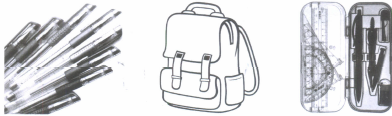
Using the concept of matrices and determinants, answer the following questions.
(i) The cost of one pen is
| (a) Rs. 2 | (b) Rs. 5 | (c) Rs. 1 | (d) Rs. 3 |
(ii) What is the cost of one pen and one bag?
| (a) Rs. 3 | (b) Rs. 5 | (c) Rs. 7 | (d) Rs. 8 |
(iii) What is the cost of one pen and one instrument box?
| (a) Rs. 7 | (b) Rs. 6 | (c) Rs. 8 | (d) Rs. 9 |
(iv) Which of the following is correct?
| (a) Determinant is a square matrix. | (b) Determinant is a number associated to a matrix |
| (c) Determinant is a number associated to a square matrix | (d) All of the above |
(v) From the matrix equation AB = AC, it can be concluded that B = C provided
| (a) A is singular | (b) A is non-singular | (c) A is symmetric | (d) A is square |
a
44.
Assertion If |A| = 4, then |A-1| = - 4.
Reason |A-1| = \(\frac{1}{|A|}\)
(a) Both A and R are correct; R is the correct explanation of A
(b) Both A and R are correct; R is not the correct explanation of A
(c) A is correct; R is incorrect
(d) R is correct; A is incorrect
45.
Two coins are tossed once.
Assertion (A) If E : tail appears on one coin and F : one coin shows head, then P(E/F) is 1.
Reason (R) If E : no tail appears and F : no head appears, then P(E/F) is 0.
(a) Both A and R are correct; R is the correct explanation of A
(b) Both A and R are correct; R is not the correct explanation of A
(c) A is correct; R is incorrect
(d) R is correct; A is incorrect
SECTION-B
This section has 5 Very Short Answer questions of 2 marks each.
1.
1
2.
\(\int \frac{e^{2 x}-e^{-2 x}}{e^{2 x}+e^{-2 x}} d x =\frac{1}{2} \int \frac{1}{t} d t
\)
\(=\frac{1}{2} \log |t|=\frac{1}{2} \log \left|e^{2 x}+e^{-2 x}\right|+C\)
3.
Matrix is skew symmetric, \(A=\left[ \begin{matrix} 0 & -1 & 2 \\ 1 & 0 & -3 \\ -2 & 3 & 0 \end{matrix} \right] A'=\left[ \begin{matrix} 0 & 1 & -2 \\ -1 & 0 & 3 \\ 2 & -3 & 0 \end{matrix} \right] =-\left[ \begin{matrix} 0 & -1 & 2 \\ 1 & 0 & -3 \\ -2 & 3 & 0 \end{matrix} \right] =-A \)
As A' = -A, so matrix A is skew-symmetric.
4.
\(
P(B / A)=\frac{P(A \cap B)}{P(A)}
\)
\(\Rightarrow 0.6 \times 0.4=P(A \cap B)
\)
\(\Rightarrow P(A \cap B)=0.24
\)
\( P(A \cup B)=P(A)+P(B)-P(A \cap B)
\)
\(=0.4+0.7-0.24=0.86
\)
5.
Given, \(f(x)=\left[\begin{array}{ccc} \cos x & -\sin x & 0 \\ \sin x & \cos x & 0 \\ 0 & 0 & 1 \end{array}\right]\)
To prove, f(x).f(y) = f(x + y).
For f(y), replace x with y, so thatf(x) becomes f(y).
LHS = f(x). f(y)
\( =\left[\begin{array}{ccc} \cos x & -\sin x & 0 \\ \sin x & \cos x & 0 \\ 0 & 0 & 1 \end{array}\right]\left[\begin{array}{ccc} \cos y & -\sin y & 0 \\ \sin y & \cos y & 0 \\ 0 & 0 & 1 \end{array}\right] \)
\(=\left[\begin{array}{cc} \cos x \cos y-\sin x \sin y+0 \\ \sin x \cos y+\cos x \sin y+0 \\ 0+0+0 \end{array}\right. \)
\(\left.\begin{array}{cc} -\cos x \sin y-\sin x \cos y+0 & 0+0+0 \\ -\sin x \sin y+\cos x \cos y+0 & 0+0+0 \\ 0+0+0 & 0+0+1 \end{array}\right]\)
[multiplying rows by columns]
\(=\left[\begin{array}{ccc} \cos (x+y) -\sin (x+y) & 0 \\ \sin (x+y) & \cos (x+y) & 0 \\ 0 & 0 & 1 \end{array}\right] \)
\(\left[\begin{array}{rc} \because \cos (A+B)=\cos A \cos B-\sin A \sin B \\ \text { and } \sin (A+B)=\sin A \cos B+\cos A \sin B \end{array}\right]\)
\(=f(x+y)=\mathrm{RHS} \)
6.
The given system of equation is
x + 3y = 5 and
2x + 6y = 8.
The given system of equations can be written in the form of A X = B, where
\(A=\left[\begin{array}{ll} 1 & 3 \\ 2 & 6 \end{array}\right], X=\left[\begin{array}{l} x \\ y \end{array}\right] \text { and } B=\left[\begin{array}{l} 5 \\ 8 \end{array}\right] \).
Now, |A| = 1(6) - 3(2) = 6 - 6 = 0
∴ A is a singular matrix.
\(\text { Now, }(\operatorname{adj} A)=\left[\begin{array}{cc} 6 & -3 \\ -2 & 1 \end{array}\right]\)
\((a d j A) B=\left[\begin{array}{cc} 6 & -3 \\ -2 & 1 \end{array}\right]\left[\begin{array}{l} 5 \\ 8 \end{array}\right]=\left[\begin{array}{c} 30-24 \\ -10+8 \end{array}\right]=\left[\begin{array}{l} 6 \\ -2 \end{array}\right] \neq O\)
Thus, the solution of the given system of equations does not exist. Hence, the system of equation is inconsistent
7.
\(64 \% , as \mathrm{P} (same fact )=P(A B or \bar{A} \bar{B})
\)
\(=\frac{70}{100} \times \frac{85}{100}+\frac{30}{100} \times \frac{15}{100}
\)
\(=\frac{5950+450}{10000}=\frac{6400}{10000}=64 \%\)
SECTION- D
This section has 4 Long Answer questions of 5 marks each.
8.
Let x, y and z be the values of resourcefulness, competence and determination respectively. Then the system of equation is
4x + 3y + 2z = 0.37
5x + 3y + 4z = 0.47
x + y + z = 0.12
Matrix equation is
\(\left[ \begin{matrix} 4 & 3 & 2 \\ 5 & 3 & 4 \\ 1 & 1 & 1 \end{matrix} \right] \left[ \begin{matrix} x \\ y \\ z \end{matrix} \right] =\left[ \begin{matrix} 0.37 \\ 0.47 \\ 0.12 \end{matrix} \right] \)
i.e., AX = B
|A| =\(\left[ \begin{matrix} 4 & 3 & 2 \\ 5 & 3 & 4 \\ 1 & 1 & 1 \end{matrix} \right] \)
= 4(3-4)-3(5-4)+2(5-3)
= -3 \(\neq \)0
\(\therefore\) A-1 exists
adj A = \(\left[ \begin{matrix} -1 & -1 & 2 \\ -1 & 2 & -1 \\ 6 & -6 & -3 \end{matrix} \right] \)
= \(\left[ \begin{matrix} -1 & -1 & 6 \\ -1 & 2 & -6 \\ 2 & -1 & -3 \end{matrix} \right] \)
X = A-1B
\(\left[ \begin{matrix} x \\ y \\ z \end{matrix} \right] =\frac { 1 }{ -3 } \left[ \begin{matrix} -1 & -1 & 6 \\ -1 & 2 & -6 \\ 2 & -1 & -3 \end{matrix} \right] \left[ \begin{matrix} 0.37 \\ 0.47 \\ 0..12 \end{matrix} \right] \)
\(\left[ \begin{matrix} x \\ y \\ z \end{matrix} \right] =\left[ \begin{matrix} 0.04 \\ 0.05 \\ 0.03 \end{matrix} \right] \)
x = 4,000, y = 5,000, z = 3,000
i.e., Rs. 4,000 for resourcefulness, Rs. 5,000 for competence and 3,000 for determination.
Value: One more value loke sincerity, kindness etc.
9.
(i)Let 'x', 'y' and 'z' be the amount invested in three investments.
Then
x + y + z = 65000 ......(1)
\({6x\over100}+{8y\over100}+{9z\over100}=4800\)
\(\Rightarrow\) 6x + 8y + 9z = 480000 ...(2)
\({9z\over100}=600+{8y\over100}\)
\(\Rightarrow\) 0x - 8y + 9z = 60000
These can be written as AX = B where:
\(A=\begin{bmatrix} 1&1&1\\6&8&9\\0&-8&9\end{bmatrix},X=\begin{bmatrix} x\\y\\z\end{bmatrix}\)
and \(B=\begin{bmatrix} 650000\\480000\\60000\end{bmatrix}\)
(ii) Now \(|A|=\begin{bmatrix}1&1&1\\6&8&9\\0&-8&9 \end{bmatrix}\)
= 1.(72 + 72) - 6(9+8)
= 144 - 102 = 42 ≠ 0
Hence, the equations have a unique solution.
(iii) No.We are not fools because most of such companies are frauds.
10.
Let E1 = Event that 5 or 6 is shown on die
and E2 = Event that 1, 2, 3 or 4 is shown on die
Here, n(E1) = 2andn(E2) = 4
Also, n(S) = 6
\(\therefore P\left(E_{1}\right)=\frac{2}{6}=\frac{1}{3}\)
and \(P\left(E_{2}\right)=\frac{4}{6}=\frac{2}{3}\)
Let E = The event that exactly one head show up.
\(\therefore P\left(\frac{E}{E_{1}}\right)=P\) (exactly one head show up when coin is tossed thrice)
\(=P\{H T T, T H T, T T H\}=\frac{3}{8}\)
\(\left[\because \text { total number of outcomes }=2^{3}=8\right]\)
\(P\left(\frac{E}{E_{2}}\right)=P\) (head shows up when coin is tossed once) \(=\frac{1}{2}\)
The probability that the girl threw 1, 2, 3 or 4 with the die, if she obtained exactly one head, is given by
\(P\left(\frac{E_{2}}{E}\right)=\frac{P\left(E_{2}\right) \cdot P\left(\frac{E}{E_{2}}\right)}{P\left(E_{1}\right) \cdot P\left(\frac{E}{E_{1}}\right)+P\left(E_{2}\right) \cdot P\left(\frac{E}{E_{2}}\right)}\)
[by Baye's theorem]
\(=\frac{\frac{2}{3} \times \frac{1}{2}}{\frac{1}{3} \times \frac{3}{8}+\frac{2}{3} \times \frac{1}{2}}=\frac{\frac{1}{3}}{\frac{1}{8}+\frac{1}{3}}=\frac{8}{8+3}=\frac{8}{11}\)
11.
Maximise Z = 70x + 40y
Subject to the constraints
\(\begin{array}{r} 3 x+2 y \leq 9 \end{array}\),
\(\begin{array}{r} 3 x+y \leq 9 \end{array}\)
and \(\begin{array}{r} x \geq 0, y \geq 0 \end{array}\)
Now, considering the inequations as equations, we get
3x + 2y = 9 .....(i)
3x + y =9 ....(ii)
Table for line 3x + 2y = 9 is
| x | 3 | 0 |
| y | 0 | 9/2 |
So, it passes through the points (3, 0) and (0, 9/2) on putting (0, 0) in the inequality 3x + 2y \(\leq\) 9.
0 \(\leq\) 9 (which is true)
So, the half plane is towards the origin.
Table for line 3x + y = 9 is
| x | 3 | 0 |
| y | 0 | 9 |
On putting (0, 0) in the inequality 3x + y \(\leq\) 9
0\(\leq\)9 (which is true)
So, the half plane is towards the origin.
Also, x \(\geq\) 0,y \(\geq\) 0, so the feasible region lies in the Ist quadrant.
The point of intersection of Eqs. (i) and (ii) is (3, 0).
The graphical representation of the above system of inequations is given below
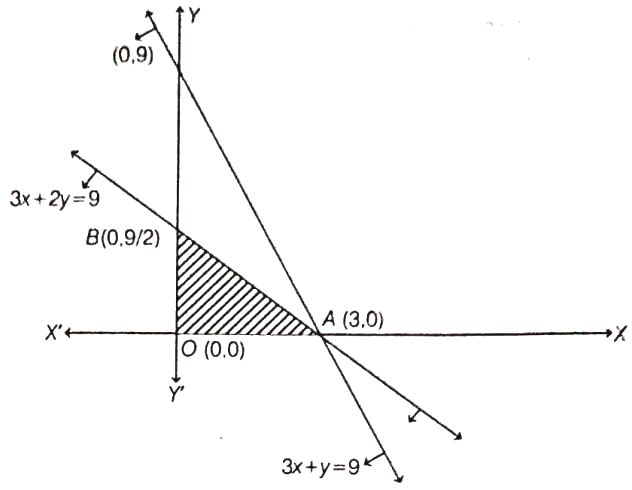
Clearly, feasible region is OABO, whose corner points are O(0, 0), A(3, 0) and B (0, 9/2).
| Corner points | Value of Z = 70 x + 40 y |
| O(0, 0) | 0 |
| A(3, 0) | 210 (Maximum) |
| B(0, 9/2) | 180 |
In the table, we find that maximum value of Z is 210 at the point A(3, 0).
12.
We have \(f(\alpha)=\left[\begin{array}{ccc}\cos \alpha & -\sin \alpha & 0 \\ \sin \alpha & \cos \alpha & 0 \\ 0 & 0 & 1\end{array}\right]\) ..(i)
For f(-ß), replace α in f(α) by -ß
\(
\therefore f(-\beta) =\left[\begin{array}{ccc}
\cos (-\beta) & -\sin (-\beta) & 0 \\
\sin (-\beta) & \cos (-\beta) & 0 \\
0 & 0 & 1
\end{array}\right]\)
\(=\left[\begin{array}{ccc}
\cos \beta & \sin \beta & 0 \\
-\sin \beta & \cos \beta & 0 \\
0 & 0 & 1
\end{array}\right]\)
By LHS \(=f(\alpha) f(-\beta)\)
\( =\left[\begin{array}{ccc}
\cos \alpha & -\sin \alpha & 0 \\
\sin \alpha & \cos \alpha & 0 \\
0 & 0 & 1
\end{array}\right]\left[\begin{array}{ccc}
\cos \beta & \sin \beta & 0 \\
-\sin \beta & \cos \beta & 0 \\
0 & 0 & 1
\end{array}\right]\)
\(=\left[\begin{array}{ccc}
\cos \alpha \cos \beta+\sin \alpha \sin \beta & \cos \alpha \sin \beta-\sin \alpha \cos \beta & 0 \\
\sin \alpha \cos \beta-\cos \alpha \sin \beta & \sin \alpha \sin \beta+\cos \alpha \cos \beta & 0 \\
0 & 0 & 1
\end{array}\right]\)
\(=\left[\begin{array}{ccc}
\cos (\alpha-\beta) & -\sin (\alpha-\beta) & 0 \\
\sin (\alpha-\beta) & \cos (\alpha-\beta) & 0 \\
0 & 0 & 1
\end{array}\right]\)
Now, for \(f(\alpha-\beta)\), replace \(\alpha\) in f(\(\alpha\)) by \((\alpha-\beta)\)
RHS \(=f(\alpha-\beta)\)
\(=\left[\begin{array}{ccc}
\cos (\alpha-\beta) & -\sin (\alpha-\beta) & 0 \\
\sin (\alpha-\beta) & \cos (\alpha-\beta) & 0 \\
0 & 0 & 1
\end{array}\right]\)
From Eqs. (ii) and (iii), we get
LHS = RHS
Hence proved.
13.
\(\frac{4}{17}\)
SECTION- C
This section has 6 Short Answer questions of 3 marks each.
14.
Let the events E1 and E2 be the events when lost card is a diamond and not a diamond respectively.
\(P({ E }_{ 1 })=\frac { 13 }{ 52 } =\frac { 1 }{ 4 } \)and
\(P({ E }_{ 2 })=\frac { 39 }{ 52 } =\frac { 3 }{ 4 } \)
Let A be the event:
"two cards drawn from the remaining pack are diamonds"
\(P(A/{ E }_{ 1 })=\frac { 12\times 11 }{ 51\times 50 } \)
\(P(A/{ E }_{ 2 })=\frac { 13\times 12 }{ 51\times 50 } \)
By Bayes' Theorem
\(P({ E }_{ 1 }/A)=\frac { P({ E }_{ 1 })P(A/{ E }_{ 1 }) }{ P({ E }_{ 1 })P(A/{ E }_{ 1 })+P({ E }_{ 2 })P(A/{ E }_{ 2 }) } \)
\(=\frac { \left( \frac { 1 }{ 4 } \right) \left( \frac { 12\times 11 }{ 51\times 50 } \right) }{ \left( \frac { 1 }{ 4 } \right) \left( \frac { 12\times 11 }{ 51\times 50 } \right) +\left( \frac { 3 }{ 4 } \right) \left( \frac { 13\times 12 }{ 51\times 50 } \right) } \)
\(=\frac { 12\times 11 }{ 12\times 11+3\times 13\times 12 } \)
\(=\frac { 132 }{ 132+468 } =\frac { 132 }{ 600 } =\frac { 11 }{ 50 } \)
15.
\(M_{11}=\begin{vmatrix} 0&4\\5&-7\end{vmatrix}=-0-20=-20\)
\(A_{11}=(-1)^{1+1}M_{11}=(-1)^2(-20)=-20\)
\(M_{12}=\begin{vmatrix}6&4\\1&-7 \end{vmatrix}=-42-4=-46\)
\(A_{12}=(-1)^{1+2}M_{12}=(-1)^3(-46)=(-1)(-46)=46\)
\(M_{13}=\begin{vmatrix}6&0\\1&5 \end{vmatrix}=30-0=30\)
\(A_{13}=(-1)^{1+3}M_{13}=(-1)^4(30)=30\)
\(M_{21}=\begin{vmatrix} -3&5\\5&-7\end{vmatrix}=21-25=-4\)
\(A_{21}=(-1)^{ 2+1}M_{21}=(-1)^3(-4=(-1 )(-4)=4)\)
\(M_{22}=\begin{vmatrix} 2&5\\1&-7\end{vmatrix}=-14-15=-19\)
\(A_{22}=(-1)^{2+2}M_{22}=(1)^4(-19)=-19\)
\(M_{23}=\begin{vmatrix} 2&-3\\1&5\end{vmatrix}=10+3=13\)
\(A_{23}=(-1)^{2+3}M_{23}=(-1)^513=-13\)
\(M_{31}=\begin{vmatrix}-3&5\\0&4 \end{vmatrix}=-12-0=-12\)
\(A_{31}=(-1)^{3+1}M_{31}=(-1)^4(-12)=-12\)
\(M_{32}=\begin{vmatrix} 2&5\\6&4\end{vmatrix}=8-30=-22\)
\(A_{32}=(-1)^{3+2}M_{32}=(-1)^5(-22)=(-1)(-22)=22\)
\(M_{33}=\begin{vmatrix} 2&-3\\6&0\end{vmatrix}=0+18=18\)
\(A_{33}=(-1)^{3+3}M_{33}=(-1)^6(18)=18\)
(ii)\(a_{11}A_{31}+a_{12}A_{32}+a_{13}A_{32}\)
\(=(2)(-12)+(-3)(22)+(5)(18)=-24-66+90=0\)
16.
\(We\quad have:\quad 2\begin{bmatrix} 1 & 3 \\ 0 & x \end{bmatrix}+\begin{bmatrix} y & 0 \\ 1 & 2 \end{bmatrix}=\begin{bmatrix} 5 & 6 \\ 1 & 8 \end{bmatrix}.\)
\(\Rightarrow \begin{bmatrix} 2 & 6 \\ 0 & 2x \end{bmatrix}+\begin{bmatrix} y & 0 \\ 1 & 2 \end{bmatrix}=\begin{bmatrix} 5 & 6 \\ 1 & 8 \end{bmatrix}\)
\( \Rightarrow \begin{bmatrix} 2+y & 6+0 \\ 0+1 & 2x+2 \end{bmatrix}=\begin{bmatrix} 5 & 6 \\ 1 & 8 \end{bmatrix}\)
\(\Rightarrow \begin{bmatrix} y+2 & 6 \\ 1 & 2x+2 \end{bmatrix}=\begin{bmatrix} 5 & 6 \\ 1 & 8 \end{bmatrix}.\)
Equating corresponding elements:
2x + 2 = 8 and y + 2 = 5
\(\Rightarrow \) 2x = 6 and y = 3.
Hence, x = 3 and y = 3.
17.
We have: \(\left[ \begin{matrix} 2x & 3 \end{matrix} \right] \begin{bmatrix} 1 & 2 \\ -3 & 0 \end{bmatrix}\left[ \begin{matrix} x \\ 8 \end{matrix} \right] =0\)
\(\Rightarrow \left[ \begin{matrix} 2x-9 & 4x \end{matrix} \right] \left[ \begin{matrix} x \\ 8 \end{matrix} \right] =0\)
\(\Rightarrow \left[ 2{ x }^{ 2 }-9x+32x \right] =[0]\)
\( \Rightarrow [2{ x }^{ 2 }+23x]=[0]\)
\(\Rightarrow 2{ x }^{ 2 }+23x=0\)
\(\Rightarrow x(2x+23)=0.\)
Hence, \(x=0,\quad -\frac { 23 }{ 2 } .\)
18.
The sample space has 216 outcomes.
\(\text { Now } \quad \mathrm{A}=\left\{\begin{array}{lllll} (1,1,4) & (1,2,4) & \ldots & (1,6,4) & (2,1,4) & (2,2,4) & \ldots (2,6,4) \\ (3,1,4) & (3,2,4) & \ldots &(3,6,4) & (4,1,4) & (4,2,4) & \ldots(4,6,4) \\ (5,1,4) & (5,2,4) & \ldots & (5,6,4) & (6,1,4) & (6,2,4) & \ldots(6,6,4) \end{array}\right\}\)
B = {(6,5,1), (6,5,2), (6,5,3), (6,5,4), (6,5,5), (6,5,6)} and A ∩ B = {(6,5,4)}.
\(\text { Now }P(B)=\frac{6}{216} \text { and } P(A \cap B)=\frac{1}{216} \)
Then \(P(A|B)=\frac { P(A\cap B) }{ P(B) } =\frac { \frac { 1 }{ 216 } }{ \frac { 6 }{ 216 } } =\frac { 1 }{ 6 }\)
19.
The shaded region is the feasible region ABC determined by the system of constraints (2) to (4), which is bounded. The coordinates of corner points
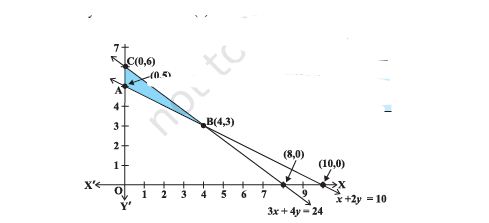
A, B and C are (0,5), (4,3) and (0,6) respectively. Now we evaluate Z = 200x + 500y at these points.
Hence, minimum value of Z is 2300 attained at the point (4, 3)
| Corner Point | Corresponding Value of Z |
| B : (0,5) | 2500 |
| D : (0,6) | 3000 |
| E : (4,3) | 2300 (Minimum) |
20.
Given \(P(A)=\frac { 1 }{ 2 } ,P(A\cup B)=\frac { 3 }{ 5 } \) and P(B) = p
\(\therefore \) \(P(A\cup B)=P(A)+P(B)-P(A\cap B)\)
\(\Rightarrow \) \(\frac { 3 }{ 5 } =\frac { 1 }{ 2 } +p-P(A\cap B)\)
\(\Rightarrow \) \(P(A\cap B)=p+\frac { 1 }{ 2 } -\frac { 3 }{ 5 } =p-\frac { 1 }{ 10 } \)
(i) When A and B are mutually exclusive,
then \(P(A\cap B)=0\Rightarrow p-\frac { 1 }{ 10 } =0\)
\(\Rightarrow \) \(p=\frac { 1 }{ 10 } \)
(ii) When A and B are independent,
then \(P(A\cap B)=P(A)P(B)\)
\(\Rightarrow \) \(p-10=\frac { 1 }{ 2 } p\Rightarrow p-\frac { p }{ 2 } =\frac { 1 }{ 10 } \)
\(\Rightarrow \) \(\frac { p }{ 2 } =\frac { 1 }{ 10 } \)
Hence, \(p=\frac { 1 }{ 5 } \)
21.
\(\int { \sec { x } } (\sec { x } +\tan { x } )dx\)
\( =\int { \sec ^{ 2 }{ x } } dx+\int { \sec { x } } \tan { x } dx\)
\(=\tan { x } +\sec { x } +C\)
22.
-12 at (4,0).
SECTION-A
This section has 20 multiple choice questions of 1 mark each.
23.
(a)
I
24.
As if A = \(\begin{bmatrix} a & b \\ c & d \end{bmatrix}\) then \(\left| A \right| =\begin{bmatrix} a & b \\ c & d \end{bmatrix}\)
\(KA=\begin{bmatrix} Ka & Kb \\ Kc & Kd \end{bmatrix}\) and \(\left| KA \right| =\begin{bmatrix} Ka & Kb \\ Kc & Kd \end{bmatrix}\)
\(={ K }^{ 2 }\begin{vmatrix} a & b \\ c & d \end{vmatrix}={ K }^{ 2 }|A|\)
25.
As \(\frac { d }{ dx } \left( \frac { { 2 }^{ x } }{ { log }_{ e }2 } \right) \)
\(=\frac { 1 }{ { log }_{ e }2 } .{ 2 }^{ x }.{ log }_{ e }2 ={ 2 }^{ x }\)
26.
(c)
1 - α² - βγ = 0
27.
(b)
\(\frac{1}{det(A)}\)
28.
(a)
tan x + cot x + C
29.
(d)
\(\frac{1}{36}\)
30.
(c)
\({ \left( \frac { 9 }{ 2 } \right) }^{ 5 }\)
31.
(d)
1
32.
(a)
\(\frac { { x }^{ 2 } }{ 2 } +\frac { 2 }{ x } +C\), where C is the constant of integration
33.
(c)
4x + c
34.
(d)
Feasible region
35.
Hint The order of SA is 3 x m and 2B is 3 x n, where m = 7L
\(\therefore\) The order of SA - 2B is 3 x m or 3 x 7L
36.
\(\frac{1}{2}\left|\begin{array}{ccc} 2 & -6 & 1 \\ 5 & 4 & 1 \\ k & 4 & 1 \end{array}\right|=\pm 35\)
37.
(b)
no feasible solution
38.
(a)
112
39.
(b)
\(\frac{2}{3}\)
40.
(c)
\(a^6\)
SECTION- E
In this section there are 3 case study questions of 4 marks each.
a

12th Standard CBSE Syllabus & Materials
12th Standard CBSE
CBSE 12th Chemistry d- and f- Block Elements Important Questions And Answers Study Material - QB365 Set A
NEW12th Standard CBSE
CBSE 12th Chemistry Chemical Kinetics Important Questions And Answers Study Material - QB365 Set B
NEW12th Standard CBSE
CBSE 12th Chemistry Chemical Kinetics Important Questions And Answers Study Material - QB365 Set A
NEW12th Standard CBSE
CBSE 12th Chemistry Electrochemistry Important Questions And Answers Study Material - QB365 Set C



NCERT Books

Syllabus

Exam Pattern

Sample Question Papers

Previous year Question Papers

Important Notes

MCQ Practice test

NCERT Exemplers

Case study Questions

Image Based Questions

Passage based Questions

HOT Questions

Value Based Questions

Model Questions Papers
NCERT ( Book Back ) Questions

Assertion and Reason
Important Questions And Answers

CBSE 12th Standard CBSE Subjects
CBSE Standards