
12th Standard CBSE Syllabus & Materials
12th Standard CBSE
CBSE 12th Biology Sexual Reproduction in Flowering Plants Assertion and Reason Study Material - QB365 Set D
NEW12th Standard CBSE
CBSE 12th Biology Sexual Reproduction in Flowering Plants Assertion and Reason Study Material - QB365 Set C
NEW12th Standard CBSE
CBSE 12th Biology Sexual Reproduction in Flowering Plants Assertion and Reason Study Material - QB365 Set B
NEW12th Standard CBSE
CBSE 12th Biology Sexual Reproduction in Flowering Plants Assertion and Reason Study Material - QB365 Set A
NEW12th Standard CBSE
CBSE 12th Standard Biology Sexual Reproduction in Flowering Plants Sample Question Papers Study Material - QB365 Set 1
NEW12th Standard CBSE
CBSE 12th Chemistry d- and f- Block Elements Important Questions And Answers Study Material - QB365 Set B

Published on: 25/10/2025
Download CBSE Class 12th Standard CBSE Maths question papers, sample papers, important questions, and previous year solved papers in PDF format. Get free study materials, NCERT solutions, and exam preparation resources for Class 12th Standard CBSE Maths
Questions + Answers key
Take MCQ Maths Test
SECTION - C
SHORT ANSWER TYPE QUESTION
1.
Evaluate the integral: \(\int{sin(x-\alpha)\over sin(x+\alpha)}dx\)
2.
Show that the diffrential equation (xex/y +y)dx = xdy is homogeneous. Find the particular solution of this differential equation, given that x = 1 when y = 1.
3.
Evaluate the following integral.
Find \(\int \frac{2 \cos x}{(1-\sin x)\left(1+\sin ^{2} x\right)} d x\)
4.
Show that given differential equation \((x-y) d y=(x+y) d x\) is homogeneous and solve it.
5.
Solve the following linear programming problem graphically:
Maximise Z = - 3x - 5y
Subject to the constraints
\(\begin{aligned}
-2 x+y \leq 4, x+y \geq 3
\end{aligned}\)
\(\begin{aligned}
x-2 y \leq 2 \text { and } x \geq 0, y \geq 0
\end{aligned}\)
6.
Find the general solution of the following differential equation \(x \frac{d y}{d x}=y-x \sin \left(\frac{y}{x}\right)\)
7.
Find \(\int \frac{3-5 \sin x}{\cos ^2 x} d x\)
8.
Find \(\int \frac{1}{\cos (x-a) \cos (x-b)} d x\)
9.
Evaluate \(\int_{-1}^2\left|x^3-3 x^2+2 x\right| d x\)
SECTION - B
VERY SHORT TYPE QUESTION
10.
Evaluate thefollowing integral.
\(\int \frac{\cos 2 x+2 \sin ^{2} x}{\cos ^{2} x} d x\)
11.
Evaluate the following integral.
\(\int \frac{d x}{5-8 x-x^{2}}\)
12.
Find the general solution of the differential equation \(\frac{d y}{d x}=e^{x+y} .\)
13.
Verify that ax2 + by2 = 1 is a solution of the differential equation \(x\left(y y_2+y_1^2\right)=y y_1\)
14.
Find \(\int \frac{1}{x\left(1+x^2\right)} d x\)
15.
Find \(\int \frac{x^2+1}{\left(x^2+2\right)\left(x^2+3\right)} d x\)
16.
Find the area of the ellipse x2 + 9y2 = 36 using integration.
SECTION - D
LONG ANSWER TYPE QUESTION
17.
Using integration, fmd the area of the region in the first quadrant enclosed by the x-axis, the line y = x and the circle x2 + y2 = 32
18.
Find the area of the region bounded by the curve 4x2 + y2 = 36 using integration.
19.
Solve the following LPP graphically.
Maximise Z = 60x + 40y
subject to the constraints
\(\begin{aligned}
x+2 y \leq 12
\end{aligned}\)
\(\begin{aligned}
2 x+y \leq 12
\end{aligned}\)
\(\begin{aligned}
4 x+5 y \geq 20 \text { and } x, y \geq 0
\end{aligned}\)
20.
Find the minimum and maximum values of the objective function.
Z = 3x + 9y
Subject to constraints
\(\begin{aligned} x+3 y \leq 60, x+y \geq 10, x \leq y \end{aligned}\)
and \(\begin{aligned} x \geq 0, y \geq 0 \end{aligned}\)
21.
Solve the differential equation \(x \sin \left(\frac{y}{x}\right) \frac{d y}{d x}+x-y \sin \left(\frac{y}{x}\right)=0 .\) Given that x = 1, when \(y=\frac{\pi}{2}\).
22.
Evaluate \(\int_0^\pi \frac{x \sin x}{1+\cos ^2 x} d x\)
SECTION - A
Multiple Choice Question
23.
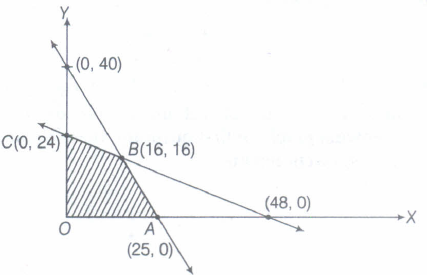
The maximum value of z= 4x + 3y, if the feasible region for an LPP is as shown below, is
112
100
72
110
24.
The value of \(\int_{-1}^1 x|x| d x\) is
\(\frac{1}{6}\)
\(\frac{1}{3}\)
-\(\frac{1}{6}\)
0
25.
Area of the region bounded by the curve y2 = 4x and the X-axis between x = 0 and x = 1 is
\(\frac{2}{3}\)
\(\frac{8}{3}\)
3
\(\frac{4}{3}\)
26.
The area of the region bounded by the curve y2= 4x and x = 1 is
\(\frac{4}{3}\)
\(\frac{8}{3}\)
\(\frac{64}{3}\)
\(\frac{32}{3}\)
27.
If \(\int_{-2}^3 x^2 d x=k \int_0^2 x^2 d x+\int_2^3 x^2 d x\), then the value of k is
2
1
0
\(\frac{1}{2}\)
28.
The area bounded by the curve \(y=\sqrt{x}\), Y-axis and between the lines y = 0 and y = 3 is
2\(\sqrt{3}\)
27
9
3
29.
The feasible region of a linear programming problem is shown in the figure below:
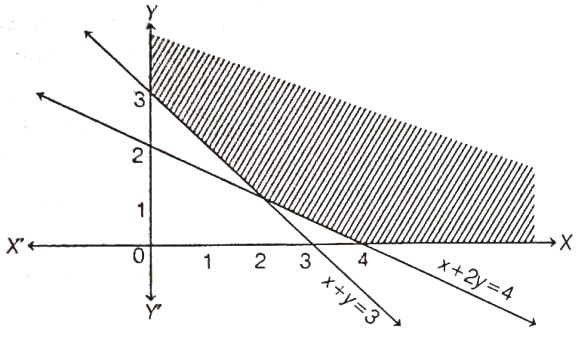
Which of the following are the possible constraints?
\(x+2 y \geq 4, x+y \leq 3, x \geq 0, y \geq 0\)
\(x+2 y \leq 4, x+y \leq 3, x \geq 0, y \geq 0\)
\(x+2 y \geq 4, x+y \geq 3, x \geq 0, y \geq 0\)
\(x+2 y \geq 4, x+y \geq 3, x \leq 0, y \leq 0\)
30.
The solution set of the inequality 3x + 5y < 4 is
an open half plane not containing the origin.
an open half plane containing the origin.
the whole XY-plane not containing the line 3x + 5y = 4.
a closed half plane containing the origin.
31.
The corner points of the shaded unbounded feasible region of an LPP are (0, 4), (0.6, 1.6) and (3, 0) as shown in the figure. The minimum value of the objective function Z = 4x + 6y occurs at
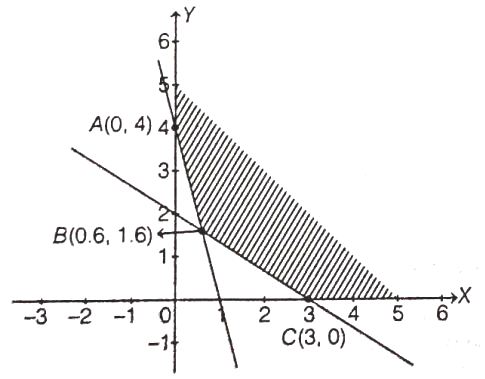
(0.6, 1.6) only
(3, 0) only
(0.6, 1.6) and (3, 0) only
at every point of the line-segment joining the points (0.6, 1.6) and (3,0)
32.
The order and degree (if defined) of the differential equation, \(\left(\frac{d^2 y}{d x^2}\right)^2+\left(\frac{d y}{d x}\right)^3=x \sin \left(\frac{d y}{d x}\right)\) respectively are
2, 2
1, 3
2, 3
2, degree not defined
33.
The order and degree of the differential equation \(\left(1+3 \frac{d y}{d x}\right)^2=4 \frac{d^3 y}{d x^3}\) respectively are
1, \(\frac{2}{3}\)
3, 1
3, 3
1, 2
34.
What is the product of the order and degree of the differential equation \(\frac{d^2 y}{d x^2} \sin y+\left(\frac{d y}{d x}\right)^3 \cos y=\sqrt{y} ?\)
3
2
6
not defined
35.
Degree of the differential equation \(\sin x+\cos \left(\frac{d y}{d x}\right)=y^2\) is
2
1
not defined
0
36.
If m and n respectively, are the order and the degree of the differential equation \(\frac{d}{d x}\left[\left(\frac{d y}{d x}\right)\right]^4=0\), then m + n is equal to
1
2
3
4
37.
The general solution of the differential equation ydx - xdy = 0 is
xy = C
x = Cy2
y = Cx
y = Cx2
38.
If \(\frac{d}{d x} f(x)=\log x\), then f(x) equals
\(-\frac{1}{x}+C\)
\(x(\log x-1)+C\)
\(x(\log x+x)+C\)
\(\frac{1}{x}+C\)
39.
\(\int \frac{\sec x}{\sec x-\tan x} d x\) equals
\(\sec x-\tan x+C\)
\(\sec x+\tan x+C\)
\(\tan x-\sec x+C\)
\(-(\sec x+\tan x)+C\)
40.
\(\int 2^{x+2} d x\) is equal to
\(2^{x+2}+C\)
\(2^{x+2} \log 2+C\)
\(\frac{2^{x+2}}{\log 2}+C\)
\(2 \cdot \frac{2^x}{\log 2}+C\)
SECTION - E
Case Study Questions
41.
Suppose a dealer in rural area wishes to purpose a number of sewing machines. He has only Rs. 5760 to invest and has space for at most 20 items for storage. An electronic sewing machine costs him Rs. 360 and a manually operated sewing machine Rs. 240. He can sell an electronic sewing machine at a profit of Rs. 22 and a manually operated sewing machine at a profit of Rs. 18.
Based on the above information, answer the following questions.
(i) Let x and y denotes the number of electronic sewing machines and manually operated sewing machines purchased by the dealer. If it is assume that the dealer purchased atleast one of the given machines, then
| (a) x + y ≥ 0 | (b) x + y < 0 | (c) x + y > 0 | (d) x + y ≤ 0 |
(ii) Let the constraints in the given problem is represented by the following inequalities
x + y ≤ 20
360x + 240y ≤ 5760
x, y ≥ 0
Then which of the following point lie in its feasible region.
| (a) (0, 24) | (b) (8, 12) | (c) (20, 2) | (d) None of these |
(iii) If the objective function of the given problem is maximise z = 22x + 18y, then its optimal value occur at
| (a) (0, 0) | (b) (16, 0) | (c) (8, 12) | (d) (0, 20) |
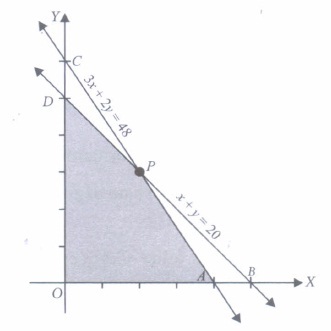
(iv) Suppose the following shaded region APDO, represent the feasible region corresponding to mathematical formulation. of given problem. Then which of the following represent the coordinates of one of its corner points.
| (a) (0, 24) | (b) (12, 8) | (c) (8, 12) | (d) (6, 14) |
(v) If an LPP admits optimal solution at two consecutive vertices of a feasible region, then
| (a) the required optimal solution is at the midpoint of the line joining two points. | (b) the optimal solution occurs at every point on the line joining these two points. |
| (c) the LPP under consideration is not solvable. | (d) the LPP under consideration must be reconstructed. |
42.
If an equation is of the form \(\frac{d y}{d x}+P y=Q\) ,where P, Q are functions of x, then such equation is known as linear differential equation. Its solu~:n is given by \(y \cdot(\mathrm{I} . \mathrm{F} .)=\int \mathrm{Q} \cdot(\mathrm{I} . \mathrm{F} .) d x+c\) where \(\text { I.F. }=e^{\int P d x}\) .
Now, suppose the given equation is \((1+\sin x) \frac{d y}{d x}+y \cos x+x=0\)
Based on the above information, answer the following questions
(i) The value of P and Q respectively are
| (a) \(\frac{\sin x}{1+\cos x}, \frac{x}{1+\sin x}\) | (b) \(\frac{\cos x}{1+\sin x}, \frac{-x}{1+\sin x}\) | (c) \(\frac{-\cos x}{1+\sin x}, \frac{x}{1+\sin x}\) | (d) \(\frac{\cos x}{1+\sin x}, \frac{x}{1+\sin x}\) |
(ii) The value of I.F. is
| (a) 1 - sin x | (b) cos x | (c) 1 + sin x | (d) 1- cosx |
(iii) Solution of given equation is
| (a) y{1-sinx)=x+c | (b) y(l + sin x) = x2+c | (c) \(y(1-\sin x)=\frac{-x^{2}}{2}+c\) | (d) \(y(1+\sin x)=\frac{-x^{2}}{2}+c\) |
(iv) If y(0) = 1, then y,equals
| (a) \(\frac{2-x^{2}}{2(1+\sin x)}\) | (b) \(\frac{2+x^{2}}{2(1+\sin x)}\) | (c) \(\frac{2-x^{2}}{2(1-\sin x)}\) | (d) \(\frac{2+x^{2}}{2(1-\sin x)}\) |
(v) Value of \(y\left(\frac{\pi}{2}\right)\) is
| (a) \(\frac{4-\pi^{2}}{2}\) | (b) \(\frac{8-\pi^{2}}{16}\) | (c) \(\frac{8-\pi^{2}}{4}\) | (d) \(\frac{4+\pi^{2}}{2}\) |
43.
An equation involving derivatives of the dependent variable with respect to the independent variables is called a differential equation. A differential equation of the form \(\frac{d y}{d x}=F(x, y)\) is said to be homogeneous if F(x, y) is a homogeneous function of degree zero. whereas a function F(x, y) is a homogenous function of degree n if \(F\left(\lambda x \cdot \lambda_y\right)=\lambda_0 F(x, y)\). To solve a homogeneous differential equation of the type \(\frac{d y}{d x}=F(x, y)=g\left(\frac{y}{x}\right)\) we make the substitution y = vx and then separate the variables.
Based on the above answer the following questions.
(i) Show that (x2 - y2)dx + 2xy dy = 0 is a differential equation of the type \(\frac{d y}{d x}=g\left(\frac{y}{x}\right)\)
(ii) Solve the above equation to find the general solution.
Assertion and reason
44.
Let a solution y =y(x) of the differential equation \(x\sqrt{x^{2}-1}dy-y\sqrt{y^{2}-1}dx=0\) satisfy \(y(2)=\frac{2}{\sqrt{3}}\)
Assertion: y(x) = sec \(\left ( sec^{-1}x-\frac{\pi}{6} \right )\)
Reason: y(x) is given by \(\frac{1}{y}=\frac{2\sqrt{3}}{x}-\sqrt{1-\frac{1}{x^{2}}}\)
(a) Assertion is correct, Reason is correct; Reason is a correct explanation for assertion.
(b) Assertion is correct, Reason is correct; Reason is not a correct explanation for Assertion
(c) Assertion is correct, Reason is incorrect
(d) Assertion is incorrect, Reason is correct.
45.
Assertion: \(\int_{0}^{\pi}\)xsin xcos2 xdx = \(\frac{\pi}{2}\int_{0}^{\pi}\)sin xcos2 xdx
Reason: \(\int_{a}^{b}xf(x)dx=\frac{a+b}{2}\int_{a}^{b}f(x)dx\)
(a) Assertion is correct, Reason is correct; Reason is a correct explanation for assertion.
(b) Assertion is correct, Reason is correct; Reason is not a correct explanation for Assertion
(c) Assertion is correct, Reason is incorrect
(d) Assertion is incorrect, Reason is correct.
SECTION - C
SHORT ANSWER TYPE QUESTION
1.
\(\int \frac{\sin \{(x+\alpha)-2 \alpha\}}{\sin (x+\alpha)} d x =\int \frac{\sin (x+\alpha) \cos 2 \alpha-\cos (x+\alpha) \sin 2 \alpha}{\sin (x+\alpha)} d x \)
\(=\cos 2 \alpha \int 1 \cdot d x-\sin 2 \alpha \int \cot (x+\alpha) d x \)
\(=\cos 2 \alpha \cdot x-\sin 2 \alpha \cdot \log |\sin (x+\alpha)|+C \)
2.
log |x| + e -y/x = \(\frac{1}{e}\), as the particular solution.
3.
Let \(I=\int \frac{2 \cos x}{(1-\sin x)\left(1+\sin ^{2} x\right)} d x\)
Put sin x = t, then cos x dx = dt
\(\therefore I=\int \frac{2 d t}{(1-t)\left(1+t^{2}\right)}\) ...(i)
Now.Iet \(\frac{2}{(1-t)\left(1+t^{2}\right)}=\frac{A}{1-t}+\frac{B t+C}{1+t^{2}}\)
\(\Rightarrow 2=\left(1+t^{2}\right) A+(1-t)(B t+C) \)
\(\Rightarrow 2=\left(1+t^{2}\right) A+\left(B t+C-B t^{2}-C t\right) \)
\(\Rightarrow 2=t^{2}(A-B)+t(B-\mid C)+(A+C) \)
On comparing the coefficients of like powers of t, we get
\(A-B=0 ; B-C=0 \text { and } A+C=2\)
\(\Rightarrow A=B ; B=C \text { and } A+C=2\)
\(\Rightarrow 2=t^{2}(A-B)+t(B-\mid C)+(A+C) \)
\(\Rightarrow A=B=C=1\)
\(\therefore \frac{2}{(1-t)\left(1+t^{2}\right)}=\frac{1}{1-t}+\frac{1+t}{1+t^{2}}\)
Now, from Eq. (i), we get
\(I=\int\left(\frac{1}{1-t}+\frac{1+t}{1+t^{2}}\right) d t=\int \frac{d t}{1-t}+\int \frac{1}{1+t^{2}} d t+\frac{1}{2} \int \frac{2 t}{1+t^{2}} d t\)
\(=\frac{\log |1-t|}{(-1)}+\tan ^{-1} t+\frac{1}{2} \log \left|1+t^{2}\right|+C\)
\(=\frac{1}{2} \log \left|1+\sin ^{2} x\right|-\log |1-\sin x|+\tan ^{-1}(\sin x)+C\)
\([\because t=\sin x]\)
\(=\tan ^{-1}(\sin x)+\log \left|\frac{\sqrt{1+\sin ^{2} x}}{1-\sin x}\right|+C\)
\(\left[\because \log m-\log n=\log \left(\frac{m}{n}\right) \text { and } n \log m=\log m^{n}\right]\)
4.
Given differential equation is \((x-y) d y=(x+y) d x\)
or \(\frac{d y}{d x}=\frac{x+y}{x-y}\) ...(i)
Let \(F(x, y)=\frac{x+y}{x-y}\)
On replacing x by \(\lambda x\) and y by \(\lambda y\) in Eq. (ii), we get
\(F(\lambda x, \lambda y)=\frac{\lambda x+\lambda y}{\lambda x-\lambda y}=\frac{\lambda(x+y)}{\lambda(x-y)}=\lambda^{0} F(x, y)\)
Thus, F(x, y) is a homogeneous function of degree zero
So, put y = vx.
On differentiating both sides w.r.t. x, we get
\(\frac{d y}{d x}=v+x \frac{d v}{d x}\)
On putting the values of y and \(\frac{d y}{d x}\) in Eq. (i), we get
\(v+x \frac{d v}{d x}=\frac{x+v x}{x-v x} \Rightarrow v+x \frac{d v}{d x}=\frac{1+v}{1-v}\)
\(\Rightarrow x \frac{d v}{d x}=\frac{1+v}{1-v}-v \Rightarrow \frac{x d v}{d x}=\frac{1+v-v+v^{2}}{1-v}\)
\(\Rightarrow x \frac{d v}{d x}=\frac{1+v^{2}}{1-v}\)
On separating the variables, we get
\(\frac{1-v}{1+v^{2}} d v=\frac{1}{x} d x\)
On integrating both sides, we get \(\int \frac{1-v}{1+v^{2}} d v=\int \frac{1}{x} d x\)
\(\Rightarrow \int \frac{1}{1+v^{2}} d v-\frac{1}{2} \int \frac{2 v}{1+v^{2}} d v=\int \frac{1}{x} d x\)
\(\Rightarrow \tan ^{-1} v-\frac{1}{2} \log \left|\left(1+v^{2}\right)\right|=\log |x|+C\)
\(\Rightarrow \tan ^{-1}\left(\frac{y}{x}\right)-\frac{1}{2} \log \left|\left(1+\frac{y^{2}}{x^{2}}\right)\right|=\log |x|+C\) \(\left[\text { put } v=\frac{y}{x}\right]\)
\(\Rightarrow 2 \tan ^{-1}\left(\frac{y}{x}\right)-\log \left|\left(1+\frac{y^{2}}{x^{2}}\right)\right|=2(\log |x|+C)\)
\(\Rightarrow 2 \tan ^{-1}\left(\frac{y}{x}\right)=\log \left|\frac{\left(x^{2}+y^{2}\right)}{x^{2}}\right|+\log |x|^{2}+2 C\)
\(\Rightarrow 2 \tan ^{-1}\left(\frac{y}{x}\right)=\log \left[\left|\frac{x^{2}+y^{2}}{x^{2}}\right||x|^{2}\right]+2 C\)
\([\because \log m+\log n=\log m n]\)
\(\Rightarrow 2 \tan ^{-1}\left(\frac{y}{x}\right)-\log \left|x^{2}+y^{2}\right|=2 C\)
\(\Rightarrow \tan ^{-1}\left(\frac{y}{x}\right)-\frac{1}{2} \log \left|x^{2}+y^{2}\right|=C\)
which is the required solution.
5.
Maximise Z = -3x - 5y
Subject to the constraints
\(\begin{aligned}
-2 x+y \leq 4, x+y \geq 3,
\end{aligned}\)
\(x-2 y \leq 2 \text { and } x \geq 0, y \geq 0
\)
Now, considering the inequations as equations, We get
-2x + y = 4 ....(i)
x + y = 3 ....(ii)
and x - 2y = 2 ....(iii)
Table for line -2x + y = 4 is
| x | -2 | 0 |
| y | 0 | 4 |
So, it passes through the points (-2, 0) and (0, 4) On putting (0, 0) in the inequality -2x + y \(\leq\) 4, we have
0 \(\leq\) 4 (which is true)
So, the half plane is towards the origin.
Table for line x + y = 3 is
| x | 3 | 0 |
| y | 0 | 3 |
So, it passes through the points (3, 0) and (0, 3).
0 + 0 \(\geq\) 3 (which is false)
So, the half plane is away from the origin.
Table for line x - 2y = 2 is
| x | 2 | 0 |
| y | 0 | -1 |
So, it passes through the point (2, 0) and (0, -1).
On putting (0, 0) in the inequality x - 2 y \(\leq\) 2.
0 \(\leq\) 2 (which is true)
So, the half plane is towards the origin.
Also, x \(\geq\) 0, y \(\geq\) 0, so the feasible region lies in the Ist quadrant.
The point of intersection of Egs. (i) and (ii) is
\(\left(-\frac{1}{3}, \frac{10}{3}\right)\), Eqs. (ii) and (iii) is \(\left(\frac{8}{3}, \frac{1}{3}\right)\) and Eqs. (i) and (iii) is \(\left(\frac{-10}{3}, \frac{-8}{3}\right)\). The graphical representation of the above system of inequations is given below.
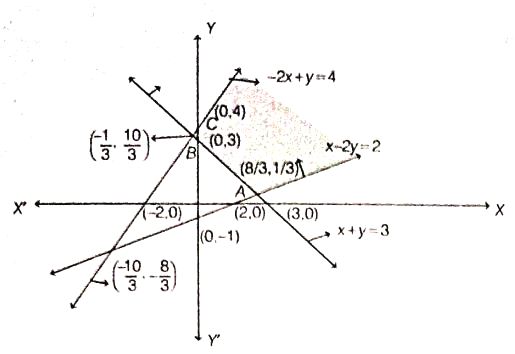
\(\therefore\) Clearly, feasible region is shaded.
The value of Z at corner points are as follows
| Corner points | Value of Z = -3x - 5y |
| \(A\left(\frac{8}{3}, \frac{1}{3}\right)\) | \(-3 \times \frac{8}{3}-5 \times \frac{1}{3}=-8-\frac{5}{3}=\frac{-29}{3}\) (Maximum) |
| B(0, 3) | -3 \(\times\) 0 - 5 \(\times\) 3 = -15 |
| C(0, 4) | -3 \(\times\) 0 - 5 \(\times\) 4 = -20 |
Here, the feasible region is unbounded and the open half plane determined by -3x - 5y > \(\frac{-29}{3}\) has no point in common with the feasible region. Hence, \(Z=-\frac{29}{3}\) is maximum at \(A\left(\frac{8}{3}, \frac{1}{3}\right)\)
6.
Given, differential equation is
\(\begin{aligned}
x \frac{d y}{d x} & =y-x \sin \frac{y}{x}
\end{aligned}\)
or \(\begin{aligned}
\frac{d y}{d x} & =\frac{y}{x}-\sin \frac{y}{x}
\end{aligned}\) ...(i)
Eq. (i) is a homogeneous differential equation.
On putting y = vx \(y=v x \Rightarrow \frac{d y}{d x}=v+x \frac{d v}{d x}\) in Eq. (i), we get
\(\begin{array}{rlrl}
v+x \frac{d v}{d x} =v-\sin v
\end{array}\)
\(\begin{array}{rlrl}
\Rightarrow \quad \frac{d v}{\sin v} =-\frac{d x}{x}
\end{array}\)
\(\begin{array}{rlrl}
\Rightarrow \quad \operatorname{cosec} v \quad d v =-\frac{d x}{x}
\end{array}\) ...(ii)
On integrating both sides of Eq. (ii), we get
\(\begin{aligned}
\int \operatorname{cosec} v d v & =-\int \frac{d x}{x}
\end{aligned}\)
\(\begin{aligned}
\log |\operatorname{cosec} v-\cot v| & =-\log |x|+\log K, K>0
\end{aligned}\)
[here, log K is an arbitrary constant]
\(\Rightarrow\) log| (cosecv - cot v)x| = log K
\(\Rightarrow\) |(cosec v - cot v)x| = K
\(\Rightarrow \quad(\operatorname{cosec} v-\cot v) x= \pm K\)
\(\Rightarrow \quad\left(\operatorname{cosec} \frac{y}{x}-\cot \frac{y}{x}\right) x=C \quad\left[\because v=\frac{y}{x}\right]\)
which is the required general solution.
7.
Let \(I =\int \frac{3-5 \sin x}{\cos ^2 x} d x\)
\(=\int\left(\frac{3}{\cos ^2 x}-\frac{5 \sin x}{\cos ^2 x}\right) d x\)
\(=3 \int \sec ^2 x d x-5 \int \sec x \tan x d x\)
\(=3 \tan x-5 \sec x+C\)
8.
We have, \(\int \frac{1}{\cos (x-a) \cos (x-b)} d x\)
\(=\frac{1}{\sin (b-a)} \int \frac{\sin \{(x-a)-(x-b)\}}{\cos (x-a) \cos (x-b)} d x\)
\(=\frac{1}{\sin (b-a)} \int \frac{-\cos (x-a) \sin (x-b)}{\cos (x-a) \cos (x-b)} d x\)
\(=\frac{1}{\sin (b-a)} \int[\tan (x-a)-\tan (x-b)] d x\)
\(=\frac{1}{\sin (b-a)}\left[\int \tan (x-a) d x-\int \tan (x-b) d x\right] \)
\(=\frac{1}{\sin (b-a)}\) (- log |cos(x - a)] + log |cos(x - b)|]+C
\(=\frac{1}{\sin (b-a)}\left[\log \left|\frac{\cos (x-b)}{\cos (x-a)}\right|\right]+C\)
9.
Let \(I=\int_{-1}^2\left|x^3-3 x^2+2 x\right| d x\)
Let \(f(x)=x^3-3 x^2+2 x \)
\(\because f(0)=0-0+0=0\)
\(\Rightarrow x-0=x\) is a factor of \(x^3-3 x^2+2 x\)
Now, \(\frac{x^3-3 x^2+2 x}{x}=x^2-3 x+2\)
\( \therefore \quad x^3-3 x^2+2 x=x\left(x^2-3 x+2\right)=x(x-1)(x-2)\)
\(\therefore I=\int_{-1}^2|x(x-1)(x-2)| d x\)
\(I=\int_{-1}^0|x(x-1)(x-2)| d x+\int_0^1|x(x-1)(x-2)| d x +\int_1^2|x(x-1)(x-2)| d x\)
[by property (iv)]
\(\therefore I=-\int_{-1}^0\left(x^3-3 x^2+2 x\right) d x+\int_0^1\left(x^3-3 x^2+2 x\right) d x -\int_1^2\left(x^3-3 x^2+2 x\right) d x \)
\(=-\left[\frac{x^4}{4}-x^3+x^2\right]_{-1}^0+\left[\frac{x^4}{4}-x^3+x^2\right]_0^1 -\left[\frac{x^4}{4}-x^3+x^2\right]_1^2 \)
\(=-\left[0-\left(\frac{1}{4}+1+1\right)\right]+\left[\left(\frac{1}{4}-1+1\right)-(0)\right]\)
\(-\left[\left(\frac{16}{4}-8+4\right)-\left(\frac{1}{4}-1+1\right)\right]
\)
\(=\frac{1}{4}+1+1+\frac{1}{4}-1+1+\frac{1}{4}=\frac{9}{4}+\frac{1}{4}+\frac{1}{4}=\frac{11}{4}\)
SECTION - B
VERY SHORT TYPE QUESTION
10.
Let \(I=\int \frac{\cos 2 x+2 \sin ^{2} x}{\cos ^{2} x} d x
\)
\(=\int \frac{1-2 \sin ^{2} x+2 \sin ^{2} x \mid}{\cos ^{2} x} d x\left[\because \cos 2 A=1-2 \sin ^{2} A\right]
\)
\(=\int \frac{1}{\cos ^{2} x} d x=\int \sec ^{2} x d x
\)
\(=\tan x+C\)
11.
Let \(I=\int \frac{d x}{5-8 x-x^{2}}=\int \frac{d x}{5-2 \cdot 4 \cdot x-x^{2}-(4)^{2}+(4)^{2}}\)
\( =\int \frac{d x}{5+16-\left[x^{2}+(4)^{2}+2 \cdot 4 \cdot x\right.} \)
\(=\int \frac{d x}{21-(x+4)^{2}} \)
\(=\int \frac{d x}{(\sqrt{21})^{2}-(x+4)^{2}} \)
\(=\frac{1}{2 \sqrt{21}} \log \left|\frac{\sqrt{21}+x+4}{\sqrt{21}-x-4}\right|+C \)
\({\left[\because \int \frac{d x}{a^{2}-x^{2}}=\frac{1}{2 a} \log \left|\frac{a+x}{a-x}\right|+C\right]} \)
12.
The given differential equation is
\(\frac{d y}{d x}=e^{x+y} \Rightarrow \frac{d y}{d x}=e^x \cdot e^y\)
\(\Rightarrow\) dy = ex.ey dx
\(\Rightarrow\) e-ydy = exdx
On integrating both sides, we get
\(\Rightarrow \int e^{-y} d y=\int e^x d x \Rightarrow-e^{-y}=e^x+C\)
which is the required solution.
13.
We have, ax2 + by2 = 1
On differentiating both sides w.r.t. x, we get
2ax + 2by y1 = 0 [\(\because\) y1 = dy/dx]
\(\Rightarrow\) 2(ax + by y1) = 0
\(\Rightarrow\) ax + byy1 = 0 ...(i)
Again, on differentiating both sides w.r.t. x,we get
a + b(y1y1 + yy2) = 0 [\(\because\) y2 = d2y/dx2]
\(\begin{aligned} \Rightarrow \quad a+b\left(y_1^2+y y_2\right)=0 \end{aligned}\)
\(\Rightarrow \quad a=-b\left(y y_2+y_1^2\right)\) ...(ii)
On putting a = - b(yy2 + \(y_1^2\)) in Eq. (i), we get
\(\begin{array}{rlrl} -b\left(y y_2+y_1^2\right) x+b y y_1 =0 \end{array}\)
\(\begin{array}{rlrl} \Rightarrow b\left\{-\left(y y_2+y_1^2\right) x+y y_1\right\} =0 \end{array}\)
\(\begin{array}{rlrl} \Rightarrow x\left(y y_2+y_1^2\right) =y y_1 \end{array}\)
Hence Proved.
14.
\(\text { Let } I=\int \frac{d x}{x\left(1+x^2\right)}\)
\( I=\int \frac{d x}{x^3\left(\frac{1}{x^2}+1\right)} \)
\( \text { Put } \frac{1}{x^2}+1=t \Rightarrow \frac{-2}{x^3} d x=d t\)
\(\therefore I=-\frac{1}{2} \int \frac{d t}{t}=-\frac{1}{2} \log |t|+C\)
\(\Rightarrow I=-\frac{1}{2} \log \left|\frac{1}{x^2}+1\right|+C \)
\(\Rightarrow I=-\frac{1}{2} \log \left|\frac{x^2+1}{x^2}\right|+C\)
\(\Rightarrow I=\frac{1}{2} \log \left|\frac{x^2}{x^2+1}\right|+C\)
15.
Let \(I=\int \frac{x^2+1}{\left(x^2+2\right)\left(x^2+3\right)} d x\)
Let \(x^2=y\)
Then, \(\frac{x^2+1}{\left(x^2+2\right)\left(x^2+3\right)}=\frac{y+1}{(y+2)(y+3)}\)
Again, let \(\frac{y+1}{(y+2)(y+3)}=\frac{A}{y+2}+\frac{B}{y+3}\)
\(\Rightarrow \quad y+1=A(y+3)+B(y+2)\)
Putting y=-2 and y=-3 successively in Eq. (ii), we get
A=-1 and B=2
On substituting the values of A and B in Eq. (i), we get
\(\frac{y+1}{(y+2)(y+3)}=\frac{-1}{y+2}+\frac{2}{y+3} \)
\(\therefore \int \frac{x^2+1}{\left(x^2+2\right)\left(x^2+3\right)} d x=\int \frac{-1}{x^2+2} d x+\int \frac{2}{x^2+3} d x\)
\(=-\frac{1}{\sqrt{2}} \tan ^{-1}\left(\frac{x}{\sqrt{2}}\right)+\frac{2}{\sqrt{3}} \tan ^{-1}\left(\frac{x}{\sqrt{3}}\right)+C\)
16.
We have, the equation of the ellipse
x2 + 9y2 = 36
\(\Rightarrow \frac{x^2}{36}+\frac{y^2}{4}=1 \Rightarrow \frac{x^2}{6^2}+\frac{y^2}{2^2}=1\)
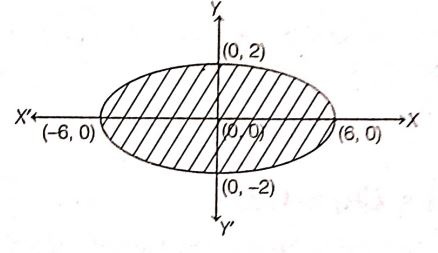
\(\therefore\) Required area \(=4 \int_0^6 y d x\)
\(\begin{aligned} & =4 \int_0^6 \frac{2}{6} \sqrt{36-x^2} d x=\frac{4}{3} \int_0^6 \sqrt{36-x^2} d x \end{aligned}\)
\(\begin{aligned} =\frac{4}{3}\left[\frac{x}{2} \sqrt{36-x^2}+\frac{36}{2} \sin ^{-1} \frac{x}{6}\right]_0^6 \end{aligned}\)
\(\begin{aligned} & =\frac{4}{3}\left[0+\frac{36}{2} \sin ^{-1} 1-0\right]=\frac{4}{3} \times 18 \times \frac{\pi}{2} \end{aligned}\)
= 12 \(\pi\) sq units
SECTION - D
LONG ANSWER TYPE QUESTION
17.
Given, the circle \(x^{2}+y^{2}=32\)
and the line y = x
Let us find the point of intersection of Eqs. (i) and (ii
On substituting y = x in Eq. (i), we get
\(x^{2}+x^{2}=32\)
\(\Rightarrow 2 x^{2}=32\)
\(\Rightarrow x^{2}=16 \Rightarrow x=\pm 4\)
Thus, the points of intersection are \(\begin{array}{c} (4,4) \text { and }(-4,-4) {[\because y=x]} \end{array}\)
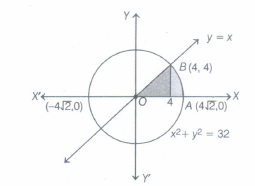
Clearly, the required area
= Area of shaded region OABO
\( =\int_{0}^{4} y(\text { line }) d x+\int_{4}^{4 \sqrt{2}} y(\text { circle }) d x\)
\(=\int_{0}^{4} x d x+\int_{4}^{4 \sqrt{2}} \sqrt{32-x^{2}} d x\)
\(\left[\because x^{2}+y^{2}=32 \Rightarrow y=\pm \sqrt{32-x^{2}} \text { and } y>0\right]\)
\(=\left[\frac{x^{2}}{2}\right]_{0}^{4}+\int_{4}^{4 \sqrt{2}} \sqrt{(4 \sqrt{2})^{2}-x^{2}} d x \)
\(=\frac{1}{2}[16-0]+\frac{1}{2}\left[x \sqrt{(4 \sqrt{2})^{2}-x^{2}}+(4 \sqrt{2})^{2} \sin ^{-1}\left(\frac{x}{4 \sqrt{2}}\right)\right]_{4}^{4 \sqrt{2}}\)
\(=8+\frac{1}{2}\left[\left(0+32 \sin ^{-1}(1)\right)-\left(4 \sqrt{32-16}+32 \sin ^{-1}\left(\frac{1}{\sqrt{2}}\right)\right)\right]\)
\(=8+\frac{1}{2}\left[32 \sin ^{-1}(1)-16-32 \sin ^{-1}\left(\frac{1}{\sqrt{2}}\right)\right]\)
\(=8+\frac{1}{2}\left[32 \cdot \frac{\pi}{2}-16-32 \cdot \frac{\pi}{4}\right]\)
\(=8+\frac{1}{2}[16 \pi-16-8 \pi]=8+\frac{1}{2}[8 \pi-16]=8+4 \pi-8\)
\(=4 \pi \text { sq units }\)
18.
Given curve is 4x2 + y2 = 36
\(\begin{array}{ll} \therefore & \frac{4 x^2}{36}+\frac{y^2}{36}=1 \end{array}\)
\(\begin{array}{ll} \therefore & \frac{x^2}{9}+\frac{y^2}{36}=1 \end{array}\) ...(i)
We know that the standard equation of ellipse is
\(\frac{x^2}{a^2}+\frac{y^2}{b^2}=1\) ...(ii)
On comparing Eqs. (i) and (ii), we get
a2 = 9 and b2 = 36
\(\Rightarrow\) a = 3 and b = 6
Here, we see that a < b, so the vertical ellipse will be formed.
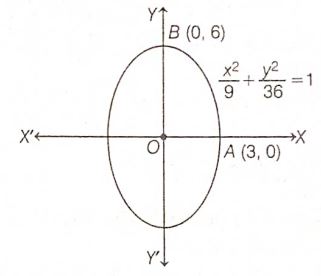
Now, required area = 4(Area of region OAB in first quadrant)
\(\begin{aligned} =4\left|\int_0^3 y d x\right| \end{aligned}\)
\(\begin{aligned} =\left|4 \int_0^3 2 \sqrt{9-x^2} d x\right| \end{aligned}\)
\(\begin{aligned} \left[\because \frac{y^2}{36}=1-\frac{x^2}{9} \Rightarrow y=2 \sqrt{9-x^2}\right] \end{aligned}\)
\(\begin{aligned} =8 \int_0^3 \sqrt{9-x^2} d x \end{aligned}\)
\(\begin{aligned} =8\left|\left[\frac{x}{2} \sqrt{9-x^2}+\frac{9}{2} \sin ^{-1}\left(\frac{x}{3}\right)\right]_0^3\right| \end{aligned}\)
\(\left[\because \sqrt{a^2-x^2} d x=\frac{x}{2} \sqrt{a^2-x^2}+\frac{a^2}{2} \sin ^{-1}\left(\frac{x}{a}\right)\right]\)
\(=8\left\{\left[\frac{3}{2} \sqrt{9-9}+\frac{9}{2} \sin ^{-1} \frac{3}{3}-0-\frac{9}{2} \sin ^{-1} 0\right]\right\}\)
\(\begin{aligned} =8\left|\left[0+\frac{9}{2} \times \frac{\pi}{2}-0\right]\right| \end{aligned}\)
\(\begin{aligned} =8 \times \frac{9 \pi}{4} \end{aligned}\)
\(=18 \pi\)
Hence, the required area is 18\(\pi\) sq units.
19.
We have, maximise, Z = 60x + 40y ...(i)
Subject to the constraints, x + 2y \(\leq 12\) ...(ii)
\(\begin{aligned}
2 x+y & \leq 12
\end{aligned}\) ...(iii)
\(\begin{aligned}
4 x+5 y & \geq 20
\end{aligned}\) ...(iv)
and \(\begin{aligned}
x, y & \geq 0
\end{aligned}\) ...(v)
Table for line x + 2y = 12 is
| x | 0 | 12 |
| y | 6 | 0 |
So, the line x + 2y = 12 is passing through the points (0, 6) and (12, 0).
On putting (0,0) in the inequality \(x+2 y \leq 12\) we get \(0+2(0) \leq 12 \Rightarrow 0 \leq 12\), which is true
So,the half plane is towards the origin.
Table for line 2x + y = 12 is
| x | 0 | 6 |
| y | 12 | 0 |
So, the line 2x + y = 12 is passing through the points (0, 12) and (6, 0).
On putting (0, 0) in the inequality \(2 x+y \leq 12\) we get
\(2(0)+0 \leq 12 \Rightarrow 0 \leq 12\) , which is true.
So, the half plane is towards the origin.
Table for line 4x + 5y = 20 is
| x | 0 | 5 |
| y | 4 | 0 |
So, the line 4x + 5y = 20 is passing through the points (0,4) and (5, 0).
On putting (0, 0) in the inequality \(4 x+5 y \geq 20\), we get 4(0) + 5(0) \(\geq\) 20 \(\Rightarrow\) 0 > 20 which is not true.
So, the half plane is away from the origin.
Also, x, y \(\geq\) 0
So, the region lies in Ist quadrant.
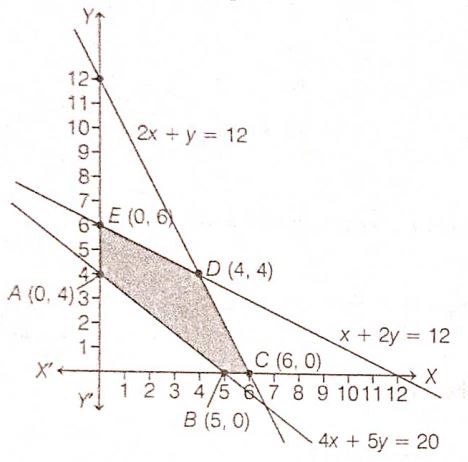
On solving Eqs. x + 2y = 12 and 2x + y = 12, we get D(4, 4)
Clearly, the feasible region is ABCDEA.
The corner points of the feasible region are A(0, 4), B(5, 0), C(6, 0), D(4, 4) and E(0, 6).
The value of Z at corner points are given below.
| Corner points | Z = 60x + 40y |
| A(0, 4) | Z = 60 \(\times\)0 + 40 \(\times\) 4 = 160 |
| B(5, 0) | Z = 60 \(\times\) 5 + 40\(\times\)0 = 300 |
| C(6, 0) | Z = 60 \(\times\) 6 + 40 \(\times\) 0 = 360 |
| D(4, 4) | Z = 60 \(\times\) 4 + 40 \(\times\) 4 = 400 (Maximum) |
| E(0, 6) | Z = 60 \(\times\) 0 + 40 \(\times\) 6 = 240 |
The maximum value of Z is 400 at D(4, 4).
20.
Given that,
Minimise and Maximise Z = 3x + 9y ...(i)
Subject to the constraints are
\(\begin{aligned} x+3 y & \leq 60 \end{aligned}\) ...(ii)
\(\begin{aligned} x+y & \geq 10 \end{aligned}\) ...(iii)
\(\begin{aligned} x & \leq y \end{aligned}\) ...(iv)
\(\begin{aligned} x \geq 0, y & \geq 0 \end{aligned}\) ...(v)
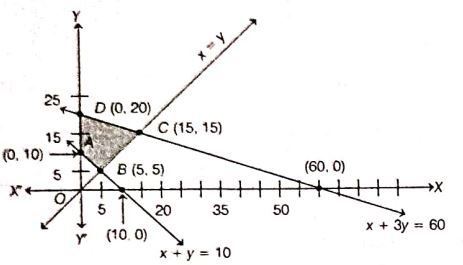
First of all,let us plot the graph of the feasible region of the system of linear inequalities (ii) to (v). The feasible region ABCDA is shown in the figure.
Note That the region is bounded. The coordinates of the corner points A, B, C and D are (0, 10), (5, 5), (15, 15) and (0, 20), respectively.
| Corner points | Corresponding value of Z = 3x + 9y |
| A (0, 10) | 90 |
| B(5, 5) | 60 (Minimum) |
| C(15, 15) | 180 (Maximum) Multiple optimal solutions) |
| D(0, 20) | 180 |
We, now find the minimum and maximum value of Z. From the table, we find that the minimum value of Z is 60 at the point B(5, 5) of the feasible region.
The maximum value of Z on the feasible region occurs at the two corner points C (15, 15) and D (0, 20) and it is 180 in each case.
Remark Observe that in the above example, the problem has multiple optimal solutions at the corner points C and D, i.e. the both points produce same maximum value 180.
In such cases, you can see that every point on the line segment CD joining the two corner points C and D also give the same maximum value. Same is also true in the case, if the two points produce same minimum value.
21.
Given, differential equation can be written as
\(\frac{d y}{d x}=\frac{y}{x}-\frac{1}{\sin \frac{y}{x}}\) ....(i)
Let \(F(x, y)=\frac{y}{x}-\frac{1}{\sin \frac{y}{x}}\)
Now, \(F(\lambda x, \lambda y)=\frac{\lambda y}{\lambda x}-\frac{1}{\sin \left(\frac{\lambda y}{\lambda x}\right)}=\lambda^{\circ}\left(\frac{y}{x}-\frac{1}{\sin \frac{y}{x}}\right)\)
\(=\lambda^{\circ} F(x, y)\)
It is a homogeneous differential equation.
Now, on putting y = vx \(\Rightarrow \frac{d y}{d x}=v+x \frac{d v}{d x}\)
\(\therefore\) From Eq. (i), we get \(v+x \frac{d v}{d x}=\frac{v x}{x}-\frac{1}{\sin \left(\frac{v x}{x}\right)}\)
\(\Rightarrow v+x \frac{d v}{d x}=v-\frac{1}{\sin v} \Rightarrow \sin v d v=-\frac{1}{x} d x\)
On integrating both sides, we get
- cos v = - log|x| - C
\(\Rightarrow-\cos \left(\frac{y}{x}\right)=-\log |x|-C\)
\(\Rightarrow \cos \left(\frac{y}{x}\right)=\log |x|+C\) ...(ii)
Given that x = 1, when y = \(\frac{\pi}{2}\)
\(\therefore \quad \cos \left(\frac{\pi}{2}\right)=\log |1|+C \Rightarrow 0=0+C\)
\(\Rightarrow \quad C=0\)
On putting C = 0 in Eq. (ii), we get
\(\cos \left(\frac{y}{x}\right)=\log |x|+0\)
22.
Let \( l=\int_0^\pi \frac{x \sin x}{1+\cos ^2 x} d x\)
\( \Rightarrow l=\int_0^\pi \frac{(\pi-x) \sin (\pi-x)}{1+\cos ^2(\pi-x)} d x\)
\(\left[\because \int_0^a f(x) d x=\int_0^2 f(a-x) d x\right]\)
\(=\int_0^\pi \frac{(\pi-x) \sin x d x}{1+\cos ^2 x}\)
On adding Eqs. (i) and (ii), we get
\(=\pi \int_0^\pi \frac{\sin x d x}{2} \Rightarrow l=\frac{\pi}{2} \int_0^\pi \frac{\sin x}{1+c} d x\)
Using \(\int_0^\pi f(x) d x=2 \int_0^\pi f(x) d x\), if f(2 a-x)=f(x)
\(\therefore \quad I=\frac{\pi}{2} \times 2 \int_0^\pi \frac{\sin x}{1+\cos ^2 x} d x\)
\(\Rightarrow \quad l=\pi \int_0^\pi \frac{\sin x}{1+\cos ^2 x} d x\)
Put \(\cos x=t\), then -sin x d x=d t
Lower limit When x=0 then t=1
Upper limit When \(x=\frac{\pi}{2}\), then t=0
\(\therefore I=\pi \int_1^0 \frac{-d t}{1+t^2} \Rightarrow I=-\pi\left[\tan ^{-1} t\right]_1^0\)
\(\Rightarrow I=-\pi\left[\tan ^{-1} 0-\tan ^{-1} 1\right]\)
\(\Rightarrow I=-\pi\left[0-\frac{\pi}{4}\right]=\frac{\pi^2}{4}\)
SECTION - A
Multiple Choice Question
23.
(a)
112
24.
(d)
0
25.
(b)
\(\frac{8}{3}\)
26.
(b)
\(\frac{8}{3}\)
27.
(a)
2
28.
(c)
9
29.
(c)
\(x+2 y \geq 4, x+y \geq 3, x \geq 0, y \geq 0\)
30.
(b)
an open half plane containing the origin.
31.
(d)
at every point of the line-segment joining the points (0.6, 1.6) and (3,0)
32.
(d)
2, degree not defined
33.
(b)
3, 1
34.
(b)
2
35.
(c)
not defined
36.
(c)
3
37.
(c)
y = Cx
38.
(b)
\(x(\log x-1)+C\)
39.
(b)
\(\sec x+\tan x+C\)
40.
(c)
\(\frac{2^{x+2}}{\log 2}+C\)
SECTION - E
Case Study Questions
41.
(i) (c)
(ii) (b): Since (8, 12) satisfy all the inequalities therefore (8, .1.2) is the point in its feasible region.
(iii) (c) : At (0, 0), z = 0
At (16, 0), z = 352
At (8, 12), z = 392
At (0, 20), z = 360
It can be observed that max z occur at (8, 12). Thus, z will attain its optimal value at (8, 12).
(iv) (c) : We have, x + y = 20 ... (i)
and 3x + 2y = 48.. (ii)
On solving (i) and (ii), we get
X = 8, y = 12.
Thus, the coordinates of P are (8,12) and hence (8, 12) is one of its corner points.
(v) (b): The optimal solution occurs at every point on the line joining these two points.
42.
(i) (b) : The given differential equation can be written as \(\frac{d y}{d x}+\frac{\cos x}{1+\sin x} y=\frac{-x}{1+\sin x}\)
Compare it with \(\frac{d y}{d x}+P y=Q\) ,we get
\(P=\frac{\cos x}{1+\sin x}\) and \(Q=\frac{-x}{1+\sin x}\)
(ii) (c) : \(\text { I.F. }=e^{\int P d x}=e^{\int \frac{\cos x}{1+\sin x} d x}\)
Put \(1+\sin x=t \Rightarrow \cos x d x=d t\)
\(\therefore \quad \text { I.F. }=e^{\int \frac{1}{t} d t}=e^{\log t}=t=1+\sin x\)
(iii) (d) : Solution of given differential equation is given by \(y \cdot(\mathrm{I} . \mathrm{F} .)=\int Q(\mathrm{I.F.}) d x+c\)
\(\Rightarrow y(1+\sin x)=\int \frac{-x}{1+\sin x} \cdot(1+\sin x) d x+c\)
\(\Rightarrow \quad y(1+\sin x)=\frac{-x^{2}}{2}+c\)
(iv) (a) : We have, y(0) = 1 i.e., x = 0, y = 1
\(\therefore \quad 1(1+\sin 0)=c \Rightarrow c=1\)
\(\therefore \quad y(1+\sin x)=\frac{-x^{2}}{2}+1=\frac{2-x^{2}}{2}\)
\(\therefore \quad y=\frac{2-x^{2}}{2(1+\sin x)}\)
(v) (b) : We have, \(y=\frac{2-x^{2}}{2(1+\sin x)}\)
\(\therefore \quad y\left(\frac{\pi}{2}\right)=\frac{2-\left(\frac{\pi}{2}\right)^{2}}{2\left(1+\sin \frac{\pi}{2}\right)}=\frac{2-\frac{\pi^{2}}{4}}{4}=\frac{8-\pi^{2}}{16}\)
43.
(i) Given, differential equation is (x2 - y2)dx + 2xydy = 0
\(\begin{aligned}
\Rightarrow \frac{d y}{d x} & =\frac{-\left(x^2-y^2\right)}{2 x y}=\frac{y^2-x^2}{2 x y}
\end{aligned}\)
\(\begin{aligned}
=\frac{x^2\left(\frac{y^2}{x^2}-1\right)}{2 x y}=\frac{\left(\frac{y}{x}\right)^2-1}{2\left(\frac{y}{x}\right)}
\end{aligned}\)
\(\therefore\) In RHS, degree of numerator and denominator is same
\(\therefore\) It is a homogeneous differential equation and can be written as
\(\frac{d y}{d x}=g\left(\frac{y}{x}\right)\)
(ii) Given, differential equation is (x2 - y2)dx + 2xy dy = 0
\(\Rightarrow \quad \frac{d y}{d x}=-\frac{\left(x^2-y^2\right)}{2 x y}=\frac{y^2-x^2}{2 x y}\) ...(i)
This is a homogeneous differential equation
On putting y = vx \(\Rightarrow \frac{d y}{d x}=v+x \cdot \frac{d v}{d x}\)
\(\therefore\) From Eq (i), we get
\(\begin{aligned}
v+x \cdot \frac{d v}{d x} & =\frac{v^2-1}{2 v}
\end{aligned}\)
\(\begin{aligned}
\Rightarrow \quad x \frac{d v}{d x} & =\frac{v^2-1}{2 v}-v
\end{aligned}\)
\(\begin{aligned}
=\frac{v^2-1-2 v^2}{2 v}=\frac{-v^2-1}{2 v}
\end{aligned}\)
\(\Rightarrow \frac{2 v}{v^2+1} d v=\frac{-d x}{x}\)
on integrating both sides, we get
log |v2 + 1| = -log x + log c
\(\begin{aligned}
& \Rightarrow \quad \log \left|\frac{y^2}{x^2}+1\right|=-\log x+\log c
\end{aligned}\)
\(\begin{aligned}
& \Rightarrow \quad \log \left|\frac{y^2+x^2}{x^2} \cdot x\right|=\log c \\
\end{aligned}\)
\(\begin{aligned}
& \Rightarrow \quad \frac{y^2+x^2}{x}=c
\end{aligned}\)
\(\Rightarrow\) y2 + x2 = cx
which is the required solution.
Assertion and reason
44.
(c) Assertion is correct, Reason is incorrect
45.
(c) Assertion is correct, Reason is incorrect

12th Standard CBSE Syllabus & Materials
12th Standard CBSE
CBSE 12th Chemistry d- and f- Block Elements Important Questions And Answers Study Material - QB365 Set A
NEW12th Standard CBSE
CBSE 12th Chemistry Chemical Kinetics Important Questions And Answers Study Material - QB365 Set B
NEW12th Standard CBSE
CBSE 12th Chemistry Chemical Kinetics Important Questions And Answers Study Material - QB365 Set A
NEW12th Standard CBSE
CBSE 12th Chemistry Electrochemistry Important Questions And Answers Study Material - QB365 Set C



NCERT Books

Syllabus

Exam Pattern

Sample Question Papers

Previous year Question Papers

Important Notes

MCQ Practice test

NCERT Exemplers

Case study Questions

Image Based Questions

Passage based Questions

HOT Questions

Value Based Questions

Model Questions Papers
NCERT ( Book Back ) Questions

Assertion and Reason
Important Questions And Answers

CBSE 12th Standard CBSE Subjects
CBSE Standards