12th Standard CBSE Syllabus & Materials
12th Standard CBSE
CBSE 12th Biology Sexual Reproduction in Flowering Plants Assertion and Reason Study Material - QB365 Set D
NEW12th Standard CBSE
CBSE 12th Biology Sexual Reproduction in Flowering Plants Assertion and Reason Study Material - QB365 Set C
NEW12th Standard CBSE
CBSE 12th Biology Sexual Reproduction in Flowering Plants Assertion and Reason Study Material - QB365 Set B
NEW12th Standard CBSE
CBSE 12th Biology Sexual Reproduction in Flowering Plants Assertion and Reason Study Material - QB365 Set A
NEW12th Standard CBSE
CBSE 12th Standard Biology Sexual Reproduction in Flowering Plants Sample Question Papers Study Material - QB365 Set 1
NEW12th Standard CBSE
CBSE 12th Chemistry d- and f- Block Elements Important Questions And Answers Study Material - QB365 Set B
Published on: 25/10/2025
Download CBSE Class 12th Standard CBSE Maths question papers, sample papers, important questions, and previous year solved papers in PDF format. Get free study materials, NCERT solutions, and exam preparation resources for Class 12th Standard CBSE Maths
Questions + Answers key
Take MCQ Maths Test
3 Marks
1.
Bag A contains 6 red and 5 blue balls and another bag B contains 5 red and 8 blue balls. A ball id drawn from bag A without seeing its color and it is put into the bag B. Then a ball is drawn from bag B at random. Find the probability that the ball drawn is blue in colour.
2.
There are 2000 scooter drivers, 4000 car drivers and 6000 truck drivers all insured. The probabilities of an accident involving a scooter, a car, a truck are 0.01, 0.03, 0.15 respectively. One of the insured drivers meets with an accident. What is the probability that he is a scooter driver?
3.
In a bulb factory machines A, B and C manufacture 60%, 30% and 10% bulbs respectively. 1%, 2% and 3% of the bulbs produced respectively by A, B and C are found to be defective. Find the probability that this bulb was produced by the machine A.
4.
Three bags contain balls as shown in the table below.
| Bag | Number of white balls | Number of black balls | Number of Red balls |
| I | 1 | 2 | 3 |
| II | 2 | 1 | 1 |
| III | 4 | 3 | 2 |
A bag is chosen art random and two balls are drawn from it. They happen to be white and red. What is the probability that they came from the III bag?
5.
In a group of 400 people, 160 are smokers and non-vegetarian, 100 are smokers and vegetarian and the remaining are non-smokers and vegetarian. The probabilities of getting a special chest disease are 35%, 20% and 10% respectively. A person is chosen from the group at random and is found to be suffering from the disease. What is the probability that the selected person is a smoker and non-vegetarian? What value is reflected in this question?
6.
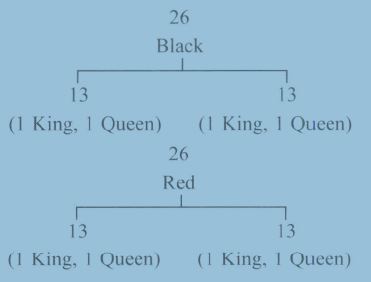
Two cards are drawn from a well-shuffled pack of 52 cards one after the other without replacement. Find the probability that one of these is a queen and the other is a king of opposite color.
7.
A doctor is to visit a patient. Form the past experience, it is known that the probabilities that he will come by train, bus, scooter or by other means of transport are respectively \({3\over10},{1\over5},{1\over10} and {2\over5}\). The probabilities that he will be late are \({1\over4},{1\over3},{1\over12}\) if he comes by train, bus and scooter respectively, but if he comes by other means of transport then he will not be late. When he arrives he is late. What is the probability that he comes by train?
8.
Suppose that the reliability of a HIV test is specified as follows: of people having HIV, 90% of the test detect the disease but 10% go undetected. Of the people free of HIV, 99% of the tests are judged HIV -ve but 1% are diagnosed as showing HIV +ve. From a large population of which only 0.1% have HIV, one person is selected at random given the HIV test, and the pathologist reports him/her as HIV +ve. What is the probability that the person actually has HIV?
9.
A letter is known to have come either from TATANAGAR or from CALCUTTA. On the envelope just two consecutive letters TA are visible. What is the probability that the letters came from TATANAGAR?
10.
There are two bags, one of which contains 3 black and 4 white balls, while the other contains 4 black and 3 white balls. Adie is thrown. It shows up 1or 3, a ball is taken from the first bag, but it shows up any other number, a ball is chosen from the second bag. Find the probability of choosing a black ball.
2 Marks
11.
Given P(A) = \(1\over2\), P(B) = \(1\over3\) and \(P(A\cap B)={1\over6}\) Are the events A and B independent?
12.
Given P(A) = 0.4, P(B) = 0.7 and P(B/A) = 0.6, Find \(P(A\cup B)\)
13.
A couple has 2 children. Find the probability that both are boys, if it is known that (a) one of them is a boy (b) the older child is boys.
14.
Two cards are drawn at random from a pack of 52 cards one-by-one without replacement. What is the probability of getting first card red and second card jack?
15.
A speaks truth in 80% cases and B speaks truth in 90% cases, In what percentage of cases are they likely to agree with each other in stating the same fact?
5 Marks
16.
A bag I contains 5 red and 4 white balls and a bag II contains 3 red and 3 white balls. Two balls are transferred from the bag I to the bag II and then one ball is drawn from bag II. If the ball drawn from the bag II is red, then find the probability that one red ball and one white ball are transferred from the bag I to the bag II.
17.
There are three coins. First is a biased that comes up tails 60% of the times, second is also a biased coin that comes up heads 75% of the times and third is an unbiased coin. One of the three coins is chosen at random and tossed, it shows heads, what is the probability that it was the first coin?
18.
A bag contains 4 red and 4 black balls, another bag contains 2 red and 6 black balls. One of the two bags is selected at random and two balls are drawn at random (without replacement) from the bag which are both found to be red. Find the probability that the balls are drawn from the first bag.
19.
A shopkeeper sells three types of flower seeds A1, A2 and A3. They are sold as a mixture, where the proportions are 4 : 4 : 2, respectively. The germination rates of the three types of seedsare 45%, 60% and 35%. Calculate the probability.
(i) of a randomly chosen seed to germinate
(ii) that it willhot germinate given that the seed is of type A3.
(iii) that it is of the type A2 given that a randomly chosen seed does not germinate.
20.
Among the students in a college, it is known that 60% reside in hostel and 40% are day scholars (not residing in hostel). Previous year results report that 30% of all students who reside in hostel attain A grade and 20% of day scholars attain A grade in their annual exams. At the end of year, one student is chosen at random from the college and he has A grade, what is the probability that the student is a hosteler?
Case Study Questions
21.
A pharmaceutical company wants to advertise a new product on T.V, where the product is specially designed for women. For that an advertising executive is hired to study television-viewing habits of married couples during prime time hours. Based on past viewing records he has determined that during prime time husbands are watching television 70% of the time. It has also been determined that when the husband is watching television, 30% of the time the wife is also watching. When the husband is not watching television, 40% of the time the wife is watching television.
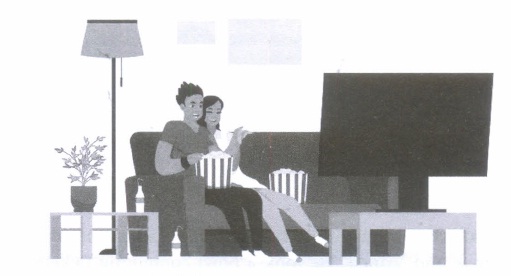
Based on the above information, answer the following questions.
(i) The probability that the husband is not watching television during prime time, is
| (a) 0.6 | (b) 0.3 | (c) 0.4 | (d) 0.5 |
(ii) If the wife is watching television, the probability that husband is also watching television, is
| (a) 2/11 | (b) 7/11 | (c) 5/11 | (d) 8/11 |
(iii) The probability that both husband and wife are watching television during prime time, is
| (a) 0.21 | (b) 0.5 | (c) 0.3 | (d) 0.4 |
(iv) The probability that the wife is watching television during prime time, is
| (a) 0.24 | (b) 0.33 | (c) 0.3 | (d) 0.4 |
(v) If the wife is watching television, then the probability that husband is not watching television, is
| (a) 2/11 | (b) 4/11 | (c) 1/11 | (d) 5/11 |
22.
In a bilateral cricket series between India and South Africa, the probability that India wins the first match is 0.6. If India wins any match, then the probability that it wins the next match is 0.4, otherwise the probability is 0.3. Aso, it is given that there is no tie in any match
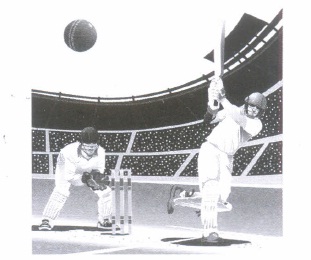
Based on the above information answer the following questions.
(i) The probability that India won the second match, if India has already loose the first match is
| (a) 0.5 | (b) 0.3 | (c) 0.4 | (d) 0.7 |
(ii) The probability that India losing the third match, if India has already loose the first two matches is
| (a) 0.2 | (b) 0.3 | (c) 0.4 | (d) 0.7 |
(iii) The probability th-.at India losing the first two matches is
| (a) 0.12 | (b) 0.28 | (c) 0.42 | (d) 0.01 |
(iv) The probability that India winning the first three matches is
| (a) 0.92 | (b) 0.96 | (c) 0.94 | (d) 0.096 |
(v) The probability that India winning exactly one of the first three matches is
| (a) 0.205 | (b) 0.21 | (c) 0.408 | (d) 0.312 |
23.
Box I contains 1 white, 3 black and 2 red balls. Box II contains 2 white, 1 black and 3 red balls. Box III contains 3 white, 2 black and 1 red balls. One box is chosen at random and two balls are drawn with replacement.
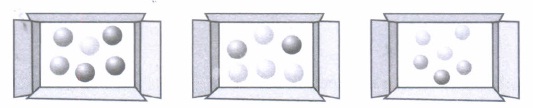
If E1, E2, E3 be the events that the balls drawn from box 1,box II and box III respectively and E be the event that balls drawn are one white and one red, then answer the following questions.
(i) Probability of occurrence of everit E given that the balls drawn are from box I, is
| (a) \(\frac{1}{9}\) | (b) \(\frac{2}{6}\) | (c) \(\frac{3}{5}\) | (d) \(\frac{1}{7}\) |
(ii) Probability of occurrence of event E, given that the balls drawn are from box II, is
| (a) \(\frac{1}{3}\) | (b) \(\frac{1}{4}\) | (c) \(\frac{3}{4}\) | (d) \(\frac{3}{5}\) |
(iii) Probability of occurrence of event E, given that balls drawn are from box III, is
| (a) \(\frac{1}{12}\) | (b) \(\frac{3}{11}\) | (c) \(\frac{1}{6}\) | (d) \(\frac{4}{11}\) |
(iv) The value of \(\sum_{i=1}^{3} P\left(E \mid E_{i}\right)\) is equal to
| (a) \(\frac{5}{18}\) | (b) \(\frac{1}{2}\) | (c) \(\frac{1}{18}\) | (d) \(\frac{11}{18}\) |
(v) The probability that the balls drawn are from box II, given that event E has already occurred, is
| (a) \(\frac{1}{11}\) | (b) \(\frac{6}{11}\) | (c) \(\frac{5}{11}\) | (d) None of these |
24.
A building contractor undertakes a job to construct 4 flats on a plot along with parking area, Due to strike, the probability of many construction workers not being present for the job is 0.65.
The probability that many are not present and still the work gets completed on time is 0.35. The probability that work will be completed on time when all workers are present is 0.80.
Let E1 : represents the event when many workers were not present for the job;
E2 : represents the event when all workers were present; and
E : represents completing the construction work on time.
Based on the above information, answer the following questions:
(i) What is the probability that all the workers are present for the job?
(ii) What is the probability that construction will be completed on time?
(iii) (a) What is the probability that many workers are not present given that the construction work is completed on time?
Or (b) What is the probability that all workers were present given that the construction job was completed on time?
3 Marks
1.
Bag A. : 6 red + 5 blue; Bag B : 5 red + 8 blue
let a red ball be drawn from bag A
\(P\left(\mathrm{red}_{A}\right)=\frac{6}{11}\)
Number of balls in bag B: (5+1) red + 8 blue
\(P\left(\text { blue }_{B}\right)=\frac{8}{14}\)
therefore probability of drawing a blue ball from bag B, when a red ball is transferred from bag A to bag B is
\(=P\left(\text { red }_{A}\right) \cdot P\left(\text { blue }_{B}\right) \)
\(=\frac{6}{11} \times \frac{8}{14} \)
let blue ball is drawn from bag A
\(P\left(\text { blue }_{A}\right)=\frac{5}{11}\)
Number of balls in bag B : 5 red + (8 + I) blue
\(P\left(\text { blue }_{B}\right)=\frac{9}{14}\)
Probability of drawing a blue ball from bag B when a blue ball is transferred from bag A to bag B is
\(=P\left(\text { blue }_{A}\right) \cdot P\left(\text { blue }_{B}\right)\)
\(=\frac{5}{11} \times \frac{9}{14} \)
Hence, probability of drawing a blue ball from bag B when a ball is transferred from bag A to bag B = \(\frac{6}{11} \times \frac{8}{14}+\frac{5}{11} \times \frac{9}{14}=\frac{48+45}{154}=\frac{93}{154}\)
2.
E : accident; S : scooter driver; C : car driver; T: truck driver
\(P(S)=\frac{2000}{12000}=\frac{2}{12} ; P(C)=\frac{4000}{12000}=\frac{4}{12} ; \)
\(P(T)=\frac{6000}{12000}=\frac{6}{12}\)
P(EIS) = 0.01; P(EIC) = 0.03; P(EIT) = 0.15
Using Bayes' Theorem the probability of accident of a scooter driver is
\(P(S / E) =\frac{P(S) \cdot P(E / S)}{P(S) \cdot P(E / S)+P(C) \cdot P(E / C)+P(T) \cdot P(E / T)} \)
\(=\frac{\frac{2}{12} \times 0.01}{\frac{2}{12} \times 0.01+\frac{4}{12} \times 0.03+\frac{6}{12} \times 0.15} \)
\(=\frac{0.02}{0.02+0.12+0.90}=\frac{2}{104}=\frac{1}{52} \)
3.
\(\begin{array}{|c|c|c|c|} \hline \text { Machine } & \boldsymbol{A} & \boldsymbol{B} & \boldsymbol{C} \\ \hline \text { Production } & 60 \% & 30 \% & 10 \% \\ \hline \text { Defective } & 1 \% & 2 \% & 3 \% \\ \hline \end{array}\)
\(P(A)=\frac{60}{100}=\frac{6}{10}, P(B)=\frac{30}{100}=\frac{3}{10}, P(C)=\frac{10}{100}=\frac{1}{10}\)
E: bulb is defective
\(P(E / A)=\frac{1}{100}, P(E / B)=\frac{2}{100}, P(E / C)=\frac{3}{100}\)
Using Bayes' Theorem, probability that defective bulbs was produced by machine A,
\(\begin{array}{r} P(A / E)=\frac{P(A) \cdot P(E / A)}{P(A) \cdot P(E / A)+P(B) \cdot P(E / B)} \\ +P(C) \cdot P(E / C) \end{array}\)
\(=\frac{\frac{6}{10} \times \frac{1}{100}}{\frac{6}{10} \times \frac{1}{100}+\frac{3}{10} \times \frac{2}{100}+\frac{1}{10} \times \frac{3}{100}}=\frac{2}{5}\)
4.
| Bag | Number of white balls | Number of black balls | Number of Red balls |
| I | 1 | 2 | 3 |
| II | 2 | 1 | 1 |
| III | 4 | 3 | 2 |
Probability of chosing a bag:
\(P(I)=\frac{1}{3}, P(I I)=\frac{1}{3}, P(I I I)=\frac{1}{3} .\)
E : one white and one red ball is drawn.
\(P(E / I)=\frac{{ }^{1} C_{1} \times{ }^{3} C_{1}}{{ }^{6} C_{2}}=\frac{1 \times 3 \times 2}{6 \times 5}=\frac{1}{5}\)
\(P(E / I I)=\frac{{ }^{2} C_{1} \times{ }^{1} C_{1}}{{ }^{4} C_{2}}=\frac{2 \times 1}{6}=\frac{1}{3} \)
\(P(E / I I)=\frac{{ }^{4} C_{1} \times{ }^{2} C_{1}}{{ }^{9} C_{2}}=\frac{4 \times 2 \times 2}{9 \times 8}=\frac{2}{9} \)
Using Bayes' Theorem,
Probability of drawing one white and one red from bag III is
\(P(I I I E) =\frac{P(I I I) \cdot P(E / I I I)}{P(I) \cdot P(E / I)+P(I I) \cdot P(E / I I)+P(I I I) \cdot P(E / I I I)} \)
\(=\frac{\frac{1}{3} \times \frac{2}{9}}{\frac{1}{3} \times \frac{1}{5}+\frac{1}{3} \times \frac{1}{3}+\frac{1}{3} \times \frac{2}{9}}=\frac{\frac{2}{9}}{\frac{1}{5}+\frac{1}{3}+\frac{2}{9}} \)
\(=\frac{\frac{2}{9}}{\frac{9+15+10}{45}}=\frac{2}{9} \times \frac{45}{34}=\frac{5}{17} \)
5.
\(28\over45\)
6.
P(a king and other a queen of opposite colour or a queen and other a king of opposite colour)
\(=\frac{4}{52} \times \frac{2}{51}+\frac{4}{52} \times \frac{2}{51} \)
\(=\frac{4}{663}
\)
7.
EI : train. Ec : bus, E3 : scooter,
E.j : other means; E : arrives late
\(P\left(E_{1}\right)=\frac{3}{10} ; P\left(E_{2}\right)=\frac{1}{5} ; P\left(E_{3}\right)=\frac{1}{10} ; P\left(E_{4}\right)=\frac{2}{5} ; \)
\(P\left(E / E_{1}\right)=\frac{1}{4} ; P\left(E / E_{2}\right)=\frac{1}{3} ; P\left(E / E_{3}\right)=\frac{1}{12} ; P\left(E / E_{4}\right)=0 \)
Using Bayes' Theorem, probability that doctor is late and come by train
\(\begin{aligned} P\left(E_{1} / E\right)=& \frac{P\left(E_{1}\right) \cdot P\left(E / E_{1}\right)}{P\left(E_{1}\right) \cdot P\left(E / E_{1}\right)+P\left(E_{2}\right) \cdot P\left(E / E_{2}\right)} \\ &+P\left(E_{3}\right) \cdot P\left(E / E_{3}\right)+P\left(E_{4}\right) \cdot P\left(E / E_{4}\right) \end{aligned}\)
\(=\frac{\frac{3}{10} \times \frac{1}{4}}{\frac{3}{10} \times \frac{1}{4}+\frac{1}{5} \times \frac{1}{3}+\frac{1}{10} \times \frac{1}{12}+\frac{2}{5} \times 0}=\frac{1}{2}\)
8.
A: people having HIV
\(P(A)=\frac{0.1}{100}=\frac{1}{1000}\)
B: people free from HIV
\(P(B)=\frac{999}{1000}\)
E: test is HIV positive
\(P(E / A)=\frac{90}{100} ; P(E / B)=\frac{1}{100}\)
Using Bayes' Theorem, probability of reporting HIV positive when he actually has it.
\(P(A / E)=\frac{\frac{1}{1000} \times \frac{90}{100}}{\frac{1}{1000} \times \frac{90}{100}+\frac{999}{1000} \times \frac{1}{100}}=\frac{90}{1089}=\frac{10}{121}\)
9.
Let EI = Letter has come from CALCUITA
E2 = Letter has come from TATANAGAR
and E = Two consecutive letters (i.e. alphabets) TA are visible on envelope
\(\therefore P\left(E_{1}\right)=\frac{1}{2}, P\left(E_{2}\right)=\frac{1}{2}, P\left(\frac{E}{E_{1}}\right)=\frac{n\left(E \cap E_{1}\right)}{n\left(E_{1}\right)}=\frac{1}{7}\)
[\(\therefore\) pairs of consecutive letters are CA, AL, LC, CU, UT, TT, TA]
and \(P\left(\frac{E}{E_{2}}\right)=\frac{n\left(E \cap E_{2}\right)}{n\left(E_{2}\right)}=\frac{2}{8}\)
[\(\therefore\)8 pairs of consecutive letters are TA, AT, TA;AN, NA, AG, GA, AR]
\(\therefore P\left(\frac{E_{2}}{E}\right)=\frac{P\left(E_{2}\right) \cdot P\left(\frac{E}{E_{2}}\right)}{P\left(E_{1}\right) \cdot P\left(\frac{E}{E_{1}}\right)+P\left(E_{2}\right) \cdot P\left(\frac{E}{E_{2}}\right)}\)
[using Baye's theorem]
\(=\frac{\frac{1}{2} \times \frac{2}{8}}{\frac{1}{2} \times \frac{1}{7}+\frac{1}{2} \times \frac{2}{8}}=\frac{\frac{2}{16}}{\frac{8+14}{2 \times 7 \times 8}}=\frac{2 \times 7}{22}=\frac{7}{11}\)
Hence, the probability that the letter TA came from TATANAGAR is \(\frac{7}{11}\).
10.
Let E1 = Die shows up 1 or 3
E2 = Die shows up 2, 4, 5, 6
and A = Black ball is drawn
Then, \(P\left(E_{1}\right)=\frac{2}{6}, P\left(E_{2}\right)=\frac{4}{6}, P\left(\frac{A}{E_{1}}\right)=\frac{3}{7}, P\left(\frac{A}{E_{2}}\right)=\frac{4}{7}\)
\(\therefore\) Required probability
\(P(A)=P\left(E_{1}\right) \cdot P\left(\frac{A}{E_{1}}\right)+P\left(E_{2}\right) \cdot P\left(\frac{A}{E_{2}}\right)\)
= \(\frac{11}{12}\)
2 Marks
11.
P(A) ⋅ P(B) = \(1\over2\)⋅\(1\over3\) = \(1\over6\) = P(A∩B)
Yes, the events are independent.
12.
\(
P(B / A)=\frac{P(A \cap B)}{P(A)}
\)
\(\Rightarrow 0.6 \times 0.4=P(A \cap B)
\)
\(\Rightarrow P(A \cap B)=0.24
\)
\( P(A \cup B)=P(A)+P(B)-P(A \cap B)
\)
\(=0.4+0.7-0.24=0.86
\)
13.
Sample space ={B1B2, B1G2, G1B2, G1G2}, B1 and G1 are the older boy and girl respectively.
Let E1 = both the children are boys;
E2 = one of the children are boys;
E3 = the older child is a boy
Then, (a) P(E1/E2) = \(P\left( \frac { { E }_{ 1 }\cap { E }_{ 2 } }{ { E }_{ 2 } } \right) =\frac { \frac { 1 }{ 4 } }{ \frac { 3 }{ 4 } } =\frac { 1 }{ 3 } \)
(b) P(E1/E3) = \(P\left( \frac { { E }_{ 1 }\cap { E }_{ 3 } }{ { E }_{ 3 } } \right) =\frac { \frac { 1 }{ 4 } }{ \frac { 2 }{ 4 } } =\frac { 1 }{ 2 } \)
14.
\(\because\) Two cards are drawn at random from a pack of 52 cards one-by-one without replacement.
\(\therefore\) The required probability = P {(the first is a red jack card and the second is a jack card) or (the first is a red non-jack card and the second is a jack card)}
\(=\frac{2}{52} \times \frac{3}{51}+\frac{24}{52} \times \frac{4}{51}=\frac{1}{26}\)
15.
Let AT : Event that A speaks truth
and BT : Event that B speaks truth.
Given, \(\begin{aligned} P\left(A_T\right)=\frac{80}{100}=\frac{4}{5} \end{aligned}\)
\(\begin{aligned} P\left(B_T\right)=\frac{90}{100}=\frac{9}{10} \end{aligned}\)
P(agree) = P(both speaking truth or both telling lie)
\(\begin{aligned} =P\left(A_T B_T \text { or } \bar{A}_T \bar{B}_T\right) \end{aligned}\)
\(\begin{aligned} =P\left(A_T\right) P\left(B_T\right) \text { or } P\left(\bar{A}_T\right) P\left(\bar{B}_T\right) \end{aligned}\)
\(\begin{aligned} =\left(\frac{4}{5}\right)\left(\frac{9}{10}\right)+\left(\frac{1}{5}\right)\left(\frac{1}{10}\right) \end{aligned}\)
\(\begin{aligned} =\frac{36+1}{50}=\frac{37}{50}=\frac{74}{100}=74 \% \end{aligned}\)
5 Marks
16.
Let, E1: Two white balls are transferred
E2: Two red balls are transferred
E3: One red and one white ball are transferred.
A: The ball drawn from the bag II is red.
\(P({ E }_{ 1 })=\frac { { 4 }_{ C_{ 2 } } }{ { 9 }_{ { c }_{ 2 } } } =\frac { 4\times 3 }{ 9\times 8 } =\frac { 1 }{ 6 } \)
\({ P({ E } }_{ 2 })=\frac { { 5 }_{ C_{ 2 } } }{ { 9 }_{ C_{ 2 } } } =\frac { 4\times 3 }{ 9\times 8 } =\frac { 5 }{ 18 } \)
\(P(E_{ 3 })=\frac { { 5 }_{ { C }_{ 1 } }\times { 4 }_{ C_{ 1 } } }{ { 9 }_{ C_{ 2 } } } =\frac { 4\times 5\times 2 }{ 9\times 8 } =\frac { 5 }{ 9 } \)
\(P(A/{ E }_{ 1 })=\frac { 3 }{ 8 } ,P(A/{ E }_{ 2 })=\frac { 5 }{ 8 } ,\)
\(P(A/{ E }_{ 3 })=\frac { 4 }{ 8 } \)
The required probability, P(E3/A), by Bayes' Theorem
\(=\frac { P({ E }_{ 3 }).P(A/{ E }_{ 3 }) }{ P({ E }_{ 1 }).P(A/{ E }_{ 1 })+P({ E }_{ 2 }).P(A/{ E }_{ 2 })+P({ E }_{ 3 }).P(A/{ E }_{ 3 }) } \)
\(=\frac { \frac { 5 }{ 9 } \times \frac { 4 }{ 8 } }{ \frac { 1 }{ 6 } \times \frac { 3 }{ 8 } +\frac { 5 }{ 18 } \times \frac { 5 }{ 8 } +\frac { 5 }{ 9 } \times \frac { 4 }{ 8 } } \)
\(=\frac { 20 }{ 37 } \)
17.
Let the events be:
E1 = Choosing 1st coin
E2 = Choosing 2nd coin
E3 = Choosing 3rd coin
A: Getting Heads
\(P({ E }_{ 1 })=P({ E }_{ 2 })=P(E_{ 3 })=\frac { 1 }{ 3 } \)
\(P(A/{ E }_{ 1 })=\frac { 40 }{ 100 } ,P(A/{ E }_{ 2 })=\frac { 75 }{ 100 } ,\)
\(P(A/{ E }_{ 3 })=\frac { 1 }{ 2 } \)
\(P({ E }_{ 1 }/A)\)
\(=\frac { P({ E }_{ 1 })P(A/{ E }_{ 1 }) }{ P({ E }_{ 1 })P(A/{ E }_{ 1 })+P({ E }_{ 2 })P(A/{ E }_{ 2 })+P({ E }_{ 3 })P(A/{ E }_{ 3 }) } \)
\(=\frac { \frac { 1 }{ 3 } .\frac { 40 }{ 100 } }{ \frac { 1 }{ 3 } .\frac { 40 }{ 100 } +\frac { 1 }{ 3 } .\frac { 75 }{ 100 } +\frac { 1 }{ 3 } .\frac { 1 }{ 2 } } =\frac { 8 }{ 33 } \)
18.
Let E1: Event selecting bag with 4 red & 4 black balls
E2: Event selecting bag with 2 red & 6 black balls
A: Event selecting 2 red balls without replacement
Then, P(E1) = P(E2) = \(\frac { 1 }{ 2 } \)
\(P(A/{ E }_{ 1 })=\frac { 4_{ C_{ 2 } } }{ { 8 }_{ C_{ 2 } } } =\frac { 3 }{ 14 } ,\)
\(P(A/{ E }_{ 2 })=\frac { { 2 }_{ { C }_{ 2 } } }{ { 8 }_{ { C }_{ 2 } } } =\frac { 1 }{ 28 } .\)
\(P\left( \frac { { E }_{ 1 } }{ A } \right) =\frac { P({ E }_{ 1 }).P(A/{ E }_{ 1 }) }{ P({ E }_{ 1 }).P(A/{ E }_{ 1 })+P({ E }_{ 2 }).P(A/{ E }_{ 2 }) } \)
\(=\frac { \frac { 1 }{ 2 } .\frac { 3 }{ 14 } }{ \frac { 1 }{ 2 } .\frac { 3 }{ 14 } +\frac { 1 }{ 2 } .\frac { 1 }{ 28 } } =\frac { 6 }{ 7 } \)
19.
We have, A1: A2 :A3 = 4: 4: 2
\(\therefore P\left(A_{1}\right)=\frac{4}{10}, P\left(A_{2}\right)=\frac{4}{10} \text { and } P\left(A_{3}\right)=\frac{2}{10}\)
where AI',A2 and A3 denote the event of choosing flower seeds A1, A2 and A3 respectively,
Let E be the event that a seed germinates and E be the event that a seed does not germinate.
Then,\(P\left(\frac{E}{A_{1}}\right)=\frac{45}{100}, P\left(\frac{E}{A_{2}}\right)=\frac{60}{100}, P\left(\frac{E}{A_{3}}\right)=\frac{35}{100}\)
and \(P\left(\frac{\bar{E}}{A_{1}}\right)=\frac{55}{100}, P\left(\frac{\bar{E}}{A_{2}}\right)=\frac{40}{100}, P\left(\frac{\bar{E}}{A_{3}}\right)=\frac{65}{100}\)
(i) Probability that a randomly chosen seed to germinate,
\(P(E)=P\left(A_{1}\right) \cdot\left(\frac{E}{A_{1}}\right)+P\left(A_{2}\right) \cdot P\left(\frac{E}{A_{2}}\right)+P\left(A_{3}\right) \cdot P\left(\frac{E}{A_{3}}\right)\)
\(=\frac{4}{10} \times \frac{45}{100}+\frac{4}{10} \times \frac{60}{100}+\frac{2}{10} \times \frac{35}{100}\)
\(=\frac{180}{1000}+\frac{240}{1000}+\frac{70}{1000}=\frac{490}{1000}=0.49\)
\(\text { (ii) } P\left(\frac{\bar{E}}{A_{3}}\right)=1-P\left(\frac{E}{A_{3}}\right)=1-\frac{35}{100}=\frac{65}{100}\)
\(\text { (iii) } P\left(\frac{A_{2}}{\bar{E}}\right)\)
\(=\frac{P\left(A_{2}\right) \cdot P\left(\frac{\bar{E}}{A_{2}}\right)}{P\left(A_{1}\right) \cdot P\left(\frac{\bar{E}}{A_{1}}\right)+P\left(A_{2}\right) \cdot P\left(\frac{\bar{E}}{A_{2}}\right)+P\left(A_{3}\right) \cdot P\left(\frac{\bar{E}}{A_{3}}\right)}\)
\(=\frac{\frac{4}{10} \times \frac{40}{100}}{\frac{4}{10} \times \frac{55}{100}+\frac{4}{10} \times \frac{40}{100}+\frac{2}{10} \times \frac{65}{100}}\)
\(=\frac{\frac{160}{1000}}{\frac{220}{1000}+\frac{160}{1000}+\frac{130}{1000}}=\frac{\frac{160}{1000}}{\frac{510}{1000}}=\frac{16}{51}\)
= 0.313725 = 0.314
20.
Let us detine the events as
E1 : Students reside in a hostel
E2 : Students are day scholars
A : Students get A grade
Then,
P(E1) = Probability that student reside in a hostel
\(=60 \%=\frac{60}{100}\)
and P(E2) = Probability that students are day scholars = 1 - \(\frac{60}{100}=\frac{40}{100}\)
Also, P(A/E1) = Probability that hostelers get A grade
\(=30 \%=\frac{30}{100}\)
and P(A/E2)= Probability that students having day scholars get A grade
\(=20 \%=\frac{20}{100}\)
\(\therefore\) The probability that the selecting student is a hosteler having A grade,
\(P\left(E_1 / A\right)=\frac{P\left(E_1\right) \cdot P\left(A / E_1\right)}{P\left(E_1\right) \cdot P\left(A / E_1\right)+P\left(E_2\right) \cdot P\left(A / E_2\right)}\)
[by Baye's theorem]
\(\begin{aligned}
=\frac{\frac{60}{100} \times \frac{30}{100}}{\left(\frac{60}{100} \times \frac{30}{100}\right)+\left(\frac{40}{100} \times \frac{20}{100}\right)}
\end{aligned}\)
\(\begin{aligned}
=\frac{1800}{1800+800}=\frac{1800}{2600}=\frac{18}{26}=\frac{9}{13}
\end{aligned}\)
Case Study Questions
21.
(i) (b): Since, it is given that during prime time husband is watching T.V. 70%of the time
∴ Required probability = 1 - P(husband is watching television during prime time)
= 1 - 0.7 = 0.3
(ii) (b): Let H be the event that husband is watching TV, W be the event that wife is watching TV.
Then, P(H) = 0.7, P(H) = 0.3
P(W I H) = 0.3 arltl P(W I H) = 0.4
∴ Required probability = P(H I W)
\(=\frac{P(\mathrm{H}) \cdot P(\mathrm{~W} \mid \mathrm{H})}{P(\mathrm{H}) \cdot P(\mathrm{~W} \mid \mathrm{H})+P(\overline{\mathrm{H}}) P(\mathrm{~W} \mid \overline{\mathrm{H}})}
\)
\(=\frac{0.7 \times 0.3}{0.7 \times 0.3+0.4 \times 0.3}=\frac{0.21}{0.33}=\frac{7}{11}\)
(iii) (a) : Required probability = P(H \(\cap\) W)
= P(H)P(W I H) = 0.7 x 0.3 = 0.21
(iv) (b): Required probability = P(W) = \(\frac{P(\mathrm{H} \cap \mathrm{W})}{P(\mathrm{H} \mid \mathrm{W})}\)
\(=\frac{0.21}{7 / 11}=\frac{21}{100} \times \frac{11}{7}=\frac{33}{100}=0.33\)
(v) (b): Required probability = P(H I W)
\(=1-P(\mathrm{H} \mid \mathrm{W})=1-\frac{7}{11}=\frac{4}{11}\)
22.
(i) (c): It is given that if India loose any match, then the probability that it wins the next match is 0.3.
∴ Required probability = 0.3
(ii) (d): It is given that, if India loose any match, then the probability that it wins the next match is 0.3.
∴ Required probability = 1 - 0.3 = 0.7
(iii) (b): Required probability = P(lndia losing first match) . P(India losing second match when India has already lost first match)
= 0.4 x 0.7 = 0.28
(iv) (d): Required probability = P(lndia winning first match) . P(India winning second match if India has already won first match) P(lndia winning third match if India has already won first two matches)
= 0.6 x 0.4 x 0.4 = 0.096
(v) (c): Required probability = P(Win 1st match) P(Lose 2nd match) P(Lose 3rd match) + P (Lose 1st match) P(Win 2nd match) P(Lose 3rd match) + P(Lose 1st match) P(Lose 2nd match) P(Win 3rd match)
= 0.6 x (1 - 0.4)・(1- 0.3) + (1 - 0.6)・(0.3)(1 - 0.4) + (1 - 0.6) (1 - 0.3) (0.3)
= 0.6 x 0.6 x 0.7 + 0.4 x 0.3 x 0.6 + 0.4 x 0.7 x 0.3
= 0.252 + 0.072 + 0.084 = 0.408
23.
We have, \(P\left(E_{1}\right)=P\left(E_{2}\right)=P\left(E_{3}\right)=\frac{1}{3}\)
(i) (a) : P(E l E1) = Probability of drawing red and white ball, if box I is selected.
= P(red) x P(white) + P(white) x P(red)
\(=\frac{2}{6} \times \frac{1}{6}+\frac{1}{6} \times \frac{2}{6}=\frac{4}{36}=\frac{1}{9}\)
(ii) (a): P(E l E1) = Probability of drawing red and white balls, if box II is selected
= P(red) x P(white) + P(white) x P(red)
\(=\frac{3}{6} \times \frac{2}{6}+\frac{2}{6} \times \frac{3}{6}=\frac{12}{36}=\frac{1}{3}\)
(iii) (c): p(E IE3) = Probability of drawing red and white balls, if box III is selected.
= P(red) x P(white) + P(white) x P(red)
\(=\frac{1}{6} \times \frac{3}{6}+\frac{3}{6} \times \frac{1}{6}=\frac{6}{36}=\frac{1}{6}\)
(iv) (d): \(\sum_{i=1}^{3} P\left(E \mid E_{i}\right)=P\left(E \mid E_{1}\right)+P\left(E \mid E_{2}\right)+P\left(E \mid E_{3}\right)\)
\(=\frac{4}{36}+\frac{12}{36}+\frac{6}{36}=\frac{4+12+6}{36}=\frac{22}{36}=\frac{11}{18}\)
(v) (b): Using Bayes' theorem
\( P\left(E_{2} \mid E\right)=\frac{P\left(E \mid E_{2}\right) \cdot P\left(E_{2}\right)}{P\left(E \mid E_{1}\right) \cdot P\left(E_{1}\right)+P\left(E \mid E_{2}\right) \cdot P\left(E_{2}\right)+P\left(E \mid E_{3}\right) \cdot P\left(E_{3}\right)} \)
\(=\frac{\frac{1}{3} \times \frac{1}{3}}{\left(\frac{1}{9} \times \frac{1}{3}\right)+\left(\frac{1}{3} \times \frac{1}{3}\right)+\left(\frac{1}{6} \times \frac{1}{3}\right)} \)
\(=\frac{\frac{1}{3}}{\frac{1}{9}+\frac{1}{3}+\frac{1}{6}}=\frac{\frac{1}{3}}{\frac{11}{18}}=\frac{1}{3} \times \frac{18}{11}=\frac{6}{11}\)
24.
Given, P(E1) = 0.65, P(E/E1) = 0.35 and \(P\left(\frac{E}{E_2}\right)=0.80\)
(i) P(E2) = 1 - P(E1) = 1 - 0.65 = 0.35
(ii) \(\begin{aligned} P(E) & =P\left(E_1\right) \cdot P\left(\frac{E}{E_1}\right)+P\left(E_2\right) P\left(\frac{E}{E_2}\right) \end{aligned}\)
\(\begin{aligned} =0.65 \times 0.35+0.35 \times 0.80 \end{aligned}\)
\(\approx 0.23+0.28=0.51\)
(iii) (a) \(\begin{aligned} P\left(\frac{E_1}{E}\right) & =\frac{P\left(E_1\right) \cdot P\left(E / E_1\right)}{P\left(E_1\right) \cdot P\left(E / E_1\right)+P\left(E_2\right) P\left(E / E_2\right)} \end{aligned}\)
\(\begin{aligned} =\frac{0.65 \times 0.35}{0.65 \times 0.35+0.35 \times 0.80}=0.45 \end{aligned}\)
or (b) \(\begin{aligned} P\left(\frac{E_2}{E}\right) & =\frac{P\left(E_2\right) P\left(E / E_2\right)}{P\left(E_1\right) \cdot P\left(E / E_1\right)+P\left(E_2\right) P\left(E / E_2\right)} \end{aligned}\)
\(\begin{aligned} =\frac{0.35 \times 0.80}{0.65 \times 0.35+0.35 \times 0.80} \end{aligned}\)
= 0.55

12th Standard CBSE Syllabus & Materials
12th Standard CBSE
CBSE 12th Chemistry d- and f- Block Elements Important Questions And Answers Study Material - QB365 Set A
NEW12th Standard CBSE
CBSE 12th Chemistry Chemical Kinetics Important Questions And Answers Study Material - QB365 Set B
NEW12th Standard CBSE
CBSE 12th Chemistry Chemical Kinetics Important Questions And Answers Study Material - QB365 Set A
NEW12th Standard CBSE
CBSE 12th Chemistry Electrochemistry Important Questions And Answers Study Material - QB365 Set C



NCERT Books

Syllabus

Exam Pattern

Sample Question Papers

Previous year Question Papers

Important Notes

MCQ Practice test

NCERT Exemplers

Case study Questions

Image Based Questions

Passage based Questions

HOT Questions

Value Based Questions

Model Questions Papers
NCERT ( Book Back ) Questions

Assertion and Reason
Important Questions And Answers

CBSE 12th Standard CBSE Subjects
CBSE Standards