
12th Standard CBSE Syllabus & Materials
12th Standard CBSE
CBSE 12th Biology Sexual Reproduction in Flowering Plants Assertion and Reason Study Material - QB365 Set D
NEW12th Standard CBSE
CBSE 12th Biology Sexual Reproduction in Flowering Plants Assertion and Reason Study Material - QB365 Set C
NEW12th Standard CBSE
CBSE 12th Biology Sexual Reproduction in Flowering Plants Assertion and Reason Study Material - QB365 Set B
NEW12th Standard CBSE
CBSE 12th Biology Sexual Reproduction in Flowering Plants Assertion and Reason Study Material - QB365 Set A
NEW12th Standard CBSE
CBSE 12th Standard Biology Sexual Reproduction in Flowering Plants Sample Question Papers Study Material - QB365 Set 1
NEW12th Standard CBSE
CBSE 12th Chemistry d- and f- Block Elements Important Questions And Answers Study Material - QB365 Set B

Published on: 25/10/2025
Download CBSE Class 12th Standard CBSE Physics question papers, sample papers, important questions, and previous year solved papers in PDF format. Get free study materials, NCERT solutions, and exam preparation resources for Class 12th Standard CBSE Physics
Questions + Answers key
Take MCQ Physics Test
1.
(i) A circular coil of 30 turns and radius 8.0 cm carrying a current of 6.0 A is suspended vertically in a uniform horizontal magnetic field of magnitude 1.0 T. The field lines make an angle of 60o with the normal of the coil. Calculate the magnitude of the counter torque that must be applied to prevent the coil from turning.
(ii) Would your answer change, if the circular coil were replaced by a planar coil of some irregular shape that encloses the same area? All other particulars are also unaltered.
2.
A \(100\mu F\) capacitor in series with a \(40\Omega \) is connected to a 110 V, 60 Hz supply.
(a) What is the maximum current in the circuit?
(b) What is the time lag between the current maximum and the voltage maximum?
3.
Given a uniform electric field
\(\overrightarrow { E } =5\times 10^{ 3 }\hat { i } NC^{ -1 }\)
Find the flux of this field through a square of 10 cm on a side., whose plane is parallel to Y-Z plane. What would be the flux through the same square if plane makes an angle of 30o with X-axis?
4.
An EM wave of intensity I falls on a surface kept in vacuum and experts radiation pressure kept in vacuum and experts radiation pressure p on it. Which of the following are true?
Radiation pressure is I/c if the wave is totally absorbed
Radiation pressure is I/c if the wave is totally reflected
Radiation pressure is 2I/c if the wave is totally reflected
Radiation pressure is in the range I/c
5.
Out of the following, choose the correct relation
1henry = \(\frac{1\ volt}{1\ ampere}\)
1henry = \(\frac{1\ amp}{1\ volt}\)
1 henry = \(\frac{1volt}{1\ amp/sec}\)
1 henry = \(\frac{1volt}{1\ amp\ .\ sec}\)
6.
Force \(\overrightarrow { F } \) acting on a test charge qo in a uniform electric field \(\overrightarrow { E } \) is
\(\overrightarrow { F } =q_{ o }\overrightarrow { E } \)
\(\overrightarrow { F } =\frac { \overrightarrow { E } }{ q_{ o } } \)
\(\overrightarrow { F } =\frac { \overrightarrow { q_o } }{\overrightarrow { E } } \)
\(\overrightarrow { F } =q_{ o }^{ 2 }\overrightarrow { E } \)
7.
In a cyclotron a charged particle
undergoes acceleration all the time
speeds up between the dees because of the magnetic field.
speeds up in a dee
slows down within a dee and speeds up between dees.
8.
Discuss the quantitative production of electromagnetic waves when a charge is accelerated.
9.
Light with an energy flux of 18 watt/cm2 falls on a non-reflecting surface at normal incidence. If the surface has an area of 20 cm2 , find the average force exerted on the surface during a 30 minute time span, when no incident light is reflected. How will your result be modified if the surface is a perfect reflector?
10.
A parallel plate capacitor made of circular plates each of radius 10 cm has a capacity 200 pF. The capacitor is connected to a 230 V a.c. supply with an angular frequency of 400 rad s-1.
(i) What is the rms value of the conduction current?
(ii) Find the amplitude of \(\overrightarrow { B } \) at a point 2.0 cm from the axis of the plates.
11.
A 2\(\mu\)F capacitor, 100 ohm resistor and 8H inductor are connected in series with an a.c.source. What should be the frequency of source for which the current drawn in the circuit is maximum? If peak value of emf of the source is 200V, find the maximum current, inductive reactance, capacitive reactance, total impedance, peak value of current in the circuit. What is the phase relation between voltage across inductor and resistor? Also, give the phase relation between voltage across inductor and capacitor.
12.
The current sensitivity of a moving coil galvanometer increases by 20% when its resistance is increased by a factor does the voltage sensitivity change ?
13.
(i) Calculate the value of R in the balance condition of the Wheatstone bridge, if the carbon resistor connected across the arm CD has the colour sequence red, red and orange as shown in the figure.
(ii) Use Kirchhoff's rules to obtain the balance condition in a Wheatstone bridge.
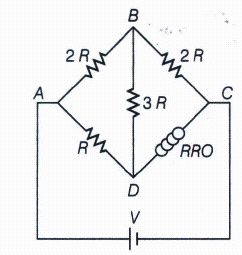
(ii) If now the resistance of the arms BC and CD are interchanged, to obtain the balance condition another carbon resistor is connected in place of R. What would now be sequence of colour bands of the carbon resistor? What is the current through the circuit?
14.
Subhash wanted to see the work of a transformer. He bought a transformer from a shop. He connected the primary to an a.c. supply. At that time an aluminium ring in his hand falls into the core of the transformer. Without noticing that he switched on the power supply. The aluminium ring flew yp into the air. He became panic. His father, an electrical engineer in Electricity Board explained the reason.
(a) What value does he exhibit ?
(b) Bring ou the reason for the above activity.
15.
State Kirchhoff's laws of current distribution in an electrical network. Using these rules determine the value of the current I1 in the electric circuit given below:
.png)
16.
The car battery is 12 volts. 8 simple cells connected in series can give 12 volt. But such cells are not used in starting a car; why?
17.
A rectangular coil of area \(2\times 10^{ -4 }m^{ 2 }\) and 40 turns is pivoted about one of its vertical sides. The coil is in a radial horizontal field of 60 G. What is the torsional constant of the hair springs connected to the coil, if a current of 4.0 mA produces an angular deflection of 16o?
18.
It is now believed that protons and neutrons (which constitute nuclei of ordinary matter) are themselves built out of more elementary units called quarks. A proton and a neutron consist of three quarks each. Two types of quarks, so-called 'up' quark (denoted by u) of charge + \(\left( \frac { 2 }{ 3 } \right) \)e and the 'down' quark (denoted by d) of charge \(\left( -\frac { 1 }{ 3 } \right) \) e, together with electrons build up ordinary matter. (Other types of quark have also been found which give rise to different unusual varieties of matter). Suggest a possible quark composition of a proton and a neutron.
19.
Two electrically charged particles, having charges of different magnitudes, when placed at a distance 'd' from each other, experience a force of attraction 'F'. These two particles are put in contact and again placed at the same distance from each other. What is the nature of new force between them? Is the magnitude of the force of interaction between them now more or less than F ?
20.
Figure (a), (b) and (c) Show three alternating circuits with equal currents. If frequency of alternating emf be increased, what will be the effect on currents In the three cases. Explain.

1.
Here, N = 30, R = 8.0 cm = 8 \(\times\)10-2 m,
I = 6.0 A, \(\theta\)= 60° and B = 1.0 T
(i) The magnitude of the counter torque
= magnitude of the deflecting torque
= NAIB sin \(\theta\) = N .(\(\pi\)R2)IB sin \(\theta\)
= 30 \(\times\) 3.14 \(\times\) (8 \(\times\) 10-2)2 \(\times\) 6.0 \(\times\) 1.0 \(\times\) sin 60°
= 3.14 N.m
(ii) The answer would not change as area enclosed by the coil as well as all other particulars remain unaltered and the formula, \(\tau\) = NAIB sin \(\theta\) is true for planar coil for any shape.
2.
(a) Io = 3.23A
(b) 1.55ms
3.
Here \(\overrightarrow { E } =5\times 10^{ 3 }\hat { i } NC^{ -1 }\)
A = (10 cm)2 = (10-1m)2 = 10-2m2
When plane is || to Y-Z plane, \(\theta =0^o\)
\(\phi=EA \ cos \theta=(5\times 10^3)\times 10^{-2}cos \ 0^o\)
= 50 Nm2C-1
When plane makes an angle of 30o with X-axis,
\(\theta =60^o\)
\(\phi'=EA \ cos\theta=5\times 10^3\times10^{-2}cos \ 60^o\)
\(=25 Nm^2C^{-1}\)
4.
(a)
Radiation pressure is I/c if the wave is totally absorbed
5.
(c)
1 henry = \(\frac{1volt}{1\ amp/sec}\)
6.
(a)
\(\overrightarrow { F } =q_{ o }\overrightarrow { E } \)
7.
(a)
undergoes acceleration all the time
8.
Consider an electric charge at rest so that at a point P some distance away, we have electric field but no magnetic field. Let, at time \(t=0\) , an impulse be given to the charge such that it starts moving with some finite velocity. For a moving charge, we expect at P both electric and magnetic fields, but we cannot immediately decide whether the magnetic field at P will change from zero to finite value instantaneously at \(t=0\) or after some time.
Instantaneous change means infinite rate of change. If the change is instantaneous at all points then considering any loop, we will conclude from Faraday's law that an infinite e.m.f. and infinite electric field is set up. This in turn would imply an infinite magnetic field as seen from the result. Fields are always finite away from charges and clearly the situation just described is inconsistent with known laws of electricity and magnetism.
\(\oint { \overset { \rightarrow }{ B } } .\overset { \rightarrow }{ dl } ={ \mu }_{ 0 }{ \varepsilon }_{ 0 }\frac { d\phi _{ e } }{ dt } \)
The moving charge sets up a magnetic field in its neighbourhood which in turn creates an electric field in the neighbourhood. The process continues since both time-varying electric and magnetic fields act as sources of each other. Thus an electromagnetic wave is started when a charge is accelerated. It is only when the wave reaches the point P that the magnetic field at P changes.
This shows that an accelerated charge emits an electromagnetic wave. It can also be shown that the electromagnetic wave and the oscillator will have the same frequency.
9.
Total energy falling on the surface,
U = 18 x 20 x 30 x 60 J = 6.48 x 10⁵ J
Total momentum delivered to the surface is
\(p=\frac { U }{ c } =\frac { 6.48\times { 10 }^{ 5 } }{ 3\times { 10 }^{ 8 } } =2.16\times { 10 }^{ -3 }kg{ ms }^{ -1 }\)
The average force exerted on the surface is
\(F=\frac { p }{ t } =\frac { 2.16\times { 10 }^{ -3 } }{ 30\times 60 } =1.2\times { 10 }^{ -6 }N\)
It the surface is a perfect reflector, the change of momentum will be = p - (- p)
= 2 p = 2 x 2.16 x 10-3 kg ms-1
Now average force,
\(F=\frac { 2\times 2.16\times { 10 }^{ -3 } }{ 30\times 60 } =2.4\times { 10 }^{ -6 }N\)
10.
Here, R = 10 cm = 0.10 cm;
C = 200 pF = 200 x 10-12 F,
\(\omega\)=400 rad s-1 , Vrms = 230 V.
(i) \({ I }_{ rms }=\frac { { V }_{ rms } }{ { X }_{ C } } =\frac { { V }_{ rms } }{ 1/\omega C } ={ V }_{ rms }\times \omega C\)
= 230 x 400 x (200 x 10-12)
= 18.4 x 10⁻⁶ A = 18.4 \(\mu A\)
(ii) Magnetic field at a distance r from the axis of plates is
\(B=\frac { { \mu }_{ 0 } }{ 2\pi } \frac { r }{ { R }^{ 2 } } I\) [See Solved Example 5]
Amplitude of \(\overrightarrow { B } \) is given by
\({ B }_{ 0 }=\frac { { \mu }_{ 0 } }{ 2\pi } \frac { r }{ { R }^{ 2 } } { I }_{ 0 }=\frac { { \mu }_{ 0 } }{ 2\pi } \frac { r }{ { R }^{ 2 } } { I }_{ rms }\sqrt { 2 } \)
\(\left[ \because { I }_{ rms }={ I }_{ 0 }/\sqrt { 2 } \right] \)
Here, r = 2.0 cm = 2.0 x 10⁻² m ; R = 0.10 m.
\(\therefore { B }_{ 0 }=\frac { \left( 4\pi \times { 10 }^{ -7 } \right) }{ 2\pi } \times \frac { 2.0\times { 10 }^{ -2 } }{ { \left( 0.10 \right) }^{ 2 } } \times \left( 18.4\times { 10 }^{ -6 } \right) \)
= 1.04 x 10⁻¹¹
11.
\(Here,C=2\mu F=2\times { 10 }^{ -6 }F, \ R=100ohm, \ L=8H, \ { E }_{ 0 }=200V, \ { I }_{ 0 }=? \ { X }_{ L }=?, \ { X }_{ C }=?, \ Z=?, \ { I }_{ 0 }=?\)
\(Current \ drawn \ in \ the \ circuit \ is \ maximum,\)
\(when \ frequency \ of \ a.c. \ source=resonance \ frequency.\)
\(v={ v }_{ r }=\frac { 1 }{ 2\pi \sqrt { LC } } =\frac { 1 }{ 2\times 3.14\sqrt { 8\times 2\times { 10 }^{ -6 } } } =\frac { 1000 }{ 8\times 3.14 } =39.8hertz.\)
\(Peak \ value \ of \ current, \ { I }_{ 0 }=\frac { { E }_{ 0 } }{ R } =\frac { 200 }{ 100 } =2A\)
\( { X }_{ L }={ X }_{ C }=\omega L=2\pi vL=2\times 3.14\times 39.8\times 82000 \ ohm\)
\(Z=R=100ohm\)
\(The \ voltages \ across \ inductor \ is \ ahead \ of \ voltage \ across \ resistor \ by \ a \ phase \ angle \ of \ { 90 }^{ \circ }.\)
\(And \ the \ voltages \ across \ inductor \ and \ capacitor \ differ \ in \ phase \ by \ { 180 }^{ \circ }.\)
12.
Given, \({ I' }_{ s }={ I }_{ s }+\frac { 20 }{ 100 } { I }_{ s }=\frac { 120 }{ 100 } { I }_{ s }\)
\(R'=2R\)
Then, initial voltage sensitivity, \({ V }_{ s }=\frac { { I }_{ s } }{ R } \)
New voltage sensitivity,
\({ V' }_{ s }=\frac { { I' }_{ s } }{ R' } =\left( \frac { 120 }{ 100 } { I }_{ s } \right) \times \frac { 1 }{ 2R } =\frac { 3 }{ 5 } { V }_{ s }\)
% decrease in voltage sensitivity
\(=\frac { { V }_{ s }-{ V' }_{ s } }{ { V }_{ s } } \times 100=\frac { { V }_{ s }-\frac { 3 }{ 5 } { V }_{ s } }{ { V }_{ s } } \times 100\)
= 40%
13.
(i) Lat carbon resistor S is given to the bridge. Then,
\(\frac { 2R }{ R } =\frac { 2R }{ S } \Rightarrow \frac { R }{ S } =1\)
R = S = 22 x 103 \(\Omega =22k\Omega \)
(ii) After interchanging the resistance, the balanced bridge would be
\(\frac { 2R }{ X } =\frac { 22\times { 10 }^{ 3 } }{ 2\times 22\times { 10 }^{ 3 } } =\frac { 1 }{ 2 }\)
X = 4R = 4 x 22 x 103
= 88 x 103 \(\Omega \)
The colour sequence of X is grey, grey and orange. Thus, equivalent resistance of Wheatstone bridge,
\(\frac { 1 }{ { R }_{ eq } } =\frac { 1 }{ 3R } +\frac { 1 }{ 6R } =\frac { 3 }{ 6R } \)
\( { R }_{ eq }=2R\)
\(\therefore \ Current \ through \ the \ circuit,I=\frac { 1 }{ 3 } \times \frac { V }{ 2R } =\frac { V }{ 6R } A\)
14.
(a) Curiosity
(b) Induced current in the aluminium ring acts in the opposite direction to than in the coil and so magnetic field.
15.
First law or Current law or Junction law: It states, "In any electrical network, the algebraic sum of currents meeting at a point (or junction) is zero."
Second law or Voltage law or Loop law: It states,
"In a closed circuit, the algebraic sum of the products of the current and the resistance in each of the conductors in any closed path (or mesh) in a network plus sum of emf in that path is equal to zero."
Now from the given figure,
I1+ I2 = I3 .....(i)
I2 = I3 - I1 ........(ii)
-20I1 - 40I3 = 40
-40 (I1 + 2I3) = 80
I1+ 2I3 = 2 ...(iii)
40I3 + 20I2 = 80 + 40
20 (2I3 + I2) = 120
2I3 + I2 = 6
2I3+ (I3- I1) = 6
2I3+ I3 -I1 = 6
3I3 - I1 = 6 ......(iv)
Now solving eqns. (ii) and (iv)
I1+ 2I3 = 2
-I1 + 3I3 = 6
\(5I_3=8\Rightarrow I_3=\frac{8}{5}=1.6 \ amp.\)
2I3+ I1= 2
I1 = 2-2I3
I1= 2-2 x \(\frac{8}{5}\)
Now, \(I_1=6-2I_3\)
\(\Rightarrow\ \ I_2=6-2\times \frac{8}{5}\)
\(\Rightarrow\ I_2=6-\frac{16}{5}\)
\(\Rightarrow\ \ I_2=\frac{30-16}{5}=\frac{14}{5}\)
\(\Rightarrow \ I_2=2.8\ amp\)
16.
To start a car, a high current is required which cannot be obtained from the series combination of 8 simple cells, because their internal resistance is of the order of \(10 Ω \) while the resistance of the car battery is only of the order of \(0.1 Ω.\)
17.
Here \(B=60G,A=2\times 10^{ -4 }\quad m^{ 2 },N=40\)
\(\\ I=4mA=4\times 10^{ -3 }A,\theta =16^{ 0 }\)
\(\because\) \(\\ I=\frac { k }{ NBA } \theta =k=\frac { NBAI }{ \theta } \)
\(\\ =\frac { 40\times 60\times 2\times 10^{ -4 }\times 4\times { 10 }^{ -3 } }{ 16 }\)
\( \\ =1.2\times 10^{ -4 }\) N-m per degree
18.
For the protons, the charge on a proton is + e.
If the number of up quarks is a, then the number of down quarks are (3-a) as the total number of quarks are 3. So, \(a\times \)up quark charge + (3-a) down quark charge) = +e
\(a\times \left( \frac { 2 }{ 3 } e \right) +\left( 3-a \right) \left( -\frac { e }{ 3 } \right) =e\)
\(\Rightarrow \frac { 2ae }{ 3 } -\frac { \left( 3-a \right) e }{ 3 } =e\)
\(\Rightarrow 2a-3+a=3\\ \Rightarrow 3a=6\\ \Rightarrow a=2\)
Thus, in the proton, there are two up quarks and one down quark.
\(\therefore \) Possible quark composition for proton = uud
For the neutron, the charge on neutron is 0.
Let the number of up quarks is b and the number of down quarks be 3-b.
so, \(b\times \) up quark charge + (3-b) down quark charge = 0
\(b\times \left( \frac { 2e }{ 3 } \right) +\left( 3-b \right) \left( -\frac { e }{ 3 } \right) =0\)
\(\Rightarrow 2b-3+b=0\)
\(\Rightarrow 3b=3\\ \Rightarrow b=1\)
Thus, in neutron, there is one up quark and two down quarks.
\(\therefore \) Possible quark composition for neutron = udd.
19.
(i) Repulsive
(ii) < F
20.
(i) No effect
(ii) Current will decrease
(iii) Current will Increase.

12th Standard CBSE Syllabus & Materials
12th Standard CBSE
CBSE 12th Chemistry d- and f- Block Elements Important Questions And Answers Study Material - QB365 Set A
NEW12th Standard CBSE
CBSE 12th Chemistry Chemical Kinetics Important Questions And Answers Study Material - QB365 Set B
NEW12th Standard CBSE
CBSE 12th Chemistry Chemical Kinetics Important Questions And Answers Study Material - QB365 Set A
NEW12th Standard CBSE
CBSE 12th Chemistry Electrochemistry Important Questions And Answers Study Material - QB365 Set C



NCERT Books

Syllabus

Exam Pattern

Sample Question Papers

Previous year Question Papers

Important Notes

MCQ Practice test

NCERT Exemplers

Case study Questions

Image Based Questions

Passage based Questions

HOT Questions

Value Based Questions

Model Questions Papers
NCERT ( Book Back ) Questions

Assertion and Reason
Important Questions And Answers

CBSE 12th Standard CBSE Subjects
CBSE Standards