
12th Standard CBSE Syllabus & Materials
12th Standard CBSE
CBSE 12th Biology Sexual Reproduction in Flowering Plants Assertion and Reason Study Material - QB365 Set D
NEW12th Standard CBSE
CBSE 12th Biology Sexual Reproduction in Flowering Plants Assertion and Reason Study Material - QB365 Set C
NEW12th Standard CBSE
CBSE 12th Biology Sexual Reproduction in Flowering Plants Assertion and Reason Study Material - QB365 Set B
NEW12th Standard CBSE
CBSE 12th Biology Sexual Reproduction in Flowering Plants Assertion and Reason Study Material - QB365 Set A
NEW12th Standard CBSE
CBSE 12th Standard Biology Sexual Reproduction in Flowering Plants Sample Question Papers Study Material - QB365 Set 1
NEW12th Standard CBSE
CBSE 12th Chemistry d- and f- Block Elements Important Questions And Answers Study Material - QB365 Set B

Published on: 25/10/2025
Download CBSE Class 12th Standard CBSE Physics question papers, sample papers, important questions, and previous year solved papers in PDF format. Get free study materials, NCERT solutions, and exam preparation resources for Class 12th Standard CBSE Physics
Questions + Answers key
Take MCQ Physics Test
1.
A speech signal of 3kHz is used to modulate a carrier signal of frequency 1MHz, using amplitude modulation.The frequencies of the sidebands will be
1.003 MHz and 0.997 MHz
3001 kHz and 2997 kHz
1003 kHz and 1000 kHz
1 MHz and 0.997 MHz
2.
The height of communication satellite from the surface of the earth is approximately
36 x 103 km
36 km
36 x 104 km
36 x 102 km
3.
An electron accelerated under a potential difference V volt has a certain wavelength. \(\lambda \) Mass of proton has to have the same wavelength \(\lambda \) then it will have to be accelerated under a potential difference of
\(V volt\)
\(1840 V volt\)
\(V/1840 volt\)
\(\sqrt { 1840 } Volt\)
4.
Two samples X and Y contain equal amounts of radioactive substances. If \(\frac { 1 }{ 16 } th\) of sample X and \(\frac { 1 }{ 256 } th\) of sample Y remain after 8 h, then the ratio of half periods of X and Y is
2 : 1
1 : 2
1 : 4
1 : 16
4 : 1
5.
IN input signal to a CE amplifier having a voltage gain of 150 is \({ V }_{ i }=2\ cos\left( 15t\ +\frac { \pi }{ 3 } \right) \)the corresponding output signal will be
\(300cos\left( 15t\ +\frac { \pi }{ 3 } \right) \)
\(75cos\left( 15t\ +\frac { \pi }{ 3 } \right) \)
\(2cos\left( 15t\ +\frac { \pi }{ 3 } \right) \)
\(2cos\left( 15t\ +\frac { \pi }{ 3 } \right) \)
6.
A 12.5 MeV \(\alpha-\)particle approaching a gold nucleus is deflected back by 1800. How close does it approach the nucleus?
7.
The electric field associated with a monochromatic beam of light becomes zero, \(2.4\times { 10 }^{ 15 }\) times per second. Find the maximum kinetic energy of the photoelectrons when this light falls on a metal surface whose work function is 2.0eV, h=\(6.63\times { 10 }^{ -34 }Js\)
8.
(a) For what kinetic energy of a neutron will the associated de-Broglie wavelength be \(1.40\times { 10 }^{ -10 }m\)?
(b) Also find the de-Broglie wavelength of a neutron, in thermal equilibrium with matter, having an average kinetic energy of 3/2kT at 300K.
Given, \(h=6.63\times { 10 }^{ -34 }Js;{ m }_{ n }=1.675\times { 10 }^{ -27 }kg;k=1.38\times { 10 }^{ -23 }J{ K }^{ -1 }\)
9.
Give (brief) reasons for the following
(i) We use the 'sky wave' mode of propagation, of electromagnetic waves, only for frequencies up to 30 to 40 MHz
(ii) The LOS communication via space waves base (fairly) limited range.
(iii)A mobile phone user gets an uninterrupted link to talk' while walking
10.
An increase in the frequency of the incident light increases the velocity with which photoelectron is ejected. Explain how?
11.
Nuclear fusion is not possible in laboratory.Why?
12.
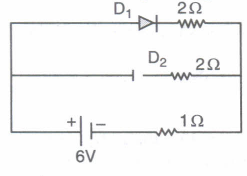
For the circuit shown here, find the current flowing through the 1\(\Omega \) resistor. Assume that the two diodes D1 and D2 are ideal diodes.
13.
According to Bohr's theory of hydrogen atom, total energy of electron in a stationary orbit is \(E=-\frac { 13.6 }{ { n }^{ 2 } } eV,\) where n is the number of orbit. Clearly, total energy of electron in a stationary orbit is negative, which means the electron is bound to the nucleus and is not free to leave it. An n increases, value of negative energy decreases, i.e., energy is progressively larger in the outer orbits.
Read the above passage and answer the following questions :
(i) What is total energy of electron in ground state of hydrogen atom? What does it imply?
(ii) Energy required to remove an electron is smaller when atoms is in any one excited state. Comment.
(iii) How is this concept translated in day to day life?
14.
In the famous conversation, Rakesh Sharma, the first Indian Astronaut in space, was asked by the Prime Minister Indira Gandhi as to how India looked from space.To which he replied,'Sare Jahan Se Achcha' (better than the whole world).
Read the above passage and answer the following questions:
(i) Which scientific mode of communication enabled the Prime Minister to speak to the Astronaut?
(ii) Name the scientific values displayed in this anecdote.
(iii) Which values are being reflected in the reply given by the astronaut?
(iv) Give one more example of this scientific mode of communication in everyday life situations.
15.
The main aim of Davisson and Germer was to study about nickel surface by directing beam of electrons at its surface and note the number of electrons that bounced off at different angles. The carried out their experiment inside a vacuum chamber where an air after entering the chamber gives an oxide film on nickel surface. Again the does their experiment and found that the electrons which hits the nickel surface were scattered by atoms that appears from crystal planes in nickel crystal. By doing their regular experiment, Davisson and Germer's at once found diffraction of electrons which was an initial proof that confirm about de Broglie's hypothesis and shows wave properties in particles.
(a) What can we infer about the values shown by Davisson and Germer?
(b) Write the expression to find the wavelength of an electron when accelerated through a potential difference of V volts.
1.
(a)
1.003 MHz and 0.997 MHz
2.
(a)
36 x 103 km
3.
(c)
\(V/1840 volt\)
4.
(a)
2 : 1
5.
(a)
\(300cos\left( 15t\ +\frac { \pi }{ 3 } \right) \)
6.
Given , E = 12.5MeV = 12.5 x 1.6 x 10-13J
For gold Z = 79
Since \(r_0{1\over4\pi\epsilon_0}{2e^2\over E}\) (for particle charge = 2e)
or \(r_0={9\times10^9\times2\times79\times1.6\times1.6\times10^{-38}\over12.5\times1.6\times10^{-13}}\)
= 1.8 x 10⁻¹⁴ m.
7.
Given, \(\phi_{0}=2.0 \mathrm{eV} ; h-6.63 \times 10^{-34} \mathrm{~J}-\mathrm{s}, \mathrm{KE}_{\max }-?\)
In one complete vibration twice the electric field becomes zero, so the frequency of incident light is given by
\(\mathrm{V}=\frac{1}{2} \times 2.4 \times 10^{15}=1.2 \times 10^{15} \mathrm{~Hz}\)
Hence, maximum kinetic energy,
\(\mathrm{KE}_{\max }=h v-\phi_{0}=\frac{6.63 \times 10^{-34} \times 1.2 \times 10^{15}}{1.6 \times 10^{-19}}-2=2.97 \mathrm{eV}\)
8.
\((a)\quad \lambda =\frac { h }{ \sqrt { 2Km } } \ or \ K=\frac { { h }^{ 2 } }{ 2{ \lambda }^{ 2 }m }\)
\(K=\frac { { \left( 6.63\times { 10 }^{ -34 } \right) }^{ 2 } }{ 2\times { \left( 1.4\times { 10 }^{ -10 } \right) }^{ 2 }\times 1.675\times { 10 }^{ -27 } } =6.634\times { 10 }^{ -21 }J\)
(ii) Kinetic energy associated with temperature
\(\mathrm{KE}=\frac{3}{2} k T=\frac{3}{2}\left(1.38 \times 10^{-23}\right) \times 300\)
= 6.21 x 10⁻²¹J
[\(\because\) absolute temperature, T = 300K and Boltzmann's constant, k =1.38 x 10⁻²³J / K]
KE =6.21 x 10⁻²¹J
de-Broglie wavelength associated with kinetic energy,
\(\lambda=\frac{h}{\sqrt{2 m_{n} \mathrm{KE}}}=\frac{6.63 \times 10^{-34}}{\sqrt{2 \times 1.675 \times 10^{-27} \times 6.21 \times 10^{-21}}}\)
\(=1.45 \times 10^{-10} \mathrm{~m}=1.45 \dot A\)
9.
(i) The ionosphere can act as a 'reflector' only for e.m. waves of frequencies upto 30 to 40 MHz. Higher frequency e.m. waves penetrate the atmosphere an escape.
(ii) The range is (fairly) limited because the e.m waves loose energy (fairly rapidly) when they glide over the surface of the earth.
(iii) This is because of the presence of a network of base stations' / cells' which keep on passing the signals from one base station/cell to the other
10.
In photoelectric emission, \(\frac { 1 }{ 2 } { mv }^{ 2 }=hv-{ \phi }_{ 0 }\)
The increase in frequency v of the incident photon. Since the work function \({ \phi }_{ 0 }\)of a given photosensitive surface being fixed, therefore the kinetic energy of the photoelectron increases with increase in the frequency of incident light due to it, the velocity v of photoelectrons increases.
11.
This is because nuclear fusion requires temperatures as high as \({ 10 }^{ 6 }-{ 10 }^{ 7 }\ K\). Such high temperature is often generated in nuclear fission. That is why fission proceeds fusion. These processes cannot be carried out in laboratory.
12.
Diode D1 is forward biased while diode D2 is reverse biased. Hence the resistances of (ideal) diodes 01 and D2 can be taken as zero and infinity respectively. The given circuit can therefore be redrawn as shown in the figure.
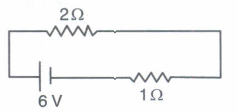
∴ Using ohm's law
1 = \({6\over(2+1)}2A\)
\(\therefore\) Current following in the 1 \(\Omega \) resistor, is 2 A.
13.
(i) For ground state, n = 1
\(\therefore E=\frac { -13.6 }{ { n }^{ 2 } } eV= \ \frac { -13.6 }{ { I }^{ 2 } } eV= \ -13.6 \ eV\)
It implies that 13.6 eV energy is required to remove an electron from hydrogen atom in its ground state.
(ii) In first excited state, n = 2,
\(\therefore \ E=-\frac { 13.6 }{ { 2 }^{ 2 } } eV \ = \ -3.4eV\)
It means that energy required to remove an electron from hydrogen atom in first excited state is 3.4 eV, which is less than 13.6 eV. Therefore, the statement is true.
(iii) Negative energy of electron indicates that it is bound to the nucleus and cannot leave it until energy equal to its negative energy is supplied from outside. The same is true in day to day life. A person intending to leave the country has to show that nothing is pending against him in a court of law, and he has cleared income tax/sales tax payments due from him. A person from whom any type of payment is due, is not free to leave the country. He is bound till he clears all his dues.
14.
(i) Radio wave communication system.
(ii) Use of scientific and technological advancement in service to mankind.
(iii) Patriotism and love for the country, presence of mind.
(iv) Television communication system.
15.
(a) Perseverance, not giving up and patience.
(b) \(\lambda =\frac { 12.27 }{ \sqrt { V } } \)\(\overset { o }{ A } \)

12th Standard CBSE Syllabus & Materials
12th Standard CBSE
CBSE 12th Chemistry d- and f- Block Elements Important Questions And Answers Study Material - QB365 Set A
NEW12th Standard CBSE
CBSE 12th Chemistry Chemical Kinetics Important Questions And Answers Study Material - QB365 Set B
NEW12th Standard CBSE
CBSE 12th Chemistry Chemical Kinetics Important Questions And Answers Study Material - QB365 Set A
NEW12th Standard CBSE
CBSE 12th Chemistry Electrochemistry Important Questions And Answers Study Material - QB365 Set C



NCERT Books

Syllabus

Exam Pattern

Sample Question Papers

Previous year Question Papers

Important Notes

MCQ Practice test

NCERT Exemplers

Case study Questions

Image Based Questions

Passage based Questions

HOT Questions

Value Based Questions

Model Questions Papers
NCERT ( Book Back ) Questions

Assertion and Reason
Important Questions And Answers

CBSE 12th Standard CBSE Subjects
CBSE Standards