
12th Standard CBSE Syllabus & Materials
12th Standard CBSE
CBSE 12th Biology Sexual Reproduction in Flowering Plants Assertion and Reason Study Material - QB365 Set D
NEW12th Standard CBSE
CBSE 12th Biology Sexual Reproduction in Flowering Plants Assertion and Reason Study Material - QB365 Set C
NEW12th Standard CBSE
CBSE 12th Biology Sexual Reproduction in Flowering Plants Assertion and Reason Study Material - QB365 Set B
NEW12th Standard CBSE
CBSE 12th Biology Sexual Reproduction in Flowering Plants Assertion and Reason Study Material - QB365 Set A
NEW12th Standard CBSE
CBSE 12th Standard Biology Sexual Reproduction in Flowering Plants Sample Question Papers Study Material - QB365 Set 1
NEW12th Standard CBSE
CBSE 12th Chemistry d- and f- Block Elements Important Questions And Answers Study Material - QB365 Set B

Published on: 25/10/2025
Download CBSE Class 12th Standard CBSE Physics question papers, sample papers, important questions, and previous year solved papers in PDF format. Get free study materials, NCERT solutions, and exam preparation resources for Class 12th Standard CBSE Physics
Questions + Answers key
Take MCQ Physics Test
1.
In Rutherford scattering experiment, if a proton is taken instead of an alpha particle, then for same distance of closest approach, how much K.E. in comparison to K.E of \(\alpha \) particle will be required?
2.
In a hydrogen atom, if the electron is replaced by a particle which is 200 times heavier but has the same charge, how would its radius change?
3.
Show that Bohr's second postulate "The electron revolves around the nucleus only in certain fixed orbits without radiating energy" can be explained on the basis of de-Broglie hypothesis of wave nature of electron.
4.
Find the ratio of energies of photons produced due to transition of electron of hydrogen atom from it's
(i) second permitted energy level to the first level
(ii) highest permitted energy level to the first permitted level.
5.
The figure shows energy level diagram of hydrogen atom.
(i) Find out the transition which results in the emission of a photon of wavelength 496 nm.
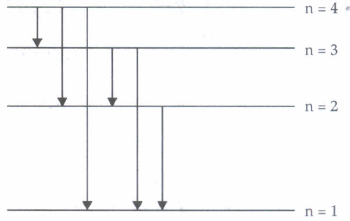
(ii) Which transition corresponds to the emission of radiation of maximum wavelength? justify your answer.
6.
Calculate shortest wavelength of Balmer series. Given \(R=1.097\times { 10 }^{ 7 }{ m }^{ -1 }\).
7.
The wavelength of \({ H }_{ \beta }\) line of Balmer series is \(4861\mathring { A } \). Calculate the wavelength of \({ H }_{ \alpha }\) line of series.
8.
(a) Using de Broglie's hypothesis, explain with the help of a suitable diagram, Bohr's second postulate of quantization of energy levels in a hydrogen atom.
(b) The ground state energy of hydrogen atom is -13.6 eV. What are the kinetic and potential energies of the electron in this state?
9.
The electron in a given Bohr orbit has a total energy of - 1.5 eV. Calculate its
(i) kinetic energy
(ii) potential energy
(iii) the wavelength of radiation emitted, when this electron makes a transition to the ground state.
[Given, energy in the ground state = - 13.6 eV and Rydberg's constant = 1.09 x 10⁷m-1]
10.
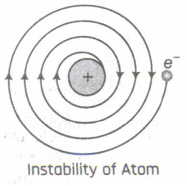
State the basic assumption of the Rutherford model of the atom. Explain in brief why this model cannot account for the stability of an atom?
11.
(a) Using Bohr's postulates derive the expression for the total energy of the electron in the stationary states of the hydrogen atom.
(b) Using Ryberg formula, calculate the wavelengths of the spectral lines of the first member of the Lyman series and of the Balmer series.
1.
At the distance of closest approach \(\left( { r }_{ 0 } \right) \),
\(K{ E }_{ \alpha }=\frac { \left( Ze \right) \left( 2e \right) }{ 4\pi { \epsilon }_{ 0 }{ r }_{ 0 } } \) and \(K{ E }_{ p }=\frac { \left( Ze \right) \left( e \right) }{ 4\pi { \epsilon }_{ 0 }{ r }_{ 0 } }\).
Clearly, \(K{ E }_{ p }=\frac { 1 }{ 2 } K{ E }_{ \alpha } \)
2.
As radius, \(r\propto \frac { 1 }{ m } \)
\(\therefore \) When electron is replaced by a particle 200 times heavier, the radius would decrease to \(\frac { 1 }{ 200 } \) time the original radius.
3.
When an electron of mass m is confined to move on a line of length l with velocity v, the de-Broglie wavelength \(\lambda \) associated with electron is \(\lambda =\frac { h }{ mv } =\frac { h }{ p } \ \ or \ \ p=\frac { h }{ \lambda } =\frac { h }{ { 2l }/{ n } } =\frac { nh }{ 2l } \)
When electron revolves in a circular orbit of radius r; then \(2l=2\pi r\)
\( \ \therefore \ \ p=\frac { nh }{ 2\pi r } \\ \ \ or \ \ p\times r=\frac { nh }{ 2\pi } \)
i.e., angular momentum \((p\times r)\) of electron is integral multiple of \({ h }/{ 2\pi }\) . This is Bohr's quantization condition of angular momentum.
4.
(i) 10.2 eV;
(ii) The highest permitted energy level to the first permitted level,
\(\Delta E=E_{\infty}-E_1\) = 0 - (-13.6) = 13.6 eV
Ratio of energies of photon
\(=\frac{10.2}{13.6}=\frac{3}{4}=3: 4\)
5.
(i) For hydrogen atom,
E1 = -13.6 eV
E2 = -3.4 eV
E3 = -1.51 eV
E4 = -0.85 eV
h = 6.63x10⁻³⁴ Js;
c = 3 x 10⁸ ms-1
Photon Energy = \(\frac{hc}{\lambda}\)
=\(\frac{6.63\times 10^{-34}\times 3\times 10^{8}}{496\times 10{-9}\times 1.6\times10^{-19}}\)
= 2.5 eV
This equals (nearly) the difference (E4- E2).
Hence the required transition is (n = 4) to ( n = 2)
(ii) The transition n = 4 to n = 3 corresponds to emission of radiation of maximum wavelength.
It is so because this transmission gives out the photon of least energy.
6.
\(3646.8\mathring { A } \)
\(Take \ { n }_{ 1 }=2 \ and \ { n }_{ 2 }=\infty \)
7.
\( 6562\mathring { A } \)
For \({ H }_{ \alpha }\) line, \({ n }_{ 1 }=2\ and\ { n }_{ 2 }=3\) and for \({ H }_{ \beta }\) line \({ n }_{ 1 }=2\ and\ { n }_{ 2 }=4\)
8.
\(\lambda=\frac{h}{p}=\frac{h}{mv}\)
\(2\pi r = n \lambda\)
\({2\pi r }= {n} \frac {h}{mv}\)
\(mvr = L = \frac {nh}{2n}\)
(b) kinetic energy = 13.6 eV
Potential energy = -27.2 eV
9.
(i) The kinetic energy (EK) of the electron in an orbit is equal to negative of its total energy (E).
EK = -E = -(-1.5) = 1.5 eV
(ii) The potential energy (Ep) of the electron in an orbit is equal to twice its total energy (E).
EP = 2E = -1.5 x 2 = -3eV
(iii) As, a result of transition of electron from excited state to ground state.
Energy of radiation = -1.5 - (- 13.6)
(\(\because\) Ground state energy of H-atom = - 13.6 eV)
E = hv = h\(\frac { c }{ \lambda } \)
\(\Rightarrow\) \(\frac { hc }{ \lambda } =12.1eV\) = energy of radiation
\(\therefore \frac { 1 }{ \lambda } =\frac { 12.1\times 1.6\times { 10 }^{ -19 } }{ 6.62\times { 10 }^{ -34 }\times 3\times { 10 }^{ 8 } } \)
\(\Rightarrow \lambda =1.025\times { 10 }^{ -7 }m=1025\mathring { A } \)
10.
Basic assumptions of Rutherford atomic model are given below:
(i) The atom consists of small central core called atomic nucleus in which whole mass and positive charge is assumed to be concentrated.
(ii) The size of the nucleus is much smaller than the size of the atom
(iii) The nucleus is surrounded by electrons. Atoms are electrically neutral as the total negative charge of electrons surrounding the nucleus is equal to the total positive charge on the nucleus.
(iv) Electrons revolve around the nucleus in various circular orbits and necessary centripetal force is provided by the electrostatic force of attraction between the positively charged nucleus and negatively charged electrons.
Stability of atom When an electron revolves around the nucleus, then it radiates electromagnetic energy and hence, the radius of the orbit of electron decreases gradually. Thus, electron revolve on spiral path of decreasing radius and finally, it should fall into the nucleus, but this does not happen. Thus, Rutherford atomic model cannot account for the stability of the atom.
11.
\(mvr = \frac {nh}{2\pi}\)
\(\frac { { mv }^{ 2 } }{ r } =\frac { 1 }{ 4\pi { \varepsilon }_{ 0 } } \frac { { e }^{ 2 } }{ { r }^{ 2 } } \)
\(r=\frac { { e }^{ 2 } }{ { 4\pi \varepsilon }_{ 0 }{ mv }^{ 2 } } \)
\(r=\frac { { Ze }^{ 2 } }{ { 4\pi \varepsilon }_{ 0 }m{ \left( \frac { nh }{ 2\pi mr } \right) }^{ 2 } } \)
\(\Rightarrow\) \(r=\frac { { \epsilon }_{ 0 }{ n }^{ 2 }{ h }^{ 2 } }{ { \pi me }^{ 2 } } \)
Potential energy U \(=-\frac { 1 }{ 4{ \pi \epsilon }_{ 0 } } .\frac { { e }^{ 2 } }{ { r } } \)
\(=\frac { { me }^{ 4 } }{ { 4\epsilon }_{ 0 }{ n }^{ 2 }{ h }^{ 2 } } \)
\(KE=\frac { 1 }{ 2 } { mv }^{ 2 }=\frac { 1 }{ 2 } m{ \left( \frac { nh }{ 2\pi mr } \right) }^{ 2 }\)
\(=\frac { { n }^{ 2 }{ h }^{ 2 }{ \pi }^{ 2 }{ m }^{ 2 }{ e }^{ 4 } }{ { 8\pi }^{ 2 }{ me }_{ 0 }^{ 2 }{ n }^{ 2 }{ h }^{ 2 } } \)
\(KE=\frac { { me }^{ 4 } }{ { 8\varepsilon }_{ 0 }^{ 2 }{ n }^{ 2 }{ h }^{ 2 } } \)
TE = KE + PE
\(=-\frac { { me }^{ 4 } }{ { 8\epsilon }_{ 0 }^{ 2 }{ n }^{ 2 }{ h }^{ 2 } } \)
(b)Rydberg formula: For first member of Lyman series
\(\frac { 1 }{ \lambda } =R\left( \frac { 1 }{ { 1 }^{ 2 } } -\frac { 1 }{ { 2 }^{ 2 } } \right) \)
\(=\frac { 4 }{ 3R } \)
For first member of Balmer Series
\(\frac { 1 }{ \lambda } =R\left( \frac { 1 }{ { 2 }^{ 2 } } -\frac { 1 }{ { 3 }^{ 2 } } \right) \)
\(\lambda =\frac { 36 }{ 5R } \)

12th Standard CBSE Syllabus & Materials
12th Standard CBSE
CBSE 12th Chemistry d- and f- Block Elements Important Questions And Answers Study Material - QB365 Set A
NEW12th Standard CBSE
CBSE 12th Chemistry Chemical Kinetics Important Questions And Answers Study Material - QB365 Set B
NEW12th Standard CBSE
CBSE 12th Chemistry Chemical Kinetics Important Questions And Answers Study Material - QB365 Set A
NEW12th Standard CBSE
CBSE 12th Chemistry Electrochemistry Important Questions And Answers Study Material - QB365 Set C



NCERT Books

Syllabus

Exam Pattern

Sample Question Papers

Previous year Question Papers

Important Notes

MCQ Practice test

NCERT Exemplers

Case study Questions

Image Based Questions

Passage based Questions

HOT Questions

Value Based Questions

Model Questions Papers
NCERT ( Book Back ) Questions

Assertion and Reason
Important Questions And Answers

CBSE 12th Standard CBSE Subjects
CBSE Standards