
12th Standard CBSE Syllabus & Materials
12th Standard CBSE
CBSE 12th Biology Sexual Reproduction in Flowering Plants Assertion and Reason Study Material - QB365 Set D
NEW12th Standard CBSE
CBSE 12th Biology Sexual Reproduction in Flowering Plants Assertion and Reason Study Material - QB365 Set C
NEW12th Standard CBSE
CBSE 12th Biology Sexual Reproduction in Flowering Plants Assertion and Reason Study Material - QB365 Set B
NEW12th Standard CBSE
CBSE 12th Biology Sexual Reproduction in Flowering Plants Assertion and Reason Study Material - QB365 Set A
NEW12th Standard CBSE
CBSE 12th Standard Biology Sexual Reproduction in Flowering Plants Sample Question Papers Study Material - QB365 Set 1
NEW12th Standard CBSE
CBSE 12th Chemistry d- and f- Block Elements Important Questions And Answers Study Material - QB365 Set B

Published on: 25/10/2025
Download CBSE Class 12th Standard CBSE Physics question papers, sample papers, important questions, and previous year solved papers in PDF format. Get free study materials, NCERT solutions, and exam preparation resources for Class 12th Standard CBSE Physics
Questions + Answers key
Take MCQ Physics Test
1.
Define ionisation energy. How would the ionisation energy change when electron in hydrogen atom is replaced by a particle 200 times heavier than electron, but having the same charge?
2.
Why is choke coil needed in the use of fluorescent tubes with ac mains?
3.
How is nuclear size related to its mass number?
4.
Can total internal reflection occur when light goes from a rarer to a denser medium.
5.
Two waves of amplitudes 3mm and 2mm reach a point in the same phase.What is the resultant amplitude?
6.
Assuming an electron is confined to a 1nm wide region, find the uncertainty in momentum using Heisenberg Uncertainty principle \(\left( \Delta x\Delta p\approx \hbar \right) \). You can assume uncertainty in position \(\Delta x\) as 1nm. Assuming p = \(\Delta p\)find the energy in electron volts.
7.
A neutron beam of energy E scatters from atoms on a surface with a spacing d = 0.1nm. The first maximum of intensity in the reflected beam occurs at \(\theta =30°\) . What is the kinetic energy E of the beam in eV?
8.
Define the term self-inductance of a coil.Write its SI unit.
9.
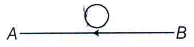
The electric current flowing in a wire in the direction from B to A is decreasing. Find out the direction of the induced current in the metallic loop kept near the wire as shown in the figure below
10.
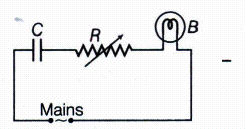
A capacitor C, a variable resistance R and a bulb B are connected in series to the AC mains in circuit as shown in the figure.The bulb glows of the bulb change, if
(i) a dielectric slab is introduced between the plates of the capacitor, keeping resistance R to be same;
(ii) the resistance R is increased keeping will capacitance?
11.
When monochromatic light travels from a rarer to a denser medium, explain the following, giving reasons.
(i) Is the frequency of reflected and refracted light same as the frequency of incident light?
(ii) Does the decrease in speed imply a reduction in the energy carried light wave?
12.
A proton and α particle have the same de-Broglie wavelength. Determine the ratio of
(i) their accelerating potentials
(ii) their speeds
13.
A biconvex lens made of a transparent material of refractive index 1.5 is immersed in a water of refractive index 1.33. Will the lens behave as a converging or a diverging lens? Give reason.
14.
Suppose that the lower half of the concave mirror’s reflecting surface in Fig. is covered with an opaque (non-reflective) material. What effect will this have on the image of an object placed in front of the mirror?
15.
A radioactive material is reduced to \(\frac { 1 }{ 16 } \) of its original amount in 4days. How much material should one begin with so that \(4\times { 10 }^{ -3 }kg\) of the material is left over after 6 days?
16.
You are given two converging lenses of focal lengths 1.25 cm and 5 cm to design a compound microscope. If it is desired to have a magnification of 30, find out separation between the objective and eye piece.
17.
One morning an old man walked bare-foot to replace the fuse wire in kit kat fitted with the power supply mains for his house. Suddenly he screamed and collapsed on the floor. His wife cried loudly for help. His neighbour's son Anil heard the cries and rushed to the place with shoes on. He took a wooden baton and used it to switch OFF the main supply. Answer the following questions:
What is the voltage and frequency of mains supply in India?
These days most of the electrical devices we use require AC voltage. Why?
Can a transformer be used to step-up DC voltage?
Write two qualities displayed by Anil by his action.
18.
Ravi is using yellow light in a single slit diffraction experiment with slit width of 06. mm. The teacher replaces yellow light by X-ray.
Now, he is not able to observe the diffraction pattern, he feels sad. Again the teacher replaces X-rays with yellow light and the diffraction pattern appears again. The teacher now explains the facts about the diffraction.
Read the above passage and answer the following questions:
(i) What values are displayed by the teacher?
(ii) Give the necessary condition for the diffraction.
19.
(a) A point object is placed in front of a double convex lens (of refractive index n =n2/n1 with respect air) with its spherical faces of radii of curvature R1 and R2.. Show the path of rays due to surface to obtain the formation of the real image of the object.
Hence obtain the lens maker's formula for a thin lens.
(b) A double convex lens having both faces of the same radius of curvature has refractive index 1.55. Find out the radius of curvature of the lens required to get the focal length of 20 cm.
20.
A small candle, 2.5 cm in size is placed at 27 cm in front of a concave mirror of radius of curvature 36 cm. At what distance from the mirror should a screen be placed in order to obtain a sharp image? Describe the nature and size of the image. If the candle is moved closer to the mirror, how would the screen have to be moved?
21.
(a) Describe briefly how Davisson - Germer experiment demonstrated the wave nature of electrons.
(b) An electron is accelerated from rest through a potential V. Obtain the expression for the de- Broglie wavelength associated with it.
22.
(i) Draw a labelled ray diagram showing the formation of a final image by a compound microscope at least distance of distinct vision.
(ii) The total magnification produced by a compound microscope is 20. The magnification produced by the eyepiece is 5. The microscope is focused'on a certain object. The distance between the objective and eyepiece is observed to be 14 cm.
(iii) If least distance of distinct vision is 20 cm. Calculate the focal length of the objective and the eyepiece.
23.
(a) Define self-inductance of a coil and hence write the definition of 'Henry'.
(b) Write any two factors each on which the following depends
(i) Self-inductance of a coil.
(ii) Mutual inductance of a pair, of coils
24.
Define the terms
(i) mass defect
(ii) binding energy for a nucleus and state the relation between the two.
For a given nuclear reaction, the B.E. / nucleon of the product nucleus/nuclei is more than that for the original nucleus/nuclei. Is this nuclear reaction exothermic or endothermic in nature? Justify your choice.
25.
Show that a convex lens produces an N times magnified image when the objet distances, from the lens, have magnitudes (f ± f / N). Here f is the magnitude of the focal length of the lens. Hence find the two values of object distance, for which a convex lens, of power 2.5D, will produce am image that is four times as large as the object?
1.
Ionisation energy is the minimum energy required to knock out an electron from an atom.Its value will be different for different atoms. Ionisation energy will also depend on the orbit from which electron is to be removed.
When an electron in hydrogen atom is replaced by a particle 200 times heavier than electron but having the same charge, ionisation energy will not change, as it depends only on charge and not on mass of particle.
2.
A choke coil reduces the voltage across the fluorescent tube without wastage of power.
3.
The radius R of atomic nucleus related to mass number A of the nucleus as \(R=R_0 A^{1 / 3} \text { where } R_0=1.2 \times 10^{-15} \mathrm{~m}\) an empty constant.
4.
No, Total internal reflection cannot occur.
5.
Resultant amplitude = 3 + 2 = 5mm
6.
\(\Delta x=1 \mathrm{~nm}=10^{-9} \mathrm{~m}, \Delta p=? \text { As, } \Delta x \Delta p \approx \hbar\)
\(
\therefore \quad \Delta p=\frac{\hbar}{\Delta x}=\frac{h}{2 \pi \Delta x}=\frac{6.6 \times 10^{-34} \mathrm{~J}-8}{2 \times(22 / 7)\left(10^{-9}\right) \mathrm{m}} \\
=1.05 \times 10^{-25} \mathrm{~kg}-\mathrm{m} / \mathrm{s} \\
\text { Energy }(E)=\frac{p^2}{2 m}=\frac{(\Delta p)^2}{2 m} \quad[\because p \approx \Delta p] \\
=\frac{\left(1.05 \times 10^{-25}\right)^2}{2 \times 9.1 \times 10^{-31}} \mathrm{~J} \\
=\frac{\left(1.05 \times 10^{-25}\right)^2}{2 \times 9.1 \times 10^{-31} \times 1.6 \times 10^{-10}} \mathrm{eV} \\
=3.8 \times 10^{-2} \mathrm{eV}
x\)
7.
\(K E=\frac{1}{2} \frac{p^2}{m}=\frac{1}{2} \times \frac{\left(6.63 \times 10^{-24}\right)^2}{1.67 \times 10^{-27}} J=\frac{1}{2} \frac{\left(6.63 \times 10^{-24}\right)^2}{1.67 \times 10^{-27} \times\left(1.6 \times 10^{-19}\right)} \mathrm{eV}=0.082 \mathrm{eV}\)
8.
Self-inductance is the property of a coil by virtue of which, the coil opposes any change in the strength of the current flowing through it by including an emf in itself.
Its SI unit is henry(H).
9.
According to Lenz's law, the direction of induced current will oppose the cause of its production. So, the current in the loop will induce in such a way that it will support the current flowing in the wire, i.e in the same direction. So, the direction of current in the loop will be clockwise.
10.
(i) As the electric slab is introduced between the plates of the capacitor, its capacitance. Hence, the potential drop across the capacitor will i.e \(V=\frac { Q }{ C } \)
As a result, the potential drop across the bulb will increase as they are connected in series. Thus its brightness will increase.
(ii) As a resistance R is increased, the potential drop across the resistor will increase. As a result, the potential drop across the bulb will decrease as they are connected in series. Thus, its brightness will decrease.
11.
(i) The frequency of reflected and refracted light remains same as that of incident light because frequency only depends on the source of light.
(ii) Since the frequency remains same, hence there is no reduction in energy.
12.
(i) The de-Broglie wavelength of a particle is given by
\(\lambda =\frac { 12.27 }{ \sqrt { V_{ } } } \mathring { A } \)
[Where, V is the accelerating potential of the particle]
\(\because \quad \lambda _{ p }=\lambda _{ \alpha }\) [given]
\(=\frac { 12.27 }{ \sqrt { V_{ p } } } =\frac { 12.27 }{ \sqrt { V_{ \alpha } } }\)
\( \Rightarrow \frac { V_{ p } }{ V_{ \alpha } } =1\)
(ii) The de-Broglie wavelength of the particle is given by
\(\lambda =\frac { h }{ mv } \)
\( \lambda _{ p }=\frac { h }{ m_{ p }.v_{ p } } \ and \ \lambda _{ \alpha }=\frac { h }{ m_{ \alpha }v_{ \alpha } } \)
We know that, \(\\ m_{ \alpha }=4 m _{ p }\)
\( \because \lambda_{p}=\lambda_{\alpha} \) [given]
\( \therefore \frac{h}{m_{p} \cdot v_{p}}=\frac{h}{4 m_{p} \cdot v_{\alpha}} \Rightarrow \frac{v_{p}}{v_{\alpha}}=4 \)
13.
A biconvex lens acts as a converging lens in air because the refractive index of air is less than that of the material of the lens. The refractive index of water is less than the refractive index of the material of the lens (1.5). So, its nature will not change, it behaves as a converging lens.
14.
You may think that the image will now show only half of the object, but taking the laws of reflection to be true for all points of the remaining part of the mirror, the image will be that of the whole object. However, as the area of the reflecting surface has been reduced, the intensity of the image will be low (in this case, half).
15.
\(Here,\ \frac { N }{ { N }_{ 0 } } =\frac { 1 }{ 16 } \ t=4 \ days\)
\(As\quad \frac { N }{ { N }_{ 0 } } ={ \left( \frac { 1 }{ 2 } \right) }^{ n }=\frac { 1 }{ 16 } ={ \left( \frac { 1 }{ 2 } \right) }^{ 4 }\therefore n=4\)
\(Half-life\quad T=\frac { t }{ n } =\frac { 4 }{ 4 } =1\ day\)
\(Now, \ N=4\times { 10 }^{ -3 }kg,\ t=6\ days,{ N }_{ 0 }=?\)
\(As \ \frac { N }{ { N }_{ 0 } } ={ \left( \frac { 1 }{ 2 } \right) }^{ n' }={ \left( \frac { 1 }{ 2 } \right) }^{ 6/1 }=\frac { 1 }{ 64 } \)
\( \therefore \ { N }_{ 0 }=64N=64\times 4\times { 10 }^{ -3 }=0.256\ kg\)
16.
Here, \(f_{ 0 }=1.25\ cm,\ f_{ e }=5\ cm, d=25\ cm,\ L=?,\ M=30\)
When final image is formed at the near point of eye, the magnifying power of compound microscope is given by
\(M=\frac { L }{ f_{ 0 } } \left( 1+\frac { d }{ f_{ e } } \right) \)
\( 30=\frac { L }{ 1.25 } \left( 1+\frac { 25 }{ 5 } \right) =\frac { 6L }{ 1.25 } \)
\( L=\frac { 30\times 1.25 }{ 6 } =6.25\ cm\)
17.
In India, the voltage and frequency of mains supply is 220 V and 50 Hz, respectively.
Since the power loss at 220 V supply is less than that at 110 V. So, due to this reason, most of the electrical devices require AC voltage.
Since the transformer requires an alternating magnetic flux to operate correctly, transformers cannot, therefore, be used to transform or supply DC voltages or currents. Also, the magnetic field must be changing to induce a voltage in the secondary winding. Even if in case, the transformer's primary winding is connected to a DC supply, the inductive reactance of the winding would be zero as DC has no frequency. So, the effective impedence of the winding will therfore be very low and equal only to the resistance of the copper used. Thus the winding will draw a very high current from the DC supply causing it to overheat and eventually burn out, because as, we know \(I=\frac { V }{ R } \). Anil is very helpful and has a great presence of mind as in such condition, he used the wooden baton to switch OFF the main supply.
18.
(i) The teacher displays the quality of the knowledge of the phenomenon and the conditions under which it occurs.In producing the diffraction pattern again, he demonstrates with compassion, kindness towards the child and eagerness to share the knowledge.
(ii) The necessary condition for diffraction is that the slit width should be less than wavelength of light.
19.
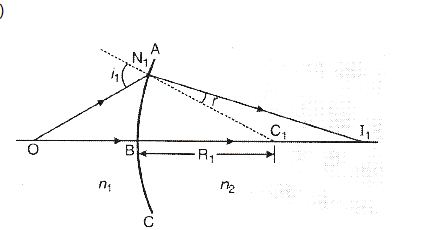
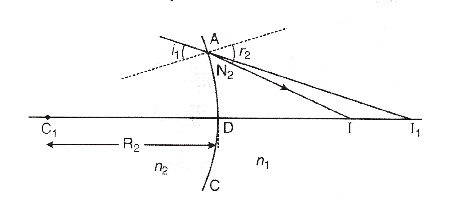
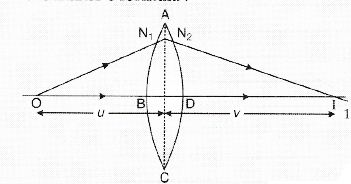
The first refracting ABC forms the image I1 of the object O. The image I1 acts as virtual object for the second refracting surface ADC, which forms the real image I as shown in the diagram
For refraction at ABC
\(\frac { { n }_{ 2 } }{ { v }_{ 1 } } -\frac { { n }_{ 1 } }{ u } =\frac { { n }_{ 2 }-{ n }_{ 1 } }{ { R }_{ 1 } } \)
For refraction at ADC
\(\frac { { n }_{ 1 } }{ v } -\frac { { n }_{ 2 } }{ { v }_{ 1 } } =\frac { { n }_{ 1 }-{ n }_{ 2 } }{ { R }_{ 2 } } \)
Adding equation (i) and equation (ii)
\(\frac { { n }_{ 1 } }{ v } -\frac { { n }_{ 2 } }{ u } =\left( { n }_{ 2 }-{ n }_{ 1 } \right) \left( \frac { 1 }{ { R }_{ 1 } } -\frac { 1 }{ { R }_{ 2 } } \right) \)
\(\frac { 1 }{ v } -\frac { 1 }{ u } =\left( \frac { { n }_{ 2 } }{ { n }_{ 1 } } -1 \right) \left( \frac { 1 }{ { R }_{ 1 } } -\frac { 1 }{ { R }_{ 2 } } \right) \)
We know, If \(u=\infty ,v=f\)
\(\frac { 1 }{ v } -\frac { 1 }{ u } =\frac { 1 }{ f } \)
\(\frac { 1 }{ f } =\left( \frac { { n }_{ 2 } }{ { n }_{ 1 } } -1 \right) \frac { 1 }{ { R }_{ 1 } } -\frac { 1 }{ { R }_{ 2 } } \)
\(\frac { 1 }{ f } =\left( { \mu }_{ 21 }-1 \right) \left( \frac { 1 }{ { R }_{ 1 } } -\frac { 1 }{ { R }_{ 2 } } \right) \)
\(\frac { 1 }{ f } =\left( { \mu }_{ 21 }-1 \right) \left( \frac { 1 }{ { R }_{ 1 } } -\frac { 1 }{ { R }_{ 2 } } \right) \)
\(\frac { 1 }{ f } =\left( 1.55-1 \right) \left( \frac { 1 }{ R } -\frac { 1 }{ -R } \right) \)
\(=0.55\times \frac { 2 }{ R } \)
\(R=0.55\times 2\times 20=22 \ cm\)
20.
Size of the candle, h = 2.5 cm
Image size = h’
Object distance, u = -27 cm
Radius of curvature of the concave mirror, R = -36 cm
\(f=\frac { R }{ 2 } =-18\)cm
Image distance = v
The image distance can be obtained using the mirror formula:
\(\frac { 1 }{ u } +\frac { 1 }{ v } =\frac { 1 }{ f } \)
\(\frac { 1 }{ v } =\frac { 1 }{ f } -\frac { 1 }{ u } \)
\(\frac { 1 }{ -18 } =\frac { 1 }{ -27 } =\frac { -3+2 }{ 54 } =-\frac { 1 }{ 54 } \)
∴ v = -54 cm
Therefore, the screen should be placed 54 cm away from the mirror to obtain a sharp image.
The magnification of the image is given as:
\(m=\frac { { h }^{ ' } }{ h } =-\frac { v }{ u } \)
\(\therefore { h }^{ ' }=-\frac { v }{ u } \times h\)
\(=-\left( \frac { -54 }{ -27 } \right) \times 2.5=-5\)cm
The height of the candle’s image is 5 cm. The negative sign indicates that the image is inverted and real.
If the candle is moved closer to the mirror, then the screen will have to be moved away from the mirror in order to obtain the image.
21.
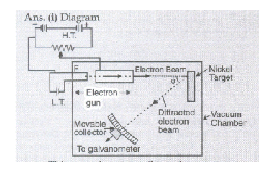
This experiment confirms the wave nature of electron.
(b) \(\lambda =\frac { h }{ p } =\frac { h }{ \sqrt { 2mK } }\)
\( K=K.E=eV\)
\(\lambda =\frac { h }{ \sqrt { 2meV } } \)
22.
Given, magnification, M = 20
Magnification of eyepiece, me = 5
Least distance vision, D = 20 cm
Distance between objective and' eyepiece,
L = 14 cm
We know that,
Magnification, M = me x mo
\(m_{ e }=\frac { m }{ m_{ e }= } =\frac { 20 }{ 5 } =4\Rightarrow m_{ e }=1+\frac { D }{ f_{ e } } \)
where, fe is focal length of eyepiece.
\(\Rightarrow 5=1+\frac { 20 }{ f } \Rightarrow f_{ e }=5cm\)
Using lens formula for eyepiece,
\(\frac { 1 }{ u_{ e } } =\frac { -1 }{ 20 } =\frac { 1 }{ 5 } =\frac { -5 }{ 20 } =\frac { -1 }{ 4 } \)
U = -4 cm
(objective distance for eyepiece)
L = Vo + I u, I = Ho = L -I u, 1= 14 - 4 = 10 cm
Magnification produced by objective,
\(m_{ e }=-\frac { v_{ e } }{ u_{ 0 } } \)
Object distance for objective,
\(u_{ e }=\frac { -v_{ e } }{ m_{ 0 } } =\frac { -10 }{ 4 } =-25cm\)
Using lens formula for objective,
\(\frac { 1 }{ f_{ 0 } } =\frac { 1 }{ v_{ 0 } } -\frac { 1 }{ u_{ 0 } } =\frac { 1 }{ 10 } -\frac { 1 }{ -2.5 } =\frac { 1 }{ 10 } +\frac { 1 }{ -2.5 } \Rightarrow f_{ 0 }=2cm\)
23.
(a) The self inductance, L, of a coil equals the magnetic flux linked with it, when a unit current flows through it.
One henry is the self inductance of a coil which the magnetic flux, linked with it, due to a current of 1A, flowing in it, equals one weber
(b) Self inductance of a coil depends on
(i) Its geometry (area and length of a coil)
(ii) Number of turns
(iii) Number of turns in each coil
(iv) Nature of medium in the intervening space
(c) Mutual inductance of a given pair of coils depends on
(i) Their geometries
(ii) Their distance of separation
(iii) Number of turns in each coil.
(iv) Nature of medium in the intervening space.
24.
(i) Mass defect (\(\Delta M\)) of any nucleus \(^A_Z X\) is the difference in the mass of the nucleus (=M) and the sum of masses of its constituent nucleons (=M').
\(\therefore\) \(\Delta M\) = M' - M
= [Zmp + (A - Z) mn] - M
where mp and mn denote the mass of the proton and the neutron respectively.
(ii) Binding energy is the energy required to separate a nucleus into its constituent nucleons. The relation between the two is
B.E. = (mass defect) c2.
(iii) There is a release of energy, i.e. the reaction is exothermic.
Reason: Increase in B.E/nucleon implies that the more mass has been converted into energy. This would result in release of energy.
25.
Magnification produced by any lens,
m = v/u = f / f + u
given m = ± N ±N = f / f + u
or f + u = ± f / N or u = - f ± f / N
hence magnitude of object distances,
|u| = f ± f / N
given P = 1/f = + 2.5 D
f = 1/ 2.5 = 0.4 m = 40 cm
Also N = 4
|u| = 40 ± 40/4 = 40 ± 10 = 50 cm or 30 cm

12th Standard CBSE Syllabus & Materials
12th Standard CBSE
CBSE 12th Chemistry d- and f- Block Elements Important Questions And Answers Study Material - QB365 Set A
NEW12th Standard CBSE
CBSE 12th Chemistry Chemical Kinetics Important Questions And Answers Study Material - QB365 Set B
NEW12th Standard CBSE
CBSE 12th Chemistry Chemical Kinetics Important Questions And Answers Study Material - QB365 Set A
NEW12th Standard CBSE
CBSE 12th Chemistry Electrochemistry Important Questions And Answers Study Material - QB365 Set C



NCERT Books

Syllabus

Exam Pattern

Sample Question Papers

Previous year Question Papers

Important Notes

MCQ Practice test

NCERT Exemplers

Case study Questions

Image Based Questions

Passage based Questions

HOT Questions

Value Based Questions

Model Questions Papers
NCERT ( Book Back ) Questions

Assertion and Reason
Important Questions And Answers

CBSE 12th Standard CBSE Subjects
CBSE Standards