
12th Standard CBSE Syllabus & Materials
12th Standard CBSE
CBSE 12th Biology Sexual Reproduction in Flowering Plants Assertion and Reason Study Material - QB365 Set D
NEW12th Standard CBSE
CBSE 12th Biology Sexual Reproduction in Flowering Plants Assertion and Reason Study Material - QB365 Set C
NEW12th Standard CBSE
CBSE 12th Biology Sexual Reproduction in Flowering Plants Assertion and Reason Study Material - QB365 Set B
NEW12th Standard CBSE
CBSE 12th Biology Sexual Reproduction in Flowering Plants Assertion and Reason Study Material - QB365 Set A
NEW12th Standard CBSE
CBSE 12th Standard Biology Sexual Reproduction in Flowering Plants Sample Question Papers Study Material - QB365 Set 1
NEW12th Standard CBSE
CBSE 12th Chemistry d- and f- Block Elements Important Questions And Answers Study Material - QB365 Set B

Published on: 25/10/2025
Download CBSE Class 12th Standard CBSE Physics question papers, sample papers, important questions, and previous year solved papers in PDF format. Get free study materials, NCERT solutions, and exam preparation resources for Class 12th Standard CBSE Physics
Questions + Answers key
Take MCQ Physics Test
1.
The bottom of a container is a 4.0 cm thick glass (n = 1.5) slab. The container contain two immiscible liquids A and B of depths 6.0 cm and 8.0 cm, respectively. what is the apparent position of a scratch on the outer surface of the bottom of the glass slab when viewed through the container? Refractive indices of A and B are 1.4 and 1.3 respectively.
2.
A compound microscope uses an objective lens of focal length 4cm and eye lens of focal length 10cm. An object is placed at 6cm from the objective lens. Calculate the magnifying power of compound microscope. Also, calculate the length of microscope.
3.
(i) Draw a neat labelled ray diagram of a compound microscope. Explain briefly its working.
(ii) Why must both the objective and the eye-piece of a compound microscope have short focal lengths ?
4.
Define power of a lens. Write its units. Deduce the relation \(\frac { 1 }{ f } =\frac { 1 }{ f_{ 1 } } +\frac { 1 }{ f_{ 2 } } \) for two thin lenses kept in contact coaxially.
5.
Taking the Bohr radius as a0 = 53pm, the radius of Li++ ion its ground state, on the basis of Bohr's model, will be about
53pm
27pm
18pm
13pm
6.
The simple Bohr model cannot be directly applied to calculate the energy levels of an atom with electrons. This because
of the electrons not being subjects to a central force
of the electrons colliding with each other
of screening effects
the force between the nucleus and an electron will no longer be given by Coulomb's law
7.
For the ground state, the electron in the H-atom has an angular momentum =h, according to the simple Bohr model. Angular momentum is a vector and hence there will be infinitely many orbits with the vector pointing in all possible directions. In actuality, this is not true,
because only one of these would have a minimum energy
because only one of these would have a minimum energy
angular momentum must be in the direction of spin of electron
because electrons go arround only in horizontal obits.
8.
The Bohr model for the spectre of a H-atom
will not be applicable to hydrogen in the molecular form
will not be applicable as it is for a He-atom
is valid only at room temperature
predicts continuous as well as discrete spectral lines
9.
The Balmer series for the H-atom can be observed
if we measure the frequencies of light emitted when an excited atom falls to the ground state
if we measure the frequencies of light emitted due to transitions between excited states and the first excited state
in any transition in a H-atom
as a sequence of frequencies with the higher frequencies getting closely packed.
10.
The binding energy of a H-atom, considering an electron moving around a fixed nuclei (proton), \(B=-\frac { { me }^{ 4 } }{ 8{ n }^{ 2 }{ \epsilon }_{ 0 }^{ 2 }{ h }^{ 2 } } \) is (m = electron mass). If one decides to work in a frame of reference where the electron is at rest, the proton would be moving around it. By similar arguments, the binding energy would be \(B=-\frac { { Me }^{ 4 } }{ 8{ n }^{ 2 }{ \epsilon }_{ 0 }^{ 2 }{ h }^{ 2 } } \left( M=proton \ mass \right) \) This last expression is not correct because
n would not be integral
Bohr-quantisation applies only to electron
the frame in which the electron is at rest is not inertial
the motion of the proton would not be in circular orbits, even approximately
11.
In a concave mirror, an object is placed at a distance \({ d }_{ 1 }\) from the focus and the real image is formed at a distance \({ d }_{ 2 }\) from the focus. then the focal length of the mirror is:
\(\sqrt { { d }_{ 1 }{ d }_{ 2 } } \)
\({ d }_{ 1 }{ d }_{ 2 }\)
\({ { (d }_{ 1 }{ /d }_{ 2 }) }^{ /2 }\)
\(\sqrt { { d }_{ 1 }{ /d }_{ 2 } } \)
12.
The relation between focal length \(f\) and radius of curvature \(R\) of a spherical mirror is
\(f=R\)
\(f=R/2\)
\(f=2 R\)
none of these
13.
The correct mirror equation is
\(\frac { 1 }{ f } =\frac { 1 }{ \upsilon } +\frac { 1 }{ u } \)
\(\frac { 1 }{ f } =\frac { 1 }{ \upsilon } -\frac { 1 }{ u } \)
\(\frac { 1 }{ f } =\frac { 1 }{ u } -\frac { 1 }{ \upsilon } \)
none of these
14.
When diameter of objective of an astronomical telescope is doubled, its limit of resolution is
doubled
quadrapled
halved
unaffected
15.
For total internal reflection, light must travel
from rarer to denser medium
from denser to rarer medium
in air only
in water only
16.
Optical fibres are based on the phenomenon of
reflection
refraction
dispersion
total internal reflection
17.
One dioptre is the power of a lens of focal length
1 cm
1 m
-1 cm
-1 m
18.
In a compound microscope, the distance between objective lens and eye lens is
fixed
variable
infinite
1 metre
19.
The final image in an astronomical telescope (w.r.t. object) is
virtual and erect
real and erect
real and inverted
virtual and inverted
20.
An astronomical telescope has a magnifying power of 10. In normal adjustment, distance between the objective and eye piece is 22 cm. The focal length of objective lens is
10 cm
22 cm
20 cm
2 cm
21.
In a hydrogen atom, if the electron is replaced by a particle which is 200 times heavier but has the same charge, how would its radius change?
22.
Show that Bohr's second postulate "The electron revolves around the nucleus only in certain fixed orbits without radiating energy" can be explained on the basis of de-Broglie hypothesis of wave nature of electron.
23.
Find the ratio of energies of photons produced due to transition of electron of hydrogen atom from it's
(i) second permitted energy level to the first level
(ii) highest permitted energy level to the first permitted level.
24.
At what angle of incidence should a light beam strike a glass slab of \(\mu =\sqrt { 3 } \), such that reflected and refracted rays are perpendicular to each other?
25.
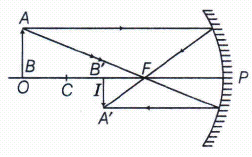
An onject AB is kept in front of a concave mirror as shown in the figure.
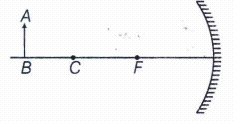
Complete the ray diagram showing the image formation of the object.
26.
(i) A point object O is kept in amedium of refractive index n1, in front of a convex spherical surface of radius of curvature R which separates the second medium of refractive index n2 from the first one, as shown in the figure.
Draw the ray diagram showing the image formation and deduce the relationship between the object distance and the image distance in term of n1, n2 and R.
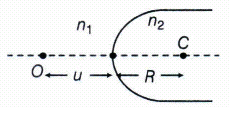
(ii) When the image formed above acts as a virtual object for a concave spherical surface separating the medium n2 from n1(n2 > n1), draw this ray diagram and write the similar [similar to (i)] relation. Hence, obtain the expression for lens maker's formula.
27.
(a) Draw a labelled ray diagram of an astronomical telescope to show the image formation of a distant object. Write the main considerations required in selecting the objective and eyepiece lenses in order to have large magnifying power and high resolution of the telescope.
(b) A compound microscope has an objective of focal length 1.25 cm and eyepiece of focal length 5 cm. A small object is kept at 2.5 cm from the objective. If the final image formed is at infinity, find the I distance between the objective and the eyepiece.
28.
(i) Draw a ray diagram for formation of image of a point object by a thin double convex lens having radii of curvatures R1 and R2 and hence, derive lens maker's formula. Define power of a lens and give its 81 unit. If a convex lens of length 50 cm is placed in contact coaxially with a concave lens of focal length 20 cm, what is the power of the combination?
29.
(a) Write two important limitations of Rutherford model which could not explain the observed features of atomic spectra. How were these explained in Bohr's model of hydrogen atom? Use the Rydberg formula to calculate the wavelength of the H∝ line.
(b) Using Bohr's postulates, obtain the expression for the radius of the nth orbit in hydrogen atom.
1.
The total apparent shift in the position of the image due to all the three media is
given by
d = t1[1-1/(\({ \mu }\)1) + t2[1-1/(\({ \mu }\)2) + t3[1-1/(\({ \mu }\)3)
Given t1 = 4.0 cm, t2 = 6.0 cm , t3 = 8.0 cm
\({ \mu }\)1 = 1.5 , \({ \mu }\)2=1.4 , \({ \mu }\)3 = 1.3 cm
d = 4.0(1-1/1.5) + 6.0(1-1/1.4) + 8.0(1-1/1.3)
= 1.33 + 1.71 + 1.85 = 4.89 cm
2.
Here, fo = 4cm, fe = 10cm, u0 = -6cm
From\({1\over v_0}-{1\over u_0}={1\over f_0}\)
\({1\over v_0}={1\over f_0}+{1\over u_0}={1\over 4}-{1\over 6}={1\over 12}\)
v0 = 12cm
\(M={v_0\over |u_0|}\left( 1+{d\over f_e}\right)={12\over 6}\left(1+{25\over10}\right)=7\)
Length of microscope = L = v0 + fe
12 + 10 = 22 cm
3.
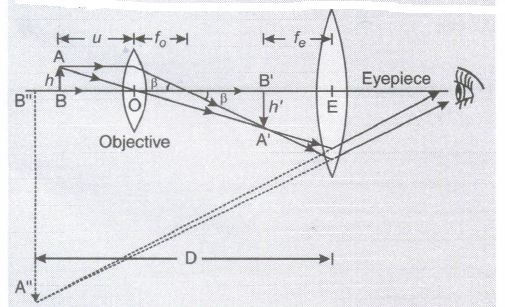
(Deduct 1/2 mark if labeling is not done or arrows are not shown)
(ii) The objective forms a real, inverted, magnified image of the object. This serves as the object for the second lens, the eyepiece, which functions essentially like a simple microscope or magnifier, produces the final image, which is enlarged and virtual.
To achieve a large magnification of a small object both the objective and the eyepiece should have small focal lengths.
4.
The power of a lens is equal to the reciprocal of its focal length when it is measured in metre. Power of a lens, P = \(\frac { 1 }{ f\left( metre \right) } \) its SI unit is dioptre(D).
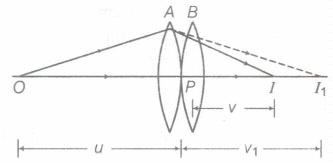
Consider two lenses A and B of focal lengths, f1 and f2 placed in contact with each other. An object is placed at a point 0 beyond the focus of the first lens A.
The first lens produces an image (real image) at I1 which serves as a virtual object for the second lens B producing the final image at I
Since, the lenses are thin, we assume the optical centres P of the lenses to be coincident. For the image formed by the first lens A. we obtain
\(\frac { 1 }{ v } -\frac { 1 }{ u } =\frac { 1 }{ f_{ 1 } } \) ...(i)
For the image formed by the second lens B, we obtain
\(\frac { 1 }{ v } -\frac { 1 }{ v_{ 1 } } =\frac { 1 }{ f_{ 2 } } \) (ii)
Adding Eqs. (i) and (Ii). we obtain
\(\frac { 1 }{ v } -\frac { 1 }{ u } =\frac { 1 }{ f_{ 1 } } +\frac { 1 }{ f_{ 2 } } \) (iii)
If two lenses system is regarded as equivalent to a single lens of focal length f, we have
\(\frac { 1 }{ v } -\frac { 1 }{ u } =\frac { 1 }{ f } \) ..(iv)
From Eqs. (iii) and (iv), we obtain
\(\frac { 1 }{ f_{ 1 } } +\frac { 1 }{ f_{ 2 } } =\frac { 1 }{ f } \)
5.
(c)
18pm
6.
(a)
of the electrons not being subjects to a central force
7.
(a)
because only one of these would have a minimum energy
8.
(b)
will not be applicable as it is for a He-atom
9.
(b)
if we measure the frequencies of light emitted due to transitions between excited states and the first excited state
10.
(c)
the frame in which the electron is at rest is not inertial
11.
(a)
\(\sqrt { { d }_{ 1 }{ d }_{ 2 } } \)
12.
(b)
\(f=R/2\)
13.
(a)
\(\frac { 1 }{ f } =\frac { 1 }{ \upsilon } +\frac { 1 }{ u } \)
14.
(c)
halved
15.
(b)
from denser to rarer medium
16.
(d)
total internal reflection
17.
(b)
1 m
18.
(a)
fixed
19.
(c)
real and inverted
20.
(c)
20 cm
21.
As radius, \(r\propto \frac { 1 }{ m } \)
\(\therefore \) When electron is replaced by a particle 200 times heavier, the radius would decrease to \(\frac { 1 }{ 200 } \) time the original radius.
22.
When an electron of mass m is confined to move on a line of length l with velocity v, the de-Broglie wavelength \(\lambda \) associated with electron is \(\lambda =\frac { h }{ mv } =\frac { h }{ p } \ \ or \ \ p=\frac { h }{ \lambda } =\frac { h }{ { 2l }/{ n } } =\frac { nh }{ 2l } \)
When electron revolves in a circular orbit of radius r; then \(2l=2\pi r\)
\( \ \therefore \ \ p=\frac { nh }{ 2\pi r } \\ \ \ or \ \ p\times r=\frac { nh }{ 2\pi } \)
i.e., angular momentum \((p\times r)\) of electron is integral multiple of \({ h }/{ 2\pi }\) . This is Bohr's quantization condition of angular momentum.
23.
(i) 10.2 eV;
(ii) The highest permitted energy level to the first permitted level,
\(\Delta E=E_{\infty}-E_1\) = 0 - (-13.6) = 13.6 eV
Ratio of energies of photon
\(=\frac{10.2}{13.6}=\frac{3}{4}=3: 4\)
24.
The reflected and refracted rays will be perpendicular when \(i={ i }_{ p },\)
where \(\tan { { i }_{ p } } =\mu =\sqrt { 3 } \ \therefore \ { i }_{ p }={ 60 }^{ ° }\)
25.
The ray diagram showing the image formation of the object.
26.
(i) \(\frac { { n }_{ 1 } }{ v } -\frac { { n }_{ 2 } }{ u } =\frac { { n }_{ 2 }-{ n }_{ 1 } }{ R } \) ............(i)
(ii) Now, the image I' acts as a virtual object for the second surface that will form a real at I. As, refraction takes place from denser to rarer medium,
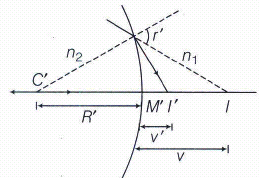
\(\therefore \quad \frac { { -n }_{ 2 } }{ v } +\frac { { n }_{ 1 } }{ { v }^{ ' } } =\frac { { n }_{ 2 }-{ n }_{ 1 } }{ { R }^{ ' } } \) ............(ii)
On adding Eqs. (i) and (ii), we get
\(\frac { 1 }{ f } =\left( { n }_{ 21 }-1 \right) \left( \frac { 1 }{ R } -\frac { 1 }{ { R }^{ ' } } \right) \ \left[ \therefore { n }_{ 21 }=\frac { { n }_{ 2 } }{ { n }_{ 1 } } ,\frac { 1 }{ f } =\frac { 1 }{ v } -\frac { 1 }{ u } \right] \)
27.
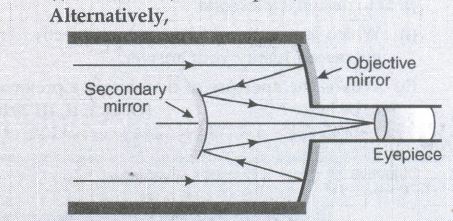
For large magnifying power fo should be large and fe should be small.
For higher resolution diameter of the objective
should be large.
(b) \(\frac { 1 }{ { v }_{ 0 } } -\frac { 1 }{ { v }_{ 0 } } =\frac { 1 }{ { f }_{ 0 } } \)
\(\frac { 1 }{ { v }_{ 0 } } =\frac { 1 }{ { f }_{ 0 } } =\frac { 1 }{ { u }_{ 0 } } \)= \(\frac { 1 }{ { 1.25 } } -\frac { 1 }{ { 2.5 } } =\frac { 1 }{ { 2.5 } } \)
vo = 2.5 cm
= (2.5 + 5.0) cm = 7.5 cm
28.
The reciprocal of focal length of lens is known as power of lens when focal length is taken in metre.
\(p=\frac { 1 }{ f(in\ metre) } \)
SI unit of power of lens is dioptre (D).
f1 = +50cm, f2 = -20 cm
\(\because \frac { 1 }{ f } =\frac { 1 }{ f_{ 1 } } +\frac { 1 }{ f_{ 2 } } =\frac { 1 }{ 50 } -\frac { 1 }{ 20 } =\frac { 2-5 }{ 100 } =\frac { -3 }{ 100 } \)
\(f=\frac { 100 }{ 3 } cm\Rightarrow f=\frac { 1 }{ 3 } m\)
\(\therefore F=\frac { 1 }{ f(in \ m) } =\frac { 1 }{ \left( -1/3 \right) } =-3D\)
29.
(a) (i) Electron moving in a circular orbit around the nucleus would get accelerated, therefore it would spiral into the nucleus, as it looses its energy.
(ii) It must emit a continuous spectrum. According to Bohr's model of hydrogen atom
(i) Electron in an atom can revolve in certain stable orbits without the emission of radiant energy

12th Standard CBSE Syllabus & Materials
12th Standard CBSE
CBSE 12th Chemistry d- and f- Block Elements Important Questions And Answers Study Material - QB365 Set A
NEW12th Standard CBSE
CBSE 12th Chemistry Chemical Kinetics Important Questions And Answers Study Material - QB365 Set B
NEW12th Standard CBSE
CBSE 12th Chemistry Chemical Kinetics Important Questions And Answers Study Material - QB365 Set A
NEW12th Standard CBSE
CBSE 12th Chemistry Electrochemistry Important Questions And Answers Study Material - QB365 Set C



NCERT Books

Syllabus

Exam Pattern

Sample Question Papers

Previous year Question Papers

Important Notes

MCQ Practice test

NCERT Exemplers

Case study Questions

Image Based Questions

Passage based Questions

HOT Questions

Value Based Questions

Model Questions Papers
NCERT ( Book Back ) Questions

Assertion and Reason
Important Questions And Answers

CBSE 12th Standard CBSE Subjects
CBSE Standards