
 100% FREE ACCESS
12th Standard CBSE Syllabus & Materials
12th Standard CBSE
CBSE 12th Economics Government Budget and the Economy Previous year Question Papers Study Material - QB365 Set A
NEW12th Standard CBSE
CBSE 12th Computer Science Interface Python with MySQL - New Previous year Question Papers Study Material - QB365 Set A
NEW12th Standard CBSE
CBSE 12th Computer Science Database Concept - New Previous year Question Papers Study Material - QB365 Set A
NEW12th Standard CBSE
CBSE 12th Computer Science Data Communication - New Previous year Question Papers Study Material - QB365 Set A
NEW12th Standard CBSE
CBSE 12th Computer Science Data Structures - New Previous year Question Papers Study Material - QB365 Set A
NEW12th Standard CBSE
CBSE 12th Computer Science Functions - New Previous year Question Papers Study Material - QB365 Set A

Published on: 17/10/2025
Download CBSE Class 12th Standard CBSE Biology question papers, sample papers, important questions, and previous year solved papers in PDF format. Get free study materials, NCERT solutions, and exam preparation resources for Class 12th Standard CBSE Biology
Questions + Answers key
Take MCQ Biology Test
1.
With the help of an example, explain how alien species invasion causes biodiveristy loss.
2.
Name the three latitudinal zones of earth.
3.
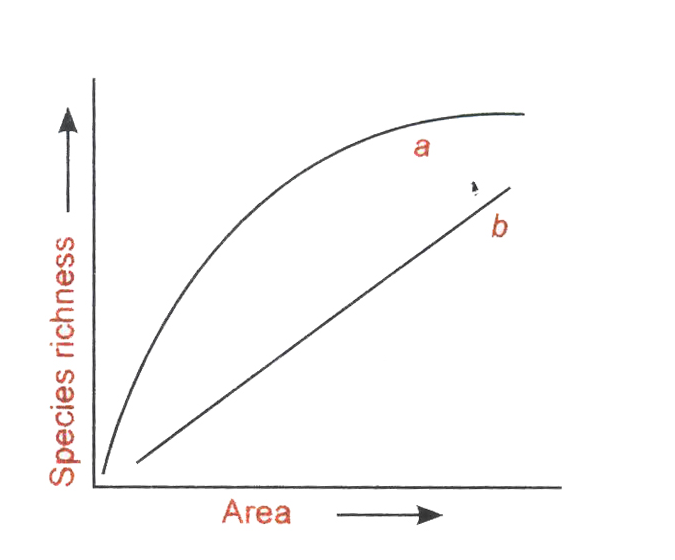
The above graph shows Species-Area relationship. Write the equation of the curve 'a' and explain.
4.
How is diapause different from hibernation?
5.
Explain why very small animals are rarely found in polar region.
6.
Neha's mother brought a big cactus plant from a nursery. She told Neha not to water the plant daily. Neha was confused. Explain the reason for not watering the plant daily and what will happen if she will water the plant daily? Do you know some animals who are also of the same nature?
7.
One day, Ganesh asked his father why is government so much worried about decreasing population of tigers ? His father replied that it is important to save the tiger as they are at the end of food chains in forest ecosystem and play a role to keep the biotic components in ecosystem in balance.
Read the above passage and answer the following questions:
(i) What is a food chain ?
(ii) What is an ecosystem ?
(iii) What value is displayed by Ganesh's father?
8.
Give an account of energy flow in an ecosystem.
9.
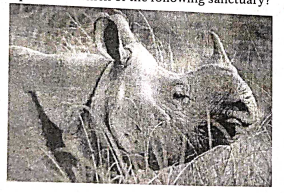
The one-horned rhinoceros shown below is specific to which of the following sanctuary?
Bhitarkanika
Bandipur
Kaziranga
Corbett park
10.
Match the items column I and column II and choose the correct option:
| Column I | Column II |
| (a) UV | (i) Biomagnification |
| (b) Biodegradable Organic mater | (ii) Eutrophication |
| (c) DDT | (iii) Snow blindness |
| (d) Phosphates | (iv) BOD |
| A | B | C | D |
| ii | i | iv | iii |
| A | B | C | D |
| iii | ii | iv | i |
| A | B | C | D |
| iii | iv | i | ii |
| A | B | C | D |
| iii | i | iv | i |
11.
Which of the ecological pyramid is always straight?
pyramid of numbers
pyramid of biomass
pyramid of energy
none of these
12.
Which of the following metals causes harmful effects?
lead
cobalt
uranium
all of these
13.
About 70% of total global carbon is found in
oceans
forests
grasslands
agroecosystems
14.
Which ecosystem has the highest primary productivity?
pond
ocean
desert
forest
15.
Maximum absorption of rainfall water is done by
tropical deciduous forest
tropical evergreen forest
tropical savannah
scrub forest
16.
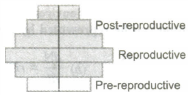
What type of human population is represented by the given age pyramid?
vanishing population
stable population
expanding population
declining population
17.
The world environment day is celebrated on
6th of June
5th of June
6th of August
5th of May
18.
Niche overlap indicates
mutualism between two species
active cooperation between two species
two different parasites on the same host
sharing of one or more resources between the two species
19.
The formula for exponential population growth is
\(d{ N }/{ dt }=\gamma N\)
\(d{ t }/dN=\gamma N\)
\({ dN }/\gamma N=dt\)
\(\gamma \quad { N }/{ dN }=dt\)
20.
Which of the following process helps in nutrient conservation?
Mineralisation
Immobilisation
Leaching
Nitrification
21.
Explain the concept of "coextinction" by taking two examples.
22.
Describe how do oxygen and chemical composition of detritus control decomposition.
23.
(a) Healthy ecosystems are the base of wide range of (ecosystem) services. Justify.
(b) Explain the difference and the similarities between hydrarch and xerarch successions of plants.
24.
The diagram given below shows a river and the types of land uses on two sides of the river in a countryside.
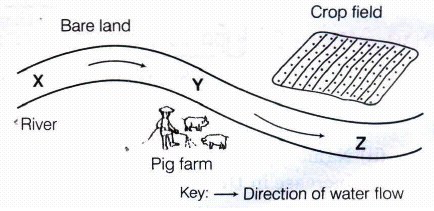
The water quality of the river was studied by measuring the amount of dissolved oxygen and ammonia in the water, collected at sites X, Y and Z. The result is presented in the table below:
| Site | Dissolved oxygen cm3/liter | Ammonia(ppm) |
| X | 8.9 | 0.02 |
| Y | 0.3 | 0.62 |
| Z | 1.6 | 5.30 |
(i) Explain why site Y has the lowest content of dissolved oxygen
(ii) Why are very few fishes found at site 'Z'?
(iii) Which organism will thrive just after site Z?
25.
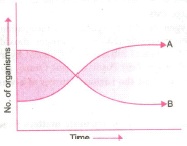
The graph below represents the growth patterns of types of aquatic organisms over a brief period of time in a water body surrounded by an agricultural land extensively supplied with fertilizers. Identify what would represent(i) A and (ii) B.
26.
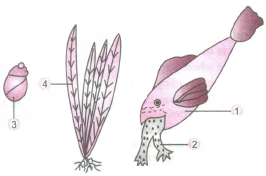
In the given picture what is the relationship between (1) and (2) with respect to population interaction and between (3) and (4) with respect to trophic levels?
27.
Explain the following terms:
(a) Acclimatization
(b) Ectotherms
(c) Endotherms
28.
29.
Observe the global biodiversity distribution of the major plant taxa in the given diagram and answer the questions accordingly.
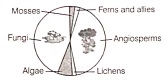
(i) Which group of plants are the most endangered?
(ii) Why are mosses/ferns so few? Give reason.
(iii) How do fungi that are heterotrophs status in themselves as a large population?
(iv) Which group of plants is most advanced and which one is most primitive?
30.
31.
32.
Assertion (A): The energy utilised by an organism for growth is not transferred to the next trophic level.
Reason (R): Growth causes an increase in biomass.
Codes:
A) Both A and R are true, and R is the correct explanation for A.
B) Both A and R are true, but R is not the correct explanation for A.
C) A is true, but R is false.
D) A is false, but R is true
33.
1.
(i) When alien species (those species which are introduced from elsewhere into a particular region) are introduced deliberately into an ecosystem for some purpose, some of then may become invasive and cause damage and decline or even extinction of the native species in the ecosystem.
(ii) The introduction of Nile perch into Lake Victoria led to the extinction of more than 200 species of cichlid fish in that lake.
(iii) Introduction of African catfish Clarias gariepinus for aquaculture poses a threat to the indigenous catfishes in Indian rivers.
(iv) Carrot grass (Parthenium) and Lantana introduced into our country have become invasive and caused environmental damage; they pose a threat to the native species of plants in our forests.
(v) Illegal introduction of African catfish, Clarias gariepinus for aquaculture purposes poses a threat to the indigenous catfishes in our rivers.
2.
Tropical (torred) zone, temperarate zone and polar (frigid) zone.
3.
S = CA2, where
S = species richness
A = area
C = V-intercept
1. Alexander Von Humboldt observed that within a region, species richness increased with increasing explored area, but only upto a limit.
2. The relation between species richness and area for a wide variety of taxa like angiosperms, birds, fishes, etc. turns out to be a rectangular hyperbola.
4.
| Diapause | Hibernation |
| It is a stage of suspended development shown by zooplanktons under unfavourable conditions in their habitat. | Hibernation is the phenomenon of escaping in time the stressful condition of the winter |
5.
Heat loss or heat gain is a function of surface area.
Since small animals (like humming birds) have a larger surface area relative to their volume, they tend to lose body heat very fast, when it is cold outside.
They spend more energy to generate body heat through metabolism; considering the cost and benefit of maintaining a constant internal temperature, small animals (humming birds) are not found in polar regions.
6.
The cactus plants grow in desert regions where they adapt to store water in the roots, stems or fruits. So, they need very less water to survive.If she waters it daily, it will gradually decay due to excess of water.
Kangaroo rats, camels and desert lizards are animals that survive without water. This is because, the kangaroo rat in North American deserts is capable of meeting all its water requirements through its internal fat oxidation (in which water is a by product). It also has the ability to concentrate its urine so that minimal volume of water is used to remove excretory products.
7.
(i) The sequential inter-linking of organisms involving the transfer of food energy from the producers, through a series of organisms with repeated eating and being eaten is referred to as the food chain.
(ii) It is defined as a structural and functional unit of the biosphere, compressing living organisms and their non living environment that interact by means of food chains and chemical cycles resulting in energy flow, biotic diversity and material cycling to form a stable, self-supporting system.
(iii) Genesh's father wanted to enhance his son's interest in environmental science.
8.
1. Sun is the ultimate source of energy for all ecosystems on the earth.
2. Only about 50% of the incident solar radiation is photosynthetically active radiation (PAR).
3. Plants capture only 2-10% of the PAR and all organisms are dependent for their food on producers, either directly or indirectly.
4. The flow of energy from the sun to producers and then to consumers is unidirectional and is keeping with the first law of thermodynamics.
5. Ecosystems need a continuous supply of energy for the synthesis of molecules needed and to counteract the tendency towards increasing disorderliness, i.e. energy flow follows the second law of thermodynamics too.
9.
(c)
Kaziranga
10.
(c)
| A | B | C | D |
| iii | iv | i | ii |
11.
(c)
pyramid of energy
12.
(d)
all of these
13.
(a)
oceans
14.
(d)
forest
15.
(b)
tropical evergreen forest
16.
(d)
declining population
17.
(b)
5th of June
18.
(d)
sharing of one or more resources between the two species
19.
(a)
\(d{ N }/{ dt }=\gamma N\)
20.
(b)
Immobilisation
21.
Co-extinction is a phenomenon in which when a species becomes extinct, the plant and animal species associated with it, in an obligatory manner, also become extinct.
(i) In case of a co-evolved plant and its pollinator, if one of them becomes extinct, invariably the other one becomes extinct.
(ii) If a host fish becomes extinct, the unique parasites depending on it would also become extinct.
22.
Effect of Oxygen : The decomposition of detritus is an energy requiring process. Most of the decomposers (bacteria and fungi) are aerobic organisms. They require Oxygen for their cellular activities while acting on dead organic matter.
Effect of Chemical : Composition Decomposition rate is slower, if detritus is rich in lignin and chitin. It is quicker if detritus is rich in nitrogen and water soluble substances like sugars.
23.
(a) Healthy ecosystems are the base for a wide range of economic, environmental and aesthetic goods and services. The products of ecosystem processes are named as ecosystem services. For examples, healthy forest ecosystem purifies air and water, minimize droughts and floods, cycle nutrients, generates fertile soils, provides wildlife habitat, maintains biodiversity, pollinate crops, provid storage site for carbon and also provide aesthetic,cultural and spiritual values. Though value of such services of biodiversity is difficult to determine, it seems reasonable to think that biodiversity should carry a healthy price tag.
(b) Based on the nature of the habitat - whether it is water (or very wet areas) or it is on very dry areas- succession of plants is called hydrarch or xerarch, respectively.
Differences: Hydrarch succession takes place in wetter areas and the successional series progress from hydric to mesic conditions. As against this, xerarch succession takes place in dry areas and the series progress from xeric to mesic conditions.
Similarity: Both hydrarch and xerarch successions lead to medium water conditions (mesic), neither too dry (xeric) nor too wet (hydric).
24.
(i) Site Y has the lowest content of dissolved oxygen due to increased bacterial population. It is caused by sewage run-off from a pig farm.
(ii) There are very few fisher at size Z due to low oxygen Concentration and choked lake (by algae and weeds)
(iii) Algae and weeds will thrive after site Z.
25.
(i) A = Dissolved Oxygen
(ii) B=Biochemical oxygen demand(BOD)
26.
(i) Relationship between (1) and (2) is of predator-prey relationship.
(ii) Relationship between (3) and (4) is producer and (3) is primary consumer.
27.
Acclimatization. The gradual physiological adjustment to shoe changing environmental conditions is called acclimatization.
Ectotherms are the cold-blooded animals who can not regulate their body temperature.
Endotherms are the warm-blooded animals who are capable of regulating their body temperatures.
28.
29.
(i) Lichens.
(ii) Mosses and ferns are very few as they need humid conditions in forests and forests are disappearing.
(iii) Fungi are able to sustain themselves as a large population because of their wider adaptability to the changing environment conditions.
(iv) Most advanced group is of angiosperms and most primitive group is of fungi.
30.
31.
32.
33.

12th Standard CBSE Syllabus & Materials
12th Standard CBSE
CBSE 12th Computer Science Python Revision Tour I - New Previous year Question Papers Study Material - QB365 Set A
NEW12th Standard CBSE
CBSE 12th Business Studies Planning Important Questions And Answers Study Material - QB365 Set A
NEW12th Standard CBSE
CBSE 12th Business Studies Business Environment Important Questions And Answers Study Material - QB365 Set A
NEW12th Standard CBSE
CBSE 12th Business Studies Principles of Management Important Questions And Answers Study Material - QB365 Set A



NCERT Books

Syllabus

Exam Pattern

Sample Question Papers

Previous year Question Papers

Important Notes

MCQ Practice test

NCERT Exemplers

Case study Questions

Image Based Questions

Passage based Questions

HOT Questions

Value Based Questions

Model Questions Papers
NCERT ( Book Back ) Questions

Assertion and Reason
Important Questions And Answers

CBSE 12th Standard CBSE Subjects
CBSE Standards