 100% FREE ACCESS
12th Standard CBSE Syllabus & Materials
12th Standard CBSE
CBSE 12th Economics Government Budget and the Economy Previous year Question Papers Study Material - QB365 Set A
NEW12th Standard CBSE
CBSE 12th Computer Science Interface Python with MySQL - New Previous year Question Papers Study Material - QB365 Set A
NEW12th Standard CBSE
CBSE 12th Computer Science Database Concept - New Previous year Question Papers Study Material - QB365 Set A
NEW12th Standard CBSE
CBSE 12th Computer Science Data Communication - New Previous year Question Papers Study Material - QB365 Set A
NEW12th Standard CBSE
CBSE 12th Computer Science Data Structures - New Previous year Question Papers Study Material - QB365 Set A
NEW12th Standard CBSE
CBSE 12th Computer Science Functions - New Previous year Question Papers Study Material - QB365 Set A

Published on: 18/10/2025
Download CBSE Class 12th Standard CBSE Biology question papers, sample papers, important questions, and previous year solved papers in PDF format. Get free study materials, NCERT solutions, and exam preparation resources for Class 12th Standard CBSE Biology
Questions + Answers key
Take MCQ Biology Test
1.
What is natural ecosystem? Explain with the help of suitable example.
2.
A template strand is given below. Write down the corresponding coding strand and the mRNA strand that can be formed along with their polarity.
3' ATGCATGCATGCATGCATGCATGC 5'
3.
Fill in the blanks with suitable words:
(a) Animals with self - fertilising ability are termed as _________.
(b) Development of unfertilized ovum into a new individual is called _________.
(c) The mature follicles are termed as _________.
(d) Degenerated corpus luteum is called. _________.
4.
(a) Illustrate the recognition sequence o EcoRI and mention what such sequences are called.
(b) How does restriction endonuclease act on a DNA molecule?
5.
Name the two layers of seed coat. Where are they formed from?
6.
The foUowing is the flow chart highlighting the steps in DNA fingerprinting technique. Identify a, b, c, d, e and f.
Isolation of DNA from blood cells
↓
Cutting of DNA by 'a'
↓
Separation of DNA fragments
by electrophoresis using 'b'
↓
Transfer (blotting) of fragments to 'c' gel
↓
DNA splits into single strands
↓
Introduction of labelled 'd' probes
↓
'e' of single-strands with 'd'
↓
Detection of banding pattern by 'f '
7.
Parthenocarpy and apomixis have been observed in some plants. Give an example of each. State a similarity and a difference observed between the two processes.
8.
Discuss the factors which affect the rate of decomposition.
9.
A number of passengers were severely burnt beyond recognition during a train accident. Name and describe a modern technique that can help hand over the dead to their relatives.
10.
What is biotechnology? Describe its different forms.
11.
After implantation interdigitationof maternal and foetal tissues takes place. Identify the tissues involved and justify their role.
12.
Explain initiation of polypeptide chain
13.


14.
15.
16.
17.
18.
19.
Using a DNA template, how many new DNA molecules would be generated after 10 cycles of amplification in PCR?
512
1024
2048
256
20.
Match the following columns.
| Column I | Column II |
| A. Monocarpellary | 1. Free pistil |
| B. Multicarpellary | 2. Fused pistil |
| C. Syncarpous | 3. Many pistil |
| D. Apocarpous | 4. Single pistil |
| A | B | C | D |
| 1 | 2 | 3 | 4 |
| A | B | C | D |
| 4 | 3 | 2 | 1 |
| A | B | C | D |
| 3 | 4 | 2 | 1 |
| A | B | C | D |
| 4 | 3 | 1 | 2 |
21.
Which one of these statements is not correct during protein synthesis
UAA codon codes for lysine
UGG codon codes for tryptophan
Cysteine is coded by UGU and UGC codones
tyrosine is coded by UAU and UAC codons
22.
Edaphic factor refers to:
Water
Soil
Relative humidity
Altitude
23.
The rate of formation of new organic matter by rabbit in a grassland, is called
not productivity
secondary productivity
net primary productivity
gross primary productivity
24.
Which one of the following is not used for construction of ecological pyramids?
fresh weight
dry weight
number of individuals
rate of energy flow
25.
From among the sets of terms given below, identify those that are associated with gynoecium.
Stigma, ovule, embryo sac, placenta
Thalamus, pistil, style, ovule
Ovule, ovary, tapetum, embryo sac
Egg, integument, embryo sac, nucellus
26.
Double fertilisation is immediately followed by development of endosperm. Explain the link between the two processes.
27.
Explain the process of protein synthesis from processed m-RNA.
28.
The biology teacher was explaining about restriction enzymes and came to a point explaining that these enzymes are extracted from bacteria and are called as molecular scissors. Varun, a student got curious and asked some questions for more clarity on the concept to his teacher.
(i) From which part of microorganisms are restriction enzymes derived?
(ii) Why are restriction enzymes called molecular scissors?
(iii) What if some strands are needed to be cut from within. would that lead to wastage of DNA?
(iv) What value are shown by varun?
29.
Read the following and answer any four questions from (i) to (v) given below:
Study the given table and answer the questions based on it.
| Hormone | Source | Function | |
| (A) | Oxytocin | W | Ejection of milk |
| (B) | X | Anterior lobe of pituitary gland | Stimulates secretion of ABP from Sertoli cells |
| (C) | Y | Placenta | Maintains corpus luteum to secrete progesterone |
| (D) | Relaxin | Ovary | Z |
(i) Identify the hormones X and Y respectively
| (a) Testosterone, FSH | (b) LH, hPL | (c) FSH, hCG | (d) ICSH, hCG |
(ii) W in the given table is
| (a) hypothalamus | (b) posterior lobe of pituitary | (c) placenta | (d) ovary |
(iii) Which of the following is correct for Z?
| (a) Dilation of uterine cervix during labour pains. | (b) Stimulates the growth of the mammary glands during pregnancy | (c) Supports the fetal growth and prevents desiccation. | (d) Forms protective plug in cervix of uterus during pregnancy. |
(iv) Which set of hormones is secreted only during pregnancy?
(a) Human chorionic gonadotropin, relaxin and human placental lactogen
(b) Human placental lactogen, estrogen and chorionic thyrotropin
(c) Human chorionic gonadotropin, human placental lactogen and progesterone
(d) Chorionic thyrotropin, chorionic gonadotropin and estrogen
(v) Assertion: Follicle stimulating hormone controls the maintenance and functions of male reproductive organs.
Reason: FSH acts directly on spermatogonia to stimulate sperm production.
(a) Both assertion and reason are true and reason is the correct explanation of assertion.
(b) Both assertion and reason are true but reason is not the correct explanation of assertion.
(c) Assertion is true but reason is false
(d) Both assertion and reason are false.
30.
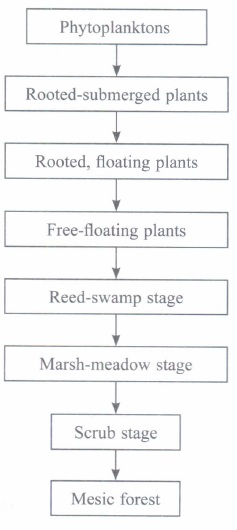
Over the years, it has been observed that some of the lakes are disappearing due to urbanisation. In the absence of human interference, depict through a flow chart, how the successional series progresses from hydric to mesic condition.
31.
Assertion: Although geitonogamy is functionally cross-pollination involving a pollinating agent, genetically it is similar to autogamy since the pollen grains come from the same parent.
Reason: In getionogamy, pollen grains from the anthers of one flower are transferred to the stigma of another flower borne on the same plant.
Codes:
(a) If both Assertion and Reason are true and Reason is the correct explanation of Assertion.
(b) If both Assertion and Reason are true but Reason is not the correct explanation of Assertion.
(c) If Assertion is true but Reason is false.
(d) If both Assertion and Reason are false.
32.
Assertion: Soil inhabiting bacterium Agrobacterium tumefaciens is called a natural plant genetic engineer.
Reason: Agrobacterium tumefaciens produce crown galls in several dicot plants.
Codes:
(a) Both assertion and reason are true and reason is the correct explanation of assertion.
(b) Both assertion and reason are true but reason is not the correct explanation of assertion.
(c) Assertion is true but reason is false.
(d) Both assertion and reason are false.
33.
Assertion: Core enzyme catalyses chain elongation of RNA.
Reason: The presence of sigma factor is required for initiation of transcription.
Codes :
(a) Both assertion and reason are true and reason is the correct explanation of assertion.
(b) Both assertion and reason are true but reason is not the correct explanation of assertion.
(c) Assertion is true but reason is false.
(d) Both assertion and reason are false
1.
A natural ecosystem is the result of interactions between organisms and the environment. For example, an ocean is classified as a marine ecosystem, which consists of algae, consumers and decomposers.
1.Grassland Ecosystem. Its main characteristic is it is inclusive of non-woody vegetation cover.
2.Temperate Forest Ecosystems. The ecosystem is common in regions that experience warm summers and cold winters.
3.Tropical Rainforest System.
4.Desert Ecosystem.
5.Coral Reefs.
2.
Codingstrand-5'
TACGTACGTACGTACGTACGTACG 3'
mRNAstrand-5'
UACGUACGUACGUACGUACGUACG 3'
3.
(a) Hermaphroditism
(b) Parthenogenesis
(c) Endometrium
(d) Corpus Albicans
4.
- Restriction endonuclease, EcoRI cuts the DNA strands a little away from the centre of the palindromic, sequence, but between the same two bases on the two strands.
\({ 5 }^{ ' }-\begin{matrix} { G }^{ \downarrow } & A \end{matrix}\begin{matrix} A & T \end{matrix}\begin{matrix} T & C \end{matrix}-{ 3 }^{ ' }\)
\({ 3 }^{ ' }-\begin{matrix} { C } & T \end{matrix}\begin{matrix} T & A \end{matrix}\begin{matrix} { A }_{ \uparrow } & G \end{matrix}-{ 5 }^{ ' }\)
This leaves single-stranded portions, called sticky ends, overhanging at the end of each strand.
Since, the stickiness facilitates the action of DNA ligase, they easily form hydrogen bonds with their complementary counterparts.
5.
The two layers of seed coat are:
(i) Testa
Testa is formed from the outer integument.
(ii) Tegmen
Tegmen is formed from the inner integument.
6.
(a) Restriction endonuclease.
(b) Agarose gel.
(c) Nitrocellulose/nylon/synthetic membrane.
(d) Variable Number Tandem Repeats (VNTR).
(e) Hybridisation with VNTR probe.
(/) Autoradiography.
7.
Examples
1. Parthenocarpy is seen in banana.
2. Apomixis is seen in Citrus, mango, some members of Asteraceae and grasses. (anyone)
Similarity
1.There is no fertilisation involved in both parthenocarpy and apomixis.
Difference
1. Parthenocarpy is fruit formation without fertilisation; the fruits are seedless or the seeds are not viable.
2. Apomixis is seed formation without fertilisation; the seeds are viable
8.
Factors that affect the rate of decomposition are :
(i) Climatic factors.
(ii) Chemical composition of the detritus.
(iii) Temperature.
(iv) Soil moisture.
9.
1. The technique that can help in the identification of victims is DNA fingerprinting which distinguishes between individuals of same species by using their DNA as sample. The chemical structure of DNA is same in everyone (99.9%) except the order of base pairs, i.e. only 0.1% of DNA makes every individual unique. DNA fingerprinting exploits the highly variable repeating sequences, i.e. VNTRs for profiling. These VNTRs are highly conserved among members of the same species.
2. The presence of similarities between the victims and their relatives determines their association on the basis of which dead bodies can be identified and handed over to their families.
10.
Biotechnology is the technique of using live organisms or their cellular components like enzymes for products and processes useful to mankind. It is mainly of two types:
(i) Traditional Biotechnology: This includes the useful processes which are based on the natural capabilities of micro organisms such as production of curd, cheese, beer, wine, vinegar etc.
(ii) Modem Biotechnology: This includes the genetic engineering. This is based on gene manipulation and the development of the recombinant DNA technlogy. Production of DNA vaccine, correction of defective gene, formation of monoclonal antibodies, in-vitro fertilization are also the part of modem biotechnology.
11.
1.After implantation interdigitation of maternal and foetal tissues results in formation of structural and functional unit between embryo and maternal body called placenta.
2.It facilitates supply of oxygen and nutrients to the embryo, removal of carbon dioxide. and excretory matenal. Also acts as endocnne tissue and produces hormones like hCG, hPL, estrogen, progesterone, relaxin.
12.
initiation of polypeptide synthesis:
1) The ribosome, in its inactive state, exists as two subunits-a large subunits and a small subunit.
2) When the small subunit encounter the mRNA translation begins
3) The mRNA binds to the small subunit of ribosomes, following base pair rule, between the bases of mRNA and those on rRNA. It is catalyst by certain 'initiation factors
4) There are two sites on the larger subunits, the P site and the A-site
5) The small subunit (with the tRNA attaches to the large subunits in such a way that the initiation codon (AUG) comes on the P-site
6) The Initiator tRNA (methionyl-tRNA) binds to the P-site
Function: It starts the transcription
In eukaryotes, there is at least three RNA polymerase in addition to those found in cell organelles.
(a) RNA-Polymerase I transcribe RNAs (28 S, 18 S and 5,8 S
(b) RNA-Polymerase II transcribe the processor of mRNA called heterogeneous nuclear RNA (tRNA)
(c) RNA-Polymerase III transcribe tRNA (5S rRNA, %S nRNAs)
13.
(c)
14.
(d)
15.
(d)
16.
(c)
17.
(b)
18.
(a)
19.
(b)
1024
20.
(b)
| A | B | C | D |
| 4 | 3 | 2 | 1 |
21.
(a)
UAA codon codes for lysine
22.
(b)
Soil
23.
(b)
secondary productivity
24.
(a)
fresh weight
25.
(a)
Stigma, ovule, embryo sac, placenta
26.
1.As the name suggests; double fertilisation involves two types of fertilisation-syngamy and triple fusion. The release of two male gametes into the cytoplasm of one of the synergids causes its degeneration.
2.One male gamete fuses with the egg cell to form a diploid zygote (which later forms embryo). This process is called syngamy or generative fertilisation. The other male gamete fuses with the two polar nuclei in the central cell by a process called triple fusion, which results in the formation of a triploid.
3.Primary Endosperm Nucleus (PEN) and the central cell becomes the Primary Endosperm Cell (PEe). This PEC divides repeatedly to form triploid endosperm tissue which further undergoes successive free nuclear divisions to give rise to free nuclear endosperm (free-nuclei).
4.This stage is followed by the wall formation around the cellular endosperm. Thus, the events of double fertilisation are immediately followed by post-fertilisation events involving development of endosperm.
27.
For initiation, the ribosome binds to the mature mRNA at the start codon (AUG) that is recognized by the initiator t-RNA. During elongation, charged t-RNA sequentially binds to the appropriate codon in m-RNA with the anticodon present on t-RNA. The ribosome moves from one codon to another adding amino acids one after the other to form polypeptide, i.e. translation. During termination, the release factor binds to stop codon (UAA,UAG, UGA), terminating translation and releasing the polypeptide chain.
28.
(i) Restriction enzymes are derived from a defence unit called restriction modification system which protects the microorganisms from harm.
(ii) They are called as molecular scissors because they cut DNA molecules at specified location indicated by presence of specific recognition sequence.
(iii) No, the strands cut from within are joined by another enzyme called DNA ligase. This joining is either with self or with another different strand.
(iv) Varun is curious, has scientific temperament and ask quick and intelligent questions.
29.
(i) (c)
(ii) (b)
(iii) (a) : Relaxin increases the flexibility of the pubis symphysis and ligaments of sacroiliac and sacrococcygeal joints and helps to dilate the uterine cervix during labour pains.
(iv) (a) : hPL, hCG and relaxin are produced in women only during pregnancy.
(v) (b)
30.
31.
(a) If both Assertion and Reason are true and Reason is the correct explanation of Assertion.
Explanation:
Geitonogamy is a type of pollination in which pollen grains of one flower are transferred to the stigma of another flower belonging to either the same plant or genetically similar plant. It usually occurs in plants which show monoecious condition (unisexual male and female flowers borne on the same plant. Thus, geitonogamy is functionally cross pollination as it involves pollinating agent to carry out pollination, but genetically it is similar to autogamy (self-pollination) since the pollen grains come from the genetically same plant.
32.
(b) Both assertion and reason are true but reason is not the correct explanation of assertion.
33.
(b): The "core' enzyme which catalyses covalent chain extension, consists of two a - polypeptides (each of molecular weight about 41,000), one S - polypeptide ( molecular weight about 155,000) one S'-polypeptide (molecular weight about 165,000) and one ro-polypeptide (molecular weight about 12,000). The "holoenzyme" contains in addition, a -polypeptide (molecular weight about 95,000). The presence of the sigma factor is required for initiation at the proper transcription initiation (or promoter) sites. After each RNA chain - initiation event, sigma is released and the core enzyme catalyses chain elongation.

12th Standard CBSE Syllabus & Materials
12th Standard CBSE
CBSE 12th Computer Science Python Revision Tour I - New Previous year Question Papers Study Material - QB365 Set A
NEW12th Standard CBSE
CBSE 12th Business Studies Planning Important Questions And Answers Study Material - QB365 Set A
NEW12th Standard CBSE
CBSE 12th Business Studies Business Environment Important Questions And Answers Study Material - QB365 Set A
NEW12th Standard CBSE
CBSE 12th Business Studies Principles of Management Important Questions And Answers Study Material - QB365 Set A



NCERT Books

Syllabus

Exam Pattern

Sample Question Papers

Previous year Question Papers

Important Notes

MCQ Practice test

NCERT Exemplers

Case study Questions

Image Based Questions

Passage based Questions

HOT Questions

Value Based Questions

Model Questions Papers
NCERT ( Book Back ) Questions

Assertion and Reason
Important Questions And Answers

CBSE 12th Standard CBSE Subjects
CBSE Standards