
 100% FREE ACCESS
12th Standard Syllabus & Materials
12th Standard
TN 12th Computer Applications மின்னணு தரவு பரிமாற்றம் Sample Question Papers Study Material - QB365 Set A
NEW12th Standard
TN 12th Computer Applications மின் - வணிக பாதுகாப்பு அமைப்புகள் Sample Question Papers Study Material - QB365 Set A
NEW12th Standard
TN 12th Computer Applications மின்னணு செலுத்தல் முறைகள் Sample Question Papers Study Material - QB365 Set A
NEW12th Standard
TN 12th Computer Applications மின் - வணிகம் Sample Question Papers Study Material - QB365 Set A
NEW12th Standard
TN 12th Computer Applications திறந்த மூல கருத்துருக்கள் Sample Question Papers Study Material - QB365 Set A
NEW12th Standard
TN 12th Computer Applications வலையமைப்பு வடமிடல் Sample Question Papers Study Material - QB365 Set A

Published on: 20/10/2025
Download Tamil Nadu 12th Standard Chemistry question papers, model tests, one-mark questions, important questions, and public exam papers in PDF format. Free study materials and answer keys for TN State Board students.
Questions + Answers key
Take MCQ Chemistry Test
1.
The rate constant for a first order reaction in 2 x 10⁻² s-1. The half life period of reaction is _______.
69.3 min
34.65 min
17.37 min
3.46 min
2.
In nature the p-block element may be a _______.
metal & non metal
metalloid
radioactive
any one of (a), (b) & (c)
3.
The nitro group can be reduced to primary amino group by _________
Sn / conc. HCI
Zn dust
Zn / NH4 CI
Zn / NaOH
4.
Which one of the following is most basic?
2,4 – dichloroaniline
2,4 – dimethyl aniline
2,4 – dinitroaniline
2,4 – dibromoaniline
5.
The product formed by the reaction an aldehyde with a primary amine ________.
carboxylic acid
aromatic acid
schiff ’s base
ketone
6.
Which one of the following nitro compounds does not react with nitrous acid.
CH3 -CH2 -CH2 -NO2
(CH3)2 CH - CH2NO2
(CH3)3 C NO2
\({ CH }_{ 3 }-\underset { \overset { || }{ O } }{ C } -\underset { \overset { || }{ { CH }_{ 3 } } }{ CH } -{ NO }_{ 2 }\)
7.
Cell equation: A + 2B- \(\rightarrow\)A2++ 2B; A2+ + 2e- \(\rightarrow\)A Eo = +0.34V and log10 K = 15.6 at 300K for cell reactions find Eo for B+ + e− \(\rightarrow\) B
0.80
1.26
-0.54
-10.94
8.
Faraday constant is defined as_______.
charge carried by 1 electron
charge carried by one mole of electrons
charge required to deposit one mole of substance
charge carried by 6.22 ×10¹⁰ electrons
9.
10.
11.
The addition of a catalyst during a chemical reaction alters which of the following quantities?
Enthalpy
Activation energy
Entropy
Internal energy
12.
For the reaction, 2NH3 ⟶ N2 + 3H2, if \(\frac { -d[NH_{ 3 }] }{ dt } \) = k1[NH3], \(\frac { d[N_{ 2 }] }{ dt } =k_{ 2 }[NH_{ 3 }],\frac { d[{ H }_{ 2 }] }{ dt } \)= k3[NH3] then the relation between k1, k2 and k3 is _________.
k1 = k2 = k3
k1 = 3k2 = 2k3
1.5k1 = 3k2 = k3
2k1 = k2 = 3k3
13.
Which of the following is not sp2 hybridised?
Graphite
graphene
Fullerene
dry ice
14.
Carbon atoms in fullerene with formula C60 have _______hybridisation.
sp3 hybridised
sp hybridised
sp2 hybridised
partially sp2 and partially sp3 hybridised
15.
An aqueous solution of borax is________.
neutral
acidic
basic
amphoteric
16.
Define: Equivalent Conductance (\(\Lambda\))
17.
What is meant by McAfee process?
18.
Give two examples for zero order reaction.
19.
What is meant by limiting molar conductivity?
20.
Complete the following reaction
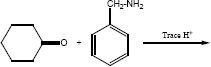
21.
There are two isomers with the formula CH3NO2. How will you distinguish between them?
22.
23.
Write Arrhenius equation and explains the terms involved.
24.
CO is a reducing agent. Justify with an example.
25.
Give the structure of CO and CO2.
26.
What is catenation ? describe briefly the catenation property of carbon.
27.
Write a short note on anomalous properties of the first element of p-block.
28.
Write ethylborate test.
29.
Write short notes on the following
iii. Gabriel phthalimide synthesis
30.
Identify compounds A, B and C in the following sequence of reactions.
vi)
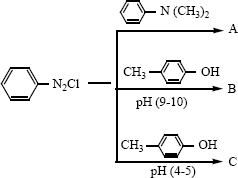
31.
Explain the function of H2 - O2 fuel cell.
32.
Identify A,B,and C
CH3- NO2 \(\overset { { L }_{ 1 }{AlH }_{ 4 } }{ \underset { {} }{ \longrightarrow } }\) A \(\overset { { 2CH_3 }{Ch_2Br } }{ \underset { {} }{ \longrightarrow } }\) B \(\overset { {H}_{ 2 }{SO}_{ 4 } }{ \underset { {} }{ \longrightarrow } } \) C
33.
Can Fe3+ oxidises Bromide to bromine under standard conditions?
Given: \({ E }_{ { Fe }^{ 3+ }|{ Fe }^{ 2+ } }^{ 0 }=0.771V\); \(\\ { E }^{0}_{ { Br }_{ 2 }|{ Br }^{ - } }=1.09V\).
34.
State Faraday’s Laws of electrolysis
35.
Explain the effect of catalyst on reaction rate with an example.
36.
Derive integrated rate law for a zero order reaction A\(\longrightarrow \) product.
37.
Write a note on metallic nature of p-block elements.
38.
Give the uses of silicones.
39.
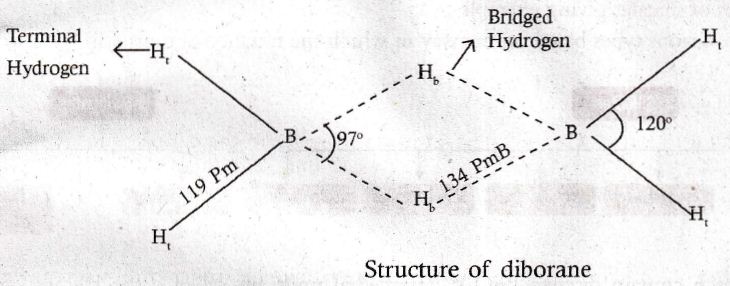
Write note on the structure of diborane.
40.
41.
State Kohlrausch Law. How is it useful to determine the molar conductivity of weak electrolyte at infinite dilution.
42.
Show that for a first order reaction the time required for 99.9% completion is about 10 times its half life period.
43.
Explain briefly the collision theory of bimolecular reactions.
1.
(b)
34.65 min
2.
(d)
any one of (a), (b) & (c)
3.
(a)
Sn / conc. HCI
4.
(b)
2,4 – dimethyl aniline
5.
(c)
schiff ’s base
6.
(c)
(CH3)3 C NO2
7.
(a)
0.80
8.
IF = 96500 C = charge of one mole of e- charge of 6.022 x 10⁻²³ electron
9.
(c)
10.
(a)
11.
A catalyst provides a new path to the reaction with low activation energy. i.e., it lowers the activation energy.
12.
\(Rate=\frac { -1 }{ 2 } \frac { d[NH_3] }{ dt } \)
\(\frac { -d\left[ { N }_{ 2 } \right] }{ dt } =\frac { 1 }{ 3 } \frac { d\left[ { H}_{ 2 } \right] }{ dt } \)
\(=\frac { 1 }{ 2 } { k_1\left[ { NH}_{ 3 } \right] } = { k_2 \left[ { NH}_{ 3 } \right] }=\frac { 1 }{ 3 } { k_3\left[ { NH}_{ 3 } \right] } \)
[3/2] k1 = 3k2 = k3
1.5k1 = 3k2 = k3
13.
(d)
dry ice
14.
(c)
sp2 hybridised
15.
(c)
basic
16.
(i) Equivalent conductance is defined as the conductance of 'V' m3 of electrolytic solution containing one gram equivalent of the electrolyte in a conductivity cell in which the electrodes are one meter apart
(ii) \(\Lambda=\frac{\kappa \times 10^{-3}}{N} \mathrm{Sm}^{2} \mathrm{~g} \mathrm{eq}{ }^{-1}\)
17.
(i) AlCl3 is obtained by heating a mixture of alumina and coke in a current of chlorine.
\(2 \mathrm{Al}_{2} \mathrm{O}_{3}+3 \mathrm{C}+6 \mathrm{Cl}_{2} \rightarrow 4 \mathrm{AlCl}_{3}+3 \mathrm{CO}_{2}\)
(ii) On industrial scale it is prepared by chlorinating aluminium around 1000 K
\(2 \mathrm{Al}+3 \mathrm{Cl}_{2} \stackrel{1000 \mathrm{~K}}{\longrightarrow} 2 \mathrm{AlCl}_{3}\)
18.
1. Photochemical reaction between H2 and Cl2 ; \(\mathrm{H}_{2(\mathrm{g})}+\mathrm{Cl}_{2(\mathrm{g})} \stackrel{h v}{\longrightarrow} 2 \mathrm{HCl}_{(\mathrm{g})}\)
2. Decomposition of N2O on hot platinum surface \(\mathrm{N}_{2} \mathrm{O}_{(\mathrm{g})} \rightleftharpoons \mathrm{N}_{2(\mathrm{~g})}+\frac{1}{2} \mathrm{O}_{2(\mathrm{~g})}\)
19.
\({ { \Lambda }_{ m }^{ o } }\) is called the limiting molar conductivity. i.e., the molar conductance of a solution at infinite dilution.
20.
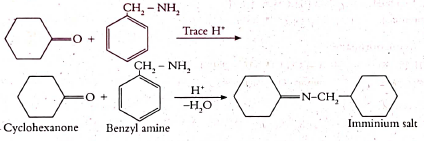
21.
a) Primary and secondary nitroalkanes, having α-H, also show an equilibrium mixture of two tautomers namely nitro - and aci - form
.JPG)
b) Difference:
| S.No | Nitro form | Aci - form |
| 1. | Less acidic in nature. | More acidic |
| 2. | Dissolves in NaOH slowly | Dissolves in NaOH instantly |
| 3. | Decolourises FeCl3 solution | With FeCl3 gives reddish brown colour |
| 4. | Electrical conductivity is low | Electrical conductivity is high |
22.
23.
Arrhenius equation is,
\(k=Ae^\left ({ \frac { -Ea }{ RT } } \right )\)
Here,
A \(\rightarrow\) Frequency factor
Ea \(\rightarrow\) Activation energy of the reaction
R \(\rightarrow\) Gas constant
T \(\rightarrow\) Absolute temperature (in K)
24.
CO acts as a strong reducing agent.
Example: 3CO + Fe2O3 \(\longrightarrow \) 2Fe + 3CO2
It reduces metallic. oxides into metals.
25.
| Oxides of Carbon | Structure | Parameters |
| CO |  |
Three electron pairs are shared between carbon and oxygen. The C-O bond distance is 1.128\(\overset{o}{A}\). |
| CO2 |  |
Equal bond distance for the both C-O bonds. Two C-O sigma bond, It has 3c-4e bond. |
26.
Catenation is an ability of an element to form chain of atoms.
The conditions for catenation.
(a) The valency of element is greater than or equal to two.
(b) Element should have an ability to bond with itself
(c) The self bond must be as strong as Its bond with other elements
(d) Kinetic inertness of catenated compound towards other molecules.
(e) Carbon possesses all the above properties and forms a wide range of compounds with itself and with other elements such as H, O, N, S and halogens.
27.
In p-block elements, the first member of each group differs from the other elements of the corresponding group. The following factors are responsible for this anomalous behaviour
(i) Small size of the first member.
(ii) High ionisation enthalpy and high electronegativity.
(iii) Absence of d-orbitals in their valance shell.
28.
When boric acid or borate salt is heated with ethyl alcohol in presence of conc. sulphuric acid, an ester, triethyl borate is formed. The vapour of this ester burns with a green edged flame and this reaction is used to identify the presence of borate.
H3BO3 + 2C2H5OH \(\frac{\text { Conc. }}{ H_2SO_4 } \longrightarrow \) 2B(OC2H5)3 + 3H2O
29.
Gabriel phthalimide synthesis:
Gabriel synthesis is used for the preparation of Aliphatic primary amines. Phthalimide on treatment with ethanolic KOH forms potassium salt of phthalimide which on heating with alkyl halide followed by alkaline hydrolysis gives primary amine. Aniline cannot be prepared by this method because the arylhalides do not undergo nucleophilic substitution with the anion formed by phthalimide.
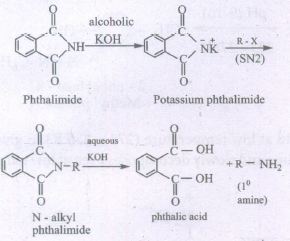
30.
.JPG)
31.
(i) In this case, hydrogen act as a fuel and oxygen as an oxidant and the electrolyte is aqueous KOH maintained at 200oC and 20-40 atm. Porous graphite electrode containing Ni and NiO serves as the inert electrodes.
(ii) Hydrogen and oxygen gases are bubbled through the anode and cathode, respectively.
Oxidation occurs at the anode:
\(2 \mathrm{H}_{2(\mathrm{~g})}+4 \mathrm{OH}_{(a q)}^{-} \rightarrow 4 \mathrm{H}_{2} \mathrm{O}_{(l)}+4 \mathrm{e}^{-}\)
Reduction occurs at the cathode:
\(\mathrm{O}_{2(\mathrm{~g})}+2 \mathrm{H}_{2} \mathrm{O}_{(t)}+4 \mathrm{e}^{-} \rightarrow 4 \mathrm{OH}_{(\mathrm{aq})}^{-}\)
(iii) The overall reaction is \(2 \mathrm{H}_{2(\mathrm{~g})}+\mathrm{O}_{2(\mathrm{~g})} \rightarrow 2 \mathrm{H}_{2} \mathrm{O}_{(1)}\)
(iv) The above reaction is the same as the hydrogen combustion reaction, however, they do not react directly ie., the oxidation and reduction reactions take place separately at the anode and cathode respectively like H2-O2 fuel cell. Other fuel cells like propane -O2 and methane O2 have also been developed.
32.

33.
(i) The half cell reactions are :
\(2Br^{-} \rightarrow Br_{2}+2e^{-}\) \(E^{0}_{ox}=-1.09V\) ...(1)
\(2Fe^{3+}+2e^{-}\rightarrow2Fe^{2+}\) \(E_{\mathrm{Fe}^{3+} / \mathrm{Fe}^{2+}}^{0}=+0.771V\) ..(2)
(ii) Adding (1) of (2) :
\(2Fe^{3+}+2Br^{-}\rightarrow 2Fe^{2+}+Br_{2}\) \(E^{0}_{cell}=?\) ...(3)
\(E^{0}_{cell}=E^{0}_{ox}+E_{\mathrm{Fe}^{3+} / \mathrm{Fe}^{2+}}^{0}\)
= (-1.09 + 0.771)V
= -0.319V
(iii) E0cell is – ve; \(\Delta G\) is +ve and the cell reaction is non spontaneous.
(iv) Hence Fe3+ cannot oxidises Br- to Br2.
34.
First law:
The mass of the substance (m) liberated at an electrode during electrolysis is directly proportional to the quantity of charge (Q) passed through the cell.
m α Q \(\left[\because \mathrm{I}=\frac{\mathrm{Q}}{\mathrm{t}} \Rightarrow \mathrm{Q}=\mathrm{It}\right]\)
m α It
m = ZIt
Where Z = electro chemical equivalent of the substance
I = current
t = time of passage of current
Second law:
When the same quantity of charge is passed through the solutions of different electrolytes, the amount of substances liberated at the respective electrodes are directly proportional to their electrochemical equivalents.
m α Z
\(\frac{m_{1}}{Z_{1}}=\frac{m_{2}}{Z_{2}}\)
m = mass of the metal deposited
Z = electro chemical equivalent
35.
(i) A catalyst is substance which alters the rate of a reaction without itself undergoing any permanent chemical change. They may participate in the reaction, but again regenerated and the end of the reaction. In the presence of a catalyst, the energy of activation is lowered and hence, greater number of molecules can cross the energy barrier and change over to products, thereby increasing the rate of the reaction.
(ii) The reaction between KMnO4 and H2SO4 and oxalic acid is catalysed by MnSO4 and increases the rate of oxidation of C2O42- by MnO4-.
36.
A reaction in which the rate is independent of the concentration of the reactant over a wide range of concentration is called a zero order reaction.
Let us consider the following by hypothetical zero order reaction.
A⟶ product
The rate law can be written as,
Rate = k[A]0
\(\frac { -d\left[ A \right] }{ dt } =k(1)\ \ \ \therefore \left( { \left[ A \right] }^{ 0 }=1 \right) \)
\(\Rightarrow -d\left[ A \right] =kdt\)
Integrate the above equation between the limits of [A0] at zero time and [A] at some later time 't',
\(-\int _{ \left[ { A }_{ 0 } \right] }^{ \left[ A \right] }{ d\left[ A \right] } =k\int _{ 0 }^{ t }{ dt } \)
\(-{ \left( \left[ A \right] \right) }_{ \left[ { A }_{ 0 } \right] }^{ \left[ A \right] }=k{ \left( t \right) }_{ 0 }^{ t }\)
[A0] - [A] = kt
\(k=\frac { \left[ { A }_{ 0 } \right] -\left[ A \right] }{ t } \)
Straight line equation y = mx + c
ie., \(\left[ A \right] =-kt+\left[ { A }_{ 0 } \right] \)
⇒ y = c + mx
A plot [A] vs time gives a straight line with a slope of -k and y intercept of [A0]
37.
Generally on descending a group the ionisation energy decreases and hence the metallic character increases.
38.
(i) Silicones are used for low temperature lubrication and in vacuum pumps, high temperature oil baths etc.
(ii) They are used for making water proofing clothes.
(iii) They are used as insulting material in electrical motor and other appliances.
(iv) They are mixed with paints and enamels to make them resistant towards high temperature, sunlight, dampness and chemicals.
39.
(i) In diborane two BH2 units are linked by two bridged hydrogens.
(ii) It has eight B-H bonds.
(iii) Diborane has only 12 valance electrons.
(iv) The four terminal B-H- bonds is 2c - 2e bond (two centre - two electron bond.)
(v) Two three centred B - H - B bonds two electrons each. (3c - 2e).
(vi) In diborane, the boron is sp3 hybridised
(vii) Three of the four sp3 hydridised orbitals contains single electron and the fourth orbital is empty.
40.
41.
Kohlraush's law:
(i) At infinite dilution, the limiting molar conductivity of an electrolyte is equal to the sum of the limiting molar conductivities of its constituent ions. i.e., the molar conductivity is due to the independent migration of cations in one direction and anions in the opposite direction.
(ii) For a uni - univalent electrolyte such as NaCl, the Kohlraush's law is expressed as
\(\left(\Lambda_{\mathrm{m}}^{0}\right)_{\mathrm{NaCl}}=\left(\lambda_{\mathrm{m}}^{0}\right)_{\mathrm{Na}^{+}}+\left(\lambda_{\mathrm{m}}^{0}\right)_{\mathrm{Cl}}^{-}\)
(iii) In general, according to Kohlraush's law, the molar conductivity at infinite dilution for a electrolyte represented by the formula Ax By, is given below.
\(\left(\Lambda_{m}^{0}\right)_{A_{x} B_{y}}=x\left(\lambda_{m}^{0}\right)_{A^{y+}}+y\left(\lambda_{m}^{0}\right)_{B^{x-}}\)
b) Calculation of molar conductance at infinite dilution for weak electrolytes experimentally.
(i) However, the same can be calculated using Kohlraush's Law. For example, the molar conductance of CH3COOH, can be calculated using the experimentally determined molar conductivities of strong electrolytes HCl, NaCl and CH3COONa.
\(\Lambda_{\mathrm{CH}_{3} \mathrm{COONa}}^{0}=\lambda_{\mathrm{Na}^{+}}^{0}+\lambda_{\mathrm{CH}_{3} \mathrm{COO}^{-}}^{0} \) ..........(1)
\(\Lambda_{\mathrm{HCl}}^{0}=\lambda_{\mathrm{H}+}^{0}+\lambda_{\mathrm{Cl}^{-}}^{0} \) .........(2)
\(\Lambda_{\mathrm{NaCl}}^{0}=\lambda_{\mathrm{Na}^{+}}^{0}+\lambda_{\mathrm{Cl}^{-}}^{0}\) ...........(3)
(ii) Equation (1) + Equation (2) - Equation (3) gives,
\(\left(\Lambda_{\mathrm{CH}_{3} \mathrm{COONa}}^{0}\right)+\left(\Lambda_{\mathrm{HCl}}^{0}\right)-\left(\Lambda_{\mathrm{NaCl}}^{0}\right)=\lambda_{\mathrm{H}+}^{0}+\lambda_{\mathrm{CH}_{3} \mathrm{COO}-}^{0} \)
\(=\Lambda_{\mathrm{CH}_{2} \mathrm{COOH}}^{0}\)
42.
Given data: Time required for 99.9% completion is about 10 times its half life period. Prove that for a first order reaction the time required for 99.9% completion is about 10 times its half life period.
Formula: \(k=\frac { 2.303 }{ t } \log { \frac { a }{ a-x } } \)
\({ t }_{ \frac { 1 }{ 2 } }=\frac { 0.693 }{ k } \)
Solution:
\({ t }_{ 99.9 }=\frac { 2.303 }{ k } \log\frac { 100 }{ 100-99.9 } \)
\(=\frac { 2.303 }{ k } \log\frac { 100 }{ 0.1 } \)
\(=\frac { 2.303 }{ k } \log1000\)
\({ t }_{ 99.9 }=\frac { 2.303\times 3 }{ k } \)
\({ t }_{ 99.9 }=\frac { 6.909 }{ k } ;\)
\({ t }_{ \frac { 1 }{ 2 } }=\frac { 0.693 }{ k } \) \(\therefore k=\frac { 0.693 }{ { t }_{ \frac { 1 }{ 2 } } } \)
\(\frac { { t }_{ 99.9\% } }{ { t }_{ \frac { 1 }{ 2 } } } =\frac { 6.909 }{ k } \times \frac { k }{ 0.693 }\)
\({ t }_{ 99.9 }=\frac { 6.909 }{ 0.693 } \times { t }_{ \frac { 1 }{ 2 } }\)
t99.9 = 10 x t1/2
Time required for 99.9% completion of the reaction = 10t1/2
43.
(i) Collision theory is based on the kinetic theory of gases. According to this theory, a chemical reaction occurs as a result of collisions between the reacting molecules.
(ii) Let us understand this theory by considering the following reaction.
A2(g) + B2(g) ⟶ 2AB(g)
(iii) If we consider that, the reaction between A2 and B2 molecules proceeds through collisions between them, then the rate would be proportional to the number of collisions per second.
(iv) Rate ∝ number of molecules colliding per litre per second (collision rate).
(v) The number of collisions is directly proportional to the concentration of both A2 and B2.
Collison rate ∝ [A2][B2]
Collision rate = Z [A2][B2]
(vi) Where, Z is a constant
(vii) A fraction of effective collisions (f) is given by the following expression
\(f={ e }^{ \frac { { -E }_{ a } }{ RT } }\)
(xiv) This fraction of collisions is further reduced due to orientation factor i.e., even if the reactant collides with sufficient energy, they will not react unless the orientation of the reactant molecules is suitable for the formation of the transition state.
(viii) The diagram illustrates the importance of proper alignment of molecules which leads to reaction.
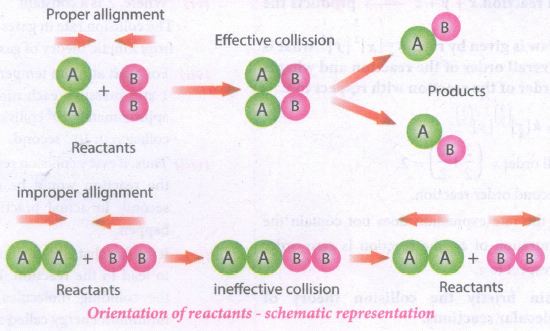
(ix) The fraction of effective collisions (f) having proper orientation is given by the steric factor p.
⇒ Rate = p x f x collision rate
\(\Rightarrow Rate=p\times { e }^{ \frac { -Ea }{ RT } }\times Z\left[ { A }_{ 2 } \right] \left[ { B }_{ 2 } \right] \quad ...(1)\)
As per the rate law,
Rate = \(k=\left[ { A }_{ 2 } \right] \left[ { B }_{ 2 } \right] \quad ...(2)\)
Where k is the rate constant
On comparing equation (1) and (2), the rate constant k is
\(k=pZ{ e }^{ \frac { -Ea }{ RT } }\)

12th Standard Syllabus & Materials
12th Standard
TN 12th Computer Applications களப்பெயர் முறைமை (DNS) Sample Question Papers Study Material - QB365 Set A
NEW12th Standard
TN 12th Computer Applications வலையமைப்பு எடுத்துக்காட்டுகள் மற்றும் நெறிமுறைகள் Sample Question Papers Study Material - QB365 Set A
NEW12th Standard
TN 12th Computer Applications கணினி வலையமைப்பு ஓர் அறிமுகம் Sample Question Papers Study Material - QB365 Set A
NEW12th Standard
TN 12th Computer Applications PHP-உடன் MySQL-ஐ இணைத்தல் Sample Question Papers Study Material - QB365 Set A



Tamilnadu Stateboard 12th Standard Subjects

Maths
Chemistry

Physics

Biology

Computer Science

Business Maths and Statistics

Economics

Commerce

Accountancy

History

Computer Applications
Biology
Computer Technology
Computer Applications
Computer Science
Business Maths and Statistics
Commerce
Economics
Maths
Chemistry
Physics
Computer Technology
History
Accountancy

Tamil

English

French
Tamilnadu Stateboard Standards


