
 100% FREE ACCESS
12th Standard Syllabus & Materials
12th Standard
TN 12th Computer Applications மின்னணு தரவு பரிமாற்றம் Sample Question Papers Study Material - QB365 Set A
NEW12th Standard
TN 12th Computer Applications மின் - வணிக பாதுகாப்பு அமைப்புகள் Sample Question Papers Study Material - QB365 Set A
NEW12th Standard
TN 12th Computer Applications மின்னணு செலுத்தல் முறைகள் Sample Question Papers Study Material - QB365 Set A
NEW12th Standard
TN 12th Computer Applications மின் - வணிகம் Sample Question Papers Study Material - QB365 Set A
NEW12th Standard
TN 12th Computer Applications திறந்த மூல கருத்துருக்கள் Sample Question Papers Study Material - QB365 Set A
NEW12th Standard
TN 12th Computer Applications வலையமைப்பு வடமிடல் Sample Question Papers Study Material - QB365 Set A

Published on: 20/10/2025
Download Tamil Nadu 12th Standard Chemistry question papers, model tests, one-mark questions, important questions, and public exam papers in PDF format. Free study materials and answer keys for TN State Board students.
Questions + Answers key
Take MCQ Chemistry Test
1.
If the initial concentration of the reactant is doubled, the time for half reaction is also doubled. Then the order of the reaction is______.
Zero
one
Fraction
none
2.
3.
For a first order reaction, the rate constant is 6.909 min-1 the time taken for 75% conversion in minutes is _______.
\(\left( \frac { 3 }{ 2 } \right) { \log 2 }\)
\(\left( \frac { 2 }{ 3 } \right) \log2\)
\(\left( \frac { 3 }{ 2 } \right) \log\left( \frac { 3 }{ 4 } \right) \)
\(\left( \frac { 2 }{ 3 } \right) \log\left( \frac { 4 }{ 3 } \right) \)
4.
In a reversible reaction, the enthalpy change and the activation energy in the forward direction are respectively −x kJ mol-1 and y kJ mol-1. Therefore, the energy of activation in the backward direction is _______.
(y-x) kJ mol-1
(x+y) J mol-1
(x-y) KJ mol-1
(x+y) x 103J mol-1
5.
For a reaction Rate = k[acetone]3/2 then unit of rate constant and rate of reaction respectively is _______.
(mol L-1 S-1),(mol1/2 L1/2 S-1)
(mol-1/2 L1/2 s-1),(mol L-1 s-1)
(mol1/2 L1/2 s-1),(mol L-1 s-1)
(mol L s-1),(mol1/2 L1/2 s)
6.
The cation leaves its normal position in the crystal and moves to some interstitial position, the defect in the crystal is known as _____.
Schottky defect
F center
Frenkel defect
non-stoichiometric defect
7.
If ‘a’ stands for the edge length of the cubic system sc, bcc, and fcc. Then the ratio of radii of spheres in these systems will be respectively ________.
\(\left( \frac { 1 }{ 2 } a;\frac { \sqrt { 3 } }{ 2 } a;\frac { \sqrt { 2 } }{ 2 } a \right) \)
\(\left( \sqrt { 1a } :\sqrt { 3a } :\sqrt { 2a } \right) \)
\(\left( \frac { 1 }{ 2 } a:\frac { \sqrt { 3 } }{ 4 } a:\frac { 1 }{ 2\sqrt { 2 } } a \right) \)
\(\frac { 1 }{ 2 } a:\sqrt { 3 } a:\frac { 1 }{ \sqrt { 2 } } a\)
8.
The fraction of total volume occupied by the atoms in a simple cubic is ________.
\(\left( \frac { \pi }{ 4\sqrt { 2 } } \right) \)
\(\left( \frac { \pi }{ 6 } \right) \)
\(\left( \frac { \pi }{ 4 } \right) \)
\(\left( \frac { \pi }{ 3\sqrt { 2 } } \right) \)
9.
A solid compound XY has NaCl structure if the radius of the cation is 100pm, the radius of the anion will be ________.
\(\left( \frac { 100 }{ 0.414 } \right) \)
\(\left( \frac { 0.732 }{ 100 } \right) \)
100 x 0.414
\(\left( \frac { 0.414 }{ 100 } \right) \)
10.
For a first order reaction A ⟶ product with initial concentration x mol L-1, has a half life period of 2.5 hours. For the same reaction with initial concentration \(\left( \frac { x }{ 2 } \right) \) mol L-1 the half life is
(2.5 x 2) hours
\(\left( \frac { 2.5 }{ 2 } \right) \) hours
2.5 hours
Without knowing the rate constant, t1/2 cannot be determined from the given data
11.
For a first order reaction A ⟶ B the rate constant is x min−1. If the initial concentration of A is 0.01M, the concentration of A after one hour is given by the expression.
001. e−x
1 x 10⁻²(1-e-60x)
(1 x 10⁻²)e-60x
none of these
12.
In a solid atom M occupies ccp lattice and \(\left( \frac { 1 }{ 3 } \right) \) of tetrahedral voids are occupied by atom N. Find the formula of solid formed by M and N ________.
MN
M3N
MN3
M3N2
13.
Fac-mer isomerism is shown by _______.
[CO(en)3]3+
[Co(NH3)4(Cl)2]+
[Co(NH3)3(Cl)3]
[Co(NH3)5Cl]SO4
14.
Formula of tris(ethane-1, 2-diamine)iron(II)phosphate _______.
[Fe(CH3-CH(NH2)2)3](PO4)3
[Fe(H2N-CH2-CH2-NH2)3](PO4)
[Fe(H2N-CH2-CH2-NH2)3](PO4)2
[Fe(H2N-CH2-CH2-NH2)3]3(PO4)2
15.
Which one of the following complexes is not expected to exhibit isomerism?
[Ni(NH3)4(H2O)2]2+
[Pt(NH3)2Cl2]
[Co(NH3)5SO4]Cl
[FeCl6]3-
16.
How many geometrical isomers are possible for [Pt(Py)(NH3)(Br)(Cl)]
3
4
0
15
17.
Which one of the following will give a pair of enantiomorphs?
[Cr(NH3)6][Co(CN)6]
[Co(en)2Cl2]Cl
[Pt(NH3)4][PtCl4]
[Co(NH3)4Cl2]NO2
18.
Crystal field stabilization energy for high spin d5 octahedral complex is _______.
-0.6\({ \Delta }_{ 0 }\)
0
2(P-\({ \Delta }_{ 0 }\))
2(P+\({ \Delta }_{ 0 }\))
19.
20.
Oxidation state of Iron and the charge on the ligand NO in [Fe(H2O)5NO]SO4 are_______.
+2 and 0 respectively
+3 and 0 respectively
+3 and -1 respectively
+1 and +1 respectively
21.
The sum of primary valence and secondary valence of the metal M in the complex [M(en)2(Ox)]Cl is________.
3
6
-3
9
22.
Which one of the following is not correct?
La(OH)3 is less basic than Lu(OH)3
In lanthanoid series ionic radius of Ln3+ ions decreases
La is actually an element of transition metal series rather than lanthanide series
Atomic radii of Zr and Hf are same because of lanthanide contract
23.
Which of the following oxidation states is most common among the lanthanoids?
+4
+2
+5
+3
24.
25.
The correct order of increasing oxidizing power in the series _______.
VO2+ < Cr2O72- < MnO4-
Cr2O72- < VO2+ < MnO4-
Cr2O72- < MnO4- < VO2+
MnO4- < Cr2O72- < VO2+
26.
The catalytic behaviour of transition metals and their compounds is ascribed mainly due to _______.
their magnetic behaviour
their unfilled d orbitals
their ability to adopt variable oxidation states
their chemical reactivity
27.
Which one of the following ions has the same number of unpaired electrons as present in V3+?
Ti3+
Fe3+
Ni2+
Cr3+
28.
Sc (Z = 21) is a transition element but Zinc (z = 30) is not because _______.
both Sc3+ and Zn2+ ions are colourless and form white compounds
In case of Sc, 3d orbital are partially filled but in Zn these are completely filled
last electron as assumed to be added to 4s level in case of zinc
both Sc and Zn do not exhibit variable oxidation states
29.
Duralumin is an alloy of ______.
Cu, Mn
Cu, Al, Mg
Al, Mn
Al, Cu, Mn, Mg
30.
Which of the following statements is not correct?
Beryl is a cyclic silicate
Mg2SiO4 is an orthosilicate
SiO44−is the basic structural unit of silicates
Feldspar is not aluminosilicate
31.
Which of the following is not sp2 hybridised?
Graphite
graphene
Fullerene
dry ice
32.
Which of the following is strongest acid among all?
HI
HF
HBr
HCl
33.
Which one of the following compounds is not formed?
XeOF4
XeO3
XeF2
NeF2
34.
The basicity of pyrophosphorous acid ( H4P2O5) is _______.
4
2
3
5
35.
On hydrolysis, PCl3 gives________.
H3PO3
PH3
H3PO4
POCl3
36.
An element belongs to group 15 and 3rd period of the periodic table, its electronic configuration would be_______.
1s2 2s2 2p4
1s2 2s2 2p3
1s2 2s2 2p6 3s2 3p2
1s2 2s2 2p6 3s2 3p3
37.
In which of the following, NH3 is not used?
Nessler's reagent
Reagent for the analysis of IV group basic radical
Reagent for the analysis of III group basic radical
Tollen's reagent
38.
The basic structural unit of silicates is _______.
\(\left( SiO_{ 3 } \right) ^{ 2- }\)
\(\left( SiO_{ 4 } \right) ^{ 2- }\)
\(\left( Sio \right) ^{ - }\)
\(\left( SiO_{ 4 } \right) ^{ 4- }\)
39.
Carbon atoms in fullerene with formula C60 have _______hybridisation.
sp3 hybridised
sp hybridised
sp2 hybridised
partially sp2 and partially sp3 hybridised
40.
Which of the following metals has the largest abundance in the earth’s crust?
Aluminium
Calcium
Magnesium
Sodium
41.
42.
43.
Considering Ellingham diagram, which of the following metals can be used to reduce alumina?
Fe
Cu
Mg
Zn
44.
Which one of the following ores is best concentrated by froth – floatation method?
Magnetite
Haematite
Galena
Cassiterite
45.
Electrochemical process is used to extract_______.
Iron
Lead
Sodium
silver
46.
Wolframite ore is separated from tinstone by the process of________.
Smelting
Calcination
Roasting
Electromagnetic separation
47.
Match items in column - I with the items of column – II and assign the correct code.
| Column-I | Column-II | ||
| A. | Cyanide process | (i) | Ultrapure Ge |
| B | Froth floatation process | (ii) | Dressing of ZnS |
| C | Electrolytic reduction | (iii) | Extraction of Al |
| D | Zone refining | (iv) | Extraction of Au |
| (v) | Purification of Ni | ||
| A | B | C | D |
| (i) | (ii) | (iii) | (iv) |
| A | B | C | D |
| (iii) | (iv) | (v) | (i) |
| A | B | C | D |
| (iv) | (ii) | (iii) | (i) |
| A | B | C | D |
| (ii) | (iii) | (i) | (v) |
48.
Which of the metal is extracted by Hall-Heroult process?
Al
Ni
Cu
Zn
49.
Which one of the following reaction represents calcinations?
\(2Zn+{ O }_{ 2 }\rightarrow 2ZnO\)
\(2ZnS+3O_{ 2 }\rightarrow 2ZnO+2SO_{ 2 }\)
\(MgCO_{ 3 }\rightarrow MgO+CO_{ 2 }\)
Both (a) and (c)
50.
Bauxite has the composition ______.
Al2O3
Al2O3.nH2O
Fe2O3.2H2O
None of these
1.
t1/2 α \(\frac{1}{[A_{0}]^{n-1}}\)...(1)
If [A0 = 2[A0]; then t1/2 = 2t1/2
2t1/2 α \(\frac{1}{[2A_{0}]^{n-1}}\)...(2)
(2)/(1) = \(2= \frac{1}{[2A_{0}]^{n-1}} \times \frac{1}{[A_{0}]^{n-1}}\)
\(2= \frac {[2A_{0}]^{n-1}} {[A_{0}]^{n-1}}\)
\(2= \frac {1} {2}^{n-1}\)
2 = (2-1)n-1
21 = (2-n+1)
n = 0
2.
(a)
3.
\(k=\frac { 2.303 }{ t } \log\frac { \left[ { A }_{ 0 } \right] }{ \left[ A \right] } \)
[A0] = 100: [A] = 25
\(6.909=\frac { 2.303 }{ t } \log\frac { \left[ {100 } \right] }{ \left[ 25\right] } \)
\(t =\frac { 2.303 }{ 6.909 } \log(4)\)
\(t =\frac { 1 }{ 3 } \log(2^2)\)
\(= \left( \frac { 2 }{ 3 } \right) \log2\)
4.
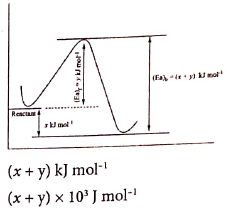
5.
Rate = k[A]n
Rate = \(\frac{-\mathrm{d}[\mathrm{A}]}{\mathrm{dt}}\)
unit of rate = \(\frac{mol L^{-1}}{s}\)=mol L-1/s-1
unit of rate constant
\(=\frac{ (mol{ L }^{ -1 }{ S }^{ -1 }) }{ ({ mol }{ L }^{ -1 })^n } \)
= mol1-nLn-1s-1
in the case
rate = k [Acetone]3/2
n = 3/2
= mol1-(3/2)L(3/2)-1s-1
(mol-(1/2) L(1/2) s-1).
6.
(c)
Frenkel defect
7.
sc ⇒ 2r = a
⇒ r = a/2
bcc ⇒ 4r = \( \sqrt{3a} \) ⇒ r = \(\frac { \sqrt{3a}} {4}\)
fcc ⇒ 4r ⇒ \( \sqrt{2a} \) ⇒ r = \(\frac { \sqrt{2a}} {4} = \frac { a} {2\sqrt{2a}}\)
\(\left( \frac { a }{ 2 } :\frac { \sqrt { 3 } }{ 4 } a:\frac { a }{ 2\sqrt { 2 } } \right) \)
8.
(b)
\(\left( \frac { \pi }{ 6 } \right) \)
9.
For a fcc structure = rx+ / ry- = 0.414
Given that rx+ = 100 pm
ry = 100pm/0.414
10.
For a first order reaction
t1/2 = \(\frac { 0.693 }{ { k }}\)
t1/2 does not depend on the initial concentration and it remains constant (whatever may be the initial concentration)
t1/2 = 2.5 hrs
11.
\(k=\frac { 2.303 }{ t } log\frac { \left[ { A }_{ 0 } \right] }{ \left[ A \right] } \)
\(k=\frac { 1 }{ t } ln \frac { \left[ { A }_{ 0 } \right] }{ \left[ A \right] } \)
\(e^{kt}=\frac { \left[ { A }_{ 0 } \right] }{ \left[ A \right] }\)
[A] = [A0] ekt
In this case
k = x min-1 and [A0] = 0.01 M = 1 x 10⁻²M
t = 1 hour = 60 min
[A] = (1 x 10⁻²)e-60x
12.
If the total number of M atoms is n, then the number of tetrahedral voids = 2n
Given that \(\left( \frac { 1 }{ 3 } \right) ^{rd}\) of tetrahedral voids are occupied.
i.,e \(\left( \frac { 1 }{ 3 } \right) \times 2n\) are occupied by N atoms
\(\therefore\)M : N = n : \(\left( \frac { 2 }{ 3 } \right) n\)
= 1 : \(\frac { 2 }{ 3 }\)
Hence M3N2 = 3 : 2
13.
(c)
[Co(NH3)3(Cl)3]
14.
[Fe(H2N-CH2-CH2-NH2)3]3(PO4)2
[Fe(en)3]2+(\(PO_{4}^{3-}\))
15.
Option (a) and (b) -geometrical isomerism is possible
Option (c) - ionization isomerism is possible
Option (d) - no possibility to show either constitutional isomerism or stereo isomerism
16.
Three isomers. If we consider any one of the ligands as reference (say Py), the arrangement of other three ligands (NH3, Br- and Cl-) with respect to (Py) gives three geometrical isomers.
17.
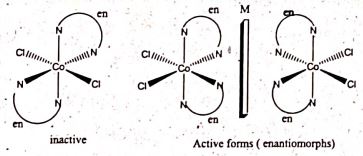
Complexes given in other options (a), (c) and (d) have symmetry elements and hence they are optically inactive.
18.
The electronic configuration t2g3, e2g
[ 3 x (-0.4)+ 2(0.6)]Δ0
[-1.2 + 1.2] Δ0 = 0
19.
(d)
20.
[\( \overset{+}{Fe}\)(H2O)5\( \overset{+}{NO}\)]2+ SO2-4
+1 and +1 respectively
21.
In the complex [M(en)2(Ox)]Cl For the central metal ion M3+
The primary valence is = +3
The secondary valence = 6
sum of primary valence and secondary valence = 3 + 6 = 9
22.
(a)
La(OH)3 is less basic than Lu(OH)3
23.
(d)
+3
24.
(c)
25.
+5 +6 +7
VO2+ < Cr2O72- < MnO4-
Greater the oxidation state, higher is the oxidising power.
26.
(c)
their ability to adopt variable oxidation states
27.
(c)
Ni2+
28.
(b)
In case of Sc, 3d orbital are partially filled but in Zn these are completely filled
29.
(d)
Al, Cu, Mn, Mg
30.
(d)
Feldspar is not aluminosilicate
31.
(d)
dry ice
32.
(a)
HI
33.
(d)
NeF2
34.
(b)
2
35.
(a)
H3PO3
36.
(d)
1s2 2s2 2p6 3s2 3p3
37.
(a)
Nessler's reagent
38.
(d)
\(\left( SiO_{ 4 } \right) ^{ 4- }\)
39.
(c)
sp2 hybridised
40.
(a)
Aluminium
41.
(d)
42.
(b)
43.
(c)
Mg
44.
(c)
Galena
45.
(c)
Sodium
46.
(d)
Electromagnetic separation
47.
(c)
| A | B | C | D |
| (iv) | (ii) | (iii) | (i) |
48.
(a)
Al
49.
(c)
\(MgCO_{ 3 }\rightarrow MgO+CO_{ 2 }\)
50.
(b)
Al2O3.nH2O

12th Standard Syllabus & Materials
12th Standard
TN 12th Computer Applications களப்பெயர் முறைமை (DNS) Sample Question Papers Study Material - QB365 Set A
NEW12th Standard
TN 12th Computer Applications வலையமைப்பு எடுத்துக்காட்டுகள் மற்றும் நெறிமுறைகள் Sample Question Papers Study Material - QB365 Set A
NEW12th Standard
TN 12th Computer Applications கணினி வலையமைப்பு ஓர் அறிமுகம் Sample Question Papers Study Material - QB365 Set A
NEW12th Standard
TN 12th Computer Applications PHP-உடன் MySQL-ஐ இணைத்தல் Sample Question Papers Study Material - QB365 Set A



Tamilnadu Stateboard 12th Standard Subjects

Maths
Chemistry

Physics

Biology

Computer Science

Business Maths and Statistics

Economics

Commerce

Accountancy

History

Computer Applications
Biology
Computer Technology
Computer Applications
Computer Science
Business Maths and Statistics
Commerce
Economics
Maths
Chemistry
Physics
Computer Technology
History
Accountancy

Tamil

English

French
Tamilnadu Stateboard Standards


