
 100% FREE ACCESS
12th Standard Syllabus & Materials
12th Standard
TN 12th Computer Applications மின்னணு தரவு பரிமாற்றம் Sample Question Papers Study Material - QB365 Set A
NEW12th Standard
TN 12th Computer Applications மின் - வணிக பாதுகாப்பு அமைப்புகள் Sample Question Papers Study Material - QB365 Set A
NEW12th Standard
TN 12th Computer Applications மின்னணு செலுத்தல் முறைகள் Sample Question Papers Study Material - QB365 Set A
NEW12th Standard
TN 12th Computer Applications மின் - வணிகம் Sample Question Papers Study Material - QB365 Set A
NEW12th Standard
TN 12th Computer Applications திறந்த மூல கருத்துருக்கள் Sample Question Papers Study Material - QB365 Set A
NEW12th Standard
TN 12th Computer Applications வலையமைப்பு வடமிடல் Sample Question Papers Study Material - QB365 Set A

Published on: 20/10/2025
Download Tamil Nadu 12th Standard Chemistry question papers, model tests, one-mark questions, important questions, and public exam papers in PDF format. Free study materials and answer keys for TN State Board students.
Questions + Answers key
Take MCQ Chemistry Test
1.
Write short notes on poly nuclear carbonyls.
2.
How double salt differs from co - ordination compounds?
3.
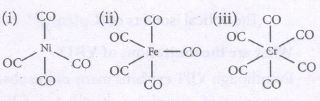
Draw the structure of the following homoleptic metal carbonyl.
(i) [Ni(CO)4]
(ii) [Fe(CO)5]
(iii) [Cr(CO)6]
4.
5.
Explain optical isomerism in coordination compounds with an example.
6.
Give one test to differentiate [Co(NH3)5Cl]SO4 and [Co(NH3)5SO4]Cl.
7.
In [Fe(H2O)6]3+ the electronic configuration of central metal ion is ________.
\(\mathrm{t}_{2 \mathrm{~g}}^{3}, \mathrm{e}_{\mathrm{g}}^{2}\)
\(\mathrm{e}_{\mathrm{g}}^{3}, \mathrm{t}_{2 \mathrm{~g}}^{3}\)
\(\mathrm{t}_{2 \mathrm{~g}}^{2}, \mathrm{e}_{\mathrm{g}}^{2}\)
\(t_{2 g}^{4}, e_{g}^{3}\)
8.
The crystal field splitting energy \(\triangle\) is given by ________.
\(\triangle\) = hv
\(\triangle\) = hc/ \(\lambda\)
\(\mathrm{hc} \overline{\mathrm{V}}\)
All of these
9.
The correct structure of Fe(CO)5 is ________.
octahedral
tetrahedral
square pyramidal
trigonal bi pyramidal
10.
The magnetic moment of [COF6]3- is ________.
5.9 BM
4.89 BM
4.00 BM
1.86 BM
11.
Linear geometry hybridisation is ________.
sp
sp2
sp3d3
sp3d2
12.
Which one is Magnus's green salt?
[Pt(NH3)4][PtCl4]
K[PtCl3(C2H4)]
[Cu(NH3)4]
[Pt(NH3)2]2+
13.
Which one is Zeise's salt?
[Pt(NH3)4][PtCI4]
K[PtCI3(C2H4)]
[Pt(NH3)2]2+
None of these
14.
Which one is neutral complex?
[Ni(CO)4]
[Fe(CO)5]
[Co(NH3)3(CI)3]
All of these
15.
Werner's theory does not explain the ________.
magnetic property
valencies
co-ordination nature
ligands
16.
The colour of CoCl3.6NH3 is ________.
yellow
purple
green
violet
17.
Which of the following is paramagnetic in nature?
[Zn(NH3)4]2+
[Co(NH3)6]3+
[Ni(H2O)6]2+
[Ni(CN)4]2-
18.
Formula of tris(ethane-1, 2-diamine)iron(II)phosphate _______.
[Fe(CH3-CH(NH2)2)3](PO4)3
[Fe(H2N-CH2-CH2-NH2)3](PO4)
[Fe(H2N-CH2-CH2-NH2)3](PO4)2
[Fe(H2N-CH2-CH2-NH2)3]3(PO4)2
19.
How many geometrical isomers are possible for [Pt(Py)(NH3)(Br)(Cl)]
3
4
0
15
20.
21.
Oxidation state of Iron and the charge on the ligand NO in [Fe(H2O)5NO]SO4 are_______.
+2 and 0 respectively
+3 and 0 respectively
+3 and -1 respectively
+1 and +1 respectively
22.
Predict the number of unpaired electrons in [CoCI4]2- ion on the basic of VBT.
23.
What is mer isomer?
24.
What is Co-ordination number?
25.
What is Co-ordination sphere?
26.
Write the IUPAC name of [Cu(NH3)4]SO4
27.
Give the names of two complexes which are used in medicines.
28.
Write the importance and applications of co - ordination complexes.
29.
In an tetrahedral crystal field, draw the figure to show splitting of d-orbitals.
30.
What are the main assumptions of Valence Bond Theory? Explain.
31.
What are the postulates of valance bond theory? Give its limitations.
32.
Give the postulates and limitation of Werner's theory of co-ordination compounds.
1.
(i) Metallic carbonyls containing two or more metal atoms are called poly nuclear carbonyls.
(ii) Poly nuclear metal carbonyls may be Homo nuclear \(\left[\mathrm{Co}_{2}(\mathrm{CO})_{8}\right],\left[\mathrm{Mn}_{2}(\mathrm{CO})_{10}\right],\left[\mathrm{Fe}_{3}(\mathrm{CO})_{12}\right]\) (or) hetero nuclear \(\left[\mathrm{MnCo}(\mathrm{CO})_{9}\right],\left[\mathrm{MnRe}(\mathrm{CO})_{10}\right]\) etc.
2.
(i) Doubles salts are those molecular or addition compounds which exist in a solid state but dissociate into constituents ions when dissolved in water. Ex: Mohr salt \(\mathrm{FeSO}_{4} .\left(\mathrm{NH}_{4}\right)_{2} \mathrm{SO}_{4} \cdot 6 \mathrm{H}_{2} \mathrm{O}\)
(ii) Coordination compounds are those molecular or addition compounds which retained their identity in aqueous solution and shows property entirely different from their constituent ions. Ex: Potassium ferrocyanide: \(\mathrm{K}_{4}\left[\mathrm{Fe}(\mathrm{CN})_{6}\right]\)
3.
4.
5.
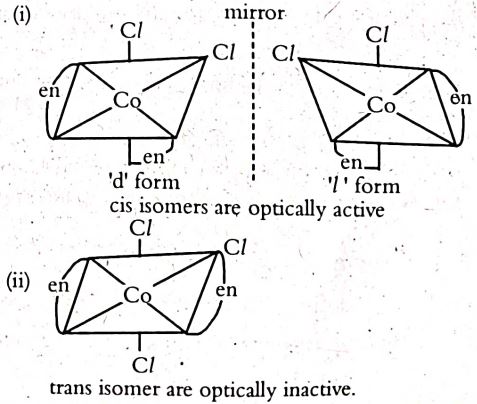
(i) Coordination compounds which possess chirality exhibit optical isomerism similar to organic compounds.
(ii) The pair of two optically active isomers which are mirror images of each other are called enantiomers.
(iii) Their solutions rotate the plane of the plane polarised light either clockwise or anticlockwise and the corresponding isomers are called 'd' (dextrorotatory) and 'I' (levorotatory) forms respectively.
(iv) The octahedral complexes of type \(\left[\mathrm{M}(\mathrm{xx})_{3}\right]^{\mathrm{n} \pm}, \left[\mathrm{M}(\mathrm{xx})_{2} \mathrm{AB}\right]^{\mathrm{n\pm}}\) and \(\left[\mathrm{M}(\mathrm{xx})_{2} \mathrm{~B}_{2}\right]^{\mathrm{n\pm}}\) exhibit optical isomerism.
Examples:
(i) The optical isomers of \(\left[\mathrm{Co}(\mathrm{en})_{3}\right]^{3+}\)
(ii) The coordination complex \(\left[\mathrm{CoCl}_{2}(\mathrm{en})_{2}\right]^{+}\) has three isomers, two optically active cis forms and one optically inactive trans form.
6.
These two are ionisation isomers. [Co(NH3)5Cl]SO4 gives white precipitate with BaCl2 solution, but not with AgNO3 solution. [Co(NH3)5SO4]Cl gives curdy white precipitate with AgNO3 solution but not with BaCl2 solution.
7.
(a)
\(\mathrm{t}_{2 \mathrm{~g}}^{3}, \mathrm{e}_{\mathrm{g}}^{2}\)
8.
(d)
All of these
9.
(d)
trigonal bi pyramidal
10.
(b)
4.89 BM
11.
(a)
sp
12.
(a)
[Pt(NH3)4][PtCl4]
13.
(b)
K[PtCI3(C2H4)]
14.
(d)
All of these
15.
(a)
magnetic property
16.
(a)
yellow
17.
a) Zn2+ (d10 ⇒ diamagnetic)
b) Co3+ (d6 Low spain ⇒ t2g6 e0g ; diamagnetic)
c) Ni2+ (d8 Low spain ⇒ t2g6 e2g ; paramagnetic)
d) [Ni(CN)4]2+ (dsp2 ; square planar, diamagnetic)
18.
[Fe(H2N-CH2-CH2-NH2)3]3(PO4)2
[Fe(en)3]2+(\(PO_{4}^{3-}\))
19.
Three isomers. If we consider any one of the ligands as reference (say Py), the arrangement of other three ligands (NH3, Br- and Cl-) with respect to (Py) gives three geometrical isomers.
20.
(d)
21.
[\( \overset{+}{Fe}\)(H2O)5\( \overset{+}{NO}\)]2+ SO2-4
+1 and +1 respectively
22.
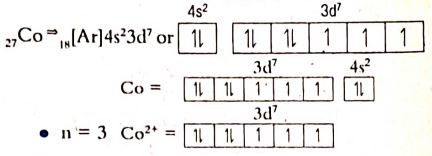
It has three unpaired electrons.
The magnetic moment of [CoCl4]2- is
\(\mu_{s}=\sqrt{n(n+2)}\)
\(=\sqrt{3(3+2)}=\sqrt{15}\) = 3.87 BM
23.
(i) If the three similar ligands are present around the meridian which is an imaginary semicircle from one apex of the octahedral to the opposite apex, the isomer is called as a meridional isomer (mer isomer).
(ii) This is called meridional because each set of ligands can be regarded as lying on a meridian of an octahedron.
24.
(i) The number of ligand donor atoms bonded to a central metal ion in a complex is called the coordination number of the metal.
(ii) In other words, the coordination number is equal to the number of σ-bonds between ligands and the central atom.
25.
(i) The complex ion of the coordination compound containing the central metal atom/ion and the ligands attached to it is collectively called coordination sphere and are usually enclosed in square brackets with the net charge.
(ii) The other ionisable ions, are written outside the bracket are called counter ions. For example, the coordination compound K4[Fe(CN)6] contains the complex ion [Fe(CN)6]4- and is referred as the coordination sphere.
(iii) The other associated ion K+ is called the counter ion.
26.
Tetraammine copper (II) sulphate.
27.
(i) EDTA is used in the treatment of lead poisoning
(ii) Cis-platin[Pt(NH3)2Cl2] is used in the treatment of cancer.
28.
1. The coordination complexes are of great importance. These compounds present in many plants, animals and in minerals. Some Important applications of coordination complexes are described below.
2. Phthalo blue - a bright blue pigment is a complex of Copper (II) ion and it is used in printing ink and in the packaging industry.
3. Purification of Nickel by Mond's process involves formation [Ni(CO)4], which Yields 99.5 % pure Nickel on decomposition.
4. EDTA is used as a chelating ligand for the separation of lanthanides, in softening of hard water and also in removing lead poisoning.
5. Coordination complexes are used in the extraction of silver and gold from their ores by forming soluble cyano complex. These cyano complexes are reduced by zinc to yield metals. This process is called as MacArthur-Forrest cyanide process.
6. Some metal ions are estimated more accurately by complex formation. For example, Ni2+ ions present in Nickel chloride solution is estimated accurately for forming an insoluble complex called [Ni(DMG)2]
7. Many of the complexes are used as catalysts in organic and inorganic reactions. For example,
(i) Wilkinson's catalyst - \(\left[(\mathrm{PPh})_{3} \mathrm{RhCl}\right]\) is used for hydrogenation of alkenes.
(ii) Ziegler-Natta catalyst - \(\left[\mathrm{TiCl}_{4}\right]+\mathrm{Al}\left(\mathrm{C}_{2} \mathrm{H}_{5}\right)_{3}\) is used in the polymerization of ethene.
8. In order to get a fine and uniform deposit of superior metals (Ag, Au, Pt etc.,) over base metals, Coordination complexes \(\left[\mathrm{Ag}(\mathrm{CN})_{2}\right]\) - and \(\left[\mathrm{Au}\left(\mathrm{CN}_{2}\right)\right]\) - etc., are used in electrolytic bath.
9. Many complexes are used as medicines for the treatment of various diseases. For example,
(1) Ca - EDTA chelate, is used in the treatment of lead and radioactive poisoning ie., is for removing lead and radioactive metal ions from the body.
(2) Cis - platin is used as an antitumor drug in cancer treatment.
10. In photography, when the developed film is washed with sodium thio sulphate solution (hypo), the negative film gets fixed. Undecomposed AgBr forms a soluble complex called sodiumdithiosulphato argentate(I) which can be easily removed by washing the film with water.
\(\mathrm{AgBr}+2 \mathrm{Na}_{2} \mathrm{~S}_{2} \mathrm{O}_{3} \longrightarrow \mathrm{Na}_{3}\left[\mathrm{Ag}\left(\mathrm{S}_{2} \mathrm{O}_{3}\right)_{2}\right]+2 \mathrm{NaBr}\)
11. Many biological systems contain metal complexes. For example,
(i) A red blood corpuscles (RBC) is composed of heme group, which is Fe2+ - Porphyrin complex. It plays an important role in carrying oxygen from lungs to tissues and carbon dioxide from tissues to lungs.
(ii) Chlorophyll, a green pigment present in green plants and algae, is a coordination complex containing Mg2+ as central metal ion surrounded by a modified Porphyrin ligand called corrin ring. It plays an important role in photosynthesis, by which plants converts CO2 and water into carbohydrates and oxygen.
(iii) Vitamin B12 (cyanocobalamin) is the only vitamin consist of metal ion. it is a coordination complex in which the central metal ion is Co+ surrounded by Porphyrin like ligand.
(iv) Many enzymes are known to be metal complexes, they regulate biological processes. For example, Carboxypeptidase is a protease enzyme that hydrolytic enzyme important in digestion, contains a zinc ion coordinated to the protein.
29.
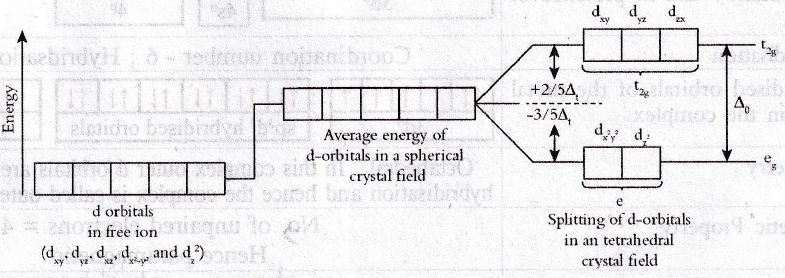
The actual configuration adopted by the complex decided by the relative values of Δ and P, where P represents the energy required for e- pairing in a single orbital and Δ is crystal field splitting energy.
30.
(i) The ligand ➝ metal bond in a coordination complex is covalent in nature. It is formed by sharing of electrons (provided by the ligands) between the central metal atom and the ligand.
(ii) Each ligand should have at least one filled orbital containing a lone pair of electrons.
(iii) In order to accommodate the electron pairs donated by the ligands, the central metal ion present in a complex provides required number (coordination number) of vacant orbitals.
(iv) These vacant orbitals of central metal atom undergo hybridisation, the process of mixing of atomic orbitals of comparable energy to form equal number of new orbitals called hybridised orbitals with same energy.
(v) The vacant hybridised orbitals of the central metal ion, linearly overlap with filled orbitals of the ligands to form coordinate covalent sigma bonds between the metal and the ligand.
(vi) The hybridised orbitals are directional and their orientation in space gives a definite geometry to the complex ion.
(vii) In the octahedral complexes, if the (n-1) d orbitals are involved in hybridisation, then they are called inner orbital complexes or low spin complexes or spin paired complexes. If the nd orbitals are involved in hybridisation, then such complexes are called outer orbital or high spin or spin free complexes. Here n represents the principle quantum number of the outermost shell.
(viii) The complexes containing a central metal atom with unpaired electron(s) are paramagnetic. If all the electrons are paired, then the complexes will be diamagnetic.
(ix) Ligands such as CO, CN·, en, and NH3 present in the complexes cause pairing of electrons present in the central metal atom. Such ligands are called strong field ligands.
(x) Greater the overlapping between the ligand orbitals and the hybridised metal orbital, greater is the bond strength.
31.
The postulates of valence bond theory
(i) The central metal atom/ion makes available a number of vacant orbitals equal to its coordination number.
(ii) These vacant orbitals form covalent bonds with the ligand orbitals.
(iii) A covalent bond is formed by the overlap of a vacant metal orbital and filled ligand orbitals. This complete overlap leads to the formation of a metal ligand, σ (sigma) bond.
(iv) A strong covalent bond is formed only when the orbitals overlap to the maximum extent.
(v) This maximum overlapping is possible only when the metal vacant orbitals undergo a process called 'hybridisation'.
(vi) A hybridised orbital has a better directional characteristic than an unhybridized one. The following table gives the coordination number, orbital hybridisation, and geometry of the complexes.
| Coordination number | Types of hybridisation | Geometry |
|---|---|---|
| 2 | sp | linear |
| 4 | sp3 | tetrahedral |
| 4 | dsp3 | square planer |
| 6 | d2sp3 | octahedral |
| 6 | sp3d2 | octahedral |
Magnetic moment
The paramagnetic moment is given by the following spin-only formula.
\({ \mu }_{ s }=\sqrt { n(n+2) } \) BM
BM = Bohr magneton
\({ \mu }_{ s }\) = spin -only magnetic moment
n = number of unpaired electrons.
32.
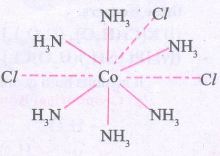
(i) Every metal atom has two types of valencies Primary valency or ionisable valency Secondary valency or non ionisable valency
(ii) The primary valency corresponds to the oxidation state of the metal ion. It is always satisfied by negative ions.
(iii) Secondary valency corresponds to the coordination number of the metal ion or atom. It is satisfied by either negative ions or neutral molecules.
(iv) The molecules or ions that satisfy secondary valencies are called ligands.
(v) The ligands which satisfy secondary valencies must project in definite directions in space. So the secondary valencies are directional in nature whereas the primary valencies are non - directional in nature.
(vi) The ligands have unshared pair of electrons. These unshared pair of electrons are donated to central metal ion or atom in a compound. Such compounds are called coordination compounds.
Werner's representation
Eg: [Co(NH)6]Cl3
Cl: primary valency (dotted lines)
NH3: secondary valency (solid lines).
Defects of Werner's theory
Werner's theory describes the structures of many co-ordination compounds successfully. However, it does not explain the magnetic and spectral properties.

12th Standard Syllabus & Materials
12th Standard
TN 12th Computer Applications களப்பெயர் முறைமை (DNS) Sample Question Papers Study Material - QB365 Set A
NEW12th Standard
TN 12th Computer Applications வலையமைப்பு எடுத்துக்காட்டுகள் மற்றும் நெறிமுறைகள் Sample Question Papers Study Material - QB365 Set A
NEW12th Standard
TN 12th Computer Applications கணினி வலையமைப்பு ஓர் அறிமுகம் Sample Question Papers Study Material - QB365 Set A
NEW12th Standard
TN 12th Computer Applications PHP-உடன் MySQL-ஐ இணைத்தல் Sample Question Papers Study Material - QB365 Set A



Tamilnadu Stateboard 12th Standard Subjects

Maths
Chemistry

Physics

Biology

Computer Science

Business Maths and Statistics

Economics

Commerce

Accountancy

History

Computer Applications
Biology
Computer Technology
Computer Applications
Computer Science
Business Maths and Statistics
Commerce
Economics
Maths
Chemistry
Physics
Computer Technology
History
Accountancy

Tamil

English

French
Tamilnadu Stateboard Standards


