
 100% FREE ACCESS
12th Standard Syllabus & Materials
12th Standard
TN 12th Computer Applications மின்னணு தரவு பரிமாற்றம் Sample Question Papers Study Material - QB365 Set A
NEW12th Standard
TN 12th Computer Applications மின் - வணிக பாதுகாப்பு அமைப்புகள் Sample Question Papers Study Material - QB365 Set A
NEW12th Standard
TN 12th Computer Applications மின்னணு செலுத்தல் முறைகள் Sample Question Papers Study Material - QB365 Set A
NEW12th Standard
TN 12th Computer Applications மின் - வணிகம் Sample Question Papers Study Material - QB365 Set A
NEW12th Standard
TN 12th Computer Applications திறந்த மூல கருத்துருக்கள் Sample Question Papers Study Material - QB365 Set A
NEW12th Standard
TN 12th Computer Applications வலையமைப்பு வடமிடல் Sample Question Papers Study Material - QB365 Set A

Published on: 20/10/2025
Download Tamil Nadu 12th Standard Chemistry question papers, model tests, one-mark questions, important questions, and public exam papers in PDF format. Free study materials and answer keys for TN State Board students.
Questions + Answers key
Take MCQ Chemistry Test
1.
Ammonium salt of benzoic acid is heated strongly with and the product so formed is reduced and then treated with NaNO2 / HCl at low temperature. The final compound formed is _______.
Benzene diazonium chloride
Benzyl alcohol
Phenol
Nitrosobenzene
2.
IUPAC name for the amine
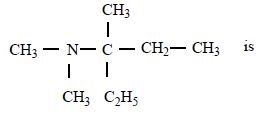
3 – Bimethylamino – 3 – methyl pentane
3 (N,N – Triethyl) – 3- amino pentane
3 – N,N – trimethyl pentanamine
N,N – dimethyl – 3- methyl - pentan - 3 amine
3.
Which one of the following is most basic?
2,4 – dichloroaniline
2,4 – dimethyl aniline
2,4 – dinitroaniline
2,4 – dibromoaniline
4.
Secondary nitro alkanes react with nitrous acid to form _______.
red solution
blue solution
green solution
yellow solution
5.
6.
Which of the following reaction is not correct.
CH3 CH2 NH2 \(\overset { { HNO }_{ 2 } }{ \longrightarrow } \)CH3CH2 OH + N2

CH2 CONH2 \(\overset { { Br }_{ 2 }/NaOH }{ \longrightarrow } \)CH3 NH2
none of these
7.
The product formed by the reaction an aldehyde with a primary amine ________.
carboxylic acid
aromatic acid
schiff ’s base
ketone
8.
Aniline + benzoylchloride \(\overset { NaOH }{ \longrightarrow } \)C6H5 - NH - COC6 H5 this reaction is known as ______.
Friedel – crafts reaction
HVZ reaction
Schotten – Baumann reaction
none of these
9.
CH3CH2 Br \(\overset { aqNaOH }{ \underset { \Delta }{ \longrightarrow } } A\overset { { KMnO }_{ 4 }{ /H }^{ + } }{ \underset { \Delta }{ \longrightarrow } } B\overset { { NH }_{ 3 } }{ \underset { \Delta }{ \longrightarrow } } C\overset { { Br }_{ 2 }/NaOH }{ \longrightarrow } D\) D' is________.
bromomethane
α - bromo sodium acetate
methanamine
acetamide
10.
Which one of the following will not undergo Hofmann bromamide reaction.
CH3CONHCH3
CH3CH2CONH2
CH3CONH2
C6H5CONH2
11.
The method by which aniline cannot be prepared is _________.
degradation of benzamide with Br2 / NaOH
potassium salt of phthalimide treated with chlorobenzene followed by hydrolysis with aqueous NaOH solution.
reduction of Nitrobenzene with LiAlH4
reduction of nitrobenzene by Sn / HCl
12.
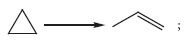 This reaction follows first order kinetics. The rate constant at particular temperature is 2.303 x 10⁻² hour-1. The initial concentration of cyclopropane is 0.25 M. What will be the concentration of cyclopropane after 1806 minutes? (log 2 = 0.3010)
0.125 M
0.215 M
0.25 x 2.303 M
0.05 M
13.
The correct difference between first and second order reactions is that________.
A first order reaction can be catalysed; a second order reaction cannot be catalysed.
The half life of a first order reaction does not depend on [A0]; the half life of a second order reaction does depend on [A0].
The rate of a first order reaction does not depend on reactant concentrations; the rate of a second order reaction does depend on reactant concentrations.
The rate of a first order reaction does depend on reactant concentrations; the rate of a second order reaction does not depend on reactant concentrations.
14.
If 75% of a first order reaction was completed in 60 minutes, 50% of the same reaction under the same conditions would be completed in_______.
20 minutes
30 minutes
35 minutes
75 minutes
15.
If the initial concentration of the reactant is doubled, the time for half reaction is also doubled. Then the order of the reaction is______.
Zero
one
Fraction
none
16.
17.
For a first order reaction, the rate constant is 6.909 min-1 the time taken for 75% conversion in minutes is _______.
\(\left( \frac { 3 }{ 2 } \right) { \log 2 }\)
\(\left( \frac { 2 }{ 3 } \right) \log2\)
\(\left( \frac { 3 }{ 2 } \right) \log\left( \frac { 3 }{ 4 } \right) \)
\(\left( \frac { 2 }{ 3 } \right) \log\left( \frac { 4 }{ 3 } \right) \)
18.
What is the activation energy for a reaction if its rate doubles when the temperature is raised from 200K to 400K? (R = 8.314 JK-1 mol-1)
234.65 kJ mol-1
434.65 kJ mol-1
2.305 kJ mol-1
334.65 J mol-1
19.
Consider the following statements:
(i) increase in concentration of the reactant increases the rate of a zero order reaction.
(ii) rate constant k is equal to collision frequency A if Ea = 0
(iii) rate constant k is equal to collision frequency A if Ea = ∞
(iv) a plot of ln (k) vs T is a straight line.
(v) a plot of ln (k) vs \(\left( \frac { 1 }{ T } \right) \) is a straight line with a positive slope.
Correct statements are
(ii) only
(ii) and (iv)
(ii) and (v)
(i), (ii) and (v)
20.
The addition of a catalyst during a chemical reaction alters which of the following quantities?
Enthalpy
Activation energy
Entropy
Internal energy
21.
The decomposition of phosphine (PH3) on tungsten at low pressure is a first order reaction. It is because the _____.
rate is proportional to the surface coverage
rate is inversely proportional to the surface coverage
rate is independent of the surface coverage
rate of decomposition is slow
22.
A two dimensional solid pattern formed by two different atoms X and Y is shown below. The black and white squares represent atoms X and Y respectively. The simplest formula for the compound based on the unit cell from the pattern is _______.
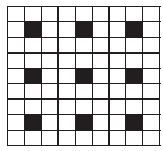
XY8
X4Y9
XY2
XY4
23.
The crystal with a metal deficiency defect is ________.
NaCl
FeO
ZnO
KCl
24.
Schottky defect in a crystal is observed when ______.
unequal number of anions and anions are missing from the lattice
Equal number of cations and anions are missing from the lattice
an ion leaves its normal site and occupies an interstitial site
no ion is missing from its lattice
25.
If ‘a’ is the length of the side of the cube, the distance between the body centered atom and one corner atom in the cube will be_________.
\(\left( \cfrac { 2 }{ \sqrt { 3 } } \right) a\)
\(\left( \cfrac { 4 }{ \sqrt { 3 } } \right) a\)
\(\left( \cfrac { \sqrt { 3 } }{ 4 } \right) a\)
\(\left( \cfrac { \sqrt { 3 } }{ 2 } \right) a\)
26.
If ‘a’ stands for the edge length of the cubic system sc, bcc, and fcc. Then the ratio of radii of spheres in these systems will be respectively ________.
\(\left( \frac { 1 }{ 2 } a;\frac { \sqrt { 3 } }{ 2 } a;\frac { \sqrt { 2 } }{ 2 } a \right) \)
\(\left( \sqrt { 1a } :\sqrt { 3a } :\sqrt { 2a } \right) \)
\(\left( \frac { 1 }{ 2 } a:\frac { \sqrt { 3 } }{ 4 } a:\frac { 1 }{ 2\sqrt { 2 } } a \right) \)
\(\frac { 1 }{ 2 } a:\sqrt { 3 } a:\frac { 1 }{ \sqrt { 2 } } a\)
27.
The yellow colour in NaCl crystal is due to ________.
excitation of electrons in F centers
reflection of light from Cl- ion on the surface
refraction of light from Na+ ion
all of the above
28.
The fraction of total volume occupied by the atoms in a simple cubic is ________.
\(\left( \frac { \pi }{ 4\sqrt { 2 } } \right) \)
\(\left( \frac { \pi }{ 6 } \right) \)
\(\left( \frac { \pi }{ 4 } \right) \)
\(\left( \frac { \pi }{ 3\sqrt { 2 } } \right) \)
29.
The radius of an atom is 300pm, if it crystallizes in a face centered cubic lattice, the length of the edge of the unit cell is ________.
488.5pm
848.5pm
884.5pm
484.5pm
30.
For a first order reaction A ⟶ product with initial concentration x mol L-1, has a half life period of 2.5 hours. For the same reaction with initial concentration \(\left( \frac { x }{ 2 } \right) \) mol L-1 the half life is
(2.5 x 2) hours
\(\left( \frac { 2.5 }{ 2 } \right) \) hours
2.5 hours
Without knowing the rate constant, t1/2 cannot be determined from the given data
31.
Among the following graphs showing variation of rate constant with temperature (T) for a reaction, the one that exhibits Arrhenius behavior over the entire temperature range is _______.

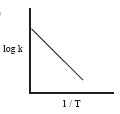
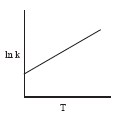
both (b) and (c)
32.
A zero order reaction X ⟶ Product, with an initial concentration 0.02M has a half life of 10 min. if one starts with concentration 0.04M, then the half life is
10 s
5 min
20 min
cannot be predicted using the given information
33.
For a first order reaction A ⟶ B the rate constant is x min−1. If the initial concentration of A is 0.01M, the concentration of A after one hour is given by the expression.
001. e−x
1 x 10⁻²(1-e-60x)
(1 x 10⁻²)e-60x
none of these
34.
The ionic radii of A+ and B− are 0.98 x 10⁻¹⁰ m and 1.81 x 10⁻¹⁰ m. the coordination number of each ion in AB is ________.
8
2
6
4
35.
In a solid atom M occupies ccp lattice and \(\left( \frac { 1 }{ 3 } \right) \) of tetrahedral voids are occupied by atom N. Find the formula of solid formed by M and N ________.
MN
M3N
MN3
M3N2
36.
37.
The ratio of close packed atoms to tetrahedral hole in cubic packing is ________.
1:1
1:2
2:1
1:4
38.
An ionic compound Ax By crystallizes in fcc type crystal structure with B ions at the centre of each face and A ion occupying corners of the cube the correct formula of Ax, By is ________.
AB
AB3
A3B
A8B6
39.
Which one of the following is not correct?
La(OH)3 is less basic than Lu(OH)3
In lanthanoid series ionic radius of Ln3+ ions decreases
La is actually an element of transition metal series rather than lanthanide series
Atomic radii of Zr and Hf are same because of lanthanide contract
40.
The actinoid elements which show the highest oxidation state of +7 are _______.
Np, Pu, Am
U, Fm, Th
U, Th, Md
Es, No, Lr
41.
The most common oxidation state of actinoids is _______.
+2
+3
+4
+6
42.
Which of the following oxidation states is most common among the lanthanoids?
+4
+2
+5
+3
43.
Which of the following lanthanoid ions is diamagnetic?
Eu2+
Yb2+
Ce2+
Sm2+
44.
Which one of the following statements related to lanthanons is incorrect?
Europium shows +2 oxidation state
The basicity decreases as the ionic radius decreases from Pr to Lu.
All the lanthanons are much more reactive than aluminium
Ce4+ solutions are widely used as oxidising agents in volumetric analysis.
45.
The number of moles of acidified KMnO4 required to oxidize 1 mole of ferrous oxalate(FeC2O4) is _______.
5
3
0.6
1.5
46.
47.
Which of the following statements is not true?
on passing H2S, through acidified K2Cr2O7 solution, a milky colour is observed
Na2Cr2O7 is preferred over K2Cr2O7 in volumetric analysis
K2Cr2O7 solution in acidic medium is orange in colour
K2Cr2O7 solution becomes yellow on increasing the PH beyond 7
48.
The magnetic moment of Mn2+ ion is _______.
5.92BM
2.80BM
8.95BM
3.90BM
49.
Which one of the following ions has the same number of unpaired electrons as present in V3+?
Ti3+
Fe3+
Ni2+
Cr3+
50.
Among the transition metals of 3d series, the one that has highest negative \(\left( \frac { M^{ 2+ } }{ M } \right) \) standard electrode potential is _______.
Ti
Cu
Mn
Zn
1.
(b)
Benzyl alcohol
2.
(d)
N,N – dimethyl – 3- methyl - pentan - 3 amine
3.
(b)
2,4 – dimethyl aniline
4.
(b)
blue solution
5.
(d)
6.
(b)
7.
(c)
schiff ’s base
8.
(c)
Schotten – Baumann reaction
9.
(c)
methanamine
10.
(a)
CH3CONHCH3
11.
(b)
potassium salt of phthalimide treated with chlorobenzene followed by hydrolysis with aqueous NaOH solution.
12.
\(k=\frac { 2.303 }{ t } log\frac { \left[ { A }_{ 0 } \right] }{ \left[ A \right] } \)
2.303 x 10⁻² hour-1 = \(\frac { 2.303 }{ 1806 min } log\frac { \left[ { 0.25 }_{ } \right] }{ \left[ A \right] } \)
\(=\left(\frac{2.303 \times 10^{-2} hour^{-1 }\times 1806 min}{2.303}\right) = \log \left(\frac{0.25}{A}\right) \)
\(=\left(\frac{ 1806 \times 10 ^{-2}}{60}\right) = \log \left(\frac{0.25}{A}\right) \)
\(= 0.301 = \log \left(\frac{0.25}{A}\right) \)
\(=\log2 = \log \left(\frac{0.25}{A}\right) \)
\(2 = \log \left(\frac{0.25}{A}\right) \)
\([A] = \log \left(\frac{0.25}{2}\right) = 0.125 M\)
13.
\({ t }_{ 1/2 }=\frac { 0.6932 }{ k } \)
For a second order reaction
\(\mathrm{t}_{1 / 2}=\frac{2^{\mathrm{n}-1}-1}{(\mathrm{n}-1) \mathrm{k} \cdot\left[\mathrm{A}_{0}\right]^{\mathrm{n}-1}}\)
n = 2
\(\mathrm{t}_{1 / 2}=\frac{2^{\mathrm{2}-1}-1}{(\mathrm{n}-1) \mathrm{k} \cdot\left[\mathrm{A}_{0}\right]^{\mathrm{2}-1}}\)
\(\mathrm{t}_{1 / 2} =\frac{1}{ \mathrm{k}\left[\mathrm{A}_{0}\right]}\)
14.
t75% = 2t50%
t50% = (t75%/2) = (60/2) = 30 minutes
15.
t1/2 α \(\frac{1}{[A_{0}]^{n-1}}\)...(1)
If [A0 = 2[A0]; then t1/2 = 2t1/2
2t1/2 α \(\frac{1}{[2A_{0}]^{n-1}}\)...(2)
(2)/(1) = \(2= \frac{1}{[2A_{0}]^{n-1}} \times \frac{1}{[A_{0}]^{n-1}}\)
\(2= \frac {[2A_{0}]^{n-1}} {[A_{0}]^{n-1}}\)
\(2= \frac {1} {2}^{n-1}\)
2 = (2-1)n-1
21 = (2-n+1)
n = 0
16.
(a)
17.
\(k=\frac { 2.303 }{ t } \log\frac { \left[ { A }_{ 0 } \right] }{ \left[ A \right] } \)
[A0] = 100: [A] = 25
\(6.909=\frac { 2.303 }{ t } \log\frac { \left[ {100 } \right] }{ \left[ 25\right] } \)
\(t =\frac { 2.303 }{ 6.909 } \log(4)\)
\(t =\frac { 1 }{ 3 } \log(2^2)\)
\(= \left( \frac { 2 }{ 3 } \right) \log2\)
18.
T1= 200 K ; k = k1
T2 =400 K ; k1 = k2 = 2k1
log\(\frac {{ k }_{ 2 } }{ { k }_{ 1 } } =\frac { { E }_{ a } }{ 2.303R } \left[ \frac { { T }_{ 2 }-{ T }_{ 1 } }{ { T }_{ 1 }{ T }_{ 2 } } \right] \)
log \( [\frac {{2 k }_{ 1 } }{ { k }_{ 1 } }]\)
\(= \left[ \frac { E_{a} }{ 2.303\times 8.314 JK^{-1} mol^{-1} } \right] \)
\(= \left[ \frac { 400 k - 200K }{200 k \times 400 k } \right] \)
\(E_{a} = \frac{ 0.3010 \times 2.303 \times 8.314 JK^{-1}mol^{-1} \times 200K \times 400 K}{200 K}\)
Ea = 2305 J mol-1
Ea = 2.305 kJ mol-1
19.
(rate constant K is equal to collision frequency A if Ea = 0)
In zero order reactions, increase in the concentration of reactant does not alter the rate.
So statement (i) is wrong.
\(k=A{ e }^{ -\left( \frac { { E }_{ a } }{ RT } \right) }\)
if Ea = 0 so, statement (ii) is correct, and statement (iii) is wrong
k = Ae0
k = A
In k = In A - \({ \left( \frac { { E }_{ a } }{ R } \right) }\) \(\left( \frac { 1 }{ T } \right) \)
This equation is of the form of a straight line y = mx+c
A plot of In k Vs \(\left( \frac { 1 }{ T } \right) \) gives a straight line with a negative slope
So statement (iv) and (v) are wrong.
20.
A catalyst provides a new path to the reaction with low activation energy. i.e., it lowers the activation energy.
21.
Given:
At low pressure the reaction follows first order therefore,
Rate α [reactant]1
Rate α (surface area)
At high pressure due to the complete coverage of surface area, the reaction follows zero order.
Rate α [reactant]0
Therefore the rate is independent of surface area.
22.
(a)
XY8
23.
(b)
FeO
24.
(b)
Equal number of cations and anions are missing from the lattice
25.
If a is the length of the side, then the length of the leading diagonal passing through the body centered atom is \(\sqrt{3a} \)
Required distance = \(\left( \cfrac { \sqrt { 3 } }{ 2 } \right) a\)
26.
sc ⇒ 2r = a
⇒ r = a/2
bcc ⇒ 4r = \( \sqrt{3a} \) ⇒ r = \(\frac { \sqrt{3a}} {4}\)
fcc ⇒ 4r ⇒ \( \sqrt{2a} \) ⇒ r = \(\frac { \sqrt{2a}} {4} = \frac { a} {2\sqrt{2a}}\)
\(\left( \frac { a }{ 2 } :\frac { \sqrt { 3 } }{ 4 } a:\frac { a }{ 2\sqrt { 2 } } \right) \)
27.
(a)
excitation of electrons in F centers
28.
(b)
\(\left( \frac { \pi }{ 6 } \right) \)
29.
let edge length = a
\(\sqrt{2a} = 4r\)
\(a = \frac{4 \times 300}{\sqrt {2}}\)
a = 600 x 1.414
a = 848.4 pm
30.
For a first order reaction
t1/2 = \(\frac { 0.693 }{ { k }}\)
t1/2 does not depend on the initial concentration and it remains constant (whatever may be the initial concentration)
t1/2 = 2.5 hrs
31.
\(k=A{ e }^{ -\left( \frac { { E }_{ a } }{ RT } \right) }\)
In k = In A - \({ \left( \frac { { E }_{ a } }{ R } \right) }\) \(\left( \frac { 1 }{ T } \right) \)
This equation is of the form of a straight line y = mx+c
A plot of In k Vs \(\left( \frac { 1 }{ T } \right) \) gives a straight line with a negative slope.
32.
for n ≠ 1 t1/2 = \(\frac{2^{n-1} -1}{(n- 1) k[A_{0}]^{-1}}\)
for n = 0; t1/2 = \(\frac{1}{2 k[A_{0}]^{-1}}\)
t1/2 = \(\frac{[A_{0}]}{2 k}\)
t1/2 α [A0] ...(1)
Given [A0] = 0.002 M; t1/2 = 10 min
[A0] = 0.04M; t1/2 = ?
Substitute in (1)
10 min α 0.02 M...(2)
t1/2 α 0.04M ....(3)
(3)(2)
⇒ t1/2 / 10 min
= 0.04 M/0.02 M
t1/2 = 2 x 10 min = 20 min
33.
\(k=\frac { 2.303 }{ t } log\frac { \left[ { A }_{ 0 } \right] }{ \left[ A \right] } \)
\(k=\frac { 1 }{ t } ln \frac { \left[ { A }_{ 0 } \right] }{ \left[ A \right] } \)
\(e^{kt}=\frac { \left[ { A }_{ 0 } \right] }{ \left[ A \right] }\)
[A] = [A0] ekt
In this case
k = x min-1 and [A0] = 0.01 M = 1 x 10⁻²M
t = 1 hour = 60 min
[A] = (1 x 10⁻²)e-60x
34.
\(\left( \frac { r_{c^+} }{ r_{A^-} } \right) \) = \(\left( \frac { 0.98 \times 10^{-10 }}{ 1.81 \times 10^{-10} } \right) = 0.54\)
It is in the range of 0.414 to 0.732, hence the coordination number of each ion is 6.
35.
If the total number of M atoms is n, then the number of tetrahedral voids = 2n
Given that \(\left( \frac { 1 }{ 3 } \right) ^{rd}\) of tetrahedral voids are occupied.
i.,e \(\left( \frac { 1 }{ 3 } \right) \times 2n\) are occupied by N atoms
\(\therefore\)M : N = n : \(\left( \frac { 2 }{ 3 } \right) n\)
= 1 : \(\frac { 2 }{ 3 }\)
Hence M3N2 = 3 : 2
36.
(c)
37.
If number of close packed atoms = N, then
The number of Tetrahedral holes formed = 2N
The number of Octahedral holes formed = N
Therefore, N:2N = 1:2
38.
Number of A ions = Nc/8 = 8/8 = 1
Number of B ions = Nf/2 = 6/2 = 3
Simplest formula = AB3
39.
(a)
La(OH)3 is less basic than Lu(OH)3
40.
(a)
Np, Pu, Am
41.
(b)
+3
42.
(d)
+3
43.
Yb2+ - 4f14 - no unpaired electrons - diamagnetic
44.
As we move from La to Lu, their metallic behaviour because almost similar to that of aluminium.
45.
+7 +2+3 2+ 3+ 4+
MnO4- + FeC2O4 ⟶ Mn2+ + Fe3+ + 2CO2
5e- acception 3e- release
5 moles of FeC2O4 \(\equiv\) 3 moles of KMnO4
1 mole of FeC2O4 \(\equiv\) (3/5) moles of KMnO4
1 mole of FeC2O4 \(\equiv\) 0.6 moles of KMnO4
46.
(c)
47.
(b)
Na2Cr2O7 is preferred over K2Cr2O7 in volumetric analysis
48.
Mn2+ ⇒ 3d5 contains 5 unpaired electrons
n = 5,
\( \sqrt{n(n+ 2)} \) BM
\(= \sqrt{5(5+ 2)} = \sqrt{35} = 5.92 BM\)
49.
(c)
Ni2+
50.
(a)
Ti

12th Standard Syllabus & Materials
12th Standard
TN 12th Computer Applications களப்பெயர் முறைமை (DNS) Sample Question Papers Study Material - QB365 Set A
NEW12th Standard
TN 12th Computer Applications வலையமைப்பு எடுத்துக்காட்டுகள் மற்றும் நெறிமுறைகள் Sample Question Papers Study Material - QB365 Set A
NEW12th Standard
TN 12th Computer Applications கணினி வலையமைப்பு ஓர் அறிமுகம் Sample Question Papers Study Material - QB365 Set A
NEW12th Standard
TN 12th Computer Applications PHP-உடன் MySQL-ஐ இணைத்தல் Sample Question Papers Study Material - QB365 Set A



Tamilnadu Stateboard 12th Standard Subjects

Maths
Chemistry

Physics

Biology

Computer Science

Business Maths and Statistics

Economics

Commerce

Accountancy

History

Computer Applications
Biology
Computer Technology
Computer Applications
Computer Science
Business Maths and Statistics
Commerce
Economics
Maths
Chemistry
Physics
Computer Technology
History
Accountancy

Tamil

English

French
Tamilnadu Stateboard Standards


