
 100% FREE ACCESS
12th Standard Syllabus & Materials
12th Standard
TN 12th Computer Applications மின்னணு தரவு பரிமாற்றம் Sample Question Papers Study Material - QB365 Set A
NEW12th Standard
TN 12th Computer Applications மின் - வணிக பாதுகாப்பு அமைப்புகள் Sample Question Papers Study Material - QB365 Set A
NEW12th Standard
TN 12th Computer Applications மின்னணு செலுத்தல் முறைகள் Sample Question Papers Study Material - QB365 Set A
NEW12th Standard
TN 12th Computer Applications மின் - வணிகம் Sample Question Papers Study Material - QB365 Set A
NEW12th Standard
TN 12th Computer Applications திறந்த மூல கருத்துருக்கள் Sample Question Papers Study Material - QB365 Set A
NEW12th Standard
TN 12th Computer Applications வலையமைப்பு வடமிடல் Sample Question Papers Study Material - QB365 Set A

Published on: 20/10/2025
Download Tamil Nadu 12th Standard Chemistry question papers, model tests, one-mark questions, important questions, and public exam papers in PDF format. Free study materials and answer keys for TN State Board students.
Questions + Answers key
Take MCQ Chemistry Test
1.
Which of the following is a co-polymer?
Orlon
PVC
Teflon
PHBV
2.
Nylon is an example of _______.
polyamide
polythene
polyester
poly saccharide
3.
Antiseptics and disinfectants either kill or prevent growth of microorganisms. Identify which of the following statement is not true.
dilute solutions of boric acid and hydrogen peroxide are strong antiseptics.
Disinfectants harm the living tissues
A 0.2% solution of phenol is an antiseptic while 1% solution acts as a disinfectant
Chlorine and iodine are used as strong disinfectants
4.
5.
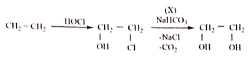
In the reaction sequence, Ethane \(\overset { HOCl }{ \longrightarrow } A\overset { x }{ \longrightarrow } \) ethan -1, 2 - diol. A and X respectively are ________.
Chloroethane and NaOH
ethanol and H2SO4
2 – chloroethan -1-ol and NaHCO3
ethanol and H2O
6.
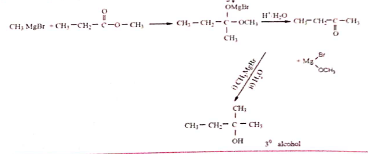
Which of the following compounds on reaction with methyl magnesium bromide will give tertiary alcohol.
benzaldehyde
propanoic acid
methyl propanoate
acetaldehyde
7.
If ‘a’ stands for the edge length of the cubic system sc, bcc, and fcc. Then the ratio of radii of spheres in these systems will be respectively ________.
\(\left( \frac { 1 }{ 2 } a;\frac { \sqrt { 3 } }{ 2 } a;\frac { \sqrt { 2 } }{ 2 } a \right) \)
\(\left( \sqrt { 1a } :\sqrt { 3a } :\sqrt { 2a } \right) \)
\(\left( \frac { 1 }{ 2 } a:\frac { \sqrt { 3 } }{ 4 } a:\frac { 1 }{ 2\sqrt { 2 } } a \right) \)
\(\frac { 1 }{ 2 } a:\sqrt { 3 } a:\frac { 1 }{ \sqrt { 2 } } a\)
8.
The ionic radii of A+ and B− are 0.98 x 10⁻¹⁰ m and 1.81 x 10⁻¹⁰ m. the coordination number of each ion in AB is ________.
8
2
6
4
9.
Graphite and diamond are ________.
Covalent and molecular crystals
ionic and covalent crystals
both covalent crystals
both molecular crystals
10.
Oxidation state of carbon in its hydrides _______.
+4
-4
+3
+2
11.
Carbon atoms in fullerene with formula C60 have _______hybridisation.
sp3 hybridised
sp hybridised
sp2 hybridised
partially sp2 and partially sp3 hybridised
12.
13.
Wolframite ore is separated from tinstone by the process of________.
Smelting
Calcination
Roasting
Electromagnetic separation
14.
Which of the following statements, about the advantage of roasting of sulphide ore before reduction is not true?
\(\Delta { G }_{ f }^{ 0 }\) of sulphide is greater than those for CS2 and H2S
\(\Delta { G }_{ r }^{ 0 }\) is negative for roasting of sulphide ore to oxide
Roasting of the sulphide to its oxide is thermodynamically feasible
Carbon and hydrogen are suitable reducing agents for metal sulphides
15.
Roasting of sulphide ore gives the gas (A).(A) is a colourless gas. Aqueous solution of (A) is acidic. The gas (A) is______.
CO2
SO3
SO2
H2S
16.
What is metamerism? Give the structure and IUPAC name of metamers of 2-methoxy propane
17.
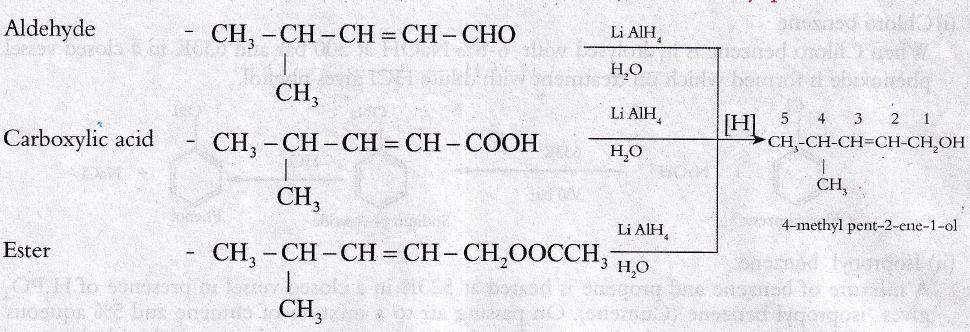
Write the structure of the aldehyde, carboxylic acid and ester that yield 4- methylpent -2-en-1-ol.
18.
What are antibiotics?
19.
An atom crystallizes in fcc crystal lattice and has a density of 10 gcm−3 with unit cell edge length of 100pm. Calculate the number of atoms present in 1 g of crystal.
20.
21.
Write a note on Fisher tropsch synthesis.
22.
23.
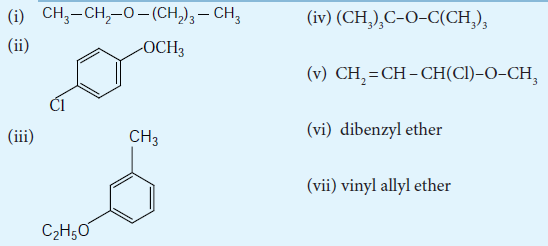
Give the IUPAC name for the following ethers and classify them as simple or mixed.
24.

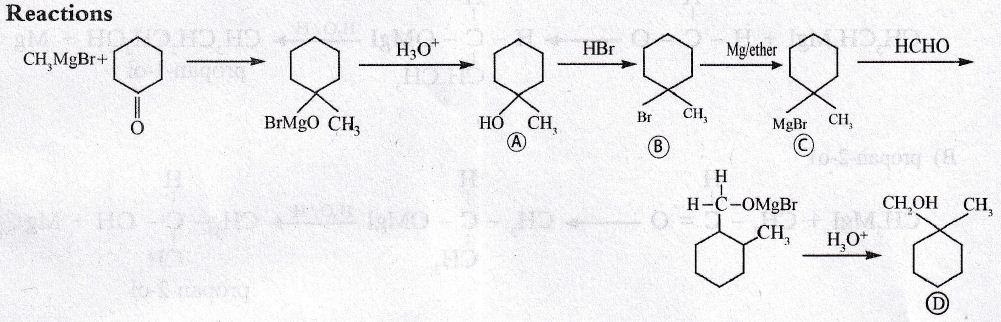
Identify A,B,C,D and write the complete equation
25.
What are narcotic and non – narcotic drugs. Give examples
26.
Write short note on metal excess and metal deficiency defect with an example.
27.
Describe briefly allotropism in p- block elements with specific reference to carbon.
28.
Explain the principle of electrolytic refining with an example.
29.
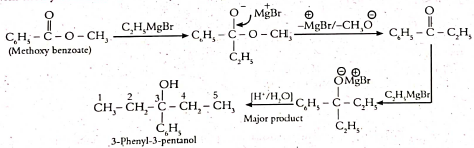
What is the major product obtained when two moles of ethyl magnesium bromide is treated with methyl benzoate followed by acid hydrolysis.
30.
How do antiseptics differ from disinfectants?
31.
Aluminium crystallizes in a cubic close packed structure. Its metallic radius is 125pm. calculate the edge length of unit cell.
32.
An element has bcc structure with a cell edge of 288 pm. The density of the element is 7.2 g cm-3. How many atoms are present in 208 g of the element.
33.
A double salt which contains fourth period alkali metal (A) on heating at 500K gives (B). Aqueous solution of (B) gives white precipitate with BaCl2 and gives a red colour compound with alizarin. Identify A and B.
34.
A hydride of 2nd period alkali metal (A) on reaction with compound of Boron (B) to give a reducing agent (C). Identify A, B and C.
35.
Write a short note on electrochemical principles of metallurgy.
1.
(d)
PHBV
2.
(a)
polyamide
3.
(a)
dilute solutions of boric acid and hydrogen peroxide are strong antiseptics.
4.
(c)
5.
6.
7.
sc ⇒ 2r = a
⇒ r = a/2
bcc ⇒ 4r = \( \sqrt{3a} \) ⇒ r = \(\frac { \sqrt{3a}} {4}\)
fcc ⇒ 4r ⇒ \( \sqrt{2a} \) ⇒ r = \(\frac { \sqrt{2a}} {4} = \frac { a} {2\sqrt{2a}}\)
\(\left( \frac { a }{ 2 } :\frac { \sqrt { 3 } }{ 4 } a:\frac { a }{ 2\sqrt { 2 } } \right) \)
8.
\(\left( \frac { r_{c^+} }{ r_{A^-} } \right) \) = \(\left( \frac { 0.98 \times 10^{-10 }}{ 1.81 \times 10^{-10} } \right) = 0.54\)
It is in the range of 0.414 to 0.732, hence the coordination number of each ion is 6.
9.
(c)
both covalent crystals
10.
(a)
+4
11.
(c)
sp2 hybridised
12.
(d)
13.
(d)
Electromagnetic separation
14.
(d)
Carbon and hydrogen are suitable reducing agents for metal sulphides
15.
(c)
SO2
16.
Ethers having same molecular formula, but alkyl groups attached to the oxygen atom are different. This phenomenon is known as metamerism.
Metamers of 2- methoxy propane
\(\mathrm{C}_{2} \mathrm{H}_{5}-\mathrm{O}-\mathrm{C}_{2} \mathrm{H}_{5}-\) diethyl ether
\(\mathrm{CH}_{3}-\mathrm{O}-\mathrm{CH}_{2}-\mathrm{CH}_{2}-\mathrm{CH}_{3}\) methyl n-propyl ether
17.
18.
(i) Many micro organisms (bacteria, fungi and moulds) produce certain chemicals which inhibit the growth or metabolism of some other micro organism. Such chemicals are called antibiotics.
(ii) Eg: Penicillin from the mould penicillium notatum
19.
\(\operatorname{Density}(\rho)=\frac{\mathrm{nM}}{\mathrm{a}^{3} \mathrm{~N}_{\mathrm{A}}} \)
\(\rho=10 \mathrm{~g} \mathrm{~cm}^{-3} ; \mathrm{a}=100 \mathrm{pm}=1 \times 10^{-8} \mathrm{~cm} ; \mathrm{N}_{\mathrm{A}}=6.023 \times 10^{23} ; \mathrm{n}=4 ; \mathrm{M}=? \)
\(M=\frac{\rho \mathrm{a}^{3} \mathrm{N_{A}}}{n} \)
\(=\frac{10 \times\left(1 \times 10^{-8}\right)^{3} \times 6.023 \times 10^{23}}{4} \)
\(=\frac{6.023}{4} \)
= 1.505 g /mol
No. of moles \(=\frac{\text { Mass }}{\text { Molar mass }}=\frac{1}{1.505}\)
= 0.664 moles
Hence number of atoms = 0.664 x 6.023 x 1023 = 3.99 x 10²³ atoms
20.
21.
The reaction of CO with hydrogen at a pressure of less than 50 atm using metal catalysts at 500 - 700 K yields saturated and unsaturated hydrocarbons.
\(nCO+(2n+1){ H_2 }\longrightarrow C_{ n }{ H }_{ (2n+2) }+{ nH }_{ 2 }O\)
\(nCO+2n{ H }_{ 2 }\longrightarrow { C }_{ n }{ H }_{ 2n }+{ nH }_{ 2 }O\)
22.
23.
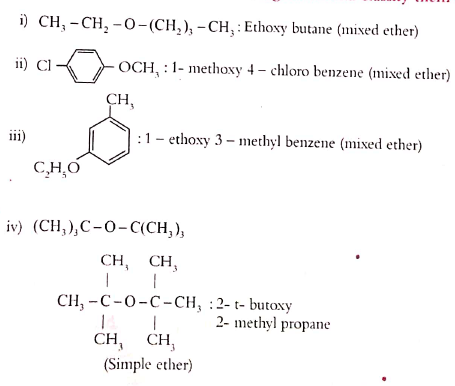
(v) CH2 = CH – CH(Cl)–O–CH3 : 3 - methoxy,3- choloro propene (mixed ether)
(vi) dibenzyl ether CH6CH5 -O-CH2-C6H5 : benzoxy toluene + Simple ether
(vii) vinyl allyl ether : ethoxy 2 - propene
CH2 = CH –O– CH2–CH–CH2(mixed ether)
24.
25.
Narcotic drugs: [Opioids]
(i) These are narcotic analgesics. These relieve pain and produce sleep. These drugs are addictive. In poisonous dose, these produces coma and ultimately death.
(ii) They are used for either short-term or long term relief of severe pains. They are mainly used for post operative pain, pain of terminal cancer.
(iii) Eg: Morphine, Codeine
Non-narcotic drugs:
(i) These are non- narcotic analgesics. These reduce the pain without causing impairment of consciousness.
(ii) They alleviate pain by reducing local inflammatory responses.
(iii) These are used for short-term pain relief and for modest pain like headache, muscle strain, bruising or arthritis.
(iv) These drugs have many other effects such as reducing fever (antipyretic) and preventing platelet coagulation (eg. aspirin).
(v) These reduce fever by causing the hypothalamus to over ride a prostaglandin - induced increase in temperature.
(vi) Eg. Aspirin, Paracetamol, Ibuprofen. There are two types in it.
a) Anti inflammatory: eg: Aspirin, Paracetamol
b) Non steroidal anti -inflammatory drugs: (NSAIDs) eg: Ibuprofen
26.
Metal excess defect:
(i) It arises due to the presence of more number of metal ions as compared to anions.
(ii) Examples: NaCl, KCl
(iii) The electrical neutrality of the crystal can be maintained by the presence of anionic vacancies equal to the presence of extra cation.
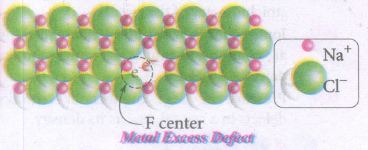
(iii) For example, when NaCI crystals are heated in the presence of sodium vapour, Na+ ions are formed and are deposited on the surface of the crystal.
(iv) Chloride ions (Cl-) diffuse to the surface from the lattice point and combines with Na+ ion.
(v) The electron lost by the sodium vapour diffuse into the vacancy created by the Cl- ions.
(vi) Such anionic vacancies which are occupied by unpaired electrons are called F centers. Hence, the formula of NaCl can be written as Na1+xCl.
Metal deficiency defect:
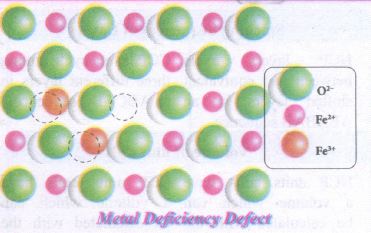
(i) Metal deficiency defect arises due to the presence of less number of cations than the anions. This defect is observed in a crystal in which, the cations have variable oxidation states.
(ii) For example, In FeO crystal, some of the Fe2+ ions are missing from the crystal lattice. To maintain the electrical neutrality, twice the number of other Fe2+ ions in the crystal is oxidized to Fe3+ ions. In such cases, overall number of Fe2+ and Fe3+ ions is less than the O2- ions.
27.
Allotropism:
1. Some elements exist in more than one crystalline or molecular forms in the same physical state
(a) In Greek "allos" means ⇒ Another
(b) "trope" means ⇒ Change
2. The different forms of an element are called allotropes.
Allotropy of carbon:
Carbon exists as diamond, graphite, fullerenes, carbon nanotubes and graphene.
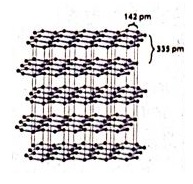
Graphite:
1. Graphite is the most stable allotropic form of carbon at normal temperature and pressure.
2. It is soft and conducts electricity.
3. It is composed of flat two dimensional sheets of carbon atoms.
4. Each sheet is a hexagonal.
5. It is "sp2" hybridised.
6. C-C bond length is 1.41 Å
7. Each C-atom forms three σ bonds with three neighbouring carbon atoms using three of its valence electrons and the fourth electron present in the unhybridised p-orbital form a π-bond.
8. The successive C-sheets are held together by weak Vander Waals forces.
9 The distance successive sheet is 3.40 Å.
10. It is used as a lubricant either on its own or as a graphited oil.
Diamond:
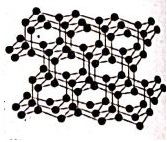
1. It is very hard.
2. It is "sp3" hybridised.
3. C-C bond length is 1.54 Å
4. It is used for sharpening hard tools, cutting glasses, making bores and rock drilling.
Fullerenes:
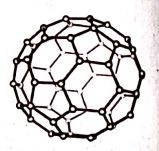
1. These allotropes are discrete molecules such as \(C_{32}, C_{50}, C_{60}, C_{70}, C_{76}\) etc.
2. It has cage like structure
3. The C60 molecules have a "soccer" ball like structure and is called buckminster fullerene or buckyballs.
4. It has a fused ring structure consists of 20 six membered rings and 12 five membered ring.
5. Each carbon atom is "sp2" hybridised.
6. It has three σ bonds and a delocalised π bond giving aromatic character to these molecules.
7. The C-C bond distance is 1.44 Å
8. The C=C bond distance is 1.38 Å.
Carbon nanotubes:
1. Carbon nanotubes, another recently discovered allotropes, have graphite like tubes with fullerene ends.
2. Along the axis, these nanotubes are stronger than steel and conduct electricity.
3. These have many applications in nanoscale electronics, catalysis, polymers and medicine.
Graphene:
It has a single planar sheet of "sp2" hybridised carbon atoms that are densely packed in a "honeycomb crystal" lattice.
28.
1. The crude metal is refined by electrolysis. It is carried out in an electrolytic cell
Anode : Impure metal to be refined with dilute acid.
Cathode : Thin strips of pure metal
Electrolyte : Aqueous solution of the salts of the metal with dilute acid.
2. The metal dissolves from the anode, pass into the solution.
3. At the same amount of metal ions from the solution will be deposited at the cathode.
4. During electrolysis, the less electropositive impurities in the anode, settle down at the bottom and are removed as anode mud.
Example: Electrolytic refining of silver.
Cathode: Pure silver
Anode: lmpure silver rods
Electrolyte: Acidified aqueous solution of silver nitrate
5. When a current is passed through the electrodes the following reactions will take place
(a) Reaction at anode: \({ Ag }_{ (s) }\longrightarrow { Ag }^{ + }_{ (aq) }+{ 1e }^{ - }\)
(b) Reaction at cathode: \({ Ag }^{ + }_{ (aq) }+{ 1e }^{ - }\longrightarrow { Ag }_{ (s) }\)
6. During electrolysis, at anode silver loses electrons and form silver ions and the silver ions migrate towards the cathode and get discharged and deposited on the cathode.
7. Copper, Zinc etc can also be refined by this process.
29.
30.
| S.No | Antiseptics | Disinfectants |
| 1. | Antiseptics are medicines applied to living tissues (living humans). | Disinfectants are applied to inanimated objects. |
| 2. | All the antiseptics are disinfectants. | All the disinfectants are not antiseptics. |
| 3. | They are not ingested or swallowed. Eg: Povidone - iodine. |
They can be injected or swallowed. Eg :Hydrogen peroxide, Chlorine compounds |
31.
For cubic closed packed structure
\(r =\frac{a \sqrt{2}}{4} \)
\(\therefore a =\frac{4 r}{\sqrt{2}} \)
\(=\frac{4 \times 1.25 \times 10^{-8}}{1.414}=3.53 \times 10^{-8} \mathrm{~cm} \)
= 353 pm
32.
\(\operatorname{Density}(\rho)=\frac{\mathrm{nM}}{\mathrm{a}^{3} \mathrm{~N}_{\mathrm{A}}} \)
\(\mathrm{n}=2, \mathrm{~N}_{\mathrm{A}}=6.023 \times 10^{23} ; \mathrm{a}=288 \mathrm{pm}=2.88 \times 10^{-8} \mathrm{~cm}, \rho=7.2 \mathrm{~g} \mathrm{~cm}^{-3} \)
\(\therefore M=\frac{\rho \times a^{3} \times N_{A}}{n} \)
\(=\frac{7.2 \times\left(2.88 \times 10^{-8}\right)^{3} \times 6.023 \times 10^{23}}{2} \)
\(=517.95 \times 10^{-1} \)
\(=51.795 \mathrm{~g} \mathrm{~mol}^{-1} \)
Number of moles (n) \(=\frac{\text { Mass }}{\text { Molar mass }}=\frac{208}{51.795}\)=4.02 moles
No. of atoms = No. of moles \(\times\) Avogadro number
=n \(\times\) NA
\(=4.01 \times 6.023 \times 10^{23} \)
\(=24.15 \times 10^{23} \text { atoms }\)
33.
1. A double salt which contains fourth-period alkali metal (A) is potash alum
K2SO4 Al2(SO4)3 - 24 H₂O
2. On heating potash alum (A) 500 k give anhydrous potash alum (or) burnt alum (B).
\(\mathrm{K}_{2} \mathrm{SO}_{4} \cdot \mathrm{Al}_{2}\left(\mathrm{SO}_{4}\right)_{3} \cdot 24 \mathrm{H}_{2} \mathrm{O} \stackrel{500 \mathrm{~K}}{\longrightarrow} \mathrm{K}_{2} \mathrm{SO}_{4} \cdot \mathrm{Al}_{2}\left(\mathrm{SO}_{4}\right)_{3}+24 \mathrm{H}_{2} \mathrm{O}\)
[Potash alum (A)] [Burnt alum (B)]
3. Aqueous solution of burnt alum, has sulphates ion, potassium ion and aluminium ion. Sulphate ion reacts with BaCl₂ to form a white precipitate of Barium Sulphate
(SO4)2 + BaCl2 → BaSO4 + 2 Cl¯
Aluminium ion reacts with alizarin solution to give a red colour compound.
34.
A hydride of 2nd period alkali metal (A) is lithium hydride (LiH).
Lithium hydride (A) reacts with diborane (B) to give lithium borohydride (C) which is acts as a reducing agent.
B2H6 + 2 LiH \(\xrightarrow[]{ether}\) 2 LiBH4
[Diborane (B)] [Lithium hydride (A)] [Lithium borohydride (C)]
Result:
| Compound | Formula | Name |
| A | LiH | Lithium hydride |
| B | B2H6 | Diborane |
| C | LiBH4 | Lithium borohydride |
35.
1. Reduction of oxides of active metals such as sodium, potassium etc., by carbon is thermodynamically not feasible.
2. Such metals are extracted from their ores by using electrochemical methods.
3. In this technique, the metal salts are taken in a fused form or in solution form.
4. The metal ion present can be reduced by some suitable reducing agent or by electrolysis.
5. Gibbs free energy for the electrolysis process is given by
Here,
\(\Delta\)Go = -nFEo
\(\Delta\)Go - Standard Gibb's free energy change
n - number of electrons involved,
F - Faraday,
Eo - Standard electrode potential
6. If Eo is positive then the \(\Delta\)Go is negative and the reduction is spontaneous
7. Hence a redox reaction is planned in such a way that the e.m.f of the net redox reaction is positive.
8. When a more reactive metal is added to less reactive metal salt solution, the more reactive metal will go into the solution.
Example:
\({ Cu }_{ (s) }+2{ Ag }^{ + }_{ (aq) }\longrightarrow { Cu }^{ 2+ }_{ (aq) }+2{ Ag }_{ (s) }\)
\({ Cu }^{ 2+ }_{ (aq) }+{ Zn }_{ (s) }\longrightarrow { Cu }_{ \left( s \right) } +{ Zn }^{ 2+ }_{ (aq) }\)

12th Standard Syllabus & Materials
12th Standard
TN 12th Computer Applications களப்பெயர் முறைமை (DNS) Sample Question Papers Study Material - QB365 Set A
NEW12th Standard
TN 12th Computer Applications வலையமைப்பு எடுத்துக்காட்டுகள் மற்றும் நெறிமுறைகள் Sample Question Papers Study Material - QB365 Set A
NEW12th Standard
TN 12th Computer Applications கணினி வலையமைப்பு ஓர் அறிமுகம் Sample Question Papers Study Material - QB365 Set A
NEW12th Standard
TN 12th Computer Applications PHP-உடன் MySQL-ஐ இணைத்தல் Sample Question Papers Study Material - QB365 Set A



Tamilnadu Stateboard 12th Standard Subjects

Maths
Chemistry

Physics

Biology

Computer Science

Business Maths and Statistics

Economics

Commerce

Accountancy

History

Computer Applications
Biology
Computer Technology
Computer Applications
Computer Science
Business Maths and Statistics
Commerce
Economics
Maths
Chemistry
Physics
Computer Technology
History
Accountancy

Tamil

English

French
Tamilnadu Stateboard Standards


