12th Standard CBSE Syllabus & Materials
12th Standard CBSE
CBSE 12th Biology Sexual Reproduction in Flowering Plants Important Questions And Answers Study Material - QB365 Set B
NEW12th Standard CBSE
CBSE 12th Biology Sexual Reproduction in Flowering Plants Important Questions And Answers Study Material - QB365 Set A
NEW12th Standard CBSE
CBSE 12th Biology Sexual Reproduction in Flowering Plants Assertion and Reason Study Material - QB365 Set D
NEW12th Standard CBSE
CBSE 12th Biology Sexual Reproduction in Flowering Plants Assertion and Reason Study Material - QB365 Set C
NEW12th Standard CBSE
CBSE 12th Biology Sexual Reproduction in Flowering Plants Assertion and Reason Study Material - QB365 Set B
NEW12th Standard CBSE
CBSE 12th Biology Sexual Reproduction in Flowering Plants Assertion and Reason Study Material - QB365 Set A
Published on: 25/10/2025
Download CBSE Class 12th Standard CBSE Maths question papers, sample papers, important questions, and previous year solved papers in PDF format. Get free study materials, NCERT solutions, and exam preparation resources for Class 12th Standard CBSE Maths
Questions + Answers key
Take MCQ Maths Test
III. SHORT ANSWERS:
1.
A pair of dice is thrown 4 times. If getting a doublet is considered a success, find the probability distribution of the number of success.
2.
Two cards are drawn simultaneously from a well shuffled pack of 52 cards. Find the mean and standard deviation of the number of kings.
Why playing cards is not healthy for students?
3.
In answering a question on a multiple choice test, a student either knows the answer or guesses. Let \(3\over 5\) be the probability that he knows the answer and \(2\over5\) be the probability that he guesses. Assuming that a student who guesses at the answer will be correct with probability \(1\over3\) what is the probability that the student knows the answer given that the answered it correctly?
4.
There are three coins. One is a two headed coin (having heads on both faces), another is a biased coin that comes up heads 75% of the times and the third is an unbiased coin. One of the three coins is chosen at random and tossed, and it shows heads. What is the probability that it was the two headed coin?
5.
In a class 40% students study statistics, 25% Mathematics and 15% both mathematics and statistics. One student is selected at random. Find the probability that
(i) he studies Statistics, if it is known that he studies Mathematics.
(ii) he studies Mathematics, if it is known that he studies Statistics.
6.
A husband and a wife appear in an interview for two vacancies for the same post. The probability of husbands selection is \(1\over7\) and that of wife's selection is \(1\over5\). What is the probability that
(i) both will be selected
(ii) only one of them will be selected
(iii) none will be selected?
7.
A company has two plants to manufacture motorcycles. Plant 1 manufactures 70% of motorcycles and Plant 2 manufacture 30%. At plant 1, 80% of the motorcycles are rated of standard quality and at plant 2, 90% of the motorcycles are rated of standard quality. A motorcycle is chosen at random and is found to be of standard quality. Find the probability that it has come from(i) Plant 1 (ii) Plant 2. Why riding a motorcycle is risker than driving other vehicles?
II. VERY SHORT ANSWERS:
8.
A couple has 2 children. Find the probability that both are boys, if it is known that (a) one of them is a boy (b) the older child is boys.
9.
The probability that atleast one of the two events A and B occurs is 0.6. If A and B occur simultaneously with probability 0.3, then evaluate \(P(\bar{A})+P(\bar{B})\).
10.
A speaks truth in 70% cases and B speaks truth in 85% cases. The probability that they speak the same fact
11.
A speaks truth in 80% cases and B speaks truth in 90% cases, In what percentage of cases are they likely to agree with each other in stating the same fact?
IV. LONG ANSWERS:
12.
An insurance company insured 2,000 cyclists, 4,000 scooter drivers and 6,000 motorbike drivers. The probability of an accident involving a cyclist, scooter driver and a motorbike driver are 0.01, 0.03 and 0.15 respectively. One of the insured persons meets with an accident. What is the probability that he is a scooter driver?
Which mode of transport would you suggest to a student and why?
13.
A bag I contains 5 red and 4 white balls and a bag II contains 3 red and 3 white balls. Two balls are transferred from the bag I to the bag II and then one ball is drawn from bag II. If the ball drawn from the bag II is red, then find the probability that one red ball and one white ball are transferred from the bag I to the bag II.
14.
There are three coins. First is a biased that comes up tails 60% of the times, second is also a biased coin that comes up heads 75% of the times and third is an unbiased coin. One of the three coins is chosen at random and tossed, it shows heads, what is the probability that it was the first coin?
15.
Two dice are thrown together and the total score is noted. The events E, F and G are 'a total of 4', 'a total of 9 or more' and 'a total divisible by 5', respectively. Calculate P(E), P(F) and P(G) and decide which pairs of events, if any are independent?
16.
If A and B are two independent events such that \(P(\bar{A} \cap B)=\frac{2}{15} \text { and } P(A \cap \bar{B})=\frac{1}{6}\) then find P{A) and P(B).
17.
Suppose a girl throws a die. If she gets a 5 or 6, she tosses a coin three times and notes the number of heads. If she gets 1, 2, 3 or 4, she tosses a coin once and notes whether a head or tail is obtained. If she obtained exactly one head, then what. is the probability that she threw 1, 2, 3 or 4 with the die?
18.
Among the students in a college, it is known that 60% reside in hostel and 40% are day scholars (not residing in hostel). Previous year results report that 30% of all students who reside in hostel attain A grade and 20% of day scholars attain A grade in their annual exams. At the end of year, one student is chosen at random from the college and he has A grade, what is the probability that the student is a hosteler?
I. MULTIPLE CHOICE QUESTIONS:
19.
Three balls are drawn from a bag containing 2 red and 5 black balls, if the random variable X represents the number of red balls drawn, then X can take values
0, 1, 2
0, 1, 2, 3
0
1, 2
20.
In a box containing 100 bulbs, 10 are defective. The probability that out of a sample of 5 bulbs, none is defective is
10–1
\({ \left( \frac { 1 }{ 2 } \right) }^{ 5 }\)
\({ \left( \frac { 9 }{ 2 } \right) }^{ 5 }\)
\(\frac { 9 }{ 10 } \)
21.
Two events A and B are said to be independent, if
A and B are mutually exclusive
\(P\left(A^{\prime} \cap B^{\prime}\right)=[1-P(A)][1-P(B)]\)
\(P(A)=P(B)\)
P(A) + P(B) = 1
22.
The probability of A, Band C solving a problem are \(\frac{1}{2}, \frac{1}{3} \text { and } \frac{1}{4}\) respectively. Then the probability that the problem will be solved is
\(\frac{1}{2}\)
\(\frac{3}{4}\)
\(\frac{1}{4}\)
none of these
23.
If P(A) = 0.3, P(B) = 0.5 and P(A/B) = 0.4, then P(B/A) is
\(-\frac{2}{3}\)
\(\frac{2}{3}\)
\(\frac{3}{5}\)
none of these
24.
A problem in Mathematics is given to three students whose chances of solving it are \(\frac{1}{2}, \frac{1}{3}, \frac{1}{4},\) respectively. If the events of their solving the problem are independent,then the probability that the problem will be solved, is
\(\frac{1}{4}\)
\(\frac{1}{3}\)
\(\frac{1}{2}\)
\(\frac{3}{4}\)
V. CASE STUDY QUESTIONS:
25.
Three friends A, B and C are playing a dice game. The numbers rolled up by them in their first three chances were noted and given by A = {1, 5},B = {2, 4, 5} and C = {1, 2, 5} as A reaches the cell 'SKIP YOUR NEXT TURN' in second throw.
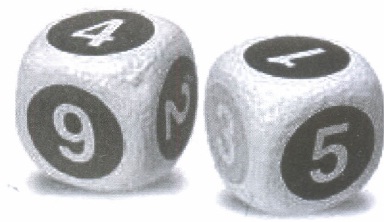
Based on the above information, answer the following questions.
(i) P (A I B) =
| \((a) \ \frac{1}{6}\) | \((b) \ \frac{1}{3}\) | \((c) \ \frac{1}{2}\) | \((d) \ \frac{2}{3}\) |
(ii) P (B I C) =
| \((a) \ \frac{2}{3}\) | \((b) \ \frac{1}{12}\) | \((c) \ \frac{1}{9}\) | \((d) \ 0\) |
(iii) P (A ⋂ B I C) =
| \((a) \ \frac{1}{6}\) | \((b) \ \frac{1}{2}\) | \((c) \ \frac{1}{12}\) | \((d) \ \frac{1}{3}\) |
(iv) P (A I C) =
| \((a) \ \frac{1}{4}\) | \((b) \ 1\) | \((c) \ \frac{2}{3}\) | (d) None of these |
(v) P (A ∪ B I C) =
| \((a) \ 0\) | \((b) \ \frac{1}{2}\) | \((c) \ \frac{2}{3}\) | \((d) \ 1\) |
26.
A card is lost from a pack of 52 cards. From the remaining cards two cards are drawn at random.
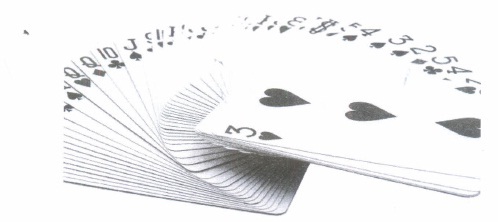
Based on the above information, answer the following questions.
(i) The probability of drawing two diamonds, given that a card of diamond is missing, is
| a) \(\frac{21}{425}\) | (b) \(\frac{22}{425}\) | (c) \(\frac{23}{425}\) | (d) None of these |
(ii) The probability of drawing two diamonds, given that a card of heart is missing, is
| a) \(\frac{26}{425}\) | (b) \(\frac{22}{425}\) | (c) \(\frac{19}{425}\) | (d) \(\frac{23}{425}\) |
(iii) Let A be the event of drawing two diamonds from remaining 51 cards and E1, E2, E3 and E4 be the events that lost card is of diamond, club, spade and heart respectively, then the approximate value of \(\sum_{i=1}^{4} P\left(A \mid E_{i}\right) \text { is }\)
| a) 0.17 | (b) 0.24 | (c) 0.25 | (d) 0.18 |
(iv) All of a sudden, missing card is found and, then two cards are drawn simultaneously without replacement. Probability that both drawn cards are king is
| a) \(\frac{1}{52}\) | (b) \(\frac{1}{221}\) | (c) \(\frac{1}{121}\) | (d) \(\frac{2}{221}\) |
(v) If two cards are drawn from a well shuffled pack of 52 cards, one by one with replacement, then probability of getting not a king in 1st and 2nd draw is
| a) \(\frac{144}{169}\) | (b) \(\frac{12}{169}\) | (c) \(\frac{64}{169}\) | (d) None of these |
III. SHORT ANSWERS:
1.
| X | 0 | 1 | 2 | 3 | 4 |
| P(x) | 625/1296 | 500/1296 | 150/1296 | 20/1296 | 1/1296 |
2.
X : Number of kings
'X' takes values 0,1, 2
\(P(X=0)=\frac { ^{ 4 }{ C }_{ 0 }\times ^{ 48 }{ C }_{ 2 } }{ ^{ 52 }{ C }_{ 2 } } =\frac { 48\times 47 }{ 52+1 } =\frac { 188 }{ 221 } \)
\(P(X=1)=\frac { ^{ 4 }{ C }_{ 1 }\times ^{ 48 }{ C }_{ 1 } }{ ^{ 52 }{ C }_{ 2 } } =\frac { 4\times 48\times 2 }{ 52\times 51 } =\frac { 32 }{ 221 } \)
\(P(X=3)=\frac { ^{ 4 }{ C }_{ 2 }\times ^{ 48 }{ C }_{ 0 } }{ ^{ 52 }{ C }_{ 2 } } =\frac { 4\times 3 }{ 52\times 51 } =\frac { 1 }{ 221 } \)
Thus we have:
| xi | pi | pixi | xi2 | pixi2 |
| 0 | \(\frac { 188 }{ 221 } \) | 0 | 0 | 0 |
| 1 | \(\frac { 32 }{ 221 } \) | \(\frac { 32 }{ 221 } \) | 1 | \(\frac { 32 }{ 221 } \) |
| 2 | \(\frac { 1 }{ 221 } \) | \(\frac { 2 }{ 221 } \) | 4 | \(\frac { 4 }{ 221 } \) |
| Total | \(\frac { 34 }{ 221 } \) | \(\frac { 36 }{ 221 } \) |
Mean \(\mu =\frac { 34 }{ 221 } =\frac { 2 }{ 13 } \)
Standard Deviation,
\(\sigma =\sqrt { \sum { { p }_{ i }{ x }_{ i }^{ 2 } } -{ \mu }^{ 2 } } =\sqrt { \frac { 36 }{ 221 } -{ \left( \frac { 2 }{ 13 } \right) }^{ 2 } } \)
\(=\sqrt { 0.1628-0.0236 } =\sqrt { 0.1392 } =0.373\)
Playing card is not healthy because it wastes precious time and there is no physical activity playing cards.
3.
\(9\over11\)
4.
\(4\over9\)
5.
\(P(S)=0.40 ; P(M)=0.25 ; P(M \cap S)=0.15\)
\(\mathrm{S} \rightarrow Statistics; \mathrm{M} \rightarrow Mathematics \)
\((i) P(S / M)=\frac{P(S \cap M)}{P(M)}=\frac{0.15}{0.25}=\frac{3}{5}\)
\((ii) P(M / S)=\frac{P(S \cap M)}{P(S)}=\frac{0.15}{0.40}=\frac{3}{8}\)
6.
Here \(P(A)=\frac { 1 }{ 7 } ,P(B)=\frac { 1 }{ 5 } \)
\(P(\overset { \_ }{ A) } =1-\frac { 1 }{ 7 } =\frac { 6 }{ 7 } \)
\(P(\overset { \_ }{ B } )=1-\frac { 1 }{ 5 } =\frac { 4 }{ 5 } \)
Required probability =\(P(A\overset { \_ }{ B } )+P(\overset { \_ }{ A } B)=P(A)P(\overset { \_ }{ B } )+P(\overset { \_ }{ A } )P(B)\)
= \(\frac { 1 }{ 7 } \times \frac { 4 }{ 5 } +\frac { 6 }{ 7 } \times \frac { 1 }{ 5 } \)
\(=\frac { 4 }{ 35 } +\frac { 6 }{ 35 } =\frac { 10 }{ 35 } =\frac { 2 }{ 7 } \)
7.
Let the events be as below:
E1 : Plant 1 is chosen
E2 : Plant 2 is chosen
and A : Motorcycle is of standard quality
We have :\(P({ E }_{ 1 })=\frac { 70 }{ 100 } P({ E }_{ 2 })=\frac { 30 }{ 100 } \)
\(P({ A/E }_{ 1 })\frac { 80 }{ 100 } P(A/{ E }_{ 2 })=\frac { 90 }{ 100 } \)
By Bayes' Theorem,
(i) \(P({ E }_{ 1 }/A)=\frac { P({ E }_{ 1 })P(A/{ E }_{ 1 }) }{ P({ E }_{ 1 })P(A/{ E }_{ 1 })+P({ E }_{ 2 })P(A/{ E }_{ 2 }) } \)
\(=\frac { \left( \frac { 70 }{ 100 } \right) \left( \frac { 80 }{ 100 } \right) }{ \left( \frac { 70 }{ 100 } \right) \left( \frac { 80 }{ 100 } \right) +\left( \frac { 30 }{ 100 } \right) \left( \frac { 90 }{ 100 } \right) } \)
\(=\frac { 5600 }{ 5600+2700 } =\frac { 56 }{ 83 } \)
(ii) \(P({ E }_{ 2 }/A)=\frac { P({ E }_{ 2 })P(A/{ E }_{ 21 }) }{ P({ E }_{ 1 })P(A/{ E }_{ 1 })+P({ E }_{ 2 })P(A/{ E }_{ 2 }) } \)
\(=\frac { \left( \frac { 30 }{ 100 } \right) \left( \frac { 90 }{ 100 } \right) }{ \left( \frac { 70 }{ 100 } \right) \left( \frac { 80 }{ 100 } \right) +\left( \frac { 30 }{ 100 } \right) \left( \frac { 90 }{ 100 } \right) } \)
\(=\frac { 2700 }{ 2700+5600 } =\frac { 27 }{ 83 } \)
Riding a motorcycle involves higher risk but children ride at very high speed and do stunts causing accidents.
II. VERY SHORT ANSWERS:
8.
Sample space ={B1B2, B1G2, G1B2, G1G2}, B1 and G1 are the older boy and girl respectively.
Let E1 = both the children are boys;
E2 = one of the children are boys;
E3 = the older child is a boy
Then, (a) P(E1/E2) = \(P\left( \frac { { E }_{ 1 }\cap { E }_{ 2 } }{ { E }_{ 2 } } \right) =\frac { \frac { 1 }{ 4 } }{ \frac { 3 }{ 4 } } =\frac { 1 }{ 3 } \)
(b) P(E1/E3) = \(P\left( \frac { { E }_{ 1 }\cap { E }_{ 3 } }{ { E }_{ 3 } } \right) =\frac { \frac { 1 }{ 4 } }{ \frac { 2 }{ 4 } } =\frac { 1 }{ 2 } \)
9.
We know that, \(A \cup B\) denotes the occurrence of at least one of A and B and \(A \cap B\) denotes the occurrence of both A and B, simultaneously.
Then, \(P(A \cup B)=0.6 \text { and } P(A \cap B)=0.3\)
\(\because P(A \cup B)=P(A)+P(B)-P(A \cap B)\)
\(\therefore \quad 0.6=P(A)+P(B)-0.3 \Rightarrow P(A)+P(B)=0.9\)
\(\Rightarrow\{[1-P(\bar{A})]+[1-P(\bar{B})]\}=0.9\)
\([\because P(A)=1-P(\bar{A}) \text { and } P(B)=1-P(\bar{B})]\)
\(\Rightarrow P(\bar{A})+P(\bar{B})=2-0.9=1.1\)
10.
\(64 \% , as \mathrm{P} (same fact )=P(A B or \bar{A} \bar{B})
\)
\(=\frac{70}{100} \times \frac{85}{100}+\frac{30}{100} \times \frac{15}{100}
\)
\(=\frac{5950+450}{10000}=\frac{6400}{10000}=64 \%\)
11.
Let AT : Event that A speaks truth
and BT : Event that B speaks truth.
Given, \(\begin{aligned} P\left(A_T\right)=\frac{80}{100}=\frac{4}{5} \end{aligned}\)
\(\begin{aligned} P\left(B_T\right)=\frac{90}{100}=\frac{9}{10} \end{aligned}\)
P(agree) = P(both speaking truth or both telling lie)
\(\begin{aligned} =P\left(A_T B_T \text { or } \bar{A}_T \bar{B}_T\right) \end{aligned}\)
\(\begin{aligned} =P\left(A_T\right) P\left(B_T\right) \text { or } P\left(\bar{A}_T\right) P\left(\bar{B}_T\right) \end{aligned}\)
\(\begin{aligned} =\left(\frac{4}{5}\right)\left(\frac{9}{10}\right)+\left(\frac{1}{5}\right)\left(\frac{1}{10}\right) \end{aligned}\)
\(\begin{aligned} =\frac{36+1}{50}=\frac{37}{50}=\frac{74}{100}=74 \% \end{aligned}\)
IV. LONG ANSWERS:
12.
Let the events defined are :
E1: Person chosen is a cyclist
E2: Person chosen is a scooter driver
E3: Person chosen is a motorbike driver
A:Person meets with an accident
P(E1_= 1/6, P(E2) = 1/3, P(E3) = 1/2
P(A/E1) = 0.01, P(A/E2) = 0.03,
P(A/E3) = 0.15
\(P{ (E }_{ 2 }/A)=\frac { P({ E }_{ 2 }).P(A/{ E }_{ 2 }) }{ P({ E }_{ 1 }).P(A/{ E }_{ 1 })+P({ E }_{ 2 }).P(A/{ E }_{ 2 })+P({ E }_{ 3 }).P(A/{ E }_{ 3) } } \)
\(=\frac { \frac { 1 }{ 3 } \times 0.03 }{ \frac { 1 }{ 6 } \times 0.01+\frac { 1 }{ 3 } \times 0.03+\frac { 1 }{ 2 } \times 0.15 } \)
\(=\frac { 0.01 }{ 0.086 } \)
= 0.11627
Suggestion: Cycle should be promoted as it is:
(i) Good for health
(ii) Pollution free
(iii) Saves energy (no petrol).
13.
Let, E1: Two white balls are transferred
E2: Two red balls are transferred
E3: One red and one white ball are transferred.
A: The ball drawn from the bag II is red.
\(P({ E }_{ 1 })=\frac { { 4 }_{ C_{ 2 } } }{ { 9 }_{ { c }_{ 2 } } } =\frac { 4\times 3 }{ 9\times 8 } =\frac { 1 }{ 6 } \)
\({ P({ E } }_{ 2 })=\frac { { 5 }_{ C_{ 2 } } }{ { 9 }_{ C_{ 2 } } } =\frac { 4\times 3 }{ 9\times 8 } =\frac { 5 }{ 18 } \)
\(P(E_{ 3 })=\frac { { 5 }_{ { C }_{ 1 } }\times { 4 }_{ C_{ 1 } } }{ { 9 }_{ C_{ 2 } } } =\frac { 4\times 5\times 2 }{ 9\times 8 } =\frac { 5 }{ 9 } \)
\(P(A/{ E }_{ 1 })=\frac { 3 }{ 8 } ,P(A/{ E }_{ 2 })=\frac { 5 }{ 8 } ,\)
\(P(A/{ E }_{ 3 })=\frac { 4 }{ 8 } \)
The required probability, P(E3/A), by Bayes' Theorem
\(=\frac { P({ E }_{ 3 }).P(A/{ E }_{ 3 }) }{ P({ E }_{ 1 }).P(A/{ E }_{ 1 })+P({ E }_{ 2 }).P(A/{ E }_{ 2 })+P({ E }_{ 3 }).P(A/{ E }_{ 3 }) } \)
\(=\frac { \frac { 5 }{ 9 } \times \frac { 4 }{ 8 } }{ \frac { 1 }{ 6 } \times \frac { 3 }{ 8 } +\frac { 5 }{ 18 } \times \frac { 5 }{ 8 } +\frac { 5 }{ 9 } \times \frac { 4 }{ 8 } } \)
\(=\frac { 20 }{ 37 } \)
14.
Let the events be:
E1 = Choosing 1st coin
E2 = Choosing 2nd coin
E3 = Choosing 3rd coin
A: Getting Heads
\(P({ E }_{ 1 })=P({ E }_{ 2 })=P(E_{ 3 })=\frac { 1 }{ 3 } \)
\(P(A/{ E }_{ 1 })=\frac { 40 }{ 100 } ,P(A/{ E }_{ 2 })=\frac { 75 }{ 100 } ,\)
\(P(A/{ E }_{ 3 })=\frac { 1 }{ 2 } \)
\(P({ E }_{ 1 }/A)\)
\(=\frac { P({ E }_{ 1 })P(A/{ E }_{ 1 }) }{ P({ E }_{ 1 })P(A/{ E }_{ 1 })+P({ E }_{ 2 })P(A/{ E }_{ 2 })+P({ E }_{ 3 })P(A/{ E }_{ 3 }) } \)
\(=\frac { \frac { 1 }{ 3 } .\frac { 40 }{ 100 } }{ \frac { 1 }{ 3 } .\frac { 40 }{ 100 } +\frac { 1 }{ 3 } .\frac { 75 }{ 100 } +\frac { 1 }{ 3 } .\frac { 1 }{ 2 } } =\frac { 8 }{ 33 } \)
15.
Two dice are thrown together, so number of outcomes in the sample space is \(36 \Rightarrow n(S)=36\)
E = Total of4 = {(2, 2),(3, 1),(1, 3)}
\(\Rightarrow n(E)=3\)
F = Total of 9 or more
\(=\left\{\begin{array}{l} (3,6),(6,3),(4,5),(5,4),(4,6), \\ (6,4),(5,5),(5,6),(6,5),(6,6) \end{array}\right\}\)
\(\Rightarrow n(F)=10\)
and G = Total divisible by 5
= {(1, 4), (4, 1), (2, 3), (3, 2), (4, 6), (6, 4), (5, 5)
\(\Rightarrow n(G)=7\)
Here,\((E \cap F)=\phi \text { and }(E \cap G)=\phi\)
\(\Rightarrow n(F \cap G)=3 \text { and }(E \cap F \cap G)=\phi\)
\(\therefore P(E)=\frac{n(E)}{n(S)}=\frac{3}{36}=\frac{1}{12}\)
\(P(F)=\frac{n(F)}{n(S)}=\frac{10}{36}=\frac{5}{18}\)
and \(P(G)=\frac{n(G)}{n(S)}=\frac{7}{36}\)
\(P(F \cap G)=\frac{3}{36}=\frac{1}{12}\)
Here, we see that \(P(F \cap G) \neq P(F) \cdot P(G)\)
[since only F and G have common events, so only F and G are used here]
Hence, there is no pair which is independent.
16.
Given, A and B are two independent events with
\(P(\bar{A} \cap B)=\frac{2}{15} \text { and } P(A \cap \bar{B})=\frac{1}{6}\)
Now, \(P(\bar{A} \cap B)=\frac{2}{15} \Rightarrow P(B) \cdot P(\bar{A})=\frac{2}{15}\)
\(\Rightarrow P(B) \cdot[1-P(A)]=\frac{2}{15}\)
\(\Rightarrow P(B)-P(A) \cdot P(B)=\frac{2}{15}\)
and \(P(A \cap \bar{B})=\frac{1}{6} \Rightarrow P(A) \cdot P(\bar{B})=\frac{1}{6}\)
\(\Rightarrow P(A) \cdot[1-P(B)]=\frac{1}{6}\)
\(\Rightarrow P(A)-P(A) P(B)=\frac{1}{6}\)
On subtracting Eq. (i) from Eq. (ii), we get
\(P(A)-P(B)=\frac{1}{6}-\frac{2}{15}=\frac{5-4}{30}=\frac{1}{30}\)
\(\Rightarrow P(A)=\frac{1}{30}+P(B)\)
Now, on substituting the value of ~A) in Eq. (i), we get
\(P(B)-\left[\frac{1}{30}+P(B)\right] \cdot P(B)=\frac{2}{15}\)
Let P(B) = x, then
\(x-\left(\frac{1}{30}+x\right) x=\frac{2}{15}\)
\( \Rightarrow 30 x-(1+30 x) x=4 \Rightarrow 30 x-x-30 x^{2}=4 \)
\(\Rightarrow 30 x^{2}-29 x+4=0 \Rightarrow(6 x-1)(5 x-4)=0\)
\(x=\frac{1}{c} \text { or } \frac{4}{c} \Rightarrow P(B)=\frac{1}{5} \text { or } \frac{4}{-}[\because x=P(B)] \)
Now, if \(\text { if } P(B)=\frac{1}{6}, \text { then } P(A)=\frac{1}{5}\)
and if \(P(B)=\frac{4}{5}, \text { then } P(A)=\frac{5}{6}\)
17.
Let E1 = Event that 5 or 6 is shown on die
and E2 = Event that 1, 2, 3 or 4 is shown on die
Here, n(E1) = 2andn(E2) = 4
Also, n(S) = 6
\(\therefore P\left(E_{1}\right)=\frac{2}{6}=\frac{1}{3}\)
and \(P\left(E_{2}\right)=\frac{4}{6}=\frac{2}{3}\)
Let E = The event that exactly one head show up.
\(\therefore P\left(\frac{E}{E_{1}}\right)=P\) (exactly one head show up when coin is tossed thrice)
\(=P\{H T T, T H T, T T H\}=\frac{3}{8}\)
\(\left[\because \text { total number of outcomes }=2^{3}=8\right]\)
\(P\left(\frac{E}{E_{2}}\right)=P\) (head shows up when coin is tossed once) \(=\frac{1}{2}\)
The probability that the girl threw 1, 2, 3 or 4 with the die, if she obtained exactly one head, is given by
\(P\left(\frac{E_{2}}{E}\right)=\frac{P\left(E_{2}\right) \cdot P\left(\frac{E}{E_{2}}\right)}{P\left(E_{1}\right) \cdot P\left(\frac{E}{E_{1}}\right)+P\left(E_{2}\right) \cdot P\left(\frac{E}{E_{2}}\right)}\)
[by Baye's theorem]
\(=\frac{\frac{2}{3} \times \frac{1}{2}}{\frac{1}{3} \times \frac{3}{8}+\frac{2}{3} \times \frac{1}{2}}=\frac{\frac{1}{3}}{\frac{1}{8}+\frac{1}{3}}=\frac{8}{8+3}=\frac{8}{11}\)
18.
Let us detine the events as
E1 : Students reside in a hostel
E2 : Students are day scholars
A : Students get A grade
Then,
P(E1) = Probability that student reside in a hostel
\(=60 \%=\frac{60}{100}\)
and P(E2) = Probability that students are day scholars = 1 - \(\frac{60}{100}=\frac{40}{100}\)
Also, P(A/E1) = Probability that hostelers get A grade
\(=30 \%=\frac{30}{100}\)
and P(A/E2)= Probability that students having day scholars get A grade
\(=20 \%=\frac{20}{100}\)
\(\therefore\) The probability that the selecting student is a hosteler having A grade,
\(P\left(E_1 / A\right)=\frac{P\left(E_1\right) \cdot P\left(A / E_1\right)}{P\left(E_1\right) \cdot P\left(A / E_1\right)+P\left(E_2\right) \cdot P\left(A / E_2\right)}\)
[by Baye's theorem]
\(\begin{aligned}
=\frac{\frac{60}{100} \times \frac{30}{100}}{\left(\frac{60}{100} \times \frac{30}{100}\right)+\left(\frac{40}{100} \times \frac{20}{100}\right)}
\end{aligned}\)
\(\begin{aligned}
=\frac{1800}{1800+800}=\frac{1800}{2600}=\frac{18}{26}=\frac{9}{13}
\end{aligned}\)
I. MULTIPLE CHOICE QUESTIONS:
19.
As there are 2 red balls, so maximum ’ red balls can be 2.
20.
(c)
\({ \left( \frac { 9 }{ 2 } \right) }^{ 5 }\)
21.
(b)
\(P\left(A^{\prime} \cap B^{\prime}\right)=[1-P(A)][1-P(B)]\)
22.
(b)
\(\frac{3}{4}\)
23.
(b)
\(\frac{2}{3}\)
24.
(d)
\(\frac{3}{4}\)
V. CASE STUDY QUESTIONS:
25.
Here, sample space = {1, 2, 3,4,5, 6}, A ⋂ B = {5}, B ⋂ C = {2, 5}, A ⋂ C = {1, 5}, A ⋂ B ⋂ C = {5} and {A U B} ⋂ C = {1, 2, 5}
Also, \(P(A)=\frac{2}{6}, P(B)=\frac{3}{6}, P(C)=\frac{3}{6}\)
\(P(A \cap B)=\frac{1}{6}, P(B \cap C)=\frac{2}{6}, P(A \cap C)=\frac{2}{6} \)
\(P(A \cap B \cap C)=\frac{1}{6} \text { and } P((A \cup B) \cap C)=\frac{3}{6}\)
\((i) \ (\mathbf{b}): P(A \mid B)=\frac{P(A \cap B)}{P(B)}=\frac{1 / 6}{3 / 6}=\frac{1}{3}\)
\((ii) \ (a): P(B \mid C)=\frac{P(B \cap C)}{P(C)}=\frac{2 / 6}{3 / 6}=\frac{2}{3}\)
\((iii) \ (\mathrm{d}): P(A \cap B \mid C)=\frac{P(A \cap B \cap C)}{P(C)}=\frac{1 / 6}{3 / 6}=\frac{1}{3}\)
\((iv) \ (c): P(A \mid C)=\frac{P(A \cap C)}{P(C)}=\frac{2 / 6}{3 / 6}=\frac{2}{3}\)
\( (v) \ (\mathbf{d}): P(A \cup B \mid C)=\frac{P((A \cup B) \cap C)}{P(C)}=\frac{3 / 6}{3 / 6}=1\)
26.
(i) (b): Required probability = \(\frac{{ }^{12} C_{2}}{{ }^{51} C_{2}}\)
\(=\frac{12 \times 11}{51 \times 50}=\frac{22}{425}\)
(ii) (a): Required probability = \(\frac{{ }^{13} C_{2}}{{ }^{51} C_{2}}=\frac{13 \times 12}{51 \times 50}=\frac{26}{425}\)
(iii) (b): Clearly, P(A l E1) = \(\frac{{ }^{12} C_{2}}{{ }^{51} C_{2}}=\frac{22}{425}\)
\(P\left(A \mid E_{2}\right)=\frac{{ }^{13} C_{2}}{{ }^{51} C_{2}}=\frac{26}{425} \)
\(P\left(A \mid E_{3}\right)=P\left(A \mid E_{4}\right)=\frac{26}{425}\)
\(\therefore \sum_{i=1}^{4} P\left(A \mid E_{i}\right)=\frac{22}{425}+\frac{26}{425}+\frac{26}{425}+\frac{26}{425}=\frac{100}{425}=0.24\)
(iv) (b): P(getting both king) = \(\frac{{ }^{4} C_{2}}{{ }^{52} C_{2}}=\frac{4 \times 3}{52 \times 51}=\frac{1}{221}\)
(v) (a): P(drawing a king) = \(\frac{4}{52}=\frac{1}{13}\)
\(
\therefore \quad P(\text { not drawing a king })=1-\frac{1}{13}=\frac{12}{13} \)
\(\therefore \quad \text { Required probability }=\frac{12}{13} \times \frac{12}{13}=\frac{144}{169}\)

12th Standard CBSE Syllabus & Materials
12th Standard CBSE
CBSE 12th Standard Biology Sexual Reproduction in Flowering Plants Sample Question Papers Study Material - QB365 Set 1
NEW12th Standard CBSE
CBSE 12th Chemistry d- and f- Block Elements Important Questions And Answers Study Material - QB365 Set B
NEW12th Standard CBSE
CBSE 12th Chemistry d- and f- Block Elements Important Questions And Answers Study Material - QB365 Set A
NEW12th Standard CBSE
CBSE 12th Chemistry Chemical Kinetics Important Questions And Answers Study Material - QB365 Set B



NCERT Books

Syllabus

Exam Pattern

Sample Question Papers

Previous year Question Papers

Important Notes

MCQ Practice test

NCERT Exemplers

Case study Questions

Image Based Questions

Passage based Questions

HOT Questions

Value Based Questions

Model Questions Papers
NCERT ( Book Back ) Questions

Assertion and Reason
Important Questions And Answers

CBSE 12th Standard CBSE Subjects
CBSE Standards