
12th Standard CBSE Syllabus & Materials
12th Standard CBSE
CBSE 12th Biology Sexual Reproduction in Flowering Plants Important Questions And Answers Study Material - QB365 Set B
NEW12th Standard CBSE
CBSE 12th Biology Sexual Reproduction in Flowering Plants Important Questions And Answers Study Material - QB365 Set A
NEW12th Standard CBSE
CBSE 12th Biology Sexual Reproduction in Flowering Plants Assertion and Reason Study Material - QB365 Set D
NEW12th Standard CBSE
CBSE 12th Biology Sexual Reproduction in Flowering Plants Assertion and Reason Study Material - QB365 Set C
NEW12th Standard CBSE
CBSE 12th Biology Sexual Reproduction in Flowering Plants Assertion and Reason Study Material - QB365 Set B
NEW12th Standard CBSE
CBSE 12th Biology Sexual Reproduction in Flowering Plants Assertion and Reason Study Material - QB365 Set A

Published on: 25/10/2025
Download CBSE Class 12th Standard CBSE Physics question papers, sample papers, important questions, and previous year solved papers in PDF format. Get free study materials, NCERT solutions, and exam preparation resources for Class 12th Standard CBSE Physics
Questions + Answers key
Take MCQ Physics Test
1.
A silver wire has a resistance of 2.1\(\Omega\) at 27.5oC and a resistance of 2.7\(\Omega\) at 100oC. Determine the temperature coefficient of resistivity of silver.
2.
A closed loop of \(\overset { \rightarrow }{ B } \ \) is produced by a changing electric field. Does it necessary mean \(\overset { \rightarrow }{ E } \) and \(d\overset { \rightarrow }{ E } /dt\) are non-zero at all points on the loop and in the area enclosed by the loop?
3.
A bar magnet made of steel has a magnetic moment of 2.5 Am2 and a mass of 6.6 g. If the density of steel is 7.9 x 10³ , find the intensity of magnetisation of magnet.
4.
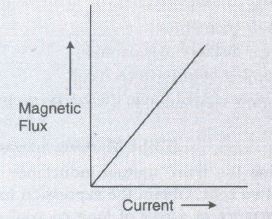
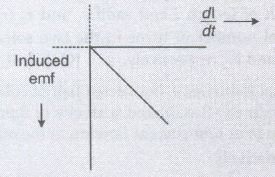
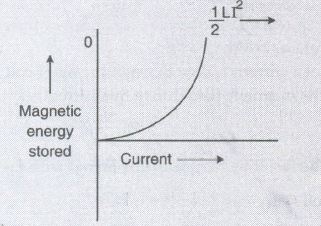
The current flowing through an inductor of self inductance L is continuously increasing. Plot a graph showing the variation of
(i) Magnetic flux versus the current
(ii) Induced emf versus dI/dt
(iii) Magnetic potential energy stored versus the current.
5.
A magnetic field \(\overrightarrow { B } \) is confined to a region \(r\le a\) and points out of the paper (the z-axis), \(r=0\) being the centre of the circular region. A charged ring (charge = Q) of radius b, \(b>a\) and mass m lies in the x-y plane with its centre at the origin. The ring is free to rotate and is at rest. The magnetic field is brought to zero in time \(\triangle t\). Find the angular velocity \(\omega \) of the ring after the field vanishes.
6.
There is a parallel plate capacitor of capacitance \(2.0\mu F.\) The voltage between the plates of parallel plate capacitor is changing at the rate of 6.0 V s-1 . What is the displacement current in the capacitor?
7.
A laser beam has intensity 3.0 x 10¹⁴ M m-2. Find the amplitudes of electric and magnetic fields in the beam.
8.
A coil when connected across a 10V d.c. supply draws a current of 2A. When it is connected across 10V-50hz a.c. supply the same coil draws a current of 1A. Explain why? Hence determine self inductance of the coil.
9.
A resistor of 200 ohm and a capacitor of 15.0 \(\mu\) F are connected in series to a 220V, 50Hz a.c. source.
(a) Calculate the current in the circuit
(b) Calculate the r.m.s. voltage across the resistor and the capacitor. Is the algebraic sum of these voltages more than the source voltage? If yes, resolve the paradox.
10.
Same current I is flowing in three infintely long wires along x, y and z directions. What is the magnetic field at point (0, 0, -a) ?
11.
While checking with metal detector at the airport, Imran was asked to take out the material from his pant and shirt pockets. Imran got annoyed and argued with airport security asking the reasons for such procedure. He was conveyed that that as per security rule, the passengers and their luggage will be checked for security check to ensure safe travel
(i) What is the value that imparts us in the above scenario?
(ii) Briefly explain the working principle of a metal detector.
12.
While discussing with her aunt one day, Shalini planned to gift a microwave oven to her aunt so that she'should get some relief from tough household activities. Shalini requested her aunt and made her agreed for the gift by telling her its details and significance.
(a) What are the values shown by Shalini?
(b) How does a microwave oven work? Explain briefly.
13.
The electric field intensity produced by the radiations coming from 100 W bulb at a 3m distance is E. The electric field intensity produced by the radiations coming from 50w bulb at the same distance is:
\(\frac { E }{ 2 } \)
\(2E\)
\(\frac { E }{ \sqrt { 2 } } \)
\(\sqrt { 2E } \)
14.
A transformer is an electric device used for
producing direct current
producing alternating current
changing d.c. into a.c.
changing a.c. voltages
15.
In a cyclotron a charged particle
undergoes acceleration all the time
speeds up between the dees because of the magnetic field.
speeds up in a dee
slows down within a dee and speeds up between dees.
16.
Consider a region inside which there are various types of charges but the total charge is zero. At points outside the region
the electric field is necessarily zero
the electric field is due to the dipole moment of the charge distribution only
the dominant electric field is \(\alpha {1\over r^3}\) , for large r , where r is the distance from a origin in this region.
the work done to move a charged particle along a closed path, away from the region, will be zero.
17.
Self induction of a coil is said to be............when a current change.................through the coil induces..................in the coil.
18.
Who discovered ultraviolet rays? Give their frequency range and mention at least two uses.
19.
In small drops o same size are charged to V volt each. They coalesce to form a bigger drop. Calculate the capacity and potential of the bigger drop.
20.
A spherical shell of radius b with charge Q is expanded to a radius a. Find the work done by the electrical forces in the process.
21.
Show variation of resistivity of copper as a function of temperature in a graph.
22.
A charged Particle q is shot towards another charged particle Q which is fixed , with a speed v. It approaches Q up to a closet distance r and then returns, If q were given a speed 2 v the n find the closet distance of approach.
1.
Temperature, T1 = 27.5°C
Resistance of the silver wire at T1, R1 = 2.1 Ω
Temperature, T2 = 100°C
Resistance of the silver wire at T2, R2 = 2.7 Ω
Temperature coefficient of silver = α
It is related with temperature and resistance as
\(\alpha=\frac{R_{2}-R_{1}}{R_{2}\left(T_{2}-T_{1}\right)}\)
\(=\frac{2.7-2.1}{2.1(100-27.5)}=0.0039^{\circ} \mathrm{C}^{-1}\)
Therefore, the temperature coefficient of silver is 0.0039°C−1.
2.
Not necessarily, The basic requirement is that the total electric flux through the area enclosed by the loop should vary with time. The flux change may arise from any portion of the area.
Elsewhere E or dE/dt may be zero. In particular. there need be no electric field at points which make the loop.
3.
Here, M = 2.5 Am2, m = 6.6 g = 6.6 x 10⁻³ kg
\(\rho =7.9\times { 10 }^{ 3 }kg/{ m }^{ 3 },\)
\(V=\frac { m }{ \rho } =\frac { 6.6\times { 10 }^{ -3 } }{ 7.9\times { 10 }^{ 3 } } =0.835\times { 10 }^{ -6 }{ m }^{ 3 }\)
\(I=\frac { M }{ V } =\frac { 2.5 }{ 0.835\times { 10 }^{ -6 } } =3.0\times { 10 }^{ 6 }{ Am }^{ -1 }\)
4.
(i) Magnetic flux versus current
(ii)
Alternatively
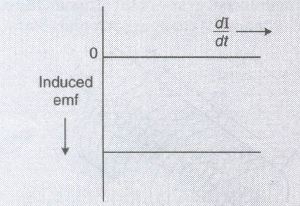
When Iis increasing at constant rate
(iii) Magnetic energy stored
5.
Since magnetic field is brought to zero in time \(\triangle t\), the magnetic flux also reduces from maximum to zero and hence induced emf is produced in the ring.
Induced emf \(=E\left( 2\pi b \right) \) ........(i) \(\left[ \therefore \ V=Ed \right] \)
E is electric field generated around the ring.
Also induced emf = rate of change of magnetic field \(\times\) area
\(=\frac { B\pi { r }^{ 2 } }{ \triangle t } \) .......(ii)
From eqn. (i) and (ii), we have
\(2\pi bE=\frac { B\pi { a }^{ 2 } }{ 2\triangle t } \)
or \(bE=\frac { B{ a }^{ 2 } }{ 2\triangle t } \) .......(iii)
Torque acting on the ring
\(\tau =b\times force=bQE\)
Using eqn. (iii), we get
\(\tau =\frac { QB{ a }^{ 2 } }{ 2\left( \Delta t \right) } \)
If \(\Delta L\) is the change in angular momentum, then
\(\Delta L=\tau \times \Delta t=\frac { QB{ a }^{ 2 } }{ 2 } \)
Initial angular momentum = 0
Final angular momentum = \(m{ b }^{ 2 }\omega =\frac { QB{ a }^{ 2 } }{ 2 } \)
or \(\omega =\frac { QB{ a }^{ 2 } }{ 2m{ b }^{ 2 } } \)
6.
\(C=2.0\mu F=2\times { 10 }^{ -6 }F,\)
\(\frac { dV }{ dt } =6V{ s }^{ -1 }\)
Displacement current,
\({ I }_{ D }={ \epsilon }_{ 0 }A\frac { dE }{ dt } ={ \epsilon }_{ 0 }A\frac { d }{ dt } \left( \frac { V }{ d } \right) \)
\(=\frac { { \epsilon }_{ 0 }A }{ d } \frac { dV }{ dt } =C\frac { dV }{ dt } \)
\(=\left( 2\times { 10 }^{ -6 } \right) \times 6=12\times { 10 }^{ -6 }A\)
\(=12\mu A\)
7.
Here, I = 3.0 x 10¹⁴ M m-2 , E0 = ?, B0 = ?
Intensity of the plane electromagnetic wave is
\(I={ u }_{ av }c=\frac { 1 }{ 2 } { \epsilon }_{ 0 }{ E }_{ 0 }^{ 2 }c\)
\(\therefore { E }_{ 0 }=\sqrt { \frac { 2I }{ { \epsilon }_{ 0 }c } = } \sqrt { \frac { 2\times 3\times { 10 }^{ 14 } }{ \left( 8.85\times { 10 }^{ -12 } \right) \times \left( 3\times { 10 }^{ 8 } \right) } } \)
= 4.75 x 10⁸ V m-1
\({ B }_{ 0 }=\frac { { E }_{ 0 } }{ c } =\frac { 4.75\times { 10 }^{ 8 } }{ 3\times { 10 }^{ 8 } } =1.58T\)
8.
The coil draws lesser current in 2nd case because of inductive reactance of the coil.
In 1st case,\( \ R=\frac { V }{ I } =\frac { 10 }{ 2 } =5\Omega \)
In second case,\( \ Z=\frac { V }{ I } =\frac { 10 }{ 1 } =10\Omega \)
Inductive reactance,
\({ X }_{ L }=\sqrt { { Z }^{ 2 }-{ R }^{ 2 } } =\sqrt { { 10 }^{ 2 }-{ 5 }^{ 2 } } =5\sqrt { 3 } \)
\(\\ 2\pi vL=5\sqrt { 3 } \ L=\frac { 5\sqrt { 3 } }{ 2\pi v } =\frac { 5\sqrt { 3 } }{ 2\times 3.14\times 50 } =0.0288 \ H\)
9.
\(Here, \ R=200 \ ohm, \ C=15.0\mu F=15\times { 10 }^{ -6 }F\)
\({ E }_{ v }=220V, \ v=50Hz, \ { I }_{ v }=? \ { V }_{ R }=?, \ { V }_{ C }=?\)
\( Now \ { X }_{ C }=\frac { 1 }{ \omega C } =\frac { 1 }{ 2\pi vC } =\frac { 1 }{ 2\times 3.14\times 50\times 15\times { 10 }^{ -6 } } =212.2\Omega \)
\((a) \ Impedance \ of \ the \ circuit,\)
\(Z=\sqrt { { R }^{ 2 }+{ X }_{ C }^{ 2 } } =\sqrt { { 200 }^{ 2 }+\left( 212.3 \right) ^{ 2 } } =291.7 \ ohm\)
\( \therefore \ \ Current \ in \ the \ circuit, \ { I }_{ v }=\frac { { E }_{ v } }{ Z } =\frac { 220 }{ 291.7 } =0.75A\)
\( (b) \ { V }_{ R }={ I }_{ v }\times R=0.75\times 200=150.8 \ V\)
\({ V }_{ C }={ I }_{ v }{ X }_{ C }=0.75\times 212.3=159.2 \ V\)
\( { V }_{ R }+{ V }_{ C }=150.8+159.2=310V, \ which \ is \ more \ than \ the \ source \ voltage \ of \ 220 \ V.\)
This paradox is resolved by the fact that the two voltage are not in same phase. Therefore, they cannot be added like ordinary numbers. As VR and VC are out of phase by \({ 90 }^{ \circ }\), therefore
\({ V }_{ RC }=\sqrt { { V }_{ R }^{ 2 }+{ V }_{ C }^{ 2 } } =\sqrt { \left( 150.8 \right) ^{ 2 }+\left( 159.2 \right) ^{ 2 } }\)
\(=220V,\ the\ source\ voltage\)
10.
The point (0, 0, -a) lies on z-axis. Therefore the magnetic field induction at the given point due to current along z-axis is zero.
The magnetic field induction due to current along x-axis at the given point is \(\overset { \rightarrow }{ { B }_{ x } } ={ \frac { { \mu }_{ 0 } }{ 4\pi } }\frac { I }{ a } \overset { \Lambda }{ j } \)
The magnetic field induction due to current along y-axis at the given point is
\(\overset { \rightarrow }{ { B }_{ y } } ={ \frac { { \mu }_{ 0 } }{ 4\pi } }\frac { I }{ a } \overset { \Lambda }{ (-i) } \)
Total magnetic field induction,
\(\overset { \rightarrow }{ B } =\overset { \rightarrow }{ { B }_{ x } } +\overset { \rightarrow }{ { B }_{ y } } =\frac { { \mu }_{ 0 } }{ 4\pi } \frac { I }{ a } (\overset { \Lambda }{ j } -\overset { \Lambda }{ i } )\)
11.
(i) Respecting law and obeying the rules enacted by the nation; self discipline and avoiding arguments
(ii) The change in the magnetic field in a metal detector due to the metals carried by the contents of checking which, induces the change in current in the coil of the metal detector. This detection of change sets up an alarm.
12.
(a) The values shown by Shalini are :
(i) high degree of general awareness,
(ii) ability to take quick decisions,
(iii) concern for her aunt,
(iv) helping and caring nature.
(b) In microwave oven, microwaves of required wavelength get strongly absorbed by water due to its energy which heated the water. Since every food items has lot of water, so they can be heated and cooked quickly in a microwave over. With this, the microwaves heat the food item completely, not simply from outside as in case of normal oven.
13.
(a)
\(\frac { E }{ 2 } \)
14.
(d)
changing a.c. voltages
15.
(a)
undergoes acceleration all the time
16.
(c)
the dominant electric field is \(\alpha {1\over r^3}\) , for large r , where r is the distance from a origin in this region.
17.
()
one henry; at the rate of 1 ampere/sec; an emf of 1 volt.
18.
The ultraviolet rays were discovered by Ritter. The frequency range of ultraviolet rays is \(8\times { 10 }^{ 14 } \ Hz \ to \ 3\times { 10 }^{ 17 } \ Hz\) ultraviolet rays are used
(i) to preserve the food stuff
(ii) in burglar alarm
19.
Let r be the radius of each small drop and R be the radius of bigger drop.
As volume of bigger drop = volume of n small drops
\({4\over 3}\pi R^3=n\times{4\over 3}r^3\)
\(R=n^{1/3}r\)
Also, potential of bigger drop = \(total \ charge\over capacity\)
\(V={nq\over 4\pi\epsilon_o R}={nq\over 4\pi\epsilon_on^{1/3}r}=n^{2/3}{q\over 4\pi\epsilon_o r}\)
\(=n^{2/3}\) times the potential of each small drop.
20.
Work done by electrical forces in the process
= Final stored energy-Initial stored energy
\(=\frac { { Q }^{ 2 } }{ { 2C }_{ 2 } } -\frac { { Q }^{ 2 } }{ { 2C }_{ 1 } }\\
=\frac { { Q }^{ 2 } }{ 2\left( 4\pi { \varepsilon }_{ 0 }a \right) } -\frac { 1 }{ 2 } .\frac { { Q }^{ 2 } }{ 2\left( 4\pi { \varepsilon }_{ 0 }b \right) }\\
=\frac { { Q }^{ 2 } }{ \left( 8\pi { \varepsilon }_{ 0 } \right) } \left( \frac { 1 }{ a } -\frac { 1 }{ b } \right) \)
21.
Graph of resistivity of copper as a function of temperature is given below (resistivity of metals increases with increase in temperature).

22.
q \(\rightarrow\)_______Q
1/2 mv2 = kQq/r
Or, v2 a1/r
Or, r a 1/v2
Or, r' = r/4

12th Standard CBSE Syllabus & Materials
12th Standard CBSE
CBSE 12th Standard Biology Sexual Reproduction in Flowering Plants Sample Question Papers Study Material - QB365 Set 1
NEW12th Standard CBSE
CBSE 12th Chemistry d- and f- Block Elements Important Questions And Answers Study Material - QB365 Set B
NEW12th Standard CBSE
CBSE 12th Chemistry d- and f- Block Elements Important Questions And Answers Study Material - QB365 Set A
NEW12th Standard CBSE
CBSE 12th Chemistry Chemical Kinetics Important Questions And Answers Study Material - QB365 Set B



NCERT Books

Syllabus

Exam Pattern

Sample Question Papers

Previous year Question Papers

Important Notes

MCQ Practice test

NCERT Exemplers

Case study Questions

Image Based Questions

Passage based Questions

HOT Questions

Value Based Questions

Model Questions Papers
NCERT ( Book Back ) Questions

Assertion and Reason
Important Questions And Answers

CBSE 12th Standard CBSE Subjects
CBSE Standards