
 100% FREE ACCESS
12th Standard Syllabus & Materials
12th Standard
TN 12th Computer Applications மின்னணு தரவு பரிமாற்றம் Sample Question Papers Study Material - QB365 Set A
NEW12th Standard
TN 12th Computer Applications மின் - வணிக பாதுகாப்பு அமைப்புகள் Sample Question Papers Study Material - QB365 Set A
NEW12th Standard
TN 12th Computer Applications மின்னணு செலுத்தல் முறைகள் Sample Question Papers Study Material - QB365 Set A
NEW12th Standard
TN 12th Computer Applications மின் - வணிகம் Sample Question Papers Study Material - QB365 Set A
NEW12th Standard
TN 12th Computer Applications திறந்த மூல கருத்துருக்கள் Sample Question Papers Study Material - QB365 Set A
NEW12th Standard
TN 12th Computer Applications வலையமைப்பு வடமிடல் Sample Question Papers Study Material - QB365 Set A

Published on: 13/05/2022
QB365 provides detailed and simple solution for every book back questions in class 12 Economics subject.It will helps to get more idea about question pattern in every book back questions with solution.
latest Book back QuestionsDownload Tamil Nadu 12th Standard Economics question papers, model tests, one-mark questions, important questions, and public exam papers in PDF format. Free study materials and answer keys for TN State Board students.
Questions + Answers key
Take MCQ Economics Test1.
What are the differences between MEC and MEI.
2.
Explain the operation of the Accelerator.
3.
Illustrate the working of Multiplier.
4.
Briefly explain the subjective and objective factors of consumption function?
5.
Explain Keynes psychological law of consumption function with diagram.
1.
| S. No | Marginal Efficiency of Captial (MEC) | Marginal Efficiency of Investment (MEI) |
|---|---|---|
| 1. | It is based on given supply price for capital. | It is based on the induced change in the price due to change in the demand for capital. |
| 2. | It represents the rate of return on all successive unit of capital without regard to existing capital. | It shows the rate of return on just those units of capital over and above the existing capital stock |
| 3. | The capital stock is taken on the X axis of diagram. | The amount of investment is taken on the X axis of diagram. |
| 4. | It is a 'Stock' concept. | It is a 'Flow' concept. |
| 5. | It determines the optimum capital stock in an economy at each level of interest rate. | It determines the net investment of the economy at each interest rate given the capital stock. |
2.
Introduction
A systematic development of the simple accelerator model was made by J.M.Clark, It was further developed by Hicks, Samuelson and Harrod.
Definition
Accelerator coefficient is the ratio between induced investment and an initial change in consumption \(\beta=\frac{\Delta \mathrm{I}}{\Delta \mathrm{C}}\)
Operation
Suppose that in order to produce 1000 consumer goods, 100 machines are needed. Working life of a machine is 10 yrs i.e, every year 10 machines have to be replaced. This is called replacement demand
(i) Suppose that demand for consumer goods rises by 10 % (i.e, from 1000 to 1100)
(ii) This results in increase in demand for 10 more machines
(iii) The total demand for machines is 20 i.e, 10 % increase in demand for consumer goods causes 100 % increase in demand for machine (from 10 to 20 )
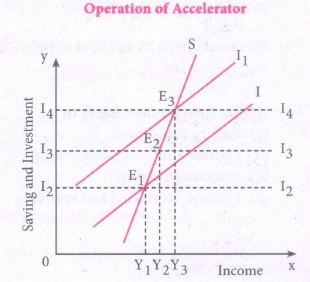
Explanation
(i) SS is the saving curve.
(ii) II is the investment curve.
(iii) At point E1 the economy is in equilibrium with OY1 income.
(iv) S and I are equal at O2.
(v) Now I increased from OI2 to OI4.
(vi) This increases income from OY1 to OY3 at E2 equilibrium.
(vii) If the increase in investment by I2I4 is purely exogenous, then the increase in income by Y1Y3 would be due to multiplier.
(viii) But in this diagram it is assumed that exogenous investment is only by I2I3 and induced investment is by I3I4.
(ix) Therefore, the increase in income by Y1Y2 is due to the multiplier effect and the increase in income by Y2Y3 is due to the accelerator effect.
3.
Introduction
The concept of multiplier Was first developed by R.F. Khan in terms of employment. J.M Keynes redefined it as investment multiplier.
Definition
Multiplier is defined as the ratio of the change in national income to change in investment.
\(K=\Delta Y / \Delta I\)
The value of multiplier depends on MPC.
\(\mathrm{K}=\frac{1}{1-\mathrm{MPC}} \text { since } \mathrm{MPC}+\mathrm{MPS}=1\)
\(k=\frac{1}{N 118}\)
Multiplier is inversely related to MPS and directly with MPC.
If MPC is, 0.75, MPS is 0.25 then K=4.00
\(\frac{1}{1-0.75} \text { or } \frac{1}{0.25}=4\)
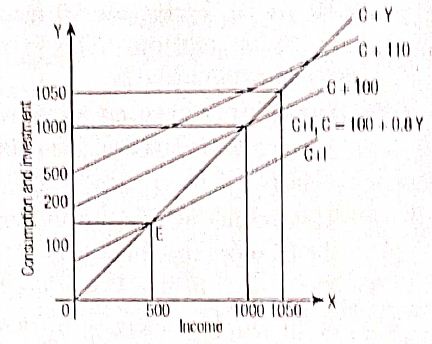
| MPC | MPS | k |
| 0.00 | 1.00 | 1 |
| 0.10 | 0.90 | 1.11 |
| 0.50 | 0.50 | 2.00 |
| 0.75 | 0.25 | 4.00 |
Working
(i) Suppose government undertakes investment expenditure equal to र100 cr on public works.
(ii) Income of labourers and suppliers of materials increases by र100 cr
(iii) If MPC is 0.8 that is 80 %. र80 cr is spent on consumption र20 cr salved
(iv) Suppliers of goods get an income of र80 cr. They spend र64 cr (ie 80% of र80 cr).
(v) In this manner consumption expenditure and increase in income act in a chain like manner.
4.
Introduction
J.M Keynes has divided factors influencing the consumption function into two namely Subjective factors and Objective factors
Subjective Factors
These factors are internal and related to psychological feelings. Keynes lists 8 motives which lead individuals to refrain from spending
Motive of precaution
To build a reserve against unforeseen contingencies. (eg.) Accidents
Motive of foresight
The desire to provide for anticipated future needs. (eg.) Old age
Motive of calculation
The desire to enjoy interest and appreciation.
Motive of improvernent
(i) The desire to enjoy for improving standard of living.
(ii) Motive of financial independence
(iii) Motive of enterprise - desire to do forward trading
(iv) Motive of pride - desire to leave a fortune
(v) Motive of avarice - miserly instinct
(vi) The government institutions, business corporations and firms may also consume mainly because of:
Motive of enterprise
The desire to get resources to carry out further capital investment without debt.
Motive of liquidity
The desire to secure liquid resources to meet emergency
Motive of improvement
The desire to secure a rising income and to demonstrate successful management
Motive of financial prudence
The desire to ensure adequate financial provision against depreciation, obsolescence and to discharge debt.
Objective Factors
They are the external factors which are real and measurable. They can be easily changed in the long run;
Income Distribution
According to VKRV Rao if incone is equally distributed propensity to consume increases
Price level
When price falls, real income rises; people consume more and save more.
Wage level
Consumption expenditure increases with a rise in wages.
Interest rate
Higher interest rate will encourage people to save more money and reduces consumption.
Fiscal Policy
When government reduces tax, disposable income rises and propensity to consume increases.
Consumer credit
The availability of consumer credit at easy installments will encourage people to buy consumer durables like car, fridge, computer
Demographic factors
(i) Size of family, stage in family life cycle, place of residence and occupation affect the consumption pattern
Duesenberry hypothesis
(i) Consumption expenditure depends on current income, past income and standard of living
(ii) As individuals are accustomed to a particular standard of living, they continue to spend the same amount on consumption
(iii) Consumption of the poor people is influenced by the rich. This is called Demonstration effect.
Windfall gain and loss
Unexpected changes in the stock market leads to gain or loss, so consumption function shifts upward or downward.
Conclusion
According to Keynes only the subjective factors do not change in the short-run, so consumption function remains stable in the short period.
5.
Law
According to Keynes, "men are disposed as a rule and on the average to increase their consumption as their income increases but not by as much as the increáse in their income".
Propositions
1. When income increases, consumption expenditure also increases, but by a smaller amount
(a) When income increases from 120 to 180; consumption also increases from 120 to 170 but the increase in consumption is less than the increase in income, 10 is saved.
2. The increased income will be divided in some proportion between consumption expenditure and saving
(a) When income increases to 180 and 240, it is divided between consumption (170 and 220) and saving (10 and 20)
3. Incrcascs in income always lead to in incrcase in both consumption and saving
(a) Increases in income to 180) and 240; lead to increased consumption 170 and 220; increased saving 10 and 20.
(b) It is clear from the widening area below the C curve and the saving gap between 45o line and C curve.
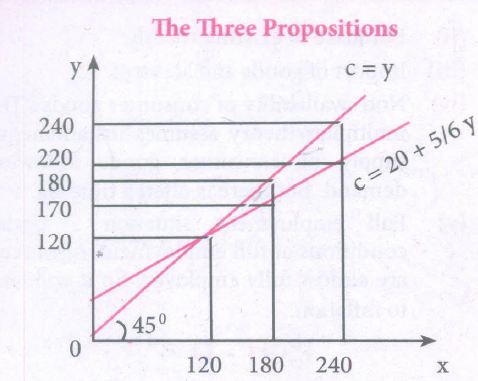
| Y | C | S |
|---|---|---|
| 120 | 120 | 0 |
| 180 | 170 | 10 |
| 240 | 220 | 20 |

12th Standard Syllabus & Materials
12th Standard
TN 12th Computer Applications களப்பெயர் முறைமை (DNS) Sample Question Papers Study Material - QB365 Set A
NEW12th Standard
TN 12th Computer Applications வலையமைப்பு எடுத்துக்காட்டுகள் மற்றும் நெறிமுறைகள் Sample Question Papers Study Material - QB365 Set A
NEW12th Standard
TN 12th Computer Applications கணினி வலையமைப்பு ஓர் அறிமுகம் Sample Question Papers Study Material - QB365 Set A
NEW12th Standard
TN 12th Computer Applications PHP-உடன் MySQL-ஐ இணைத்தல் Sample Question Papers Study Material - QB365 Set A



Tamilnadu Stateboard 12th Standard Subjects

Maths

Chemistry

Physics

Biology

Computer Science

Business Maths and Statistics
Economics

Commerce

Accountancy

History

Computer Applications
Biology
Computer Technology
Computer Applications
Computer Science
Business Maths and Statistics
Commerce
Economics
Maths
Chemistry
Physics
Computer Technology
History
Accountancy

Tamil

English

French
Tamilnadu Stateboard Standards