
 100% FREE ACCESS
12th Standard Syllabus & Materials
12th Standard
TN 12th Computer Applications மின்னணு தரவு பரிமாற்றம் Sample Question Papers Study Material - QB365 Set A
NEW12th Standard
TN 12th Computer Applications மின் - வணிக பாதுகாப்பு அமைப்புகள் Sample Question Papers Study Material - QB365 Set A
NEW12th Standard
TN 12th Computer Applications மின்னணு செலுத்தல் முறைகள் Sample Question Papers Study Material - QB365 Set A
NEW12th Standard
TN 12th Computer Applications மின் - வணிகம் Sample Question Papers Study Material - QB365 Set A
NEW12th Standard
TN 12th Computer Applications திறந்த மூல கருத்துருக்கள் Sample Question Papers Study Material - QB365 Set A
NEW12th Standard
TN 12th Computer Applications வலையமைப்பு வடமிடல் Sample Question Papers Study Material - QB365 Set A

Published on: 13/05/2022
QB365 provides detailed and simple solution for every Creative Questions in class 12 Economics Subject. It will helps to get more idea about question pattern in every Creative questions with solution.
latest Creative QuestionsDownload Tamil Nadu 12th Standard Economics question papers, model tests, one-mark questions, important questions, and public exam papers in PDF format. Free study materials and answer keys for TN State Board students.
Questions + Answers key
Take MCQ Economics Test1.
Derive the value of the multiplier assuming the basic form of the consumption function as C = a + bY where "a" is autonomous consumption and "b" is the marginal propensity to consume. You may assume a two-sector economy.
2.
State the Relationship between rate of interest and Investment:
3.
Explain the concept of super multiplier.
4.
Explain Marginal propensity to consume and multiplier, with the help of a diagram.
5.
What are the determinants of investment function?
1.
Since Y = C + I we can write Y = a + bY + I.
This equation can be rearranged to yield
Y - bY = a + I
Y(1 - b) = a + I
We can then solve for Y in terms of I by dividing through by (1 - b):
Y = (a + I) (1/1 - b)
Now we can see that an increase in I will increase Y by
ΔY = ΔI x (1/1 - b)
Since b D MPC, the expression becomes
ΔY = ΔI x 1/(1 - MPC)
Therefore, the multiplier is 1/1 - MPC or 1/MPS.
2.
(i) Higher interest rates reduce investment, because higher rates increase the cost of borrowing and require investment to have a higher rate of return to be profitable.
(ii) If interest rates rise from 5% to 8 %, then we get a fall in the amount of investment.
(iii) from Rs. 100 cr to Rs. 80 cr.
(iv) If interest rates are increased then it will tend to discourage investment because investment has a higher opportunity cost.
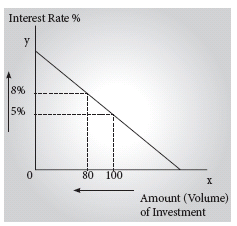
If interest rates are increased then it will tend to discourage investment because investment has a higher opportunity cost.
1. With higher rates, it is more expensive to borrow money from a bank.
2. Saving money in a bank gives a higher rate of return. Therefore, using savings to finance investment has an opportunity cost of lower interest payments.
If interest rates rise, firms will need to gain a better rate of return to justify the cost of borrowing using savings.
3.
Meaning of Super Multiplier
(i) In order to measure the total effect of initial investment on income, Hicks has combined the k and β mathematically and given it the name of the Super Multiplier.
(ii) The super multiplier is worked out by combining both induced consumption and induced investment. The combined name of the super multiplier and the accelerator is also called the leverage effect
Components of Super Multiplier
(i) The super multiplier is greater than simple multiplier which includes only autonomous investment and no induced investment, while super multiplier includes induced investment.
(ii) The super multiplier is greater than simple multiplier which includes only autonomous investment and no induced investment, while super multiplier includes induced investment.
The Leverage Effect
The combined effect of the multiplier and the accelerator is also called the leverage effect which may lead the economy to very high or low level of income propagation.
Symbolically,
Y= C + IA + IP
Y = Aggregate income.
C = Consumption expenditure
IA = autonomous investment
IP = induced private investment
The super – multiplier, tells us that if there is an initial increase in autonomous investment, income will increase by K times the autonomous investment.
4.
(i) The propensity to consume refers to the portion of income spent on consumption.
MPC = \(\frac{ΔC}{ΔY}\)
(K) = \(\frac{1}{1-MPC}\)
(ii) The multiplier is the reciprocal of one minus marginal propensity to consume.
(iii) Multiplier is 1/MPS
(iv) The multiplier is therefore define as reciprocal of MPS.
(v) Multiplier is inversely related to MPS and directly with MPC.
Numerically, if MPC is 0.75, MPS is 0.25 and K is 4.
Using formula K = \(\frac{1}{1-MPC}\)
⇒\(\frac{1}{1-0.75}\) = 1/0.25 = 4
∴ Multiplier (K) = 4
| MPC | MPS | K |
|---|---|---|
| 1.00 | 1.00 | 1 |
| 0.10 | 1.90 | 1.11 |
| 0.50 | 0.50 | 2.00 |
| 0.75 | 0.25 | 4.00 |
| 0.90 | 0.10 | 10.00 |
| 1.00 | 0.00 | ∝ |
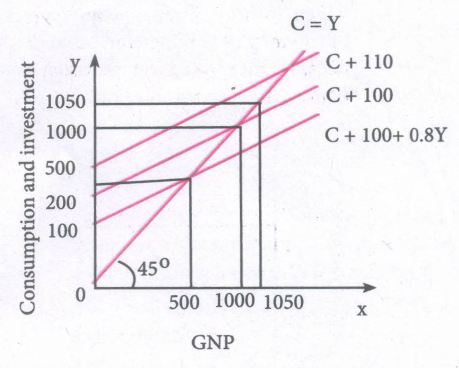
C = 100 + 0.8Y;
I = 10
Y = C + I
= 100 + 0.8 Y +9p00
.JPG)
0.2Y = 1000
∴ Y = 1000
Here, C = 100 + 0.8y
= 100 + 1000 = 900
S = 100 = I
After I is raised by 10, now I = 110
Y = 100 + 0.8y + 110
0.2y = 210
y = \(\frac{210}{0.2}\) = 1050
Here, C = 100 = 0.8 (1050) = 940,
S = 110 = I
(i) It implies the variables in axis-and axis are equal.
(ii) The MPC is assumed to be at 0.8. (C = 100 + 0.8y)
(iii) The aggregate demand (C + I) curve intersects 45° line at point E.
(iv) The new aggregate demand curve is
C + I = 100 + 0.8Y + 100 + 10
Y = \(\frac{210}{0.2}\)
C = 940; S = 110 = Z
5.
(i) The classical economists believed that investment depended exclusively on rate of interest.
(ii) Investment decision depends on a number of factors.
(iii) They are as follows:
(1) Rate of interest
(2) Level of uncertainty
(3) Political environment
(4) Rate of growth of population
(5) Stock of capital goods
(6) Necessity of new products
(7) Level of income of investors
(8) Inventions and innovations
(9) Consumer demand
(10 ) Policy of the state
(11) Available of capital
(12) Liquid assets of the investors

12th Standard Syllabus & Materials
12th Standard
TN 12th Computer Applications களப்பெயர் முறைமை (DNS) Sample Question Papers Study Material - QB365 Set A
NEW12th Standard
TN 12th Computer Applications வலையமைப்பு எடுத்துக்காட்டுகள் மற்றும் நெறிமுறைகள் Sample Question Papers Study Material - QB365 Set A
NEW12th Standard
TN 12th Computer Applications கணினி வலையமைப்பு ஓர் அறிமுகம் Sample Question Papers Study Material - QB365 Set A
NEW12th Standard
TN 12th Computer Applications PHP-உடன் MySQL-ஐ இணைத்தல் Sample Question Papers Study Material - QB365 Set A



Tamilnadu Stateboard 12th Standard Subjects

Maths

Chemistry

Physics

Biology

Computer Science

Business Maths and Statistics
Economics

Commerce

Accountancy

History

Computer Applications
Biology
Computer Technology
Computer Applications
Computer Science
Business Maths and Statistics
Commerce
Economics
Maths
Chemistry
Physics
Computer Technology
History
Accountancy

Tamil

English

French
Tamilnadu Stateboard Standards