
 100% FREE ACCESS
12th Standard Syllabus & Materials
12th Standard
TN 12th Computer Applications மின்னணு தரவு பரிமாற்றம் Sample Question Papers Study Material - QB365 Set A
NEW12th Standard
TN 12th Computer Applications மின் - வணிக பாதுகாப்பு அமைப்புகள் Sample Question Papers Study Material - QB365 Set A
NEW12th Standard
TN 12th Computer Applications மின்னணு செலுத்தல் முறைகள் Sample Question Papers Study Material - QB365 Set A
NEW12th Standard
TN 12th Computer Applications மின் - வணிகம் Sample Question Papers Study Material - QB365 Set A
NEW12th Standard
TN 12th Computer Applications திறந்த மூல கருத்துருக்கள் Sample Question Papers Study Material - QB365 Set A
NEW12th Standard
TN 12th Computer Applications வலையமைப்பு வடமிடல் Sample Question Papers Study Material - QB365 Set A

Published on: 13/05/2022
QB365 provides detailed and simple solution for every Creative Questions in class 12 Economics Subject. It will helps to get more idea about question pattern in every Creative questions with solution.
latest Creative QuestionsDownload Tamil Nadu 12th Standard Economics question papers, model tests, one-mark questions, important questions, and public exam papers in PDF format. Free study materials and answer keys for TN State Board students.
Questions + Answers key
Take MCQ Economics Test1.
Use the table below (for a simple economy with no foreign sector or government) to answer the questions that follow.
| (1) Income (Y) |
(2) Consumption (C) |
(3) Investment (l) |
(4) Aggregate Demand AD = C + 1 = Column(2) + Column(3) |
| 0 | 30 | (a) | 50 |
| 300 | 300 | 20 | (b) |
| 400 | (c) | 20 | 410 |
| 500 | 480 | 20 | 500 |
| 600 | (d) | 20 | (e) |
Fill in the missing numbers in the spaces marked (a)-(c). Determine the consumption function, and use the result to fill in the remaining missing numbers (d)-(e). (f) Determine the equilibrium output level.
2.
Explain the short and long run factors of MEC.
3.
Explain Multiplier with help of suitable diagram.
4.
Draw a consumption table where autonomous consumption is Rs.200 and the marginal propensity to consume is .8. Make sure to start with an income level of Rs.0 and increase by Rs.100 each time up to an income level of Rs.400. Without completing the table any further determine the level of income where consumption and income are equal. Prove this algebraically.
5.
What are the factors on which MEC depends? Also give details on the factors which influence MEC.
1.
| (1) Income (Y) |
(2) Consumption (C) |
(3) Investment (l) |
(4) Aggregate Demand AD = C + 1 = Column(2) + Column(3) |
| 0 | 30 | (a) | 50 |
| 300 | 300 | 20 | 320 |
| 400 | 390 | 20 | 410 |
| 500 | 480 | 20 | 500 |
| 600 | 570 | 20 | (e) |
Using AD = C + II,
(a) 50 = 30 + 20
(b) 320 = 300 + 20
(c) 410 = 390 + 20 Deriving the consumption function:
Autonomous consumption = 30 (from the first row where Y = 0).
To find the mpc, calculate a change in C (e.g. 390 – 300 = 90), and divide by the corresponding change in Y (400 – 300 = 100).
So the mpc = ΔC/ΔY = 90/100 = 0.9 Hence, the consumption function is C = 30 + 0.9Y To fill in
(d) C = 30 + 9(600) = 30 + 540 = 570.
(e) follows from 590 = 570 + 20.
f. Equilibrium is where Y = AD, which is at 500 (see shaded row).
2.
a) Short - Run Factors
(i) Demand for the product:
If the market for a particular good is expected to grow and its costs are likely to fall, the rate of return from investment will be high. If entrepreneurs expect a fall in demand for goods and a rise in cost, the investment will decline.
(ii) Liquid assets:
If the entrepreneurs are holding large volume of working capital, they can take advantage of the investment opportunities that come in their way. The MEC will be high.
(iii) Sudden changes in income:
The MEC is also influenced by sudden changes in income of the entrepreneurs. If the business community gets windfall profits, or tax concession the MEC will be high and hence investment in the country will go up. On the other hand, MEC falls with the decrease in income.
(iv) Current rate of investment:
Another factor which influences MEC is the current rate of investment in a particular industry. If in a particular industry, much investment has already taken place and the rate of investment currently going on in that industry is also very large, then the marginal efficiency of capital will be low.
(v) Waves of optimism and pessimism:
The marginal efficiency of capital is also affected by waves of optimism and pessimism in the business cycle. If businessmen are optimistic about future, the MEC will be likely to be high. During periods of pessimism the MEC is under estimated and so will be low.
b) Long - Run Factors
The long run factors which influence the marginal efficiency of capital are as follows
(i) Rate of growth of population:
Marginal efficiency of capital is also influenced by the rate of growth of population. If population is growing at a rapid speed, it is usually believed that the demand of various types of goods will increase. So a rapid rise in the growth of population will increase the marginal efficiency of capital and a slowing down in its rate of growth will discourage investment and thus reduce marginal efficiency of capital.
(ii) Technological progress:
If investment and technological development take place in the industry, the prospects of increase in the net yield brightens up. For example, the development of automobiles in the 20th century has greatly stimulated the rubber industry, the steel and oil industry etc. So we can say that inventions and technological improvements encourage investment in various projects and increase marginal efficiency of capital.
(iii) Monetary and Fiscal policies:
Cheap money policy and liberal tax policy pave the way for greater profit margin and so MEC is likely to be high.
(iv) Political environment:
Political stability, smooth administration, maintenance of law and order help to improve MEC.
(v) Resource availability:
Cheap and abundant supply of natural resources, efficient labour and stock of capital enhance the MEC.
3.
Definition
(i) The multiplier is defined as the ratio of the change in national income to change in investment.
(ii) If ΔI stands for increase in investment and ΔY stands for resultant increase in income, the multiplier K =ΔY/ΔI.
Assumptions of Multiplier
1. There is change in autonomous investment.
2. There is no induced investment
3. The marginal propensity to consume is constant.
4. Consumption is a function of current income.
5. There are no time lags in the multiplier process.
6. Consumer goods are available in response to effective demand for them.
7. There is a closed economy unaffected by foreign influences.
8. There are no changes in prices.
9. There is less than full employment level in the economy.
The value of multiplier depends on MPC
Multiplier K = 1/1-MPC
(i) The multiplier is the reciprocal of one minus marginal propensity to consume. Since marginal propensity to save is 1 - MPC. (MPC + MPS = 1).
(ii) Multiplier is 1/ MPS. The multiplier is therefore defined as reciprocal of MPS. Multiplier is inversely related to MPS and directly with MPC.
Numerically, if MPC is 0.75, MPS is 0.25 and k is 4.
Using formula k = 1/1- MPC
1/1-0.75 =1/0.25 =4
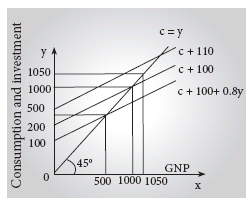
Diagrammatic Explanation.
(1) At 45° line y = C+ S
(2) It implies the variables in axis and axis are equal.
(3) The MPC is assumed to be at 0.8 (C = 100 + 0.8y)
(4) The aggregate demand (C + I) curve intersects 45° line at point E.
(5) The original national income is 500. (C = 100 + 0.8y = 100 + 0.8(500) = 500)
(6) When I is 100, y = 1000, C = 900; S = 100 = I
(7) The new aggregate demand curve is C + I = 100 + 0.8y + 100 +10
(8) Y = 210 / 0.2 = 1050
(9) C = 940; S = 110 = I
4.
| Income | Consumption |
| Rs.0 | Rs.200 |
| Rs.100 | 280 |
| Rs.200 | 360 |
| Rs.300 | 440 |
| Rs.400 | 520 |
(i) The consumption function is C = 200 + .8Y
(ii) Therefore if C = Y we can write Y = 200 + 8Y.
(iii) After rearranging terms this yields 2Y = 200.
(iv) Solving for Y gives us 1000.
5.
MEC depends on the following 2 factors :
(1) The prospective yield from a capital asset.
(2) The supply price of a capital asset. The marginal efficiency of capital is influenced by short-run as well as long run factors.
(a) Short - Run factors:
(i) Demand for the product:
If the market for a particular good is expected to grow and its costs are likely to fall, the rate of return from investment will be high.
(ii) Liquid assets:
If the entrepreneurs are holding large volume of working capital, they can take advantage of the investment opportunities that come in their way. The MEC will be high.
(iii) Sudden changes in incomes:
If the business community gets windfall profits, or tax concession the MEC will be high. On the other hand, MEC falls with the decrease in income.
(iv) Current rate of investment:
If in a particular industry, much investment has already taken place and the rate of investment currently going on in that industry is also very large, then the marginal efficiency of capital will be low.
(v) Wales of optimism and pessimism:
If businessmen are optimistic about future, the MEC will be likely to be high. During periods of pessimism the MEC is under estimated and so will be low.
(b) Long - Run Factors:
(i) Rate of growth of population:
If population is growing at a rapid speed, it is usually believed that the demand of various types of goods will increase.
(ii) Technological progress:
If investment and technological development take place in the industry, the prospects of increase in the net yield brightens up.
(iii) Monetary and fiscal policies:
Cheap money policy and liberal tax policy pave the way for greater profit margin and so MEC is likely to be high.
(iv) Political environment :
Political stability, smooth administration, maintenance of law and order help to improve MEC.
(v) Resource avaiqability:
Cheap and abundant supply of natural resources, efficient labour and stock of capital enhance the MEC.

12th Standard Syllabus & Materials
12th Standard
TN 12th Computer Applications களப்பெயர் முறைமை (DNS) Sample Question Papers Study Material - QB365 Set A
NEW12th Standard
TN 12th Computer Applications வலையமைப்பு எடுத்துக்காட்டுகள் மற்றும் நெறிமுறைகள் Sample Question Papers Study Material - QB365 Set A
NEW12th Standard
TN 12th Computer Applications கணினி வலையமைப்பு ஓர் அறிமுகம் Sample Question Papers Study Material - QB365 Set A
NEW12th Standard
TN 12th Computer Applications PHP-உடன் MySQL-ஐ இணைத்தல் Sample Question Papers Study Material - QB365 Set A



Tamilnadu Stateboard 12th Standard Subjects

Maths

Chemistry

Physics

Biology

Computer Science

Business Maths and Statistics
Economics

Commerce

Accountancy

History

Computer Applications
Biology
Computer Technology
Computer Applications
Computer Science
Business Maths and Statistics
Commerce
Economics
Maths
Chemistry
Physics
Computer Technology
History
Accountancy

Tamil

English

French
Tamilnadu Stateboard Standards