
 100% FREE ACCESS
12th Standard Syllabus & Materials
12th Standard
TN 12th Computer Applications மின்னணு தரவு பரிமாற்றம் Sample Question Papers Study Material - QB365 Set A
NEW12th Standard
TN 12th Computer Applications மின் - வணிக பாதுகாப்பு அமைப்புகள் Sample Question Papers Study Material - QB365 Set A
NEW12th Standard
TN 12th Computer Applications மின்னணு செலுத்தல் முறைகள் Sample Question Papers Study Material - QB365 Set A
NEW12th Standard
TN 12th Computer Applications மின் - வணிகம் Sample Question Papers Study Material - QB365 Set A
NEW12th Standard
TN 12th Computer Applications திறந்த மூல கருத்துருக்கள் Sample Question Papers Study Material - QB365 Set A
NEW12th Standard
TN 12th Computer Applications வலையமைப்பு வடமிடல் Sample Question Papers Study Material - QB365 Set A

Published on: 13/05/2022
QB365 provides detailed and simple solution for every Book back Questions in class 12 Physics Subject. It will helps to get more idea about question pattern in every book back questions with solution.
latest Book back QuestionsDownload Tamil Nadu 12th Standard Physics question papers, model tests, one-mark questions, important questions, and public exam papers in PDF format. Free study materials and answer keys for TN State Board students.
Questions + Answers key
Take MCQ Physics Test1.
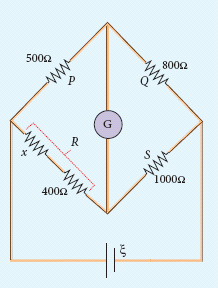
What is the value of x when the Wheatstone’s network is balanced?
P = 500 Ω, Q = 800 Ω, R = x + 400, S = 1000 Ω
2.
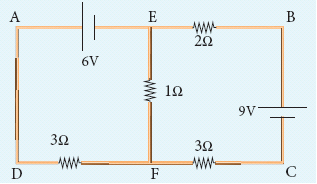
Calculate the current that flows in the 1 Ω resistor in the following circuit.
3.
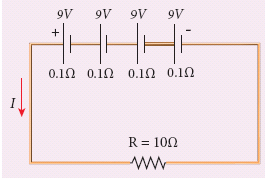
From the given circuit,
Find
i) Equivalent emf of the combination
ii) Equivalent internal resistance
iii) Total current
iv) Potential difference across external resistance
v) Potential difference across each cell
4.
Two electric bulbs marked 20 W – 220 V and 100 W – 220 V are connected in series to 440 V supply. Which bulb will get fused?
5.
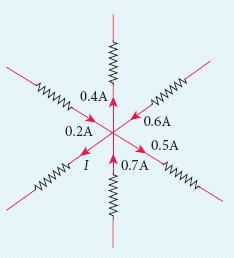
For the given circuit find the value of I.
1.
\(\frac { P }{ Q } =\frac { R }{ S } \), when the network is balanced
\(\frac { 500 }{ 800 } =\frac { x+400 }{ 1000 } \)
\(x+400=\frac { 5 }{ 8 } \times 1000\)
x + 400 = 625
x = 625 – 400
x = 225 Ω
2.
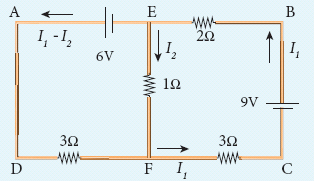
We can denote the current that flows from 9V battery as I1 and it splits up nto I2 and (I1 – I2) at the junction E according Kirchoff’s current rule (KCR).
Now consider the loop EFCBE and apply KVR, we get
1I2 + 3I1 + 2I1 = 9
5I1 + I2 = 9 (1)
Applying KVR to the loop EADFE, we get
3 (I1 – I2 ) – 1I2 = 6
3I1 – 4I2 = 6 (2)
Solving equation (1) and (2), we get
I1 = 1.83 A and I2 = -0.13 A
It implies that the current in the 1 ohm resistor flows from F to E.
3.
Equivalent emf of the combination
ξeq = nξ = 4 x 9 = 36 V
ii) Equivalent internal resistance req = nr = 4 x 0.1 = 0.4 Ω
iii) Total current \(I=\frac { n\xi }{ R+nr } \)
\(=\frac { 4\times 9 }{ 10+(4\times 0.1) } \)
\(=\frac { 4\times 9 }{ 10+0.4 } =\frac { 36 }{ 10.4 } \)
I = 3.46 A
iv) Potential difference across external resistance V = IR = 3.46 x 10 = 34.6 V. The remaining 1.4 V is dropped across the internal resistance of cells.
v) Potential difference across each cell \(\frac { V }{ n } =\frac { 34.6 }{ 4 } =8.65V\)
4.
To check which bulb will be fused, the voltage drop across each bulb has to be calculated.
The resistance of a bulb,
\(R=\frac { V^{ 2 } }{ P } =\frac { { (Ratedvoltage) }^{ 2 } }{ Ratedpower } \)
For 20W - 220V bulb,
\({ R }_{ 1 }=\frac { { \left( 220 \right) }^{ 2 } }{ 20 } \Omega =2420\Omega \)
For 100W - 220V bulb,
\({ R }_{ 2 }=\frac { { \left( 220 \right) }^{ 2 } }{ 20 } \Omega =484\Omega \)
Both the bulbs are connected in series. So same current will pass through both the bulbs. The current that passes through the circuit, \(I=\frac { V }{ { R }_{ tot } } \)
Rtot (R1 + R2)
Rtot = (484 + 2420) \(\Omega\) = 2904 \(\Omega\)
\(I=\frac { 440V }{ 2904\Omega } \approx 0.151A\)
The voltage drop across the 20W bulb is
\(V_1=IR_1=\frac { 440V }{ 2904 }\times2420 \approx 366.6V\)
The voltage drop across the 100W bulb is
\({ V }_{ 2 }=I{ R }_{ 2 }=\frac { 440 }{ 2904 } 484\approx 73.3A\)
The 20 W bulb will get fused because the voltage across it is more than the voltage rating.
5.
Applying Kirchoff’s rule to the point P in the circuit,
The arrows pointing towards P are positive and away from P are negative.
Therefore, 0.2A - 0.4A + 0.6A - 0.5A + 0.7A - I = 0
0.7 A - I = 0
1.5A - 0.9A – I = 0
0.6A - I = 0
I = 0.6 A

12th Standard Syllabus & Materials
12th Standard
TN 12th Computer Applications களப்பெயர் முறைமை (DNS) Sample Question Papers Study Material - QB365 Set A
NEW12th Standard
TN 12th Computer Applications வலையமைப்பு எடுத்துக்காட்டுகள் மற்றும் நெறிமுறைகள் Sample Question Papers Study Material - QB365 Set A
NEW12th Standard
TN 12th Computer Applications கணினி வலையமைப்பு ஓர் அறிமுகம் Sample Question Papers Study Material - QB365 Set A
NEW12th Standard
TN 12th Computer Applications PHP-உடன் MySQL-ஐ இணைத்தல் Sample Question Papers Study Material - QB365 Set A



Tamilnadu Stateboard 12th Standard Subjects

Maths

Chemistry
Physics

Biology

Computer Science

Business Maths and Statistics

Economics

Commerce

Accountancy

History

Computer Applications
Biology
Computer Technology
Computer Applications
Computer Science
Business Maths and Statistics
Commerce
Economics
Maths
Chemistry
Physics
Computer Technology
History
Accountancy

Tamil

English

French
Tamilnadu Stateboard Standards



