
 100% FREE ACCESS
12th Standard Syllabus & Materials
12th Standard
TN 12th Computer Applications மின்னணு தரவு பரிமாற்றம் Sample Question Papers Study Material - QB365 Set A
NEW12th Standard
TN 12th Computer Applications மின் - வணிக பாதுகாப்பு அமைப்புகள் Sample Question Papers Study Material - QB365 Set A
NEW12th Standard
TN 12th Computer Applications மின்னணு செலுத்தல் முறைகள் Sample Question Papers Study Material - QB365 Set A
NEW12th Standard
TN 12th Computer Applications மின் - வணிகம் Sample Question Papers Study Material - QB365 Set A
NEW12th Standard
TN 12th Computer Applications திறந்த மூல கருத்துருக்கள் Sample Question Papers Study Material - QB365 Set A
NEW12th Standard
TN 12th Computer Applications வலையமைப்பு வடமிடல் Sample Question Papers Study Material - QB365 Set A

Published on: 13/05/2022
QB365 provides detailed and simple solution for every Book back Questions in class 12 Physics Subject. It will helps to get more idea about question pattern in every book back questions with solution.
latest Book back QuestionsDownload Tamil Nadu 12th Standard Physics question papers, model tests, one-mark questions, important questions, and public exam papers in PDF format. Free study materials and answer keys for TN State Board students.
Questions + Answers key
Take MCQ Physics Test1.
For the given capacitor configuration
(a) Find the charges on each capacitor
(b) potential difference across them
(c) energy stored in each capacitor
2.
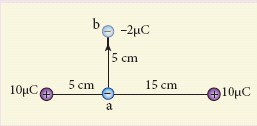
A point charge of +10 μC is placed at a distance of 20 cm from another identical point charge of +10 μC. A point charge of -2 μC is moved from point a to b as shown in the figure. Calculate the change in potential energy of the system? Interpret your result.
3.
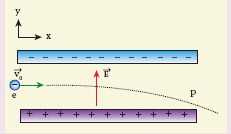
Consider an electron travelling with a speed vo and entering into a uniform electric field \(\vec{E}\) which is perpendicular to \(\vec { { v }_{ 0 } } \) as shown in the Figure. Ignoring gravity, obtain the electron’s acceleration, velocity and position as functions of time.
4.
An electron and a proton are allowed to fall through the separation between the plates of a parallel plate capacitor of voltage 5 V and separation distance h = 1 mm as shown in the figure.
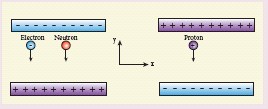
(a) Calculate the time of flight for both electron and proton
(b) Suppose if a neutron is allowed to fall, what is the time of flight?
(c) Among the three, which one will reach the bottom first? (Take mp = 1.6 x 10⁻²⁷ kg, me = 9.1 x 10⁻³¹ kg and g = 10 m s-2)
5.
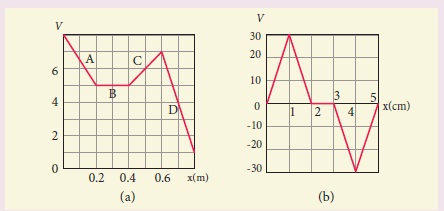
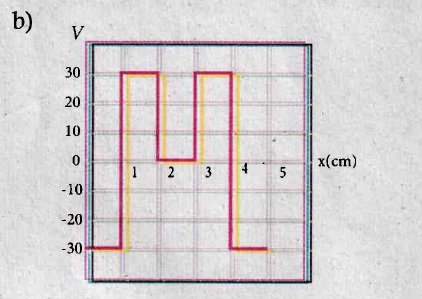
The electrostatic potential is given as a function of x in figure (i) and (ii). (a) Calculate the corresponding electric fields in regions A, B, C and D for the Figure (i). (b) Plot the electric field as a function of x for the figure (ii).
1.
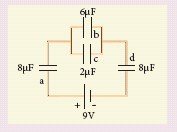
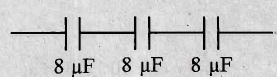
Cp = Cb + Cc
\(C_{P}=6+2=8 \mu \mathrm{F} \)
\(\frac{1}{C_{s}}=\frac{1}{C_a}+\frac{1}{C_p}=\frac{1}{C_d} \)
\(C_{s}=\frac{1}{8}+\frac{1}{8}+\frac{1}{8}=\frac{3}{8} \)
\(\therefore C_{s}=\frac{8}{3} \mu \mathrm{F} \)
Total capacitance \(C_{s}=\frac{8}{3} \times 10^{-6} \mathrm{~F} \)
Total Charge, \(Q=C_{s} V=\frac{8}{3} \times 10^{-6} \times 9 \)
\(Q_{a}=24 \mu C\)
(a) Charge on capacity \(Q_{a}=24 \mu C\) .....(1)
Charge on capacitor \(Q_{b}=24 \times \frac{6}{8}=18 \mu \mathrm{C} \) ..............(2)
Charge on capacitor \(Q_{c}=24 \times \frac{2}{8}=6 \mu \mathrm{C} \) ..............(3)
Charge on capacitor \(Q_{d}=24 \times \frac{8}{8}=24 \mu \mathrm{C} \) ..............(4)
(b) Potential difference across \(C_{a} \ is\ V_{a}=\frac{Q_{a}}{C_{a}} \)
\(=\frac{24}{8}=3 \mathrm{~V} \) ...(5)
Potential difference across \(C_{b}\ is \ V_{b}=\frac{Q_{b}}{C_{b}} \)
\(=\frac{18}{6}=3 \mathbf{V}\) ........(6)
Potential difference across \(C_{c}\ is \ V_{c}=\frac{Q_{c}}{C_{c}}=\frac{6}{2}=3 \mathrm{~V} \) ......(7)
Potential difference across \(C_{d}\ is \ V_{d}=\frac{Q_{d}}{C_{d}} \)
\(=\frac{24}{8}=3 \mathbf{V} \) ....(8)
(c) Energy stored in each capacitor \(U=\frac{1}{2} C V^{2}\)
Energy stored in \(\mathrm{C}_{\mathrm{a}} \text { is } U_{a}=\frac{1}{2} C_{a} V_{a}^{2}\)
\(U_{\mathrm{a}}=\frac{1}{2} \times 8 \times 10^{-6} \times 3 \times 3=36 \mu \mathrm{J}\) ....(9)
Energy stored in \(C_{b}\ is \ U_{b}=\frac{1}{2} C_{b} V_{b}^{2} \)
\(U=\frac{1}{2} \times 6 \times 10^{-6} \times 3 \times 3 \)
\(=27 \mu \mathrm{J} \) ........(10)
Energy stored in Ce is \(U_{c} =\frac{1}{2} C_{c} V_{c}^{2} \)
\(=\frac{1}{2} \times 2 \times 10^{-6} \times 3 \times 3=9 \mu \mathrm{J} \) ......(11)
Energy stored in Cd is \(U_{d} =\frac{1}{2} C_{d} V_{d}^{2} \)
\(U_d=\frac{1}{2} \times 8 \times 10^{-6} \times 3 \times 3 \)
\(=36 \times 10^{-6} \mathrm{~J}=36 \mu \mathrm{J} \) .........(12)
2.
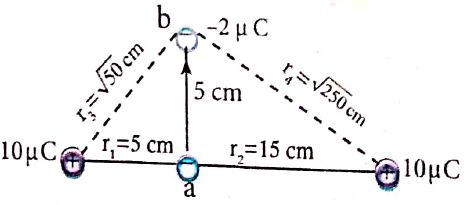
\(W =\left(V_{b}-V_{a}\right) q\left[where\ V=\frac{K Q}{r}\right] \)
To find Vb :
\(V_b=\frac{kQ}{r_3}+\frac{kQ}{r_4}\)
\(V_{b} =\frac{K \times 10 \times 10^{-6}}{\sqrt{50 \times 10^{-4}}}+\frac{K \times 10 \times 10^{-6}}{\sqrt{250 \times 10^{-4}}} \)
\(V_{b} =\frac{K \times 10^{-5}}{\sqrt{50} \times 10^{-2}}+\frac{K \times 10^{-5}}{\sqrt{250} \times 10^{-2}} \)
\(=K \times 10^{-3}\left[\frac{1}{\sqrt{50}}+\frac{1}{\sqrt{250}}\right] \)
\(=9 \times 10^{9} \times 10^{-3}\left[\frac{1}{\sqrt{50}}+\frac{1}{\sqrt{250}}\right] \)
Vb = 1842002 V
To find Va :
\(V_a=\frac{kQ}{r_1}+\frac{kQ}{r_2}\)
\(V_{a} =\frac{K \times 10 \times 10^{-6}}{\sqrt{5 \times 10^{-2}}}+\frac{K \times 10 \times 10^{-6}}{\sqrt{15 \times 10^{-2}}} \)
Va = 2400000 V
\(\therefore W_{D} =\left(V_{b}-V_{a}\right) q=(1842002-2400000)( -2 \times 10^{-6} )\)
W = +1.12J
Positive sign implies that to move the charge - 2 μC external work is required.
3.
(a) Acceleration of the electron \(a=\frac{F}{m}\)
Electrostatic force F = - eE
\(a=\frac{F}{m}=\frac{-e E \hat{j}}{m}\) ... ( 1)
(b) Let velocity of the electron be \(\vec{v}\)
v = u + at ...(2)
Here, \( u=v_{0} \hat{i} \), \(a=\frac{-e \bar{E}}{m} \hat{j}\)
Substituting these values in the equation (2) we get
\(\therefore \vec{v}=\nu_{0} \hat{i}-\frac{e E}{m} t \hat{j}\)
(c) Displacement \(\vec{r}\) represents position,
\( s=u t+\frac{1}{2} a t^{2} \) ...(3)
Let, \(s=\hat{r} \) and Here, \(u=v_{0} \hat{i} \), \(a=\frac{-e E}{m} \hat{j}\)
Substituting these values in the equation (3), we get,
\(\hat{r}=v_{0} t \hat{i}-\frac{1}{2} \frac{e E}{m} t^{2} \hat{j}\)
4.
h = 1 x 10⁻³ m, e = 1.6 x 10⁻¹⁹ C, me = 9.1 x 10⁻³¹ kg, mp =1.6 x 10⁻²⁷ kg
(a) (i) Time of flight for electron \(t_{c}=\sqrt{\frac{2 h m_{e}}{e E}}\)
Where,
\(E =\frac{V}{d}=\frac{5}{1 \times 10^{-3}}=5000 \mathrm{Vm}^{-1} \)
\(t_{e} =\sqrt{\frac{2 \times 1 \times 10^{-3} \times 9.1 \times 10^{-31}}{1.6 \times 10^{-19} \times 5000}}=\sqrt{\frac{18.2 \times 10^{-34}}{8 \times 10^{-16}}}=\sqrt{2.275 \times 10^{-18}} \)
= 1.5 x 10⁻⁹s
te = 1.5 ns (ignoring the gravity)
(ii) Time of flight for proton \(t_{p}=\sqrt{\frac{2 h m_{p}}{e E}}\)
\(t_{p} =\sqrt{\frac{2 \times 1 \times 10^{-3} \times 1.6 \times 10^{-27}}{1.6 \times 10^{-19} \times 5000}} \)
\(=\sqrt{\frac{3.2 \times 10^{-30}}{8 \times 10^{-16}}}=\sqrt{\frac{3.2}{8} \times 10^{-14}}=\sqrt{4000 \times 10^{-18}} \)
tp = 63 x 10-9s
tp = 63 ns (ignoring the gravity)
(b) Time of flight for neutron, \(t_{n}=\sqrt{\frac{2 h}{g}}\)
\(t_{n} =\sqrt{\frac{2 \times 1 \times 10^{-3}}{10}}=\sqrt{2 \times 10^{-4}} \)
\(=1,414 \times 10^{-2} \)
\(=14.14 \times 10^{-3} \mathrm{~s} \)
tn = 14.14 ms
(c) The value of Time period for electron is the least. So, electron will reach the bottom first.
5.
(i) Electric field is given by \(|E|=\frac{d V}{d x}\)
(a) For region A,
dV = 8 - 5 = 3V, dx - (0.2 - 0) = 0.2m
\(\therefore E_{x}=\frac{d V}{d x}=\frac{3}{0.2}=15 \mathrm{Vm}^{-1}\)
(b) For region B,
dv = 0, Ex = 0
(c) For region C
dV = (7 - 5) = 2V, dx = (0.6 - 0.4) = 0.2 m
\(\therefore E_{x}=\frac{d V}{d x}=\frac{2}{0.2}=10 \mathrm{Vm}^{-1}\)
(d) For region D
dV = (7 - 1)=6V, dx = (0.8 - 0.6) = 0.2 m
\(\therefore E_{x}=\frac{d V}{d x}=\frac{6}{0.2}=30 \mathrm{Vm}^{-1}\)
(ii) Electric field as a function of x for Figure (ii).

12th Standard Syllabus & Materials
12th Standard
TN 12th Computer Applications களப்பெயர் முறைமை (DNS) Sample Question Papers Study Material - QB365 Set A
NEW12th Standard
TN 12th Computer Applications வலையமைப்பு எடுத்துக்காட்டுகள் மற்றும் நெறிமுறைகள் Sample Question Papers Study Material - QB365 Set A
NEW12th Standard
TN 12th Computer Applications கணினி வலையமைப்பு ஓர் அறிமுகம் Sample Question Papers Study Material - QB365 Set A
NEW12th Standard
TN 12th Computer Applications PHP-உடன் MySQL-ஐ இணைத்தல் Sample Question Papers Study Material - QB365 Set A



Tamilnadu Stateboard 12th Standard Subjects

Maths

Chemistry
Physics

Biology

Computer Science

Business Maths and Statistics

Economics

Commerce

Accountancy

History

Computer Applications
Biology
Computer Technology
Computer Applications
Computer Science
Business Maths and Statistics
Commerce
Economics
Maths
Chemistry
Physics
Computer Technology
History
Accountancy

Tamil

English

French
Tamilnadu Stateboard Standards