
 100% FREE ACCESS
12th Standard Syllabus & Materials
12th Standard
TN 12th Computer Applications மின்னணு தரவு பரிமாற்றம் Sample Question Papers Study Material - QB365 Set A
NEW12th Standard
TN 12th Computer Applications மின் - வணிக பாதுகாப்பு அமைப்புகள் Sample Question Papers Study Material - QB365 Set A
NEW12th Standard
TN 12th Computer Applications மின்னணு செலுத்தல் முறைகள் Sample Question Papers Study Material - QB365 Set A
NEW12th Standard
TN 12th Computer Applications மின் - வணிகம் Sample Question Papers Study Material - QB365 Set A
NEW12th Standard
TN 12th Computer Applications திறந்த மூல கருத்துருக்கள் Sample Question Papers Study Material - QB365 Set A
NEW12th Standard
TN 12th Computer Applications வலையமைப்பு வடமிடல் Sample Question Papers Study Material - QB365 Set A

Published on: 13/05/2022
QB365 provides detailed and simple solution for every Book back Questions in class 12 Physics Subject. It will helps to get more idea about question pattern in every book back questions with solution.
latest Book back QuestionsDownload Tamil Nadu 12th Standard Physics question papers, model tests, one-mark questions, important questions, and public exam papers in PDF format. Free study materials and answer keys for TN State Board students.
Questions + Answers key
Take MCQ Physics Test1.
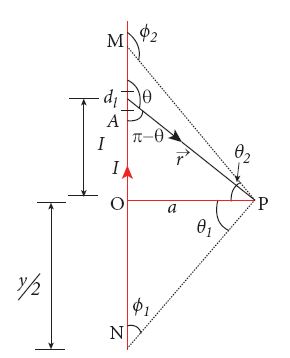
Show that for a straight conductor, the magnetic field
\(\overset { \rightarrow }{ B } =\frac { { \mu }_{ ° }I }{ 4\pi a } (cos\varphi _{ 1 }-cos\varphi _{ 2 })\hat { n } \)
\(=\frac { { \mu }_{ ° }I }{ 4\pi a } (sin{ \theta }_{ 1 }+sin{ \theta }_{ 2 })\hat { n } \)
2.
A particle of charge q moves with velocity\(\vec { v } \) along positive y-direction in a magnetic field \(\vec { B } \) .Compute the Lorentz force experienced by the particle
(a) when magnetic field is along positive y - direction
(b) when magnetic field points in positive z - direction
(c) when magnetic field is in zy - plane and making an angle θ with velocity of the particle. Mark the direction of magnetic force in each case
3.
Compute the magnitude of the magnetic field of a long, straight wire carrying a current of 1 A at distance of 1m from it. Compare it with Earth’s magnetic field.
4.
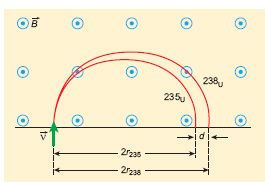
Two singly ionized isotopes of uranium \(_{ 92 }^{ 235 }{ U \ and \ _{ 92 }^{ 238 }{ U } }\) (isotopes have same atomic number but different mass number) are sent with velocity 1.00 x 10⁵ m s–1 into a magnetic field of strength 0.500 T normally. Compute the distance between the two isotopes after they complete a semi-circle. Also, compute the time taken by each isotope to complete one semi-circular path. (Given: masses of the isotopes: m235 = 3.90 x 10⁻²⁵ kg and m238 = 3.95 x 10⁻²⁵ kg)
5.
An electron moving perpendicular to a uniform magnetic field 0.500 T undergoes circular motion of radius 2.50 mm. What is the speed of electron?
1.
In a right angle triangle OPN let the angle \(\angle\)OPN = \(\theta \)1 which implies, \({ \varphi }_{ 1 }=\frac { \pi }{ 2 } -{ \theta }_{ 1 }\) and also in a right angle triangle OPM,
\(\angle\)OPN = \(\theta \)2 which implies, \({ \varphi }_{ 2 }=\frac { \pi }{ 2 } +{ \theta }_{ 2 }\)
Hence,
\(\overset { \rightarrow }{ B } =\frac { { \mu }_{ ° }I }{ 4\pi a } \left( cos\left( \frac { \pi }{ 2 } -{ \theta }_{ 1 } \right) -cos\left( \frac { \pi }{ 2 } +{ \theta }_{ 2 } \right) \right) \hat { n } \)
\(=\frac { { \mu }_{ ° }I }{ 4\pi a } (si{ n }_{ 1 }+{ sin }_{ 2 })\hat { n } \)
2.
Velocity of the particle is \(\vec { v } =v\hat { j } \)
(a) Magnetic field is along positive y-direction, this implies \(\vec B=B\hat { j } \)
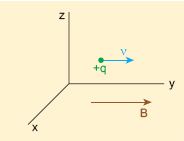
From Lorentz force, \( {\vec F } _{ m }=q(v\hat { j } \times B\hat { j } )=\vec 0\)
So, no force acts on the particle when it moves along the direction of magnetic field.
(b) Since the magnetic field points in positive z - direction, this implies, \(\vec { B } =B\hat { k } \)
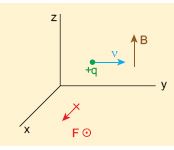
From Lorentz force, \( {\vec F } _{ m }=q(v\hat { j } \times B\hat { k } )=qvB\vec i \)
Therefore, the magnitude of the Lorentz force is qvB and direction is along positive x - direction.
(c) Magnetic field is in zy - plane and making an angle θ with the velocity of the particle, which implies \( {\vec B } =Bcos\theta \hat { j } +Bsin\theta \hat { k } \)
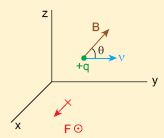
From Lorentz force,
\({ \vec F }_{ m }=q(v\hat { j } )\times (Bcos\theta \hat { j } +Bsin\theta \hat k)\)
\(=qvBsin\theta \hat { i } \)
3.
Given that I = 1 A and radius r = 1 m
Bstraightwire = \(=\frac { { \mu }_{ ° }I }{ 2\pi r } =\frac { 4\pi \times { 10 }^{ -7 }\times 1 }{ 2\pi \times 1 } =2\times { 10 }^{ -7 }T\)
But the Earth’s magnetic field is Bearth \(\sim { 10 }^{ -5 }T\)
So, Bstraightwire is one hundred times smaller than BEarth.
4.
Since isotopes are singly ionized, they have equal charge which is equal to the charge of an electron, q = - 1.6 x 10⁻¹⁹ C. Mass of uranium \(_{ 92 }^{ 235 }{ U and _{ 92 }^{ 238 }{ U } }\) are 3.90 x 10⁻²⁵ kg and 3.95 x 10⁻²⁵ kg respectively. Magnetic field applied, B = 0.500 T. Velocity of the electron is 1.00 x 10⁵ m s-1, then
(a) the radius of the path of \(_{ 92 }^{ 235 }{ U }\) is r235
\({ r }_{ 235 }=\frac { { m }_{ 235 }v }{ \left| q \right| B } =\frac { 3.90\times { 10 }^{ -25 }\times 1.00\times { 10 }^{ 5 } }{ 1.6\times { 10 }^{ -19 }\times 0.500 } =48.8\times { 10 }^{ -2 }m\)
r235 = 48.8cm
The diameter of the semi-circle due to \(_{ 92 }^{ 235 }{ U\ \ is \ \ { d }_{ 235 }=2{ r }_{ 235 } }\) = 97.6 cm
The radius of the path of \(_{ 92 }^{ 238 }{ U\ is\ 2{ r }_{ 238 }\ then}\)
\({ r }_{ 238 }=\frac { { m }_{ 238 }v }{ \left| q \right| B } =\frac { 3.90\times { 10 }^{ -25 }\times 1.00\times { 10 }^{ 5 } }{ 1.6\times { 10 }^{ -19 }\times 0.500 } =49.4\times { 10 }^{ -2 }m\)
r238 = 49.4 cm
The diameter of the semi-circle due to \(^{ 238 }_{92}{ U\ is \ 2{ r }_{ 238 } \ =98.8 \ cm}\)
Therefore the separation distance between the isotopes is \(\triangle d={ d }_{ 238 }-{ d }_{ 235 }=1.2 \ cm\)
(b) The time taken by each isotope to complete one semi-circular path are
\({ t }_{ 235 }=\frac { \text{ magnitude of the displacement} }{ velocity } \)
\(=\frac { 97.6\times { 10 }^{ -2 } }{ 1.00\times { 10 }^{ 5 } } =9.76\times { 10 }^{ -6 }s=9.76\mu s\)
\({ t }_{ 238 }=\frac { \text{magnitude of the displacement }}{ velocity } \)
\(=\frac { 98.8\times { 10 }^{ -2 } }{ 1.00\times { 10 }^{ 5 } } =9.88\times { 10 }^{ -6 }s=9.88\mu s\)
5.
Charge of an electron q = –1.60 × 10⁻¹⁹ C ⇒ |q| = 1 60 x 10-19 C
Magnitude of magnetic field B = 0.500 T
Mass of the electron, m = 9.11 × 10⁻³¹ kg
Radius of the orbit, r = 2.50 mm = 2.50 × 10⁻³ m
Speed of the electron, V = \(q \frac{\mathrm{rB}}{\mathrm{m}}\)
\( v = 1.60 \times 10^{-19} \times\frac{ 2.50 \times 10^{-3} \times 0.500}{9.11 \times 10^{-31}}\)
\(v=2.195 \times 10^8 \mathrm{~m} \mathrm{s} ^{-1}\)

12th Standard Syllabus & Materials
12th Standard
TN 12th Computer Applications களப்பெயர் முறைமை (DNS) Sample Question Papers Study Material - QB365 Set A
NEW12th Standard
TN 12th Computer Applications வலையமைப்பு எடுத்துக்காட்டுகள் மற்றும் நெறிமுறைகள் Sample Question Papers Study Material - QB365 Set A
NEW12th Standard
TN 12th Computer Applications கணினி வலையமைப்பு ஓர் அறிமுகம் Sample Question Papers Study Material - QB365 Set A
NEW12th Standard
TN 12th Computer Applications PHP-உடன் MySQL-ஐ இணைத்தல் Sample Question Papers Study Material - QB365 Set A



Tamilnadu Stateboard 12th Standard Subjects

Maths

Chemistry
Physics

Biology

Computer Science

Business Maths and Statistics

Economics

Commerce

Accountancy

History

Computer Applications
Biology
Computer Technology
Computer Applications
Computer Science
Business Maths and Statistics
Commerce
Economics
Maths
Chemistry
Physics
Computer Technology
History
Accountancy

Tamil

English

French
Tamilnadu Stateboard Standards