
 100% FREE ACCESS
12th Standard Syllabus & Materials
12th Standard
TN 12th Computer Applications மின்னணு தரவு பரிமாற்றம் Sample Question Papers Study Material - QB365 Set A
NEW12th Standard
TN 12th Computer Applications மின் - வணிக பாதுகாப்பு அமைப்புகள் Sample Question Papers Study Material - QB365 Set A
NEW12th Standard
TN 12th Computer Applications மின்னணு செலுத்தல் முறைகள் Sample Question Papers Study Material - QB365 Set A
NEW12th Standard
TN 12th Computer Applications மின் - வணிகம் Sample Question Papers Study Material - QB365 Set A
NEW12th Standard
TN 12th Computer Applications திறந்த மூல கருத்துருக்கள் Sample Question Papers Study Material - QB365 Set A
NEW12th Standard
TN 12th Computer Applications வலையமைப்பு வடமிடல் Sample Question Papers Study Material - QB365 Set A

Published on: 13/05/2022
12th Standard Physics English Medium Electrostatics Important Questions
latest Sample Question PapersDownload Tamil Nadu 12th Standard Physics question papers, model tests, one-mark questions, important questions, and public exam papers in PDF format. Free study materials and answer keys for TN State Board students.
Questions + Answers key
Take MCQ Physics Test
1.
State the elements of Earth's magnetic field.
2.
Why are household appliances connected in parallel?
3.
When does a dielectric said to be polarized?
4.
What is meant by hysteresis?
5.
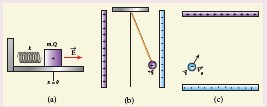
Draw the free body diagram for the following charges as shown in the figure (a), (b) and (c).
6.
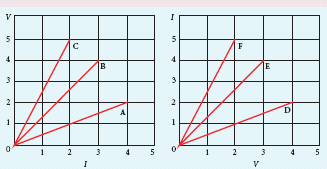
The following graphs represent the current versus voltage and voltage versus current for the six conductors A, B, C, D, E, and F. Which conductor has least resistance and which has maximum resistance?
7.
If the resistance of coil is 3 Ω at 20oC and α = 0.004/oC then determine its resistance at 100oC.
8.
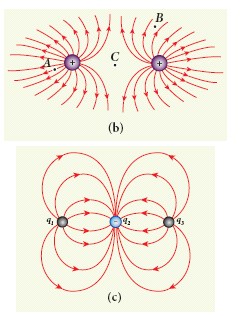
The following pictures depict electric field lines for various charge configurations.
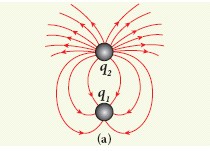
(i) In figure (a) identify the signs of two charges and find the ratio \(\left| \frac { { q }_{ 1 } }{ { q }_{ 2 } } \right| \)
(ii) In figure (b), calculate the ratio of two positive charges and identify the strength of the electric field at three points A, B, and C
(iii) Figure (c) represents the electric field lines for three charges. If q2 = -20 nC, then calculate the values of q1 and q3.
9.
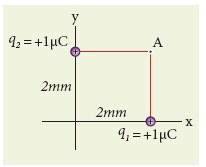
Consider the charge configuration as shown in the figure. Calculate the electric field at point A. If an electron is placed at points A, what is the acceleration experienced by this electron? (mass of the electron = 9.1 x 10⁻³¹ kg and charge of electron = −1.6 x 10⁻¹⁹ C)
10.
State macroscopic form of Ohm’s law.
11.
Drive an expression of Potential energy of a bar magnet in a uniform magnetic field.
12.
The radius of gold nucleus (Z = 79) is about 7 x 10-15 m. Assume that the positive charge is distributed uniformly throughout the nuclear volume. Find the volume charge density.
13.
What charge would be required to electrify a sphere of radius 25 cm. So as to get a surface charge density of \(\frac{3}{\pi}\) cm-1?
14.
Calculate the effect internal resistance in series and parallel.
15.
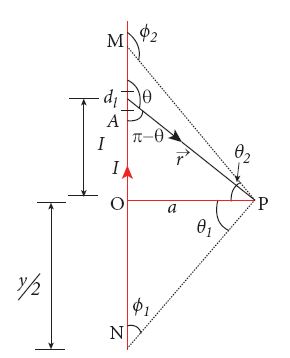
Show that for a straight conductor, the magnetic field
\(\overset { \rightarrow }{ B } =\frac { { \mu }_{ ° }I }{ 4\pi a } (cos\varphi _{ 1 }-cos\varphi _{ 2 })\hat { n } \)
\(=\frac { { \mu }_{ ° }I }{ 4\pi a } (sin{ \theta }_{ 1 }+sin{ \theta }_{ 2 })\hat { n } \)
16.
Consider a point charge +q placed at the origin and another point charge -2q placed at a distance of 9 m from the charge +q. Determine the point between the two charges at which electric potential is zero.
17.
Derive an expression of drift velocity and write the relation between drift velocity and mobility.
18.
Define and derive an expression for the energy density in parallel plate capacitor.
19.
Explain the Lightning arrester or lightning conductor.
20.
Obtain the expression for energy stored in the parallel plate capacitor.
21.
A coil of a tangent galvanometer of diameter 0.24 m has 100 turns. If the horizontal component of Earth’s magnetic field is 25 x 10–6 T then, calculate the current which gives a deflection of 60o .
22.
A parallel plate capacitor filled with mica having εr = 5 is connected to a 10 V battery. The area of the parallel plate is 6 cm2 and separation distance is 6 mm.
(a) Find the capacitance and stored charge.
(b) After the capacitor is fully charged, the battery is disconnected and the dielectric is removed carefully.
Calculate the new values of capacitance, stored energy and charge.
23.
An electron of mass 0.90 x 10⁻³⁰kg under the action of a magnetic field moves in a circle of 2cm radius at a speed of 3 x 10⁶ m/s if a proton of mass 1.8 x 10⁻²⁷ kg was to move in a circle of the same radius in the same magnetic field, then its speed will be _______________.
3.0 x 10⁶ m/s
1.5 x 10³ m/s
6.0 x 10⁴ m/s
cannot be estimated from the same data
24.
When current is doubled deflection is also doubled in ______________.
moving coil galvanometer
tangent galvanometer
both of them
neither of two
25.
The most suitable metal for permanent magnet is ______________.
copper
aluminium
steel
iron
26.
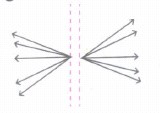
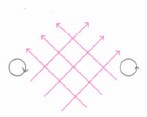
Which one of the following represents current magnetic field lines?
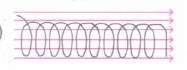
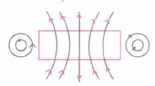
27.
Four wires each of length 2m are bent into four loops P, Q, R, and S, and then suspended into a uniform magnetic field as shown in the figure same current is passed in each loop. On which loop the couple will be the highest?
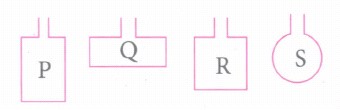
P
Q
R
S
28.
Region around a charge q in which it exerts force on a test charge is called
electric flux intensity
electric force
electric field
Coulomb's force
29.
Which of the following statement on equipotential surface is wrong?
The potential difference between any two points on the surface, is zero.
The electric field is always perpendicular to the surface
Equipotential surface is always spherical.
No work is done in moving a charge along the surface
30.
An electric dipole placed at an angle in a nonuniform electric field experiences
neither a force nor a torque
torque
both force and torque
force only
31.
The capacitance of a parallel plate capacitor increases from 5μf of 50μf when a dielectric is filled between the plates. The permitivity of the dielectric is
8.854 x 10⁻¹² C2N-1 m-2
8.854 x 10⁻¹¹C2N-1 m-2
10 x 10-12C2N-1 m-2
12 x 10-12C2N-1 m-2
32.
In the given cricuit the effective capacitance between A and B will be
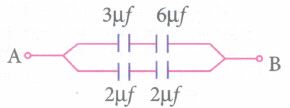
3μf
\(\frac{36}{13}\) μf
13μf
7μf
33.
The dipole is called point dipole when the distance ______________
2a approaches infinity and q approaches zero
2a approaches zero and q approaches infinity
2a approaches zero and q approaches zero
2a approaches infinity and q approaches infinity
34.
A positively charged body 'A' has been brought near a brass cylinder 'B' mounted on a glass stand as shown in the figure. The potential of 'B' will be
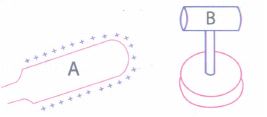
zero
Negative
positive
Infinite
35.
Which one of these is a vector quantity?
Electric charge
Electric field
Electric flux
Electric potential
36.
An isolated metal sphere of radius 'r' is given a charge' q'. The potential energy of the sphere is ____________
\(\frac { { q }^{ 2 } }{ 4\pi { \varepsilon }_{ 0 }r } \)
\(\frac { { q }^{ } }{ 4\pi { \varepsilon }_{ 0 }r } \)
\(\frac { { q }^{ } }{ 8\pi { \varepsilon }_{ 0 }r } \)
\(\frac { { q }^{ 2 } }{ 8\pi { \varepsilon }_{ 0 }r } \)
37.
The figure shows tow parallel equipotential surface A and B kept at a small distance 'r' a part from each other. A point change of Q coulomb is taken from the surface A to B. The amount of net work done will be
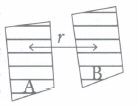
\(W=\frac { -1 }{ 4\pi { \varepsilon }_{ 0 }r } \frac { q }{ r } \)
\(W=\frac { 1 }{ 4\pi { \varepsilon }_{ 0 }r } \frac { q }{ r } \)
\(W=\frac { -1 }{ 4\pi { \varepsilon }_{ 0 }r } \frac { q }{ r^2 } \)
zero
38.
The value of constant 'K' in coulomb law is _____________.
0.9 x 10⁹ Nm2 C2
9 x 10⁻⁹ Nm2C2
9 x 10⁹ Nm-2 C-2
9 x 10⁹ Nm2 C-2
39.
The electrostatic force obeys _______.
Newton's I law
Newton's II law
Newton's III law
none of the above
40.
The BH curve for a ferromagnetic material is shown in the figure. The material is placed inside a long solenoid which contains 1000 turns/cm. The current that should be passed in the solenoid to demagnetize the ferromagnet completely is _____.
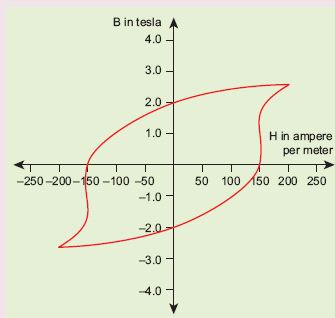
1.00 m A
1.25 mA
1.50 mA
1.75 mA
41.
A wire of length l carrying a current I along the Y direction is kept in a magnetic field is given by \(\vec { B } =\frac { \beta }{ \sqrt { 3 } } =(\hat { i } +\hat { j } +\hat { k } )T.\) The magnitude of Lorentz force acting on the wire is _____.
\(\sqrt { \frac { 2 }{ { 3 } } } \beta Il\)
\(\sqrt { \frac { 1 }{ { 3 } } } \beta Il\)
\(\sqrt { 2 } \beta Il\)
\(\sqrt { \frac { 1 }{ 2 } } \beta Il\)
42.
A thin insulated wire forms a plane spiral of N = 100 tight turns carrying a current I = 8 m A (milli ampere). The radii of inside and outside turns are a = 50 mm and b = 100 mm respectively. The magnetic induction at the centre of the spiral is ______.
\(5\mu T\)
\(7\mu T\)
\(8\mu T\)
\(10\mu T\)
43.
An electron moves in a straight line inside a charged parallel plate capacitor of uniform charge density σ. The time taken by the electron to cross the parallel plate capacitor undeflected when the plates of the capacitor are kept under constant magnetic field of induction \((\vec{B})\) is
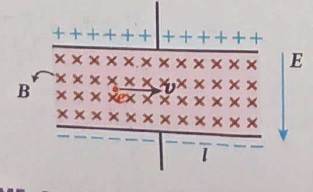
\({ \varepsilon }_{ ° }\frac { elB }{ \sigma } \)
\({ \varepsilon }_{ ° }\frac { lB }{ \sigma {l} } \)
\({ \varepsilon }_{ ° }\frac { lB }{ {e}\sigma } \)
\({ \varepsilon }_{ ° }\frac { lB }{ \sigma } \)
44.
Three capacitors are connected in triangle as shown in the figure. The equivalent capacitance between the points A and C is
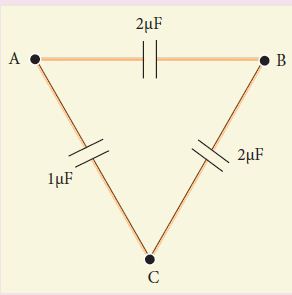
1μF
2μF
3μF
\(\frac{1}{4}\)μF
45.
An electric field \(\vec { E } =10x\hat { i } \) exists in a certain region of space. Then the potential difference V = Vo – VA, where Vo is the potential at the origin and VA is the potential at x = 2 m is _____.
10 V
-20 V
+20 V
-10 V
46.
Two identical conducting balls having positive charges q1 and q2 are separated by a centre to centre distance r. If they are made to touch each other and then separated to the same distance, the force between them will be _____.
less than before
same as before
more than before
zero
47.
Two identical point charges of magnitude –q are fixed as shown in the figure below. A third charge +q is placed midway between the two charges at the point P. Suppose this charge +q is displaced a small distance from the point P in the directions indicated by the arrows, in which direction(s) will +q be stable with respect to the displacement?
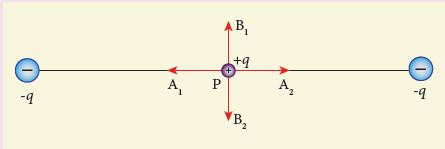
A1 and A2
B1 and B2
both directions
No stable
48.
Find the odd one out.
(a) MRI scan
(b) head phones
(c) Hard disc of laptop
(d) Capacitor
49.
Find the odd one out.
(a) Electric current
(b) Pole strength
(c) Magnetic flux
(d) Magnetic dipole moment
50.
(a) Electric dipole moment
(b) Electric field intensity
(c) Electric potential difference
(d) Electrostatic shielding
51.
Which one is incorrect pair?
| (a) | Magnetic sensing of birds | - | Cryptochromes protein (Cry4) |
| (b) | Aurora borealis | - | Southern hemisphere |
| (c) | Pole strength | - | newton per tesla |
| (d) | Super conductors | - | diamagnetic materials |
52.
| a. | Kirchhoff's I law | - | conservation of energy |
|---|---|---|---|
| b. | Ohm's law | - | resistance |
| c. | Kirchhoff's IIlaw | - | voltage law |
| d. | Joule's law | heating effect current |
Which one is incorrect pair?
53.
| a) | Franklin | - | +ve, -ve charges |
| b) | Gauss | - | electrical battery |
| c) | Van de graaff | - | high potential |
| d) | Faraday | - | Unit of capacitance |
54.
Assertion: If two ends of a solenoid are bent and together to form a closed ring shape, it is called as toroid
Reason: Magnetic field due to a long current-carrying solenoid is m
B=\(\frac { \mu NI }{ L } \) =μnI (where, n=\(\frac { N }{ L } \))
Codes:
(a) Assertion and Reason are correct and Reason is the correct explanation of Assertion.
(b) Assertion and Reason are true but Reason is the false explanation of the Assertion.
(c) Assertion is true but Reason is false.
(d) Assertion is false but Reason is true
55.
Assertion : A galvanometer can be converted into a voltmeter by connecting hight resistance (Rh) in series with the galvanometer.
Reason : The high resistance, Rh = \(\frac { V }{ { I }_{ g } } \)-Rg
Codes:
where, Ig ⟶ current through galvanometer
Rg ⟶ Resistance of the galvanometer
(a) Assertion and Reason are correct and Reason is the correct explanation of Assertion.
(b) Assertion and Reason are true but Reason is the false explanation of the Assertion.
(c) Assertion is true but Reason is false.
(d) Assertion is false but Reason is true.
56.
Assertion: Kirchoff's voltage rule can be expressed as \({ \varepsilon }_{ 1 }+{ \varepsilon }_{ 2 }+{ \varepsilon }_{ 3 }+...{ \varepsilon }_{ n }={ I }_{ 1 }{ R }_{ 1 }+{ I }_{ 2 }{ R }_{ 2 }+...{ I }_{ n }{ R }_{ n }\)
Reason: For the given diagrams
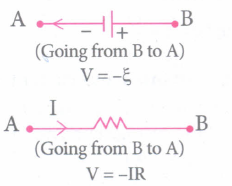
Codes:
(a) Assertion and Reason are correct and Reason is the correct explanation of Assertion.
(b) Assertion and Reason are true but Reason is the false explanation of the Assertion.
(c) Assertion is true but Reason is False.
(d) Assertion is false but Reason is True
1.
There are three quantities required to specify the magnetic field of the earth on its surface, which are often called as the elements of the earth's magnetic field. they are
(a) Magnetic declination (D)
(b) Magnetic dip or inclination (I)
(c) the horizontal component of the Earth's magnetic field (BH)
2.
House hold appliances are always connected in parallel so that even if one is switched off, the other devices could function properly.
3.
When an external electric field is applied, the centers of positive and negative charges are separated by a small distance which induces dipole moment in the direction of the external electric field. Then the dielectric is said to be polarized by an external electric field.
4.
Hysteresis is the phenomenon of lagging of magnetic induction behind the magnetising field.
5.
(a) In the figure
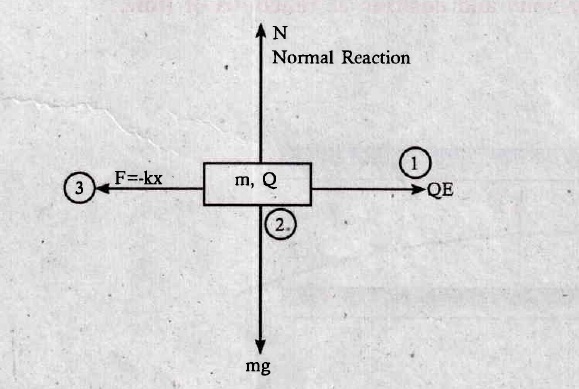
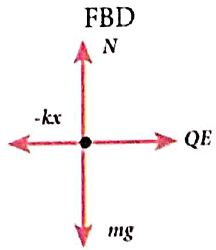
1 - Electrostatic force Fe = QE
2 - Weight W = mg
3 - Elastic force F = -kx
4 - Upward force = Normal reaction = N
b) In this figure
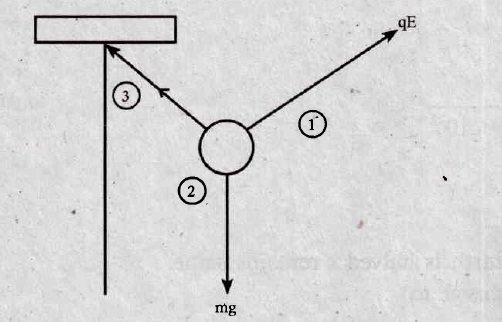
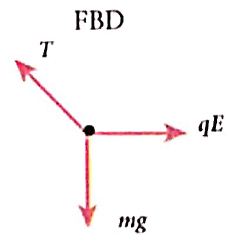
1- Electrostatic force F = qE
2 - Weight W = mg
3 - Tension acting along the string is T
(c) The charge is attracted towards the positively charged plate because it is a negative charge.
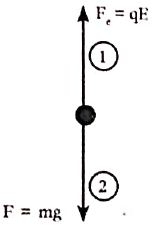
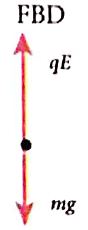
1 - Force = qE
2 - Downward force F = mg
6.
Resistance of the conductor, \(\mathrm{R}=\frac{\mathrm{V}}{\mathrm{I}}\)
From Graph - I,
Resistance of the conductor A is, \(\mathrm{R}_{\mathrm{A}}=\frac{\mathrm{V}}{\mathrm{I}}=\frac{2}{4}=0.5 \Omega\)
Resistance of the conductor B is, \(\mathrm{R}_{\mathrm{B}}=\frac{\mathrm{V}}{\mathrm{I}}=\frac{4}{3}=1.33 \Omega\)
Resistance of the conductor C is, \(\mathrm{R}_{\mathrm{c}}=\frac{\mathrm{V}}{\mathrm{I}}=\frac{5}{2}=2.5 \Omega\)
From Graph - II,
Resistance of the conductor D is, \(\mathrm{R}_{\mathrm{D}}=\frac{\mathrm{V}}{\mathrm{I}}=\frac{4}{2}=2 \Omega\)
Resistance of the conductor E is, \(\mathrm{R}_{\mathrm{E}}=\frac{\mathrm{V}}{\mathrm{I}}=\frac{3}{4}=0.75 \Omega\)
Resistance of the conductor F is, \(\mathrm{R}_{\mathrm{F}}=\frac{\mathrm{V}}{\mathrm{I}}=\frac{2}{5}=0.4 \Omega\)
The conductor F has least resistance, \(R_F=\mathbf{0. 4} \Omega\)
The conductor C has maximum resistance, \(\mathbf{R}_{\mathrm{c}}=2.5 \Omega\)
7.
R0 = 3 Ω, T = 100oC, T0 = 20oC
α = 0.004/oC, RT = ?
RT = R0(1 + α(T - T0))
R100 = 3(1 + 0.004 x 80)
R100 = 3.96 Ω
8.
(i) The electric field lines start at q2 and end at q1. In figure (a), q2 is positive and q1 is negative. The number of lines starting from q2 is 18 and number of the lines ending at q1 is 6. So q2 has greater magnitude. The ratio of \(\left| \frac { { q }_{ 1 } }{ { q }_{ 2 } } \right| =\frac { { N }_{ 1 } }{ { N }_{ 2 } } =\frac { 6 }{ 18 } =\frac { 1 }{ 3 } \). It implies that |q2| = 3|q1|.
(ii) In figure (b), the number of field lines emanating from both positive charges are equal (N = 18). So the charges are equal. At point A, the electric field lines are denser compared to the lines at point B. So the electric field at point A is greater in magnitude compared to the field at point B. Further, no electric field line passes through C, which implies that the resultant electric field at C due to these two charges is zero.
(iii) In the figure (c), the electric field lines start at q1 and q3 and end at q2. This implies that q1 and q3 are positive charges. The ratio of the number of field lines is \(\left| \frac { { q }_{ 1 } }{ { q }_{ 2 } } \right| =\frac { 8 }{ 16 } =\left| \frac { { q }_{ 3 } }{ { q }_{ 2 } } \right| =\frac { 1 }{ 2 } \), implying that q1 and q3 are half of the magnitude of q2. So q1 = q3 = +10 nc.
9.
By using superposition principle, the net electric field at point A is
\(\vec { E_{ A } } =\frac { 1 }{ 4\pi { \varepsilon }_{ 0 } } \frac { { q }_{ 1 } }{ { r }_{ 1A }^{ 2 } } \hat { { r }_{ 1A } } +\frac { 1 }{ 4\pi { \varepsilon }_{ 0 } } \frac { { q }_{ 1 } }{ { r }_{ 2A }^{ 2 } } \hat { { r }_{ 2A } } \)
where r1A and r2A are the distances of point A from the two charges respectively
\(\vec { E_{ A } } =\frac { 9\times 10^{ 4 }\times 1\times { 10 }^{ -6 } }{ (2\times { 10 }^{ -3 })^{ 2 } } (\hat { j } )+\frac { 9\times 10^{ 9 }\times 1\times { 10 }^{ -6 } }{ (2\times 10^{ -3 })^{ 2 } } (\hat { i } )\)\(\)
= 2.25 x 10⁹\(\hat { j } \) + 2.25 x 10⁹\(\hat { i } \) = 2.25 x 10⁹ (\((\hat { i } +\hat { j } )\)
The magnitude of electric field
\(|\vec { { E }_{ A } } |=\sqrt { (2.25\times { 10 }^{ 9 })^{ 2 }+(2.25\times 10^{ 9 })^{ 2 } } \)
= 2.25 x \(\sqrt { 2 } \) x 109 NC-1
The direction of \(\vec { { E }_{ A } } \) is given by \(\frac { \vec { { E }_{ A } } }{ |\vec { { E }_{ A } } | } =\frac { 2.25\times 10^{ 9 }(\hat { i } +\hat { j } ) }{ 2.25\times \sqrt { 2 } \times { 10 }^{ 9 } } =\frac { (\hat { i } +\hat { j } ) }{ \sqrt { 2 } } \), which is the unit vector along OA as shown in the figure.
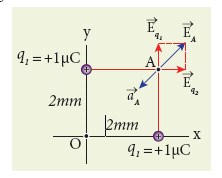
The acceleration experienced by an electron placed at point A is
\(\vec { a_{ A } } =\frac { \vec { F } }{ m } =\frac { q\vec { { E }_{ A } } }{ m } \)
=\(\frac { (-1.6\times 10^{ -19 })\times (2.25\times 10^{ 9 })(\hat { i } +\hat { j } ) }{ 9.1\times { 10 }^{ -31 } } \)
= -3.95 x 10²⁰ \((\hat { i } +\hat { j } )\)Nkg-1
The electron is accelerated in a direction exactly opposite to \(\vec { { E }_{ A } } \).
10.
Macroscopic form of Ohm's law is V = IR
Where V - Potential difference
I - current
R - resistance of a conductor.
11.
When a bar magnet (magnetic dipole) of dipole moment \(\vec { { p }_{ m } } \) is held at an angle θ with the direction of a uniform magnetic field \(\vec { { B } } \), as shown in Figure the magnitude of the torque acting on the dipole is
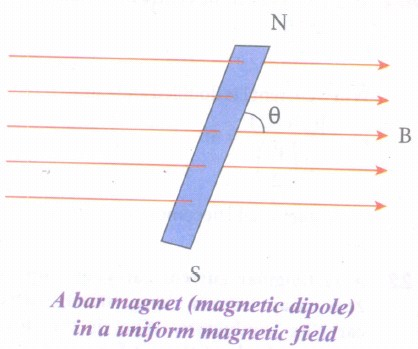
\(|\vec { \tau _{ B } } |=|\vec { { p }_{ m } } ||\vec { B } |sin\theta \)
If the dipole is rotated through a very small angular displacement dθ against the torque ፒB at constant angular velocity, then the work done by external torque \((\vec { { \tau }_{ ext } } )\) for this small angular displacement is given by
dW = \(|\vec { { { \tau }_{ ext } } } |\) dθ
Since the bar magnet to be moved at constant angular velocity, it implies \(|\vec { { \tau }_{ B } } |=|\vec { \tau _{ ext } } |\)
dW = PmB sinθ dθ
Total work done in rotating the dipole from θ' to θ is
W =\(\int _{ \theta ' }^{ \theta }{ \tau d\theta } =\int _{ \theta ' }^{ \theta }{ p_{ m } } Bsin\theta d\theta ={ p }_{ m }B[-cos\theta d\theta ]_{ \theta ' }^{ \theta }\)
W = pmB(cosθ - cosθ')
This work done is stored as potential energy in bar magnet at an angle θ when it is rotated from θ' to θ and it can be written as
U = pmB(cosθ - cosθ') .........(1)
In fact, equation (1) gives the difference in potential energy between the angular positions θ' and θ. We can choose the reference point θ' = 90°, so that second term in the equation becomes zero and the equation (1) can be written as
U = -pmB(cosθ) ............(2)
The potential energy stored in a bar magnet in a uniform magnetic field is given by
U = -\(\vec { { p }_{ m } } .\vec { B } \) ............(3)
Case 1
(i) If θ = 0°, then
U = PmB (cos00) = - PmB
(ii) If θ = 180°, then
U = PmB (cos 180°) = pmB
We can infer from the above two results, the potential energy of the bar magnet is minimum when it is aligned along the external magnetic field and maximum when the bar magnet is aligned anti-parallel to an external magnetic field.
12.
The total positive charge in the nucleus is,
q = +ze = 79 x 1.6 x 10-19C.
Volume charge density, \(\sigma =\frac { q }{ \frac { 4 }{ 3 } \times \pi { R }^{ 3 } } \)
\(s=\frac { q }{ \frac { 4 }{ 3 } \times 3.14\times (7.5\times { 10 }^{ -15 }{ ) }^{ 3 } } \)
= 0.088 x 1026
= 8.8 x 1024 Cm-3
13.
r = 25cm = 25 x 10-2m
\(\sigma =\frac { 3 }{ \pi } { cm }^{ -2 }\)
\(AS,\quad \sigma =\frac { q }{ A } =\frac { q }{ 4\pi { r }^{ 2 } } \) [A - surface Area of the sphere]
\(q=(4\pi { r }^{ 2 })\sigma \)
\(=4\pi (0.25{ ) }^{ 2 }\times \frac { 3 }{ \pi } \)
= 0.75C.
14.
(i) Suppose n cells, each of emf volts and internal resistance r ohms are connected in series with an external resistance R as shown in Figure
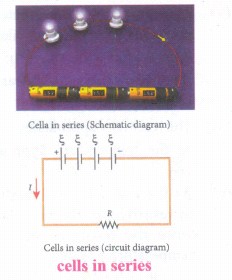
(ii) The total emf of the battery = nr
The total resistance in the circuit = nr + R
By Ohm's law, the current in the circuit is
\(I=\cfrac { total\ emf }{ total\ resistance } =\cfrac { n\xi }{ nr+5 } \)
Case (a) If r << R, then
\(I=\cfrac { n\xi }{ R } ={ nl }_{ 1 }\)
where II is the current due to a single cell
\(\left( { I }_{ 1 }=\cfrac { \xi }{ R } \right) \)
(iii) Thus, if r is negligible when compared to R the current supplied by the battery is n times that supplied by a single cell
Case (b) If >> R, \(I=\cfrac { n\xi }{ nr } =\cfrac { \xi }{ r } \)
(iv) It is the current due to a single cell. That is, current due to the whole battery is the same as that due to a single cell and hence there is no advantage in connecting several cells.
(v) Thus series connection of cells is advantageous only when the effective internal resistance of the cells is negligibly small compared with R. Cells in parallel
(i) In parallel connection all the positive terminals of the cells are connected to one point and all the negative terminals to a second point. These two points form the positive and negative terminals of the battery.
(ii) Let n cells be connected in parallel between the points A and B and a resistance R is connected between the points A and B as shown in Figure. Let be the emf and r the internal resistance of each cell.
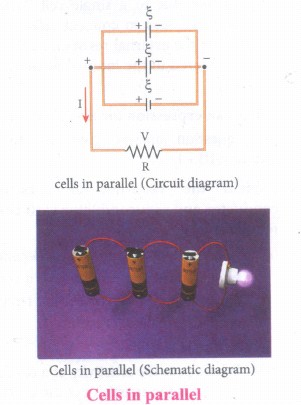
(iii) The equivalent internal resistance of the battery is \(\cfrac { 1 }{ { { r }_{ eq } } } =\cfrac { 1 }{ r } +\cfrac { 1 }{ r } +...\cfrac { 1 }{ r } (netrms)=\cfrac { n }{ r } \)
So \(\cfrac { 1 }{ { r }_{ eq } } =\cfrac { r }{ n } \) and the total resistance in the circuit = \(R+\cfrac { r }{ n } \) The total emf is the potential difference between the points A and B, which is equal to \(\xi \) The current in the circuit is given by
\(I=\cfrac { \xi }{ \frac { r }{ n } +R } \)
\(I=\cfrac { n\xi }{ r+nR } \)
Case (a) If >> R,\(I=\cfrac { n\xi }{ r } ={ nl }_{ 1 }\)
Case (b) If < \(I=\cfrac { \xi }{ R } \)
where II is the current due to a single cell and is equal to \(\cfrac { \xi }{ r } \) when R is negligible. Thus, the current through the external resistance due to the whole battery is n times the current due to a single cell.
15.
In a right angle triangle OPN let the angle \(\angle\)OPN = \(\theta \)1 which implies, \({ \varphi }_{ 1 }=\frac { \pi }{ 2 } -{ \theta }_{ 1 }\) and also in a right angle triangle OPM,
\(\angle\)OPN = \(\theta \)2 which implies, \({ \varphi }_{ 2 }=\frac { \pi }{ 2 } +{ \theta }_{ 2 }\)
Hence,
\(\overset { \rightarrow }{ B } =\frac { { \mu }_{ ° }I }{ 4\pi a } \left( cos\left( \frac { \pi }{ 2 } -{ \theta }_{ 1 } \right) -cos\left( \frac { \pi }{ 2 } +{ \theta }_{ 2 } \right) \right) \hat { n } \)
\(=\frac { { \mu }_{ ° }I }{ 4\pi a } (si{ n }_{ 1 }+{ sin }_{ 2 })\hat { n } \)
16.
According to the superposition principle, the total electric potential at a point is equal to the sum of the potentials due to each charge at that point.
Consider the point at which the total potential zero is located at a distance x from the charge +q as shown in the figure.
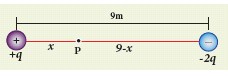
The total electric potential at P is zero.
Vtot = \(\frac { 1 }{ 4\pi { \varepsilon }_{ 0 } } \left( \frac { q }{ x } -\frac { 2q }{ (9-x) } \right) \)=0
Which gives \(\frac { q }{ x } -\frac { 2q }{ (9-x) } \)
or \(\frac { 1 }{ x } =\frac { 2 }{ (9-x) } \)
Hence, x = 3m
17.
The drift velocity is the average velocity acquired by the electrons inside the conductor when it is subjected to an electric field. The average time between successive collisions is called the mean free time denoted by \(\tau \). The acceleration \(\vec { a } \) experienced by the electron in an electric field \(\vec { E } \) is given by
\(\vec { a } =\cfrac { -e\vec { E } }{ m } \left( since\vec { F } =-e\vec { E } \right) \)
The drift velocity is given by
\({ \vec { V } }_{ d }=\vec { a } \tau \)
\({ \vec { V } }_{ d }=\cfrac { e\tau }{ m } \vec { E } \)
\({ \vec { V } }_{ d }=-\mu \vec { E } \)
Here \(\mu =\cfrac { e\tau }{ m } \) is the mobility of the electron and it is defined as the magnitude of the drift velocity per unit electric field \(\mu =\cfrac { \left| { \vec { v } }_{ d } \right| }{ \left| \vec { E } \right| } \)
18.
Energy stored in the capacitor
\(U=\frac { 1 }{ 2 } { Cv }^{ 2 }\quad \quad ...(1)\)
This is rewritten as using \(C=\frac { { \varepsilon }_{ 0 }A }{ d } \& Ed=V\)
\(U=\frac { 1 }{ 2 } \left( \frac { { \varepsilon }_{ 0 }A }{ d } \right) { (Ed })^{ 2 }=\frac { 1 }{ 2 } { \varepsilon }_{ 0 }(Ad)\quad { E }^{ 2 }...(2)\)
where Ad = volume of the space between the capacitor plates. The energy stored per unit volume of space is defined as energy density \({ U }_{ E }=\frac { U }{ Volume } \) From equation (4),
We get
\({ u }_{ E }=\frac { 1 }{ 2 } { \varepsilon }_{ 0 }{ E }^{ 2 }\quad \quad \quad \quad \quad ...(3)\)
(iv) The energy density depends only on the electric field and not on the size of the plates of the capacitor.
19.
(i) This device consists of a long thick copper rod passing from top of the building to the ground. The upper end of the rod has a sharp spike or a sharp needle as shown in Figure 1.64 (a) and (b).
(ii) The lower end of the rod is connected to the copper plate which is buried deep into the ground. When a negatively charged cloud is passing above the building, it induces a positive charge on the spike.
(iii) Since the induced charge density on thin sharp spike is large, it results in a corona discharge.
(iv) This positive charge ionizes the surrounding air which in turn neutralizes the negative charge in the cloud.
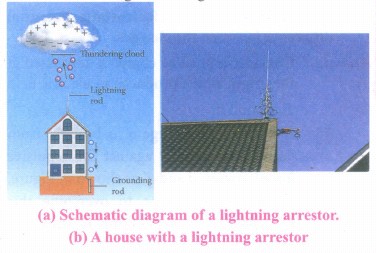
(v) The negative charge pushed to the spikes passes through the copper rod and is safely diverted to the earth.
(vi) The lightning arrester does not stop the lightning; rather it diverts the lightning to the ground safely.
20.
Energy stored in the capacitor
i) Capacitor not only stores the charge but also it stores energy. When a battery is connected to the capacitor, electrons of total charge - Q are transferred from one plate to the other plate. To transfer the charge, work is done by the battery. This work done is stored as electrostatic potential energy in the capacitor.
ii) To transfer an infinitesimal charge dQ for a potential difference V, the work done is given by
dW = V dQ
Where \(V=\frac { Q }{ C } \) .....(1)
iii) The total work done to charge a capacitor is
\(W=\int _{ 0 }^{ Q }{ \frac { Q }{ C } } dQ=\frac { { Q }^{ 2 } }{ 2C } \quad \quad ....(2)\)
This work done is stored as electrostatic potential energy (UE) in the capacitor.
\({ U }_{ E }=\frac { { Q }^{ 2 } }{ 2C } =\frac { 1 }{ 2 } { CV }^{ 2 },\quad (\therefore Q=CV)\quad ....(3)\)
(iv) This stored energy is thus directly proportional to the capacitance of the capacitor and the square of the voltage between the plates of the capacitor.Substituting \(C=\frac { { \varepsilon }_{ 0 }A }{ d } \) and V = Ed.
\(U=\frac { 1 }{ 2 } \left( \frac { { \varepsilon }_{ 0 }A }{ d } \right) { (Ed) }^{ 2 }=\frac { 1 }{ 2 } { \varepsilon }_{ 0 }(Ad){ E }^{ 2 }\quad \quad \quad \quad \quad ...(4)\)
where Ad = volume of the space between the capacitor plates. The energy stored per unit volume of space is defined as energy density \({ u }_{ E }=\frac { U }{ Volume } \)
Equation (4) ⇒ \({ u }_{ E }=\frac{1}{2}{ \varepsilon }_{ 0 }{ E }^{ 2 }\).....(5)
(v) From equation (5),
(a) We infer that the energy is stored in the electric field existing between the plates of the capacitor. Once the capacitor is allowed to discharge, the energy is retrieved.
(b) The energy density depends only on the electric field and not on the size of the plates of the capacitor.
(c) This is true for the electric field due to any type of charge configuration.
21.
The diameter of the coil is 0.24 m. Therefore, radius of the coil is 0.12 m.
Number of turns is 100 turns. Earth’s magnetic field is 25 x 10-6 T
Deflection is
\(\theta =60°\Rightarrow tan60°=\sqrt { 3 } =1.732\)
\(I=\frac { 2R{ B }_{ H } }{ { \mu }_{ ° }N } tan\theta \)
\(=\frac { 2\times 0.12\times 25\times 1{ 0 }^{ -6 } }{ 4\times 1{ 0 }^{ -7 }\times 3.14\times 100 } \times 1.732=0.82\times 1{ 0 }^{ -1 }A\)
I = 0.082 A
22.
(a) The capacitance of the capacitor in the presence of dielectric is
C = \(\frac { { \varepsilon }_{ r }{ \varepsilon }_{ 0 }A }{ d } =\frac { 5\times 8.85\times 10^{ -12 }\times 6 \times 10^{-4}}{ 6\times 10^{ -3 } } \)
= 44.25 x 10⁻¹³F = 4.425 pF
The stored charge is
Q = CV = 44.25 x 10-13 x 10
= 442.5 x 10⁻¹³C = 44.25pC
The stored energy is
\(U=\frac { 1 }{ 2 } \) CV2 = \(\frac { 1 }{ 2 } \) x 44.25 x 10-13 x 100
= 2.21 x 10⁻¹⁰ J
(b) After the removal of the dielectric, since the battery is already disconnected the total charge will not change. But the potential difference between the plates increases. As a result, the capacitance is decreased.
New capacitance is
C0=\(\frac { C }{ { \varepsilon }_{ r } } =\frac { 44.25\times 10^{ -12 } }{ 5 } \)
= 0.885 x 10⁻¹² F = 0.885 pF
The stored charge remains same and 44.25 pC. Hence newly stored energy is
U0 =\(\frac { { Q }^{ 2 } }{ 2{ C }_{ 0 } } =\frac { { Q }^{ 2 }{ \varepsilon }_{ r } }{ 2C } =\varepsilon _{ r }U\)
= 5 x 2.21 x 10-10J = 11.05 x 10⁻¹⁰J
The increased energy is ΔU = (11.05 - 2.21) x 10-10 J = 8.84 x 10⁻¹⁰ J
When the dielectric is removed, it experiences an inward pulling force due to the plates. To remove the dielectric, an external agency has to do work on the dielectric which is stored as additional energy. This is the source for the extra energy 8.84 x 10⁻¹⁰ J.
23.
(b)
1.5 x 10³ m/s
24.
(a)
moving coil galvanometer
25.
(c)
steel
26.
(d)
27.
(d)
S
28.
(c)
electric field
29.
(a)
The potential difference between any two points on the surface, is zero.
30.
(c)
both force and torque
31.
(b)
8.854 x 10⁻¹¹C2N-1 m-2
32.
(a)
3μf
33.
(b)
2a approaches zero and q approaches infinity
34.
(c)
positive
35.
(b)
Electric field
36.
(a)
\(\frac { { q }^{ 2 } }{ 4\pi { \varepsilon }_{ 0 }r } \)
37.
(d)
zero
38.
(d)
9 x 10⁹ Nm2 C-2
39.
(b)
Newton's II law
40.
(c)
1.50 mA
41.
\(\vec { B } =\frac { \beta }{ \sqrt { 3 } } =(\hat { i } +\hat { j } +\hat { k } )T\)
Using an equation,
Lorentz force, \(\vec{F}=Il\hat{j}\times\vec B\)
We can get,
Lorentz force \(F=\sqrt { \frac { 2 }{ { 3 } } } \beta Il\)
42.
(b)
\(7\mu T\)
43.
Electric field between the plates \(= \frac{σ}{ε_0}\)
Electric force on an electron \(= e\frac{σ}{ε_0}\)
Magnetic force on an electron, F = BIl
But, \(I= \frac{e}{t}\)
∵Electron moves in a straight line. So,
EF = MF
\(e\frac{σ}{ε_0}=B(\frac{e}{t})l\)
\(\therefore t = ε_0\frac{lB}{σ}\)
44.
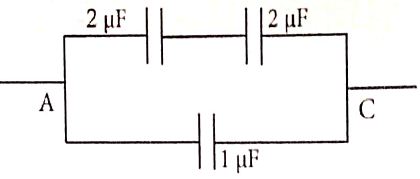
\(\frac{1}{C_s}=\frac{1}{2}+\frac{1}{2}=1 \ μF\)
Cp = 1 + 1 = 2 μF
45.
\(\vec {E}\) = 10x\(\hat{i},\) when x = 2 m
\(\vec {E}\) = 10 x 2 x \(\hat{i}\) = 20\(\hat{i}\)
Since, \(E=\frac{-dV}{dx}\therefore V=+20 V\)
46.
Force ∝ charge
After the separation, the magnitude of charge will be increased. So the force will be more than before.
47.
The charge + q will be stable between B1 and B2 with respect to the displacement.
48.
Capacitor
49.
Magnetic dipole moment
50.
(d) Electrostatic shielding
51.
Aurora borealis - Southern hemisphere
52.
Kirchhoff's I law - conservation of energy
53.
b) Gauss - electrical battery
54.
(b) Assertion and Reason are true but Reason is the false explanation of the Assertion.
55.
(a) Assertion and Reason are correct and Reason is the correct explanation of Assertion.
56.
(a) Assertion and, Reason are correct and Reason is the correct explanation of Assertion.

12th Standard Syllabus & Materials
12th Standard
TN 12th Computer Applications களப்பெயர் முறைமை (DNS) Sample Question Papers Study Material - QB365 Set A
NEW12th Standard
TN 12th Computer Applications வலையமைப்பு எடுத்துக்காட்டுகள் மற்றும் நெறிமுறைகள் Sample Question Papers Study Material - QB365 Set A
NEW12th Standard
TN 12th Computer Applications கணினி வலையமைப்பு ஓர் அறிமுகம் Sample Question Papers Study Material - QB365 Set A
NEW12th Standard
TN 12th Computer Applications PHP-உடன் MySQL-ஐ இணைத்தல் Sample Question Papers Study Material - QB365 Set A



Tamilnadu Stateboard 12th Standard Subjects

Maths

Chemistry
Physics

Biology

Computer Science

Business Maths and Statistics

Economics

Commerce

Accountancy

History

Computer Applications
Biology
Computer Technology
Computer Applications
Computer Science
Business Maths and Statistics
Commerce
Economics
Maths
Chemistry
Physics
Computer Technology
History
Accountancy

Tamil

English

French
Tamilnadu Stateboard Standards


