12th Standard CBSE Syllabus & Materials
12th Standard CBSE
CBSE 12th Biology Sexual Reproduction in Flowering Plants Important Questions And Answers Study Material - QB365 Set B
NEW12th Standard CBSE
CBSE 12th Biology Sexual Reproduction in Flowering Plants Important Questions And Answers Study Material - QB365 Set A
NEW12th Standard CBSE
CBSE 12th Biology Sexual Reproduction in Flowering Plants Assertion and Reason Study Material - QB365 Set D
NEW12th Standard CBSE
CBSE 12th Biology Sexual Reproduction in Flowering Plants Assertion and Reason Study Material - QB365 Set C
NEW12th Standard CBSE
CBSE 12th Biology Sexual Reproduction in Flowering Plants Assertion and Reason Study Material - QB365 Set B
NEW12th Standard CBSE
CBSE 12th Biology Sexual Reproduction in Flowering Plants Assertion and Reason Study Material - QB365 Set A

Published on: 28/11/2025
Download CBSE Class 12th Standard CBSE Biology question papers, sample papers, important questions, and previous year solved papers in PDF format. Get free study materials, NCERT solutions, and exam preparation resources for Class 12th Standard CBSE Biology
Questions + Answers key
Take MCQ Biology Test
1.
Justify with the help of an example where a deliberate attempt by humans has led to the extinction of a particular species.
2.
Can you think of a situation where we deliberately want to make a species extinct? How would you justify it?
3.
What is Ramsar convention? How was it called previously?
4.
Why are the conventional methods not suitable for the assessment of biodiversity of bacteria?
5.
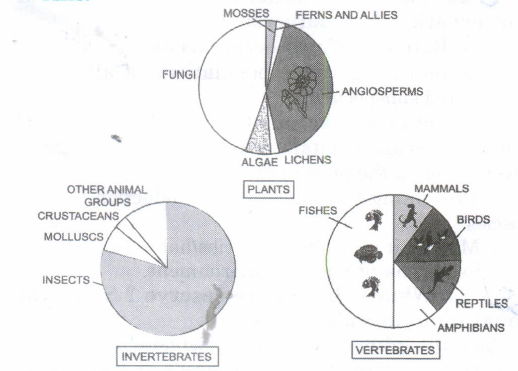
Decipt with the help of sample sketches the representation of global biodiversity of major taxa of plants, invertebrates and vertebrates.
6.
Name a few pollutants added to air by nature.
7.
Match the items given in column I with items (one or more) given in column II.
| Column I | Column II |
| (i) Biodegradable pollutants | (a) D,D.T. |
| (ii) Non-biodegradble pollutants | (b) PAN |
| (iii) Secondary pollutants | (c) Low temperature |
| (iv) Photochemical smog | (d) Organic wastes (Sewage) |
| (v) Classical smog | (e) High temperature |
| (f) Ozon | |
| (g) Cadmium |
8.
Explain briefly the 'rivet popper hypothesis' of Paul Ehrlich.
9.
Explain effects of habitat fragmentation on biodiversity.
10.
In 1984, the Bhopal gas tragedy took place because methyl isocyanate
Reacted with ammonia
Reacted with CO2
Reacted with water
Reacted with DDT
11.
A lake with an inflow of domestic sewage rich in organic waste may result in
Drying of the lake very soon due to algal bloom
An increased production of fish due to lot of nutrients
Death of fish due to lack of oxygen
Increased population of aquatic food web organisms.
12.
Bhopal gas tragedy 1984 was caused by the leakage of gas__
Hydrogen cyanide
Ammonia
2, 4-Dichlorophenoxy acetic acid
Methyl isocyanate
13.
The term 'Bio-magnification' refers to the
Growth of organisms due to food consumption
Increase in population size
Blowing up of environmental issues by man
Increase in conc. of non-degradable pollutants as they pass through food chain.
14.
Identify the correct matched pair
Basal convention : Biodiversity conservation
Kyoto protocol : Climatic change
Montreal protocol : Global warming
Ramsar convention : Ground water pollution
15.
Which one of the following statements pertaining to pollutants is correct?
DDT is a non-biodegradable pollutant
excess fluoride in drinking water causes osteoporosis.
excess cadmium in drinking water causes black foot disease.
methyl mercury in water may cause 'Itai Itai' disease.
16.
Which of the following is secondary pollutant?
NO
NO2
SO2
PAN
17.
Which is always present in photochemical smog ?
ozone
CO2
SO2
CH4
18.
The Montreal protocol refers to
persistent organic pollutants
global warming and climatic change
substances that deplete the ozone layer
biosafety of genetically modified organisms
19.
In a coal fired power plant electrostatic precipitators are installed to control emission of
NOX
SPM
CO
SO2
20.
What is meant by environmental pollution?
21.
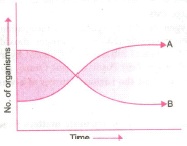
The graph below represents the growth patterns of types of aquatic organisms over a brief period of time in a water body surrounded by an agricultural land extensively supplied with fertilizers. Identify what would represent(i) A and (ii) B.
1.
When Nile perch a large predator fish was introduced in lake Victoria, it started feeding on native fish, cichlid fish. As a result, cichlid fish become extinct and Nile perch, not finding any food for itself, died too.
2.
A harmful organism, that is harmful for one/more populations/species, can be made extinct; the food chain should not be affected. For example, the virus causing small pox has been controlled world over.
3.
Ramsar Convention is a global environmental treaty that provides the framework for national action and international cooperation for the conservation and wise use of wetlands and their resources. It was called convention on wetlands of international Importance.
4.
Many bacteria cannot be cultured under normal conditions in vitro, which creates a problem in studying their morphological and biochemical charateristics.
Morphology and biochemistry along with some other charateristics are used for the assessment of biodiversity of bacteria. Thus, conventional methods are not suitable for the assessment of biodiversity of bacteria.
5.
6.
Gases and ashes from volcanic erruptions; gases from forest fires and decomposition; dust from storms; pollen, spores, cysts, bacteria from living organisms .
7.
(i) d
(ii) a, g
(iii) b, f
(iv) e
(v) c
8.
Ecologist Paul Ehrlich gave 'rivet popper hypothesis' to understand the contribution of the species richness. He compared each species with rivet in the body of an airplane.
(i) This hypothesis explain that ecosystem to be an airplane and the species to be the rivets joining all parts together.
(ii) If every passenger traveling in the airplane start taking rivets home(causing a species to become extinct), initially it may not affect flight safety (proper functioning of ecosystem), but over a period of time the plane become weak and dangerous (Species become endangered and then extinct).
9.
Effects of habitat fragmentation on Biodiversity:
1.Fragmentation creates barriers that limit the potential of species to disperse and colonise new areas.
2. Species get divided into smaller populations which are unable to sustain.
3.Migratory birds lose their seasonal habitats.
4.It Increases edge areas thus making the species more vulnerable to predators as well as wind and fire.
Thus there is loss of biodiversity because a large number of animals, e.g. elephant, lions, bears, and large cats require big territories to move around and live in. Likewise some birds reproduce successfully only in deep forests.
10.
(c)
Reacted with water
11.
(c)
Death of fish due to lack of oxygen
12.
(d)
Methyl isocyanate
13.
(d)
Increase in conc. of non-degradable pollutants as they pass through food chain.
14.
(b)
Kyoto protocol : Climatic change
15.
(a)
DDT is a non-biodegradable pollutant
16.
(d)
PAN
17.
(c)
SO2
18.
(c)
substances that deplete the ozone layer
19.
(b)
SPM
20.
Environmental pollution may be defined as an undesirable change in the physical, chemical or biological aspects of environment which makes it harmful for humans, for other living organisms, and for cultural assets.
21.
(i) A = Dissolved Oxygen
(ii) B=Biochemical oxygen demand(BOD)

12th Standard CBSE Syllabus & Materials
12th Standard CBSE
CBSE 12th Standard Biology Sexual Reproduction in Flowering Plants Sample Question Papers Study Material - QB365 Set 1
NEW12th Standard CBSE
CBSE 12th Chemistry d- and f- Block Elements Important Questions And Answers Study Material - QB365 Set B
NEW12th Standard CBSE
CBSE 12th Chemistry d- and f- Block Elements Important Questions And Answers Study Material - QB365 Set A
NEW12th Standard CBSE
CBSE 12th Chemistry Chemical Kinetics Important Questions And Answers Study Material - QB365 Set B



NCERT Books

Syllabus

Exam Pattern

Sample Question Papers

Previous year Question Papers

Important Notes

MCQ Practice test

NCERT Exemplers

Case study Questions

Image Based Questions

Passage based Questions

HOT Questions

Value Based Questions

Model Questions Papers
NCERT ( Book Back ) Questions

Assertion and Reason
Important Questions And Answers

CBSE 12th Standard CBSE Subjects
CBSE Standards