
12th Standard CBSE Syllabus & Materials
12th Standard CBSE
CBSE 12th Biology Sexual Reproduction in Flowering Plants Important Questions And Answers Study Material - QB365 Set B
NEW12th Standard CBSE
CBSE 12th Biology Sexual Reproduction in Flowering Plants Important Questions And Answers Study Material - QB365 Set A
NEW12th Standard CBSE
CBSE 12th Biology Sexual Reproduction in Flowering Plants Assertion and Reason Study Material - QB365 Set D
NEW12th Standard CBSE
CBSE 12th Biology Sexual Reproduction in Flowering Plants Assertion and Reason Study Material - QB365 Set C
NEW12th Standard CBSE
CBSE 12th Biology Sexual Reproduction in Flowering Plants Assertion and Reason Study Material - QB365 Set B
NEW12th Standard CBSE
CBSE 12th Biology Sexual Reproduction in Flowering Plants Assertion and Reason Study Material - QB365 Set A

Published on: 28/11/2025
Download CBSE Class 12th Standard CBSE Biology question papers, sample papers, important questions, and previous year solved papers in PDF format. Get free study materials, NCERT solutions, and exam preparation resources for Class 12th Standard CBSE Biology
Questions + Answers key
Take MCQ Biology Test
1.
What are the major causes of species losses in a geographical region?
2.
Can you think of a situation where we deliberately want to make a species extinct? How would you justify it?
3.
Biodiversity decreased as one moves from eqyator towards poles.Justify with an example
4.
Enumerate the aesthetic benefits of biodiversity.
5.
When and where was Earth Summit held? What was its objective?
6.
What is Ramsar convention? How was it called previously?
7.
List any two major causes other than anthropogenic causes of the loss of biodiversity.
8.
What is genetic diversity? Explain.
9.
What is the basis speciation?
10.
What are quantitative pollutants?
11.
Explain 'rivet popper' hypothesis. Name the ecologist who proposed it.
12.
Write an account on biodiversity in India.
13.
Mention the three attributes that a stable community has.
14.
What is the ' wise use' concept of Ramsar convention? Name four types of wetlands included in its mission.
15.
What does 'red' indicate in the IUCN red list (2004)?
16.
What is acid rain? What are its effects on plants?
17.
Microbes play a dual role when used for sewage treatment as they not only help to retrieve usable water but also generate fuel. Write in points how this happens?
18.
Why is thermal pollution harmful to aquatic animals?
19.
The figure is given shows relative contributions of various greenhouse gasses to the total global warming.

(i) Name the gasses (a) and (b)
20.
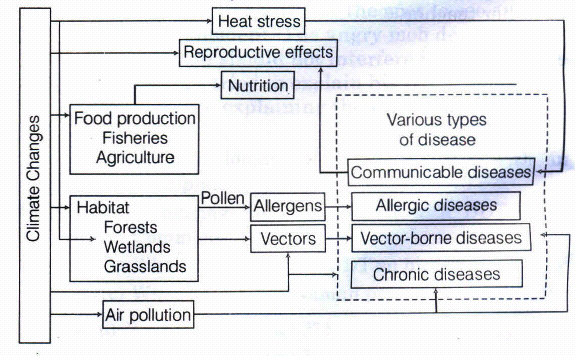
The gradual increase in the temperature of the world is cause of major climatic changes. These climatic changes affect the different aspects of human physiology. Explain the impact of climate change causing various human diseases with the help of flowchart
21.
Describe in detail the species-area relationship of biodiversity
22.
List the uses of biodiversity.
23.
What are the uses of IUCN Red list categories?
24.
(a) Why should we conserve biodiversity? How can we do it?
(b) Explain the importance of biodiversity hot spots and sacred groves.
25.
Bhopal gas tragedy 1984 was caused by the leakage of gas__
Hydrogen cyanide
Ammonia
2, 4-Dichlorophenoxy acetic acid
Methyl isocyanate
26.
Which of the following is biogas?
CO2
N2O
CH4
N2
27.
Photochemical smog pollution does not contain
PAN (peroxy acyl nitrate)
ozone
nitrogen dioxide
carbon dioxide
28.
Greenhouse effect is due to
CO2
CO
NO
PO4
29.
Ozone hole results in
UV radiation reaching the earth
Cataract
increase in skin cancer
all the above
30.
Freon gas causing stratospheric ozone depletion is mainly released from
refrigerator
automobile
thermal power plant
steel industry
31.
Select the correct statements from the following:
Activated sludge-sediment in settlement tanks of sewage treatment plant is a rich source of aerobic bacteria.
Biogas is produced by the activity of aerobic bacteria on animal waste
Methanobacterium is an aerobic bacterium found in rumen of cattle.
Biogas, commonly called gobar gas, is pure methane
32.
When domestic sewage mixes with river water
small animals like rats will die after drinking river water
the increased microbial activity releases micronutrients such as iron
the increased microbial activity uses up dissolved oxygen
the river water still suitable for drinking as impurities are only about 0-1%.
33.
The Air(Prevention and control of pollution) Act was amended in 1987 to include one of the following as pollutant
water
noise
dust
none of these
34.
In domestic sewage, impurities in the form of suspended solids, colloidal materials and dissolved materials, are about
0.1%
2.1%
5.0%
10.0%
1.
(i) Habitat loss and fragmentation
(ii) Over-exploitation by man for natural resources
(iii) Invasion of alien species, which complete with the native species and cause their extinction.
(iv) Co-extinction of related plants and animals.
2.
A harmful organism, that is harmful for one/more populations/species, can be made extinct; the food chain should not be affected. For example, the virus causing small pox has been controlled world over.
3.
Species diversity decreases from equator towards poles because
(i) Equator (tropic) regions have less seasonal or more constant environments, which promote niche specialisation and thereby more species diversity.
(ii) These regions have more solar energy which contributes to more productivity and greater diversity. e.g. The tropics (between 23.5oN to 23.5 oS ) harbours more species than temperate and polar regions. Columbia situated near equator has about 1400 species of birds, while New York (41 oN) has about 56 species.
4.
Aesthetic benefits:
(i) Ecotourism
(ii) Birdwatching
(iii) Pet-keeping
(iv) Gardening
5.
The first Earth Summit was held in Rio de Janerio in 1992.
its objectives were:
(i) Conservation of biodiversity, and
(ii) Sustainable utilisation of the benefits from biodiversity
6.
Ramsar Convention is a global environmental treaty that provides the framework for national action and international cooperation for the conservation and wise use of wetlands and their resources. It was called convention on wetlands of international Importance.
7.
The two major causes other than anthropogenic causes of the loss of biodiversity are
(i) Alien species invasions When alien species are introduced unintentionally or deliberately in a habitat, some of them can cause decline or extinction of indigenous species.
(ii) Co-extinctions when a species becomes extinct, the plant and animal species associated with it, in an obligatory way, also become extinct.
8.
Genetic Diversity.
(i) Greater the genetic diversity among organisms of a species, more sustenance it has against environmental perturbations, The genetically uniform populations are highly prone to diseases and harsh environment.
(ii) The genetic variation shown by Rauwolfia can be in terms of the conservation and potency of the chemical reserpine.
There are more than 50,000 genetically different strains of rich and 1000 varieties of mango in India.
9.
Basis of speciation: The amount of genetic variation is the basis of speciation (evolution of new species). It has a key role in the maintenance of diversity at species and community levels. The total genetic diversity of a community will be greater if there are many species, as compared to a situation where there are only a few species. Genetic diversity within a species often increases with environmental variability.
10.
The quantitative pollutants are materials that are normally present in the environment but are also added in large amounts by man, e.g., CO2.
11.
1. It was 'proposed by Paul Ehrlich.
2. In an airplane (Ecosystem) all parts are joined together using thousands of rivets (species).
3. If every passenger traveling in it, starts popping a rivet to take home (causing a species to become extinct), it may not effect the flight safety (proper functioning of the ecosystem) initially, but as more and more rivets are removed, the plane becomes dangerously weak over a period of time.
4. Further, which rivet is removed may also be critical; i.e. loss of rivets on the wings. Key species that drive major ecosystem function is obviously a more serious threat to flight safety than loss of a few rivets on the seats or windows inside the plane.
12.
1. India is one of the twelve biodiversity rich countries of the world.
2. Though India has only 2.4% of the land area of the world, it has 8.1% of the global species biodiversity.
3. There are about 45,000 species of plants and 90,000-1,00,000 species of animals, many more species are yet to be discovered and named.
4. If we apply Robert May's global estimate that only 22% of the total species have been recorded, India probably has more than 1,00,000 species of plants and 3,00,000 species of animals to be discovered and described.
13.
Stable community
(i) It shall not show too much variations in the year-to-year productivity.
(ii) It must be either resistant or resilient to sesonal disturbances.
(iii) It must be resistant to invasion of alien species.
14.
The 'wise use' of wetlands refers to the maintenance of their ecological characters through the implementation of ecosystem approaches and the conservation and sustainable use of wetlands and their resources for human benefit. e.g. swamps and marshes, coral reefs, mangroves, estuaries, near-shore marine areas, peatlands.
15.
'Red' in IUCN red list (2004) indicates the threatened species i.e. the species under varying degree of extinction risk categories.
16.
Acid rain refers to precipitation with a pH of less than 5. It is, in fact, a mixture of sulphuric acid and nitric acid.
17.
Sewage is treated in sewage treatment plants to remove pollutants and retrieving clean water for its reuse again. This treatment is carried in two stages.
1. Primary treatment: It is a physical process of removal of small and large particles through filtration and sedimentation.
2. Secondary treatment. It is a biological process that employs bacteria. The activated sludge after primary treatment is pumped into a large tank called anaerobic sludge digester where anaerobic bacteria act on the organic matter in anaerobic conditions to produce the mixture of gasses(biogas). The latter can be used as the source of energy as it is inflammable.
18.
Warm water can hold much less dissolved oxygen than cold water. Also, rise in temperature speeds up animal metabolism increasing O2 requirement thus further aggravating O2 problem for aquatic animals.
19.
(i) (a) N2O (nitrous oxide) (b) CH4(Methane)
20.
Flow char showing impact of climate change.
21.
Species-Area Relationship
1. Alexander Von Humboldt has observed that within a region, species richness increases with increased explored area, but only upto a limit.
2. The relationship between species richness and area for a number of taxa like angiospermic plants, freshwater fishes and birds is found to be a rectangular hyperbola.
3. On a log scale, the relationship becomes linear (straight line) and is described by the equation:
log S = log C + Z log A, where
S = Species Richness
Z = Slope of the line (regression coefficient)
A = Area and C = Y - intercept
4. Ecologists have found that the value of Z-line ranges between 0.1 and 0.2 irrespective of the taxonomic group of the region.
5. But in very large areas, like a continent, the Z value ranges between 0.6 and 1.2 and indicate species richness.
22.
Uses of biodiversity.
1. As source of food and improved varieties.
2. As source of drugs and medicines.
3. Aesthetic and cultural benefits.
Examples of aesthetic rewards include ecotourism, bird watching, wildlife, pet keeping, gardening, etc. Throughout human history, people have related biodiversity to the very existence of human race through cultural and religious beliefs.
4. Biodiversity is essential for the maintenance and sustainable utilization of goods and services from ecological system as well as from individual species.
23.
The uses of the Red list categories: The uses of the Red Lists are:
(i) Developing awareness about the importance of threatened biodiversity;
(ii) Identification and documentation of endangered species;
(iii) Providing a global index of the decline of biodiversity;
(iv) Define conservation priorities at the local level and guiding conservation action.
24.
(a) Why should we Conserve biodiversity :
1. Narrow utilitarian arguments Human being draw.direct economic benefits from nature like food,firewood, fibre, construction materials, industrial products, medicines etc.
2. Broadly utilitarian arguments.
Biodiversity plays major role in maintaining and sustaining supplyofgoodsand services(i) Amazonforests provide 20% of oxygen present in atmosphere. (ii) Ecosystemprovidepollinatores.
3.Ethical reasons. Every organism have intrinsic value even if there is no economicvalue. Conservation of biodiversity.
(b) Importance of biodiversity hot-spots and sacred groves They provide protection of species richness and high degree of endemism in natural Habitat. Hot Spots are regions of igh level of species in their natural habitat. Sacret groves are forest tracts set aside and all trees and wildlife within area are giventotal protection.
25.
(d)
Methyl isocyanate
26.
(c)
CH4
27.
(d)
carbon dioxide
28.
(a)
CO2
29.
(d)
all the above
30.
(a)
refrigerator
31.
(a)
Activated sludge-sediment in settlement tanks of sewage treatment plant is a rich source of aerobic bacteria.
32.
(c)
the increased microbial activity uses up dissolved oxygen
33.
(b)
noise
34.
(a)
0.1%

12th Standard CBSE Syllabus & Materials
12th Standard CBSE
CBSE 12th Standard Biology Sexual Reproduction in Flowering Plants Sample Question Papers Study Material - QB365 Set 1
NEW12th Standard CBSE
CBSE 12th Chemistry d- and f- Block Elements Important Questions And Answers Study Material - QB365 Set B
NEW12th Standard CBSE
CBSE 12th Chemistry d- and f- Block Elements Important Questions And Answers Study Material - QB365 Set A
NEW12th Standard CBSE
CBSE 12th Chemistry Chemical Kinetics Important Questions And Answers Study Material - QB365 Set B



NCERT Books

Syllabus

Exam Pattern

Sample Question Papers

Previous year Question Papers

Important Notes

MCQ Practice test

NCERT Exemplers

Case study Questions

Image Based Questions

Passage based Questions

HOT Questions

Value Based Questions

Model Questions Papers
NCERT ( Book Back ) Questions

Assertion and Reason
Important Questions And Answers

CBSE 12th Standard CBSE Subjects
CBSE Standards