12th Standard CBSE Syllabus & Materials
12th Standard CBSE
CBSE 12th Biology Sexual Reproduction in Flowering Plants Important Questions And Answers Study Material - QB365 Set B
NEW12th Standard CBSE
CBSE 12th Biology Sexual Reproduction in Flowering Plants Important Questions And Answers Study Material - QB365 Set A
NEW12th Standard CBSE
CBSE 12th Biology Sexual Reproduction in Flowering Plants Assertion and Reason Study Material - QB365 Set D
NEW12th Standard CBSE
CBSE 12th Biology Sexual Reproduction in Flowering Plants Assertion and Reason Study Material - QB365 Set C
NEW12th Standard CBSE
CBSE 12th Biology Sexual Reproduction in Flowering Plants Assertion and Reason Study Material - QB365 Set B
NEW12th Standard CBSE
CBSE 12th Biology Sexual Reproduction in Flowering Plants Assertion and Reason Study Material - QB365 Set A

Published on: 05/03/2026
Download CBSE Class 12th Standard CBSE Biology question papers, sample papers, important questions, and previous year solved papers in PDF format. Get free study materials, NCERT solutions, and exam preparation resources for Class 12th Standard CBSE Biology
Questions + Answers key
Take MCQ Biology Test
SECTION - B
Answer the following.
1.
Geitonogamous flowering plants are genetically autogamous, but functionally cross-pollinated. Justify.
2.
List the adaptive features of water-pollinated flowers like Vallisneria.
3.
Mention an advantage and a disadvantage of a cleistogamous flower.
4.
Differentiate between albuminous and non-albuminous seeds, giving one example of each.
5.
Why should a breeder need to emasculate a bisexual flower? Mention a condition in a flower, where emasculation is not necessary?
SECTION - C
Answer the following.
6.
Explain the characteristic features of flowers that facilitate wind pollination.
7.
Draw a longitudinal section of a post-pollinated pistil showing entry of pollen tube into a mature embryo sac. Label filiform apparatus, chalazal end, hilum, antipodals, male gametes and secondary nucleus.
8.
Write the functions of micropyle.
SECTION - D (Any two)
Answer the following.
9.
(a) Differentiate between: Autogamy, geitonogamy and xenogamy.
(b) Explain the events that occur during pollen-pistil interaction.
10.
(a) Describe the process of syngamy and triple fusion in angiosperms.
(b) Explain the development of a fertilised egg upto a mature embryo in a dicot plant. draw a labelled diagram of a mature dicot embryo,
11.
Draw a diagram of an enlarged view of T.S. of one microsporangium of an angiosperm and label the following parts:
(i) Tapetum
(ii) Middle layers
(iii) Endothecium
(iv) Microspore mother cells.
(b) Mention the characteristic features and function of tapetum.
(c) Explain the following giving reasons:
(i) Pollen grains are well-preserved as fossils.
(ii) Pollen tablets are in use by people these days.
section - A
Multiple Choice Question
12.
Insect-pollinated flowers are characterized by
Large number of pollens
Dry and smooth pollens
Sticky and rough pollens
Heavy pollens
13.
Pollen grains are able to withstand extremes of temperature and desiccation because their exine is composed of
Cutin
Suberin
Sporopollenin
Callose
14.
In some plants anthers and stigma grow and mature at the same time. This phenomenon is called
Homogamy
Syngamy
Allogamy
Fusion
15.
The phenomenon wherein the ovary develops into a fruit without fertilization is called:
Parthenocarpy
Apomixis
Asexual reproduction
Sexual reproduction
16.
Residual persistent nucellus is known as
perisperm
pericarp
integuments
none of these
17.
Case Study Questions
18.
Read the following and answer any four questions from (i) to (v) given below:
The anther is a four-sided structure consisting of four microsporangia located at the corners two in each lobe. The microsporangia develop further and become pollen sacs. In a transverse section, a typical microsporangium appears near circular in outline. It is generally surrounded by four wall layers-the epidermis, endothecium, middle layers and the tapetum.
(i) A dithecous anther consists of (A) microsporangia, (B) in each lobe. Select the option that correctly fills the blanks
| A | B |
| (a) four | two |
| (b) two | one |
| (c) two | two |
| (d) four | one |
(ii) The given diagram shows microsporangium of a mature anther. Identify A, Band C.
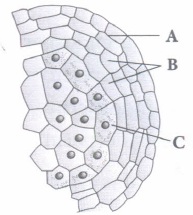
| (a) A-Middle layer | B-Endothecium | C-Tapetum |
| (b) A-Endothecium | B-Tapetum | C- Middle layer |
| (c) A-Endothecium | B-Middle layer | C-Tapetum |
| (d) A-Tapetum | B-Middle layer | C- Endothecium |
(iii) The function oflabelled part X is
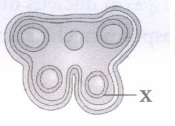
| (a) dehiscence | (b) mechanical | (c) nutrition | (d) protection |
(iv) Select the incorrect statement
(a) Microsporangium is generally surrounded by four wall layers-epidermis, endothecium, middle layers and tapetum
(b) Outer three layers perform functions of protection and dehiscence of anthers.
(c) Cells of tapetum possess dense cytoplasm and generally have more than one nucleus.
(d) Cells of tapetum undergo meiosis and produce microspore tetrads.
(v) Which function of tapetum is correct?
(a) Helps in pollen wall formation
(b) Transportation of nutrients to inner side of anther.
(c) Synthesis of callase enzyme for separation of microspore tetrads.
(d) All of these
19.
SECTION - B
Answer the following.
1.
1. Since geitonogamy involves two different flowers of the same plant, it is genetically similar to autogamy; both autogamy and geitonogamy do not result in genetic variation in the progeny.
2. Geitonogamy and cross-pollination involve different flowers and a pollinating agent.
2.
(i) In Vallisneria, the male flowers are released on the surface of water and female flowers reach the surface by the long stalk.
(ii) Pollen grains are protected from wetting by a mucilaginous covering.
3.
Advantage
1. Since cleistogamous flowers are autogamous, there is an assured seed-set.
Disadvantage
1. Continued self-pollination leads to inbreeding depression.
4.
| Albuminous seeds | Non-albuminous seeds |
|
The endosperm is completely used by the developing embryo before the maturation of seed and so there is no endosperm left in the seed, e.g. pea, bean, groundnut. |
The endosperm is not completely used by the developing embryo and hence, a portion of it remains in the seed, e.g. castor, maize, coconut. |
5.
1. Emasculation is necessary to prevent the self-pollen grains falling on the stigma.
2. Emasculation is not needed when the female parent chosen bears unisexual, i.e. female flowers.
SECTION - C
Answer the following.
6.
In wind pollinated flowers,
(i) The stamens are well-exposed, so that pollen grains are easily dispersed in wind currents.
(ii) The stigma is large and often feathery, to easily trap the air-borne pollen grains.
(iii) The pollen grains are light and non-sticky, to be transported in wind currents.
(iv) Pollen grains are produced in enormous quantity.
(v) Numerous small flowers are packed into an inflorescence.
(vi) There is a single ovule in the ovary of these flowers.
7.
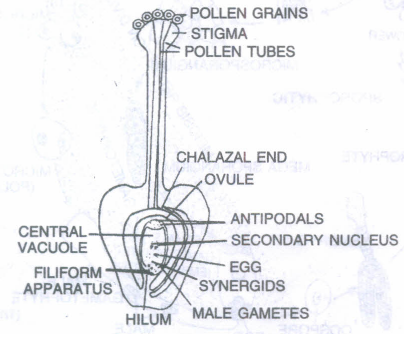
8.
Functions of micropyle
(i) It is the passage through which the pollen tube enters the ovule.
(ii) It remains as a small pore in the seed coat and facilitates the entry of water and oxygen during seed germination.
SECTION - D (Any two)
Answer the following.
9.
(a) Differences:
| Autogamy | Getonogamy | Xenogamy |
| It refers to the transfer of pollen grains from the anther of a flower to the stigma of the same flower | It refers to the transfer of pollen grains from the anther of a flower to the stigma of same plant. | It refers to the transfer of pollen grains from the anther of a flower to the stigma of another flower on a different plant of the same species. |
| It does not lead to genetic variation in the progency | It does not lead to genetic variation in the progeny. | It leads to genetic variation in the progeny |
| No pollinating agent is needed. | A pollinating agent is needed. | A pollinating agent is needed. |
(b) Pollen-Pistil Interaction.
The stigma/pistil has the ability to recognise the right type of pollen, i.e. the compatible pollen of the same species and rejects the wrong type of pollen grains.
It is the result of interaction between the chemical components of the pollen and those of stigma. - A compatible pollen grain starts its germination on the stigma.
The intine grows out through one of the germ pores as a protuberance.
The contents of the pollen move into this tube, i.e. the tube nucleus (nucleus of the vegetative cell) and the generative cell (or the two male gametes in those species where pollen is liberated in the three-celled stage).
The pollen tube grows through the tissues of stigma and style and enters the ovule through micropyle.
It enters the embryo sac through the filiform apparatus of one of the synergids to liberate the male gametes.
The events from the deposition of pollen on the stigma till the pollen tube enters the ovule, are collectively referred to as pollen-pistil interaction.
10.
(a) Syngamy
Syngamy refers to the fusion of a male gamete with the female gamete in the embryo sac to form a diploid zygote.
Triple fusion
Triple fusion refers to the fusion of a male gamete with the secondary nucleus (formed by fusion of two haploid polar nuclei) to form the triploid primary endosperm nucleus.
(b) Embryo development
Th'e zygote undergoes mitotic divisions during embryogeny.
The first division is transverse and results in a basal cell and a terminal cell; the basal cell forms the suspensor while the terminal cell forms the embryo proper.
It first, forms a filamentous proembryo, which later forms in sequence a globular embryo, heart-shaped embryo and then a mature embryo.
11.
(b) Tapetum is the innermost wall layer; whose cells possess dense cytoplasm and more than one nucleus.
It nourishes the developing pollen grains.
(c) (i) The exine of pollen grains is made of sporopollenin, which can withstand high temperature and action of strong acids or alkalies; no enzyme can degrade sporopollenin and hence, pollen grains are well preserved as fossils.
(ii) Pollen grains are rich in nutrients and hence, are used in the form of tablets as food supplements.
section - A
Multiple Choice Question
12.
(c)
Sticky and rough pollens
13.
(c)
Sporopollenin
14.
(b)
Syngamy
15.
(a)
Parthenocarpy
16.
(a)
perisperm
17.
(b)
Case Study Questions
18.
(i) (a) : A typical angiosperm anther is bilobed with each lobe having two theca, i.e., dithecous and a dithecous anther is tetrasporangiate having four microsporangia, two in each lobe.
ii) (c)
(iii) (c) : The tapetal layer is of great physiological significance as all the food material entering into the sporogenous tissue diffuses through this layer. Ultimately the cells of tapetal layer disorganise. Thus, tapetum makes a nutritive layer for the developing microspores or pollen grains.
(iv) (d)
(v) (d) : Tapetum secretes Ubisch bodies which get covered with sporopollenin and so increase thickness of exine of pollen grain wall. Tapetum provides nourishment to developing microspores. It also secretes callase enzyme which dissolves callose substances by which four pollens of a pollen tetrad are united, hence separating microspores or pollens of a tetrad.
19.

12th Standard CBSE Syllabus & Materials
12th Standard CBSE
CBSE 12th Standard Biology Sexual Reproduction in Flowering Plants Sample Question Papers Study Material - QB365 Set 1
NEW12th Standard CBSE
CBSE 12th Chemistry d- and f- Block Elements Important Questions And Answers Study Material - QB365 Set B
NEW12th Standard CBSE
CBSE 12th Chemistry d- and f- Block Elements Important Questions And Answers Study Material - QB365 Set A
NEW12th Standard CBSE
CBSE 12th Chemistry Chemical Kinetics Important Questions And Answers Study Material - QB365 Set B



NCERT Books

Syllabus

Exam Pattern

Sample Question Papers

Previous year Question Papers

Important Notes

MCQ Practice test

NCERT Exemplers

Case study Questions

Image Based Questions

Passage based Questions

HOT Questions

Value Based Questions

Model Questions Papers
NCERT ( Book Back ) Questions

Assertion and Reason
Important Questions And Answers

CBSE 12th Standard CBSE Subjects
CBSE Standards