12th Standard CBSE Syllabus & Materials
12th Standard CBSE
CBSE 12th Biology Sexual Reproduction in Flowering Plants Important Questions And Answers Study Material - QB365 Set B
NEW12th Standard CBSE
CBSE 12th Biology Sexual Reproduction in Flowering Plants Important Questions And Answers Study Material - QB365 Set A
NEW12th Standard CBSE
CBSE 12th Biology Sexual Reproduction in Flowering Plants Assertion and Reason Study Material - QB365 Set D
NEW12th Standard CBSE
CBSE 12th Biology Sexual Reproduction in Flowering Plants Assertion and Reason Study Material - QB365 Set C
NEW12th Standard CBSE
CBSE 12th Biology Sexual Reproduction in Flowering Plants Assertion and Reason Study Material - QB365 Set B
NEW12th Standard CBSE
CBSE 12th Biology Sexual Reproduction in Flowering Plants Assertion and Reason Study Material - QB365 Set A

Published on: 05/03/2026
Download CBSE Class 12th Standard CBSE Biology question papers, sample papers, important questions, and previous year solved papers in PDF format. Get free study materials, NCERT solutions, and exam preparation resources for Class 12th Standard CBSE Biology
Questions + Answers key
Take MCQ Biology Test
1.
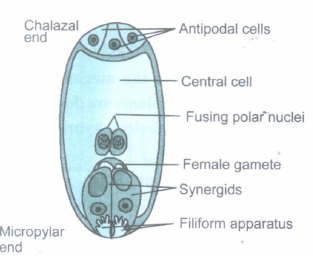
A fully developed embryo sac
A fully-developed and mature embryo sac is shown above.
(a) Name the cell from which it has developed.
(b) What is the ploidy level of its nuclei?
(c) What is filiform apparatus? Mention its significance.
2.
A farmer has been cultivating paddy in his field season after season. Of late, the yield has been decreasing though there is no occurrence of pests or disease. He has been advised to use Nostoe by the local centre of the Agricultural department. To his surprise, the yield started increasing.
(a) How does Nostoe help to increase the yield of paddy crops?
(b) Name two other organisms ofthe same category that can serve this purpose.
3.
A pond is a shallow water body, which is fairly a self-sustainable unit that explains the complex interactions in an aquatic ecosystem. The water with all the dissolved inorganic and organic nutrients is the major abiotic component.
Name the three groups of biotic components in the pond and give an example for each.
4.
Organisms occupy a specific place in their natural surroundings or in a community according to their feeding relationship with the other organisms. Based on the source of nutrition of food organisms occupy a particular place, called trophic level, in a food chain.
(a) What technical term is given to the organisms occupying the first, second and third trophic levels in a food chain?
(b) Choose an example for each of the above trophic levels, from the following list of organisms: Rabbit, Wolf, phytoplanktons, frog, snail, Hydrilla, jackal.
5.
Read the following and answer any four questions from (i) to (v) given below :
Translation is the process of polymerisation of amino acids to form a polypeptide. The order and sequence of amino acids are defined by the sequence bases in the mRNA. The amino acids are joined by a bond called peptide bond. Ribosome is the site of protein synthesis.
(i) Which ion is essential for association of both units of ribosome at the time of protein formation ?
| (a) Mg2+ | (b) Mn2+ | (c) Cl- | (d) Ca2+ |
(ii) During translation, how many initiation factors are required in eukaryotes for initiation reactions?
| (a) 3 | (b) 6 | (c) 7 | (d) 9 |
(iii) Which part of mRNA contains untranslated regions (UTR)?
| (a) 3' end | (b) 5' end | (c) Either 3' or 5' end | (d) Both 5' end and 3' end |
(iv) Name the enzyme that helps in combining amino acid to its particular tRNA.
| (a) Activating enzyme | (b) Amino-acyl tRNA-synthetase | (c) Peptidyl transferase | (d) Both (a) and (b) |
(v) From the given list, select the translation machinery.
1. mRNA
2. Ribosomes
3. Amino acids
4. tRNAs
5. Peptidyl transferase
6. Amino acyl tRNA synthetase
7. Pyrophosphatase
| (a) (1), (2), (3), (4) and (6) | (b) (1), (2), (3), (4) and (5) | (c) (1), (2), (3), (4), (5) and (6) | (d) (1), (2), (3), (4), (5), (6) and (7) |
6.
Read the following and answer any four questions from (i) to (v) given below:
Transgenic animals can serve as factories that in some cases, may produce large amount of proteins more efficiently. Transgenic mice have been engineered to express human antibodies by introducing large segment of human DNA encoding human immunoglobulin genes. In transgenic large animals such as cow or sheep proteins of pharmaceutical value can be produced in large quantities in milk which is later purified. Transgenesis can be used to alter many phenotypic properties including growth rate, fat composition, milk production, hair texture, etc.
(i) The production of transgenic animals includes
| (a) identification and separation of desired gene |
| (b) combining the desired gene with appropriate vector |
| (c) introduction of vector in cells, tissues or embryos |
| (d) all of these. |
(ii) In transgenic animals, i.e., cow and sheep proteins of pharmaceutical value are produced in large quantities in the
| (a) blood | (b) accumulated fat | (c) mammary glands | (d) none of these. |
(iii) Mouse is mostly preferred animal for studies on gene transfer because
A. short oestrous cycle
B.long gestation period
C.Short generation time
D.Production of one or two offspring per pregnancy
| (a) both (A) and (C) | (b) both (A) and (B) | (C) Only D | (d) both (C) and (D). |
(iv) Transgenic genes alter many phenotypic properties including
| (a) growth rate | (b) fat composition | (c) milk production | (d) all of these |
(v) Assertion : Transgenic mice have been engineered to express human antibodies.
Reason : Large segment of human DNA encoding human immunoglobulin have been transferred to mice.
| (a) Both assertion and reason are true and reason is the correct explanation of assertion. |
| (b) Both assertion and reason are true but reason is not the correct explanation of assertion. |
| (c) Assertion is true but reason is false. |
| (d) Both assertion and reason are false |
7.
Read the following and answer any four questions from (i) to (v) given below:
Insulin used to cure diabetes was earlier extracted from pancreas of slaughtered cattle and pigs. Insulin extracted from an animal source, though caused some patients to develop allergy or other types of reactions to the foreign protein. Human insulin consists of two short polypeptide chains: chain A and chain B, that are linked together by disulphide bridges. In mammals including humans, insulin is synthesised as a pro-hormone which contains an extra stretch called the C-peptide. This C peptide is not present in mature insulin and is removed during maturation into insulin.
(i) Identify A in the given figure.
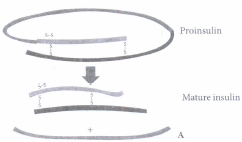
| (a) Polypeptide chain A | (b) Polypeptide chain B | (c) Polypeptide chain C | (d) None of these |
(ii) The following is a list of some stages involved in producing human insulin from genetically engineered bacteria.
1. The bacteria are cultured in a fermenter for large scale production.
2. Recombinant insulin is extracted from the bacterial cells that expresses insulin gene.
3. The same restriction enzyme is used again to cut the bacterial plasmid for insertion of the human insulin gene.
4. Bacteria take up the plasmid carrying the insulin gene.
5. A restriction enzyme is used to cut human DNA to extract the insulin gene.
Select the correct order of these stages.
| (a) 1,5,3,4,2 | (b) 2,4,3,5,1 | (c) 4,5,3,2,1 | (d) 5,3,4,1,2 |
(iii) To insert the insulin gene into bacterial DNA, both the bacterial plasmid and the human chromosome containing the insulin gene are treated with the same restriction enzyme. Using the same restriction enzyme ensures that
| (a) DNA ligase is able to join the segments of human and bacterial DNA |
| (b) the exact length of nucleotides matching the insulin gene is removed from the plasmid |
| (c) both the bacterial and human DNA will contain sticky ends |
| (d) Sticky ends in the cut plasmid and insulin gene are complementary. |
(iv) Why is the fermentor important for the production of human insulin by transgenic bacteria
| (a) It provides optimal conditions for the transgenic to multiply rapidly. |
| (b) It facilitates the extraction and purification of insulin from the transgenic bacteria. |
| (c) It maximise the rate of fermentation of the transgenic bacteria. |
| (d) It provides the low-oxygen conditions that are important for insulin production. |
(v) A bacteriologist carries out his first attempt at engineering E.coli with the gene for human insulin. During the process, he realises that his stock of DNA ligase has depleted but decides to continue anyway. What is a likely consequence of his decision?
| (a) Bacteria with the rDNA will not be able to form colonies in a fermenter |
| (b) The resulting plasm ids are not able to enter the E.coli bacteria even after applying heat shock. |
| (c) The resulting E.coli bacteria do not contain the human insulin gene. |
| (d) The bacterial plasm ids do not have sticky ends and are unable to accommodate the human gene. |
8.
Read the following passage and answer the questions given below .
During the unfortunate corona virus lockdown, Kavita started cursing the existence of microbes on earth. On hearing this, Deepak told Kavita that not all the microbes are harmful for us. Many microbes are useful in producing medicines, bioactive molecules and household products .
(i) Antibiotics are produced by a living organism. What relationship do these hare with target and non-target organisms?
(ii) Mention the source and functions of cyclosporin-A and statins.
(iii) Beside making curd, mention the household function of bacterial microbe Lactobacillus.
(iv) Mention any two functions of fungal microbe Saccharomyces cerevisiae.
(v) Swiss cheese is characterised by large holes. What causes such a condition in it ?
9.
10.
Rama lives in a society where a robbery occurred last night. Robbers came into the flat and murdered the old lady residing there. Police came and restricted entry into the flat. They took samples from the room, where the dead body was found. While examining, they found that there is some blood and tissue in the nails of an old lady. According to their observation, police filtered out their inspection to three suspects viz. servant, cook, and milkman. Finally, after two days of robbery, the police caught the criminal. It was the old lady’s cook. Rama was amazed to see how quickly the police completed and shut the case. She asked the inspector how they did it. The policeman told her that it become possible due to the sample collected from the victim, which lead them to the criminal. The sample taken from nail scraping was amplified using PCR and then tested.
1.What technique was used by the police to identify the criminal?
(a) DNA fingerprinting
(b) Gel electrophoresis
(c) Molecular diagnosis
(d) Cloning
2.In PCR, the temperature used to denature the DNA is about
(a) 76°C
(b) 25°C
(c) 95°C
(d) 40°C
3.Which of the following statements regarding PCR is correct?
(a) Taq polymerase, which is isolated from the bacterium Thermus aquaticus is stable at low temperature only.
(b) With the help of D N A ligase, t h e complementary sticky ends of the DNA are joined to produce an rDNA.
(c) Since the sequence of primers is complementary to the 5′ end of the template DNA, they anneal to it.
(d) DNA purified from the cell is precipitated by adding hot ethanol.
4.Taq polymerase synthesizes DNA region between the primers using
(a) Mg2+
(b) dNTPs
(c) DNA ligase
(d) both (a) and (b)
5.Given below are the steps of the polymerase chain reaction

Select the option that correctly mentions the sequence in which they occur.
(a) (ii) → (iii) → (i)
(b) (i) → (ii) → (iii)
(c) (iii) → (i) → (ii)
(d) (ii) → (i) → (iii)
11.

12.
13.
Assertion: Nucellus functions as a nutritive tissue.
Reason: Nucellus is always exhausted completely during development of embryo sac.
Codes:
(a) Both assertion and reason are true and reason is the correct explanation of assertion.
(b) Both assertion and reason are true but reason is not the correct explanation of assertion.
(c) Assertion is true but reason is false.
(d) Both assertion and reason are false
14.
Assertion: The egg apparatus, consists of two synergids and one egg cell.
Reason: Filiform apparatus play an important role in guiding the pollen tubes into the synergids
Codes:
(a) Both assertion and reason are true and reason is the correct explanation of assertion.
(b) Both assertion and reason are true but reason is not the correct explanation of assertion.
(c) Assertion is true but reason is false.
(d) Both assertion and reason are false
15.
Assertion: Sequences of bases in one polynucleotide chain of DNA can determine the sequence of bases in the other chain.
Reason: In a DNA, amount of adenine equals that of thymine and amount of guanine equals that of cytosine, i.e., A = T and C = G.
Codes :
(a) Both assertion and reason are true and reason is the correct explanation of assertion.
(b) Both assertion and reason are true but reason is not the correct explanation of assertion.
(c) Assertion is true but reason is false.
(d) Both assertion and reason are false
16.
Assertion: Lactose in lac operon is promoter gene.
Reason: Lactose inactivates the repressor gene.
Codes :
(a) Both assertion and reason are true and reason is the correct explanation of assertion.
(b) Both assertion and reason are true but reason is not the correct explanation of assertion.
(c) Assertion is true but reason is false.
(d) Both assertion and reason are false
17.
Assertion: cDNA is copy DNA which is synthesised in vivo on a DNA template using DNA polymerase.
Reason: cDNA of all possible genes are ligated with different plasmids and maintained in either plant or animal cells.
Codes:
(a) Both assertion and reason are true and reason is the correct explanation of assertion.
(b) Both assertion and reason are true but reason is not the correct explanation of assertion.
(c) Assertion is true but reason is false.
(d) Both assertion and reason are false.
18.
Assertion (A) : Embryo sac development is monosporic in Polygonum.
Reason (R) : In this development, only one functional megaspore is present at chalazal end.
(a) If both A and R are true and R is correct explanation of A
(b) If both A and R are true, but R is not the correct explanation of A
(c) If A is true, but R is false
(d) If A is false, but R is true
19.
Assertion (A): Ethanol is produced by distillation of fermented broth.
Reason (R): Ethanol is produced by fermenting malted cereals and fruit juices by yeast.
Codes:
(a) Both A and R are true and R is the correct explanation of A.
(b) Both A and R are true and R is not the correct explanation of A.
(c) A is true, but R is false.
(d) A is false, but R is true.
20.
Assertion (A) : Transgenic plant production can be achieved we recombinant DNA technology.
Reason (R) : An organism that contains and expresses a transgene is called transgenic organism.
(a) If both A and R are true and R is the correct explanation of A
(b) If both A and R are true,but R isnot the correct explanation of A
(c) IfA is true, but R is false
(d) If A is false, but R is true
21.
Given below is the nucleosome model in which the histone proteins are bounded by DNA. One nucleosome contains about 200 base pairs of DNA helix. Study the structure and comment upon the appropriateness of the Assertion and the Reason
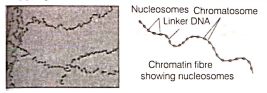
Assertion (A) : Histones are basic in nature.
Reason (R) : DNA being negatively charged, wrap around histone to octamer. These are rich in the amino acids lysine and arginine.
(a) If both A and Rare true and R is the correct explanation of A
(b) If both A and R are true, but R is not the correct explanation of A
(c) If A is true, but R is false
(d) If A is false, but R is true
22.
Assertion : Chasmogamous flowers require pollinating agents.
Reason : Cleistogamous flowers do not expose their sex organs.
Codes:
(a) If both Assertion and Reason are true and Reason is the correct explanation of Assertion.
(b) If both Assertion and Reason are true but Reason is not the correct explanation of Assertion.
(c) If Assertion is true but Reason is false.
(d) If both Assertion and Reason are false.
23.
Assertion: Hydrophily is a major mode of pollination in most of the aquatic plants in angiosperms.
Reason: Almost all the aquatic dicot and monocot plants require water for the transport of male gametes and for fertilisation.
Codes:
(a) If both Assertion and Reason are true and Reason is the correct explanation of Assertion.
(b) If both Assertion and Reason are true but Reason is not the correct explanation of Assertion.
(c) If Assertion is true but Reason is false.
(d) If both Assertion and Reason are false.
24.
Assertion: The uptake of DNA during transformation is an active, energy requiring process.
Reason: Transformation occurs only in those bacteria, which possess the enzymatic machinery involved in the active uptake and recombination.
Codes:
(a) If both Assertion and Reason are true and Reason is the correct explanation of Assertion.
(b) If both Assertion and Reason are true but Reason is not the correct explanation of Assertion.
(c) If Assertion is true but Reason is false.
(d) If both Assertion and Reason are false.
25.
26.
27.
Assertion (A) : In a DNA molecule, A-T rich part melt before-G-C rich parts.
Reason (R): In between A and T there are three H-bond, whereas in between G and C there are two H-bonds
Codes:
a) Both (A) and (R) are true and (R) is the correct explanation of (A)
b) Both (A) and (R) are true and (R) is not correct explanation of (A)
c) (A) is true but (R) is false
d) (A) is false but (R) is true
28.
Assertion (A): Scientists have identified about 1.8 billion locations where single base DNA differences occur in humans
Reason (R): Less than 2 percent of the genome codes for proteins
Codes:
a) Both (A) and (R) are true and (R) is the correct explanation of (A)
b) Both (A) and (R) are true and (R) is not correct explanation of (A)
c) (A) is true but (R) is false
d) (A) is false but (R) is true
29.
30.
31.
32.
33.
34.
1.
(a) Megaspore
(b) Haploid
(c) (i) Filiform apparatus refers to the special cellular thickenings in the synergids, towards micropylar tip.
(ii) They play an important role in guiding the pollen tube to enter one of the synergids.
2.
(a) Nostoc enriches soil fertility by
(i) fixing atmospheric nitrogen in the soil.
(ii) adding oranic matter to the soil through its photosynthetic activity.
(b) Anabaena and Oscillatoria.
3.
The three groups of biotic components
(i) Producers - e.g. Phytoplanktons, some algae, submerged and floating plants.
(ii) Consumers - e.g. zooplanktons, sanils, fish.
(iii) Decomposers - e.g. some bacteria, fungi, flagellates.
4.
(a) First trophic level - Producers
Second trophic level - Herbivores/Primary consumers
Third trophic level - Secondary consumers/Primary carnivores.
(b) First trophic level - Phytoplanktons, Hydrilla. Second trophic level - Rabbit, snail Third trophic level - Wolf, frog, jackal.
5.
(i) (a) :The two subunits of ribosomes come together at the time of protein formation. This phenomenon is called association. Mg2+ is essential for it.
(ii) (d): Eukaryotes have nine initiation factors- elf2, elf3, elfl, elf4A, elf4B, elf4C, elf4D, elf5,elf6.
(iii) (d): An mRNA molecule has some additional sequences that are not translated and are called untranslated regions (UTR). The UTRs are present at both 5' end (before start codon) and at 3'-end (after stop codon). They are required for efficient translation process.
(iv) (d): Amino-acyl tRNA-synthetase is also called aa-activating enzyme.
(v) (a): Enzyme peptidyl transferase is component of larger subunit of ribosome. It catalyses two principal chemical reaction - peptide bond formation and peptide release. Enzyme pyrophosphatase hydrolyses pyrophosphate and provides energy for driving the initial reaction of activating amino acids.
6.
(i) (d)
(ii) (c)
(iii) (a) : Mouse has short gestation period and it produces several number of offspring per pregnancy.
(iv) (d)
(v) (a)
7.
(i) (c) : A represents polypeptide chain C which is removed prior to insulin formation.
(ii) (d)
(iii) (d) : Each particular restriction enzyme produces unique sticky ends. Using the same enzyme for both the bacterial and human DNA will produce complementary sticky ends that can bind together by complementary base pairing. This would allow the human insulin gene to be inserted into the plasmid.
(iv) (a) : The optimal temperature, pH, oxygen and nutrient conditions in the fermenter allow the bacteria containing the insulin gene to reproduce quickly and produce large quantities of it.
(v) (c) : DNA ligase forms strong hydrogen bonds between the DNA bases on the human insulin gene and the bacterial plasmid, producing a continuous double stranded DNA loop. Without DNA ligase, the human insulin gene, despite being able to undergo complementary base pairing with the bacterial DNA at the sticky ends would not be securely inserted into the plasmid. Thus, the resulting E.coli bacteria would receive plasm ids that lack the human insulin gene.
8.
(i) Antibiotics are drugs/chemicals produced by a living organism. These adversely affect the target organism and generally render the non-target organisms harmless.
(ii) Cyclosporin-A is produced by fungus Trichoderma polysporum and it is used as an immunosuppressive agent in organ transplant patients. Statins are produced by the yeast Monascus purpureus and they functions as blood cholesterol lowering agents.
(iii) Lactobacillus increases the nutritional quality of curd by increasing vitamin-B12 content in it.
(iv) (a) It is used in bread making.
(b) It is used in the commercial production of ethanol.
(v) Swiss cheese is characterised by large holes. These holes are produced due to the production of CO2, in large amounts by Propionibacterium shermanii.
9.
10.
1.(a) DNA fingerprinting
2.(c) 95°C
3.(b) With the help of D N A ligase, t h e complementary sticky ends of the DNA are joined to produce an rDNA.
4.(d) both (a) and (b)
5.(a) (ii) → (iii) → (i)
11.
12.
13.
(c) The body of the ovule consists of a mass of parenchymatous cells named nucellus. The nucellus is mostly consumed by the developing embryo sac or endosperm. But in some plants it persists in the mature seed as a nutritive tissue. The persistent nucellus is called perisperm.
14.
(b) Both assertion and reason are true but reason is not the correct explanation of assertion.
15.
(b): Although A = T and C = G, there is no any restriction or sequence of bases in one polynucleotide chain. Since A is always linked to T and C to G as determined from the above evidences, sequence of bases in one of polynucleotide should determine the sequence of bases in the other polynucleotide of the double helix.
16.
(d): Lactose is not a promotor gene but an inducer of lac operon as it combines with repressor protein formed by repressor or regulatory gene and not the gene itself. The inducer joins the repressor, forming a repressor-inducer complex. This complex prevents the repressor from binding with the operator gene of the operon. This frees the operator gene so that the RNA polymerase can move from the promoter to the structural genes.
The structural genes are then transcribed, forming a piece of polycistronic mRNA. The latter is transcribed by tRNA and ribosomes into enzymes.
17.
(d) Both assertion and reason are false.
18.
(a) If both A and R are true and R is correct explanation of A
19.
A is false, but R is true.
20.
(b) If both A and R are true,but R isnot the correct explanation of A
21.
(b) If both A and R are true, but R is not the correct explanation of A
22.
(b) If both Assertion and Reason are true but Reason is not the correct explanation of Assertion.
Explanation :
The majority of angiosperms bear chasmogamous flowers, which means the flowers expose their mature anthers and stigma to the pollinating agents. There is another group of plants which set seeds without exposing their sex organs. Such flowers are called cleistogamous and the phenomenon is cleistogamy.
23.
(d) If both Assertion and Reason are false.
Explanation:
Hydrophily is the mode of pollination which is accomplished through the agency of water. Pollination by water is quite rare in flowering plants and is limited to only about 30 genera, mostly monocotyledons e.g., Vallisneria, Zostera, Ceratophyllum, etc. In many aquatic plants with emergent flowers, pollination occurs by wind or insects, e.g., Lotus, Water Lily, Water Hyacinth, etc.
24.
(a) If both Assertion and Reason are true and Reason is the correct explanation of Assertion.
Explanation:
Transformation does not involve passive entry of DNA molecules through permeable cell walls and membranes. It does not occur ‘naturally’ in all species of bacteria, only in those species possessing the enzymatic machinery involved in the active uptake and recombination processes. Even in these species, all cells in a given population are not capable of active uptake of DNA. Only competent cells, which possess a so – called competence factor are capable of serving as recipients in transformation.
25.
26.
27.
c) (A) is true but (R) is false
28.
d) (A) is false but (R) is true
29.
30.
31.
32.
33.
34.

12th Standard CBSE Syllabus & Materials
12th Standard CBSE
CBSE 12th Standard Biology Sexual Reproduction in Flowering Plants Sample Question Papers Study Material - QB365 Set 1
NEW12th Standard CBSE
CBSE 12th Chemistry d- and f- Block Elements Important Questions And Answers Study Material - QB365 Set B
NEW12th Standard CBSE
CBSE 12th Chemistry d- and f- Block Elements Important Questions And Answers Study Material - QB365 Set A
NEW12th Standard CBSE
CBSE 12th Chemistry Chemical Kinetics Important Questions And Answers Study Material - QB365 Set B



NCERT Books

Syllabus

Exam Pattern

Sample Question Papers

Previous year Question Papers

Important Notes

MCQ Practice test

NCERT Exemplers

Case study Questions

Image Based Questions

Passage based Questions

HOT Questions

Value Based Questions

Model Questions Papers
NCERT ( Book Back ) Questions

Assertion and Reason
Important Questions And Answers

CBSE 12th Standard CBSE Subjects
CBSE Standards