12th Standard CBSE Syllabus & Materials
12th Standard CBSE
CBSE 12th Biology Sexual Reproduction in Flowering Plants Important Questions And Answers Study Material - QB365 Set B
NEW12th Standard CBSE
CBSE 12th Biology Sexual Reproduction in Flowering Plants Important Questions And Answers Study Material - QB365 Set A
NEW12th Standard CBSE
CBSE 12th Biology Sexual Reproduction in Flowering Plants Assertion and Reason Study Material - QB365 Set D
NEW12th Standard CBSE
CBSE 12th Biology Sexual Reproduction in Flowering Plants Assertion and Reason Study Material - QB365 Set C
NEW12th Standard CBSE
CBSE 12th Biology Sexual Reproduction in Flowering Plants Assertion and Reason Study Material - QB365 Set B
NEW12th Standard CBSE
CBSE 12th Biology Sexual Reproduction in Flowering Plants Assertion and Reason Study Material - QB365 Set A

Published on: 05/03/2026
Download CBSE Class 12th Standard CBSE Biology question papers, sample papers, important questions, and previous year solved papers in PDF format. Get free study materials, NCERT solutions, and exam preparation resources for Class 12th Standard CBSE Biology
Questions + Answers key
Take MCQ Biology Test
1.
How many haploid cells are present in a mature female gametophyte of a flowering plant? Name them.
2.
Write the importance of bagging of unisexual flowers in a crop improvement programme.
3.
Name the parts of pistil which develop into fruits and seeds
4.
A single pea plant in your kitchen garden produces pods with viable seeds, but the individual papaya plant does not. Explain.
5.
(a) Give one example each of albuminous and non-albuminous seeds.
(b) Name the parts of the ovule and the embryo sac of an angiosperm that develop into
(i) perisperm,
(ii) seed coat,
(iii) endosperm, and
(iv) embryonal axis.
6.
Write the differences between male and female gametophyte.
7.
Name the two end products of double fertilisation in angiosperms. How are they formed? Write their fate during the development of seed.
8.
Insect-pollinated flowers are characterized by
Large number of pollens
Dry and smooth pollens
Sticky and rough pollens
Heavy pollens
9.
An ovule which becomes curved so that the nucellus and embryo sac lie at right angles to the funicle is
Campylotropous
Anatropous
Orthotropous
Hemitropous
10.
In a type of apomixis known as adventive embryology, embryos develop directly from the
Nucellus or integuments
Zygote
Synergids or antipodals in an embryo sac
Accessory embryo sacs in the ovule
11.
Does ornithophily refer to the pollination by which of the following?
Insects
Birds
Snails
Air
12.
Which one of the following pollinations is autogamous?
geitonogamy
xenogamy
chasmogamy
cleistogamy
13.
Match the following columns.
| Column I | Column II |
| A. Monocarpellary | 1. Free pistil |
| B. Multicarpellary | 2. Fused pistil |
| C. Syncarpous | 3. Many pistil |
| D. Apocarpous | 4. Single pistil |
| A | B | C | D |
| 1 | 2 | 3 | 4 |
| A | B | C | D |
| 4 | 3 | 2 | 1 |
| A | B | C | D |
| 3 | 4 | 2 | 1 |
| A | B | C | D |
| 4 | 3 | 1 | 2 |
14.
15.
Kanchan went to a garden and saw some flower which were closed.She assumed that those flowers must be buds.But she was astonished to see that all the flower were closed and neither of them were open.
She was confused and asked her queries to her teacher.
(i)What do you think,are there any plants with closer flower?Give an example
(ii)Are such plants pollinated?Explain.
(iii)What are such flowers/plants called?
(iv)What values are shown by Kanchan?
16.
Trace the development of a 2-celled pollen grain of an angiosperm within an anther. Draw a labelled diagram to substantiate your answer.
17.
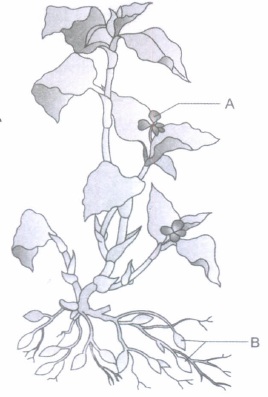
Identify the types of flowers A and B on the Commelina plant shown above.
(b) Mention the type(s) of pollination that can occur in each of them.
18.
Assertion: Perisperm is protective covering of seed and helps in dispersal and nutrition.
Reason: Pericarp is covering of fruit which is non-functional.
Codes :
(a) Both assertion and reason are true and reason is the correct explanation of assertion
(b) Both assertion and reason are true but reason is not the correct explanation of assertion
(c) Assertion is true but reason is false
(d) Both assertion and reason are false
19.
Assertion (A) : Embryo sac development is monosporic in Polygonum.
Reason (R) : In this development, only one functional megaspore is present at chalazal end.
(a) If both A and R are true and R is correct explanation of A
(b) If both A and R are true, but R is not the correct explanation of A
(c) If A is true, but R is false
(d) If A is false, but R is true
1.
There are six haploid cells. They are: three antipodal cells, two synergids and one female gamete.
2.
1. In crop breeding programmes, pollen grains from the selected male parent only are used.
2. So, to prevent contamination of the stigma of the unisexual/female flower, they are bagged.
3.
The parts of pistil which develop into fruits and seed are ovary and ovules, respectively.
4.
Pea : Flowers of pea plants are bisexual, monoecious, self-pollinated (to produce pods with viable seeds).
Pea plant bears bisexual flowers. Therefore, the single pea plant can produce viable seeds after self-pollination. Papaya, on the other hand is a dioecious plant, bearing unisexual flowers that requires cross-pollination for viable seed production. Thus, they cannot produce viable seeds.
5.
(a) Albuminous seed-Castor, Coconut
Non-albuminous seed-Pea, groundnut.
(b) (i) Nucellus
(ii) Integuments
(iii) Primary endosperm cell
(iv) Zygote.
6.
| Male gametophyte | Female gametophyte |
| It is derived from a micros pore, which is produced inside the pollen chamber of anther. | It is derived from a megaspore, which is formed inside the nucellus of an ovule. |
| The micros pores are shed at maturity and transferred from anthers to stigma by the process called pollination. | The megaspores do not shed from the ovule. They develop to form embryo sac within the ovule. |
| The mature male gametophyte is 3-celled. | The mature female gametophyte is 7-celled. |
7.
1. Zygote and the primary endosperm nucleus are the products of double fertilisation.
2. Zygote is formed by the fusion of the female gamete and one of the male gametes, i.e. syngamy.
3. Primary endosperm nucleus is formed by the fusion of two polar nuclei (into a secondary nucleus) and one of the male gametes, i.e. triple fusion.
4. The endosperm development from the primary endosperm cell precedes that of the zygote, to provide assured nutrition to the embryo.
5. The zygote develops into the embryo after some amount of endosperm is formed.
8.
(c)
Sticky and rough pollens
9.
(d)
Hemitropous
10.
(a)
Nucellus or integuments
11.
(b)
Birds
12.
(d)
cleistogamy
13.
(b)
| A | B | C | D |
| 4 | 3 | 2 | 1 |
14.
(b)
15.
(i)Yes, there are plants with closed flower eg:Oxalis
(ii)Yes,such flower undergo self-pollination,The pollen from the anthers of same flower are transfered to the strigma of the same flower.
(iii)Such flower are called clistogamous flower
(iv)Kanchan is very curious about nature,active and lively in her life
16.
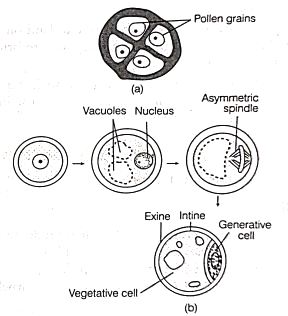
While the development of 2-celled pollen grain of an angiosperm within an anther, each cell of sporogenous tissue develops into a microspore mother cell, that undergoes the process of meiosis forming four cells that is microspore tetrad, and mature pollen grain contains two cells the vegetative cell along with the generative cell.
17.
(a) A - Chasmogamous flower
B - Cleistogamous flower
(b) A - Autogamy, geitonogamy and xenogamy
B - Autogamy only.
18.
(d) Perisperm is unused nucellus in the seed. It is often non-functional for seed. Pericarp is the covering of fruit that develops from ovary wall. It is protective covering and also helps in dispersal and nutrition.
19.
(a) If both A and R are true and R is correct explanation of A

12th Standard CBSE Syllabus & Materials
12th Standard CBSE
CBSE 12th Standard Biology Sexual Reproduction in Flowering Plants Sample Question Papers Study Material - QB365 Set 1
NEW12th Standard CBSE
CBSE 12th Chemistry d- and f- Block Elements Important Questions And Answers Study Material - QB365 Set B
NEW12th Standard CBSE
CBSE 12th Chemistry d- and f- Block Elements Important Questions And Answers Study Material - QB365 Set A
NEW12th Standard CBSE
CBSE 12th Chemistry Chemical Kinetics Important Questions And Answers Study Material - QB365 Set B



NCERT Books

Syllabus

Exam Pattern

Sample Question Papers

Previous year Question Papers

Important Notes

MCQ Practice test

NCERT Exemplers

Case study Questions

Image Based Questions

Passage based Questions

HOT Questions

Value Based Questions

Model Questions Papers
NCERT ( Book Back ) Questions

Assertion and Reason
Important Questions And Answers

CBSE 12th Standard CBSE Subjects
CBSE Standards