
 100% FREE ACCESS
12th Standard Syllabus & Materials
12th Standard
TN 12th Computer Applications மின்னணு தரவு பரிமாற்றம் Sample Question Papers Study Material - QB365 Set A
NEW12th Standard
TN 12th Computer Applications மின் - வணிக பாதுகாப்பு அமைப்புகள் Sample Question Papers Study Material - QB365 Set A
NEW12th Standard
TN 12th Computer Applications மின்னணு செலுத்தல் முறைகள் Sample Question Papers Study Material - QB365 Set A
NEW12th Standard
TN 12th Computer Applications மின் - வணிகம் Sample Question Papers Study Material - QB365 Set A
NEW12th Standard
TN 12th Computer Applications திறந்த மூல கருத்துருக்கள் Sample Question Papers Study Material - QB365 Set A
NEW12th Standard
TN 12th Computer Applications வலையமைப்பு வடமிடல் Sample Question Papers Study Material - QB365 Set A

Published on: 28/11/2025
Download Tamil Nadu 12th Standard Chemistry question papers, model tests, one-mark questions, important questions, and public exam papers in PDF format. Free study materials and answer keys for TN State Board students.
Questions + Answers key
Take MCQ Chemistry Test
1.
Novolac is a _______ polymer of phenol and formaldehyde.
Linear
Cross linked
Soft and Stretchy
Addition
2.
Which one is anionic complex?
[Ag(CN)2]-
[Ag(NH3)2]+
[Ni(CO4)]
[Co(NH3)6]3+
3.
It can be obtained in small quantities by the reaction of Iodine with sodium borohydride in diglyme_______.
Boric acid
Borax
Diborane
Both (a) & (b)
4.
The emf of the cell is measured in _______.
ohm
amperes
volts
coulomb
5.
The test to distinguish HCOOH and CH3COOH is/are ________.
Tollens reagent test
Litmus test
Sodium bicarbonate test
Both (b) and (c)
6.
Glucose is an aldose. Which one of the following reactions is not expected with glucose?
It does not form oxime
It does not react with Grignard reagent
It does not form osazones
It does not reduce tollens reagent
7.
Aniline + benzoylchloride \(\overset { NaOH }{ \longrightarrow } \)C6H5 - NH - COC6 H5 this reaction is known as ______.
Friedel – crafts reaction
HVZ reaction
Schotten – Baumann reaction
none of these
8.
The reaction

Can be classified as ______.
dehydration
Williams on alcoholsynthesis
Williamson ether synthesis
dehydrogenation of alcohol
9.
Hair cream is _____.
gel
emulsion
solid sol
sol.
10.
The solubility of AgCl (s) with solubility product 1.6 × 10⁻¹⁰ in 0.1M NaCl solution would be _______.
1.26 × 10⁻⁵M
1.6 × 10⁻⁹M
1.6 × 10⁻¹¹M
Zero
11.
For the reaction \({ N }_{ 2 }{ O }_{ 5 }\left( g \right) \longrightarrow { 2NO }_{ 2 }\left( g \right) +\frac { 1 }{ 2 } { O }_{ 2 }\left( g \right) \) value of rate of disappearance of N2O5 is given as 6.5 x 10⁻² mol L-1s-1. The rate of formation of NO2 and O2 is given respectively as_____.
(3.25 x 10⁻² mol L-1s-1) and (1.3 x 10⁻² mol L-1s-1)
(1.3 x 10⁻² mol L-1s-1) and (3.25 x 10⁻² mol L-1s-1)
(1.3 x 10⁻¹ mol L-1s-1) and (3.25 x 10⁻² mol L-1s-1)
None of these
12.
13.
Which one of the following ions has the same number of unpaired electrons as present in V3+?
Ti3+
Fe3+
Ni2+
Cr3+
14.
On hydrolysis, PCl3 gives________.
H3PO3
PH3
H3PO4
POCl3
15.
Which of the metal is extracted by Hall-Heroult process?
Al
Ni
Cu
Zn
16.
Why is acid anhydride preferred to acyl chloride for carrying out acylation reactions?
17.
What happens when 1-phenyl ethanol is treated with acidified KMnO4.
18.
Arrange the following solutions in the decreasing order of specific conductance.
i) 0.01M KCl
ii) 0.005M KCl
iii) 0.1M KCl
iv) 0.25M KCl
v) 0.5M KCl
19.
Ksp of Al(OH)3 is 1\(\times\)10-15M. At what pH does 1.0×10⁻³M Al3+ precipitate on the addition of buffer of NH4Cl and NH4OH solution?
20.
Write a note on co –polymer
21.
Justify the position of lanthanoids and actinoids in the periodic table.
22.
Explain briefly seven types of unit cell.
23.
A hydride of 2nd period alkali metal (A) on reaction with compound of Boron (B) to give a reducing agent (C). Identify A, B and C.
24.
25.
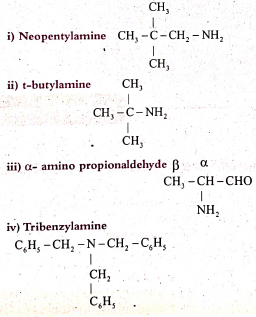
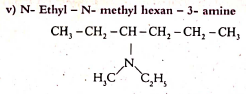
Draw the structure of the following compounds
i. Neopentylamine
ii. Tert – butylamine
iii. α- amino propionaldehyde
iv. Tribenzylamine
v. N – ethyl – N – methylhexan – 3- amine
26.
Identify A, B, C and D
\(\text { ethanoic acid } \stackrel{\mathrm{SOCl}_{2}}{\longrightarrow} \mathrm{A} \stackrel{\mathrm{Pd} / \mathrm{BaSO}_{4}}{\longrightarrow} \mathrm{B} \stackrel{\mathrm{NaOH}}{\longrightarrow} \mathrm{C} \stackrel {\longrightarrow}{\triangle} \mathrm{D}\)
27.
Explain intermediate compound formation theory of catalysis with an example.
28.
What type of linkages hold together monomers of DNA?
29.
Discuss briefly the nature of bonding in metal carbonyls.
30.
Give the balanced equation for the reaction between chlorine with cold NaOH and hot NaOH.
31.
Differentiate crystalline solids and amorphous solids.
32.
Describe briefly allotropism in p- block elements with specific reference to carbon.
33.
Explain the principle of electrolytic refining with an example.
34.
Write the equation for the extraction of silver by leaching with sodium cyanide and show that the leaching process is a redox reaction.
35.
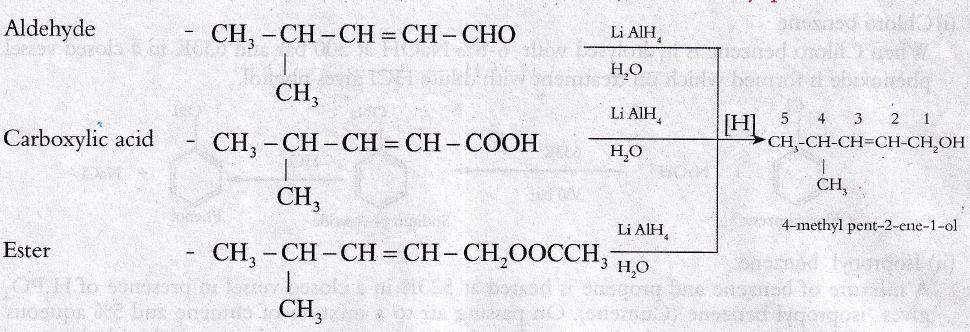
Write the structure of the aldehyde, carboxylic acid and ester that yield 4- methylpent -2-en-1-ol.
36.
Give two important characteristics of physisorption.
37.
Is it possible to store copper sulphate in an iron vessel for a long time?
Given : \(E^{0}_{Cu^{2+}|Cu} = 0.34\) V and \(E^{0}_{Fe^{2+}|Fe} = -0.44\)V.
38.
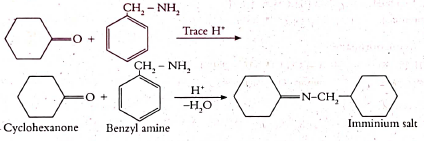
Complete the following reaction
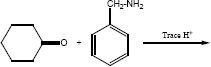
39.
Name the Vitamins whose deficiency cause i) rickets ii) scurvy
40.
41.
What is crystal field stabilization energy (CFSE)?
42.
Chalcogens belongs to p-block. Give reason.
1.
(a)
Linear
2.
(a)
[Ag(CN)2]-
3.
(c)
Diborane
4.
(c)
volts
5.
(a)
Tollens reagent test
6.
(b)
It does not react with Grignard reagent
7.
(c)
Schotten – Baumann reaction
8.
Cyclic alcolhol → sodium cyclic alkoxide- Williamson ether synthesis.
9.
Emulsion-Dispersed phase
Dispersion meduun -liquid
10.
AgCl(s) ⇌ Ag+(aq) + Cl-(aq)
NaCl → Na+ +Cl-
0.1M 0.1M 0.1M
Ksp = 1.6 × 10⁻¹⁰
Ksp = [Ag+][ Cl-]
Ksp = (s) (s + 0.1)
0.1 >>> s
∴ s + 0.1 = 0.1
∴ s = 1.6 × 10⁻¹⁰/ 0.1 = 1.6 × 10⁻⁹
11.
Rate \(=\frac { d\left[ { N_2O_5 } \right] }{ dt } =\frac { 1 }{ 2 } =\frac { d\left[ { NO}_{ 2 } \right] }{ dt } =\frac { 2d\left[ { O }_{ 2 } \right] }{ dt } \)
Given that \(=\frac { d\left[ { N_2O_5 } \right] }{ dt } \) =6.5 x 10⁻² mol L-1 s-1
\(=\frac { d\left[ { NO}_{ 2 } \right] }{ dt }\) =2 x 6.5 x 10-2 = 1.3 x 10⁻¹ mol L-1 s-1
\(=\frac { d\left[ { O}_{ 2 } \right] }{ dt }\)\(=\frac{6.5 \times 10^{-2}}{2}\) = 3.25 x 10⁻² mol L-1s-1
12.
(c)
13.
(c)
Ni2+
14.
(a)
H3PO3
15.
(a)
Al
16.
Both are acetylating agents, but acylehloride gives pale fumes of hydrogen chloride also, Hence acid anhydride are preferred. Acid anhydride gives acetic acid as the by product in acylation reaction, lt will also help for further acylation.
17.
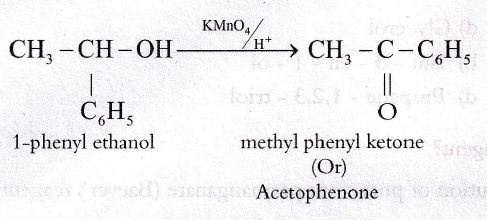
18.
1. \(\kappa=\mathrm{C}\left(\frac{1}{\mathrm{~A}}\right)\)
2. \(\operatorname{let} \frac{l}{A}=x\)
i) \(0.01 \mathrm{M} \mathrm{KCl}: \kappa=0.01 x=10^{-2} x\)
ii) \(0.005 \mathrm{M} \mathrm{KCl}: \kappa=0.005 x=5 \times 10^{-3} x\)
iii) \(0.1 \mathrm{M} \mathrm{KCl} \quad: \kappa=0.1 x=10^{-1} x\)
iv) \(0.25 \mathrm{M} \mathrm{KCl}: \kappa=0.25 x=2.5 \times 10^{-1} x\)
v) \(0.5 \mathrm{M} \mathrm{KCl}: \mathrm{K}=0.5 x=5 \times 10^{-1} x\)
\(\therefore 5 \times 10^{-1} x>2.5 \times 10^{-1} x>10^{-1} x>10^{-2} x>5 \times 10^{-3} x\)
\((ie) 0.5 \mathrm{M} \mathrm{KCl}>0.25 \mathrm{M} \mathrm{KCl}>0.1 \mathrm{M} \mathrm{KCl}>0.01 \mathrm{M} \mathrm{KCl}>0.005 \mathrm{M} \mathrm{KCl}\)
19.
\(Al(OH)_{3}\rightleftharpoons Al^{3+}_{(aq)}+3OH^{-}_{(aq)}\)
\(K_{sp}=[Al^{3+}][OH^{-}]^{3}\)
Al(OH)3 precipitates when ionic product > Ksp
Ks = 1.0 \(\times\) 10-15m, [Al3+] = 1.0 \(\times\) 10-3m
1.0 \(\times\) 10-15 = [1.0 \(\times\) 10-3][OH-]3
\(\left[\mathrm{OH}^{-}\right]^3=\frac{1.0 \times 10^{-15}}{1.0 \times 10^{-3}}\)
[OH-]3 = 1.0 \(\times\) 10-12
(or)
[OH-]3 = 10-4M
[H+][OH-] = 10-4M
[H+] = \(\frac{10^{14}}{10^{-4}}\) =10-10
Here,
pH = 10
ie., At pH = 10, Al(OH)3 gets precipitated on the addition of NH4Cl & NH4OH solution.
20.
(i) A polymer containing two or more different kinds of monomer units is called a copolymer.
(ii) For example, SBR rubber(Buna-S) contains styrene and butadiene monomer units.
(iii) Copolymers have properties quite different from the homopolymers.
(iv) Mixture of styrene and 1,3 butadiene to form a copolymer (Buna -S)
Preparation of Buna-S:
It is a co-polymer. It is obtained by the polymerisation of buta -1,3 - diene and styrene in the ratio 3: 1 in the presence of sodium.
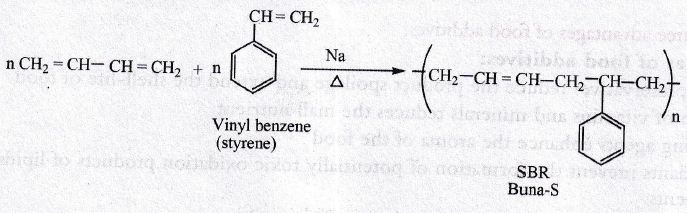
21.
(i) The actual position of Lanthanides in the periodic table is at group number 3 and period number 6. However, in the sixth period after lanthanum, the electrons are preferentially filled in inner 4f sub shell and these fourteen elements following lanthanum show similar chemical properties.
(ii) Similarly the fourteen elements following actinium resemble in their physical and chemical properties. Hence they are placed separately bottom of the modern periodic table.
22.
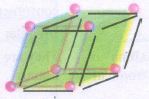
There are seven types of unit cell, Cubic, tetragonal, orthorhombic, hexagonal, monoclinic, triclinic and rhombohedral. They differ in the arrangement of their crystallographic axes and angles.
i) Cubic: a = b = c; α = β = ૪ = 90o.
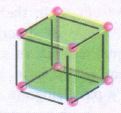
ii) Tetragonal: a = b ≠ c; α = β = ૪ = 90°.
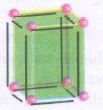
iii) Orthorhombic: a ≠ b ≠ c; α = β = ૪ = 90°.
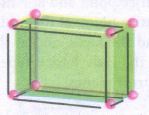
iv) Hexagonal: a = b ≠ c; α = β = 90o, ૪ = 120o.
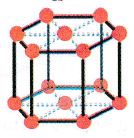
v) Monoclinic: a ≠ b ≠ c; α = ૪ = 90o, β ≠ 90o,
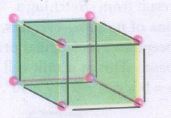
vi) Triclinic: a ≠ b ≠ c; α ≠ β ≠ ૪ ≠ 90o.
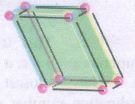
vii) Rhombohedral: a = b = c; α = β = ૪ ≠ 90o.
23.
A hydride of 2nd period alkali metal (A) is lithium hydride (LiH).
Lithium hydride (A) reacts with diborane (B) to give lithium borohydride (C) which is acts as a reducing agent.
B2H6 + 2 LiH \(\xrightarrow[]{ether}\) 2 LiBH4
[Diborane (B)] [Lithium hydride (A)] [Lithium borohydride (C)]
Result:
| Compound | Formula | Name |
| A | LiH | Lithium hydride |
| B | B2H6 | Diborane |
| C | LiBH4 | Lithium borohydride |
24.
25.
26.
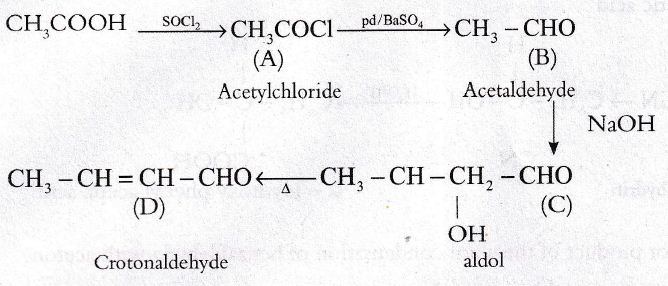
| Compound | Name |
| A | Acetylchloride |
| B | Acetaldehyde |
| C | 3 - Hydroxy butanal |
| D | Crotonaldehyde |
27.
The intermediate compound formation theory :
A catalyst acts by providing a new path with low energy of activation. In homogeneous catalysed reactions a catalyst may combine with one or more reactant to form an intermediate which reacts with other reactant or decompose to give products and the catalyst is regenerated.
Consider the reactions :
A+B➝AB; C is the catalyst .............(1)
A + C ➝ AC (intermediate) ..........(2)
AC + B ⟶ AB + C ...............(3)
Example 1:
The mechanism of Fridel crafts reaction is given below
\({ C }_{ 6 }{ H }_{ 6 }+{ { CH }_{ 3 }Cl\overset { anhydrous\\ { AlCl }_{ 3 } }{ \longrightarrow } }{ C }_{ 6 }{ H }_{ 5 }{ CH }_{ 3 }+HCl\)
The action of catalyst is explained as follows
CH3Cl + AlCl3 ⟶ [CH3]+ [AlCl4]-
It is an intermediate.
\({ C }_{ 6 }{ H }_{ 6 }+\left[ { CH }_{ 3 }^{ + } \right] \left[ { AlCl }_{ 4 } \right] ^{ - }\longrightarrow { C }_{ 6 }{ H }_{ 5 }{ CH }_{ 3 }+{ AlCl }_{ 3 }+Hcl\)
Example 2:
\({ { 2KClO }_{ 3 }\overset {\\ { MnO }_{ 3 } }{ \longrightarrow } }{ 2KCl }+{ 3O }_{ 2 }\)
Thermal decomposition of KCIO3 in the presence of MnO2 proceeds as follows. Steps in the reaction
2KCIO3 ⟶ 2KCI + 3O2 Can be given as
2KClO3 + 6MnO2 → 6MnO3 + 2KCl
It is an intermediate
6MnO3 → 6MnO2 + 3O2
Example 3:
Formation of water due to the reaction of H2 and O2 in the presence of Cu can be given as
H2 + 1/2O2 → H2O
2Cu + \(\frac{1}{2}\)O2 → Cu2O
It is an intermediate.
Cu2O + H2 → H2O + 2Cu
Advantages:
This theory describes
(a) The specificity of a catalyst and
(b) The increase in the rate of the reaction with increasc inthe concentration of a catalyst
Limitations:
(a) The intermediate compound theory fails to explain the action of catalytic poison and activators (promoters).
(b) This theory is unable to explain the mechanism of heterogeneous catalysed reactions.
28.
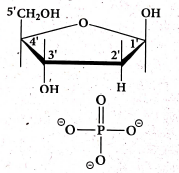
Watson & Crick proposed a 3-dimensional secondary structure of DNA. In this DNA molecule, Monomners of DNA are held together by Phosphodiester linkage. This linkages are occured in 5' & 3' carbon atoms of Pentose sugar.
29.
Bonding in metal carbonyls:
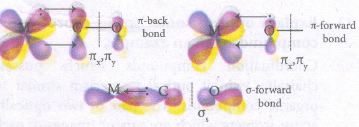
(i) In metal carbonyls, the bond between metal atom and the carbonyl ligand consists of two components.
(ii) The first component is an electron pair donation from the carbon atom of carbonyl ligand into a vacant d-orbital of central metal atom.
(iii) This electron pair donation forms \(M\overset { \sigma \ bond }{ \longleftarrow } \text {CO sigma bond}\)
(iv) This sigma bond formation increases the electron density in metal d orbitals and makes the metal electron rich.
(v) In order to compensate for this increased electron density, a filled metal d-orbital interacts with the empty \({ \pi }^{ \bigstar }\) orbital on the carbonyl ligand and transfers the added electron density back to the ligand.
(vi) This second component is called \(\pi\)-back bonding.
(vii) Thus in metal carbonyls, electron density moves from ligand to metal through sigma bonding and from metal to ligand through pi bonding, this synergic effect accounts for strong M⇽CO bond in metal carbonyls.
(viii) This phenomenon is shown diagrammatically as follows.
30.
Chlorine reacts with cold dilute alkali to give chloride and hypochlorite, while with hot concentrated alkali chlorides and chlorates are formed.
\(\mathrm{Cl}_{2}+\mathrm{H}_{2} \mathrm{O} \rightarrow \mathrm{HCl}+\underset{\text { Hypochlorous acid }}{\mathrm{HOCl}} \)
\(\mathrm{HCl}+\mathrm{NaOH} \rightarrow \mathrm{NaCl}+\mathrm{H}_{2} \mathrm{O} \)
\(\mathrm{HOCl}+\mathrm{NaOH} \rightarrow \mathrm{NaOCl}+\mathrm{H}_{2} \mathrm{O} \)
(Sodium hypo chlorite)
Overall Reaction
3Cl2 + 6NaOH \(\rightarrow\) NaClO3 + 5NaCl + 3H2O
(Sodium Chlorate)
31.
| S. No | Crystalline Solids | Amorphous Solids |
| 1. | Long range orderly arrangement of constituents. | Short range, random arrangement of constituents. |
| 2. | Definite shape | Irregular shape |
| 3. | Anisotropic in nature | They are "isotropic" like liquids |
| 4. | They are true solids | They are considered as pseudo solids (or) super cooled liquids |
| 5. | Definite Heat of fusion | Heat of fusion is not definite |
| 6. | They have sharp melting points. | Gradually soften over a range of temperature and so can be moulded. |
| 7. | Eg: NaCl, diamond etc. | Eg: Rubber, plastics, glass etc. |
32.
Allotropism:
1. Some elements exist in more than one crystalline or molecular forms in the same physical state
(a) In Greek "allos" means ⇒ Another
(b) "trope" means ⇒ Change
2. The different forms of an element are called allotropes.
Allotropy of carbon:
Carbon exists as diamond, graphite, fullerenes, carbon nanotubes and graphene.
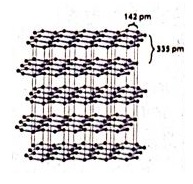
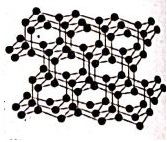
Graphite:
1. Graphite is the most stable allotropic form of carbon at normal temperature and pressure.
2. It is soft and conducts electricity.
3. It is composed of flat two dimensional sheets of carbon atoms.
4. Each sheet is a hexagonal.
5. It is "sp2" hybridised.
6. C-C bond length is 1.41 Å
7. Each C-atom forms three σ bonds with three neighbouring carbon atoms using three of its valence electrons and the fourth electron present in the unhybridised p-orbital form a π-bond.
8. The successive C-sheets are held together by weak Vander Waals forces.
9 The distance successive sheet is 3.40 Å.
10. It is used as a lubricant either on its own or as a graphited oil.
Diamond:
1. It is very hard.
2. It is "sp3" hybridised.
3. C-C bond length is 1.54 Å
4. It is used for sharpening hard tools, cutting glasses, making bores and rock drilling.
Fullerenes:
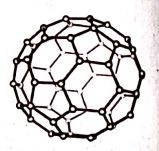
1. These allotropes are discrete molecules such as \(C_{32}, C_{50}, C_{60}, C_{70}, C_{76}\) etc.
2. It has cage like structure
3. The C60 molecules have a "soccer" ball like structure and is called buckminster fullerene or buckyballs.
4. It has a fused ring structure consists of 20 six membered rings and 12 five membered ring.
5. Each carbon atom is "sp2" hybridised.
6. It has three σ bonds and a delocalised π bond giving aromatic character to these molecules.
7. The C-C bond distance is 1.44 Å
8. The C=C bond distance is 1.38 Å.
Carbon nanotubes:
1. Carbon nanotubes, another recently discovered allotropes, have graphite like tubes with fullerene ends.
2. Along the axis, these nanotubes are stronger than steel and conduct electricity.
3. These have many applications in nanoscale electronics, catalysis, polymers and medicine.
Graphene:
It has a single planar sheet of "sp2" hybridised carbon atoms that are densely packed in a "honeycomb crystal" lattice.
33.
1. The crude metal is refined by electrolysis. It is carried out in an electrolytic cell
Anode : Impure metal to be refined with dilute acid.
Cathode : Thin strips of pure metal
Electrolyte : Aqueous solution of the salts of the metal with dilute acid.
2. The metal dissolves from the anode, pass into the solution.
3. At the same amount of metal ions from the solution will be deposited at the cathode.
4. During electrolysis, the less electropositive impurities in the anode, settle down at the bottom and are removed as anode mud.
Example: Electrolytic refining of silver.
Cathode: Pure silver
Anode: lmpure silver rods
Electrolyte: Acidified aqueous solution of silver nitrate
5. When a current is passed through the electrodes the following reactions will take place
(a) Reaction at anode: \({ Ag }_{ (s) }\longrightarrow { Ag }^{ + }_{ (aq) }+{ 1e }^{ - }\)
(b) Reaction at cathode: \({ Ag }^{ + }_{ (aq) }+{ 1e }^{ - }\longrightarrow { Ag }_{ (s) }\)
6. During electrolysis, at anode silver loses electrons and form silver ions and the silver ions migrate towards the cathode and get discharged and deposited on the cathode.
7. Copper, Zinc etc can also be refined by this process.
34.
Ag₂S + 4NaCN ⇌ 2NalAg(CN)₂] + Na₂S
Sodium Argento cyanide
2Na[Ag(CN)₂] + Zn → Na₂[Zn(CN)4] + 2Ag↓
Silver is obtained by the reduction of sodium Argento cyanide with zinc. At the same time zinc gets oxidised into its complex. Hence leaching process is a redox reaction.
35.
36.
(i) It is instantaneous.
(ii) It is non-specific.
(iii) No transfer of electrons.
(iv) Multilayer of adsorbate is formula.
37.
\((E^{0}_{ox})_{Fe^{2+}|Fe} = -0.44\) and
\((E^{0}_{red})_{Cu^{2+}|Cu} = 0.34\)
These +ve emf values shows that iron will oxidise and copper will get reduced i.e., the vessel will dissolve. Hence it is not possible to store copper sulphate in an iron vessel.
38.
39.
i) Rickets - Vitamin - D (Cholecalciferol - (D3) Ergocalciferol - (D2)
ii) Scurvy (bleeding gums) - vitamin - C (Ascorbic acid)
40.
41.
The CFSE is defined as the energy of the electronic configuration in the ligand field minus the energy of the electronic configuration in the isotropic field.
CFSE (\(\Delta\)Eo) = {ELf}-{Eiso}
={[nt2g(-0.4) + neg(0.6)]\(\Delta\)o + npP} - {n'pP}
Here, nt2g is the number of electrons in t2g orbitals;
neg is number of electrons in eg orbitals;
np is number of electron pairs in the ligand field; &
n'p is the number of electron pairs in the isotropic field (barycenter).
P - pairing energy
42.
(i) The Chalcogens belong to group (16).
(ii) The group consists of elements: Oxygen, Sulphur, Selenium, Tellurium and Polonium.
(iii) These are ore forming elements as most of the ores are oxides and sulphides.
(iv) Chalcos meaning 'ore formers'.

12th Standard Syllabus & Materials
12th Standard
TN 12th Computer Applications களப்பெயர் முறைமை (DNS) Sample Question Papers Study Material - QB365 Set A
NEW12th Standard
TN 12th Computer Applications வலையமைப்பு எடுத்துக்காட்டுகள் மற்றும் நெறிமுறைகள் Sample Question Papers Study Material - QB365 Set A
NEW12th Standard
TN 12th Computer Applications கணினி வலையமைப்பு ஓர் அறிமுகம் Sample Question Papers Study Material - QB365 Set A
NEW12th Standard
TN 12th Computer Applications PHP-உடன் MySQL-ஐ இணைத்தல் Sample Question Papers Study Material - QB365 Set A



Tamilnadu Stateboard 12th Standard Subjects

Maths
Chemistry

Physics

Biology

Computer Science

Business Maths and Statistics

Economics

Commerce

Accountancy

History

Computer Applications
Biology
Computer Technology
Computer Applications
Computer Science
Business Maths and Statistics
Commerce
Economics
Maths
Chemistry
Physics
Computer Technology
History
Accountancy

Tamil

English

French
Tamilnadu Stateboard Standards


