
 100% FREE ACCESS
12th Standard Syllabus & Materials
12th Standard
TN 12th Computer Applications மின்னணு தரவு பரிமாற்றம் Sample Question Papers Study Material - QB365 Set A
NEW12th Standard
TN 12th Computer Applications மின் - வணிக பாதுகாப்பு அமைப்புகள் Sample Question Papers Study Material - QB365 Set A
NEW12th Standard
TN 12th Computer Applications மின்னணு செலுத்தல் முறைகள் Sample Question Papers Study Material - QB365 Set A
NEW12th Standard
TN 12th Computer Applications மின் - வணிகம் Sample Question Papers Study Material - QB365 Set A
NEW12th Standard
TN 12th Computer Applications திறந்த மூல கருத்துருக்கள் Sample Question Papers Study Material - QB365 Set A
NEW12th Standard
TN 12th Computer Applications வலையமைப்பு வடமிடல் Sample Question Papers Study Material - QB365 Set A

Published on: 28/11/2025
Download Tamil Nadu 12th Standard Chemistry question papers, model tests, one-mark questions, important questions, and public exam papers in PDF format. Free study materials and answer keys for TN State Board students.
Questions + Answers key
Take MCQ Chemistry Test
1.
Find 'X' and 'Y'
\({ CH }_{ 3 }Br\underrightarrow { Na{ N }_{ 3 } } \underline { 'X' } ?\underrightarrow { LiAl{ H }_{ 4 } } \underline { 'Y' } ?\)
2.
Why does bleeding stop by rubbing moist alum
3.
What is the difference between a sol and a gel?
4.
There are two isomers with the formula CH3NO2. How will you distinguish between them?
5.
Write down the possible isomers of the C4H9NO2 give their IUPAC names.
6.
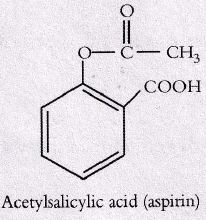
Write the structural formula of aspirin.
7.
What are antibiotics?
8.
Write the IUPAC name of [Cu(NH3)4]SO4
9.
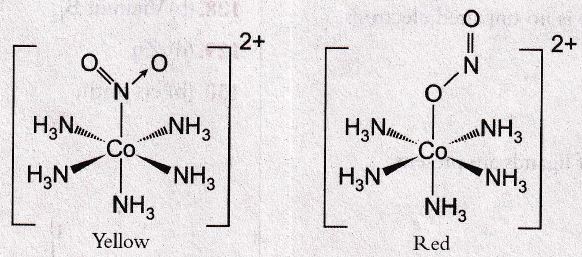
What is linkage isomerism? Explain with an example.
10.
Give an example of coordination compound used in medicine and two examples of biologically important coordination compounds.
11.
Write short notes on the following
ix. Gomberg reaction
12.
Write short notes on the following
iii. Gabriel phthalimide synthesis
13.
How double salt differs from co - ordination compounds?
14.
An Organic compound (A) with molecular formula C6H7N gives (B) with HNO2 / HCI at 273 K. The aqueous solution of (B) on heating gives compound (C) which gives violet colour with netural FeCI3. Identify the compounds (A), (B) and (C) and write the equations.
15.
Write a note on catalytic poison
16.
Addition of Alum purifies water. Why?
17.
How is terylene prepared?
18.
What are food preservatives?
19.
Give one test to differentiate [Co(NH3)5Cl]SO4 and [Co(NH3)5SO4]Cl.
20.
Based on VB theory explain why [Cr(NH3)6]3+ is paramagnetic, while [Ni(CN)4]2- is diamagnetic.
21.
\(\left[\mathrm{Ni}(\mathrm{CO})_{4}\right]\) is tetrahedral, but \(\left[\mathrm{Ni}(\mathrm{CN})_{4}\right]^{-4}\) is square planar. Explain it.
22.
Write a note on the reduction of nitro benzene under different conditions.
23.
Write the characteristics of catalysts.
24.
Explain intermediate compound formation theory of catalysis with an example.
25.
Differentiate physisorption and chemisorption.
26.
How will you distinguish between primary secondary and tertiary alphatic amines.
27.
Differentiate thermoplastic and thermosetting.
28.
What are narcotic and non – narcotic drugs. Give examples
29.
A solution of [Ni(H2O)6]2+ is green, whereas a solution of [Ni(CN)4]2- is colorless -Explain
30.
Write the postulates of Werner’s theory.
31.
Which one is Zeise's salt?
[Pt(NH3)4][PtCI4]
K[PtCI3(C2H4)]
[Pt(NH3)2]2+
None of these
32.
Oil of mirbane is ________
nitrobenzene
benzaldehyde
methyl salicylate
aspirin
33.
Regarding cross-linked or network polymers, which of the following statement is incorrect?
Examples are Bakelite and melamine
They are formed from bi and tri-functional monomers
They contain covalent bonds between various linear polymer chains
They contain strong covalent bonds in their polymer chain
34.
35.
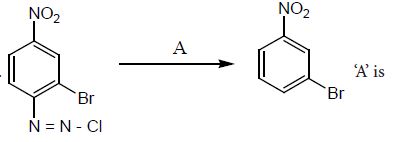 _______.
H3PO2 and H2O
H+/H2O
HgSO4/H2SO4
Cu2Cl2
36.
The order of basic strength for methyl substituted amines in aqueous solution is _________.
N(CH3)3> N(CH3)2H> N(CH3)H2> NH3
N(CH3)H2>N(CH3)2H > N(CH3)3>NH3
NH3> N(CH3)H2> N(CH3)2 H>N(CH3)3
N(CH3)2H>N(CH3)H2> N(CH3)3> NH3
37.
The product formed by the reaction an aldehyde with a primary amine ________.
carboxylic acid
aromatic acid
schiff ’s base
ketone
38.
Match the following
| a | Pure nitrogen | i | Chlorine |
| b | Haber process | ii | Sulphuric acid |
| c | Contact process | iii | Ammonia |
| d | Deacons Process | iv | Sodium azide (or) Barium azide |
Which of the following is the correct option?
| A | B | C | D |
| i | ii | iii | iv |
| A | B | C | D |
| ii | iv | i | iii |
| A | B | C | D |
| iii | iv | ii | i |
| A | B | C | D |
| iv | iii | ii | i |
39.
Which one of the following is an example for homogeneous catalysis?
manufacture of ammonia by Haber’s process
manufacture of sulphuric acid by contact process
hydrogenation of oil
Hydrolysis of sucrose in presence of all HCl
40.
Which one of the following is correctly matched?
Emulsion - Smoke
Gel - butter
foam - Mist
whipped cream - sol
41.
Which of the following is incorrect for physisorption?
reversible
increases with increase in temperature
low heat of adsorption
increases with increase in surface area
42.
Which is a double salt?
K2SO4AI2(SO4)324H2O
NaCI
K4[Fe(CN)6]
KCl
43.
Choose the correct statement.
Square planar complexes are more stable than octahedral complexes
The spin only magnetic moment of [Cu(Cl)4]2- is BM and it has square planar structure.
Crystal field splitting energy \(\left( { \Delta }_{ 0 } \right) \) [FeF6]4- is higher than the \((\Delta _{ 0 })\) of [Fe(CN)6]4-
crystal field stabilization energy of [V(H2O)6]2+ is higher than the crystal field stabilization of [Ti(H2O)6]2+
44.
As per IUPAC guidelines, the name of the complex [Co(en)2(ONO)Cl]Cl is _______.
chloro bis ethylenediamine nitrocobalt(III) chloride
chloridobis(ethane-1, 2-diamine)nitro K-O Cobaltate(III) chloride
chloridobis(ethane-1, 2-diammine)nitrito K-O Cobalt(II) chloride
chloridobis(ethane-1, 2-diamine)nitrito K-O Cobalt(III) chloride
45.
An excess of silver nitrate is added to 100ml of a 0.01M solution of Pentaaquachlorochromium (III)chloride. The number of moles of AgCl precipitated would be _______.
0.02
0.002
0.01
0.2
1.
\(\underset { Mehylbromide }{ { CH }_{ 3 }-Br } \underrightarrow { Na{ N }_{ 3 } } \underset { Methylazide }{ { CH }_{ 3 }-N_{ 3 } } \underrightarrow { LiAl{ H }_{ 4 } } \underset { Methylamine }{ { CH }_{ 3 }{ NH }_{ 2 }+{ N }_{ 2 } } \)
X is CH3N3 - Methyl azide
Y is CH3NH2 - Methyl amine
2.
(a) Blood is a colloidal sol. When we rub the injured part with moist alum, coagulation of blood takes place.
(b) Coagulation stops bleeding. Moist alum is an electrolyte.
3.
| S.no | Sol | Gel |
| (a) | The liquid state of collidal solution | The solid (or) semi solid stage of a colloidal solution. |
| (b) | Very low viscosity | Very high viscosity |
| (c) | It does not have definite structure. | It possesses definite structure. |
4.
a) Primary and secondary nitroalkanes, having α-H, also show an equilibrium mixture of two tautomers namely nitro - and aci - form
.JPG)
b) Difference:
| S.No | Nitro form | Aci - form |
| 1. | Less acidic in nature. | More acidic |
| 2. | Dissolves in NaOH slowly | Dissolves in NaOH instantly |
| 3. | Decolourises FeCl3 solution | With FeCl3 gives reddish brown colour |
| 4. | Electrical conductivity is low | Electrical conductivity is high |
5.
| Isomerism | Structural formula of isomers |
| Chain isomerism: They differ in the length of carbon chain. |
.JPG) |
| Position isomerism: They differ in the position of nitro group. |
.JPG) |
| Functional isomerism: Nitroalkanes exhibit functional isomerism with alkylnitrites |
\( \mathrm{CH}_{3} \mathrm{CH}_{2} \mathrm{CH}_{2} \mathrm{CH}_{2}-\mathrm{NO}_{2} \text { and } \mathrm{CH}_{3} \mathrm{CH}_{2} \mathrm{CH}_{2} \mathrm{CH}_{2}-\mathrm{O}-\mathrm{N}=\mathrm{O}\\ \quad 1 - nitrobutane \quad \quad \quad \quad \quad \quad \quad butyl \ nitrite\) |
6.
Aspirin is o-acetyl salicylic acid
7.
(i) Many micro organisms (bacteria, fungi and moulds) produce certain chemicals which inhibit the growth or metabolism of some other micro organism. Such chemicals are called antibiotics.
(ii) Eg: Penicillin from the mould penicillium notatum
8.
Tetraammine copper (II) sulphate.
9.
(i) This is also called as salt isomerism.
(ii) This type of isomers arises when an ambidentate ligand is bonded to the central metal atom/ion through either of its two different donor atoms. In the below mentioned examples, the nitrite ion is bound to the central metal ion Co3+ through a nitrogen atom in one complex and through oxygen atom in other complex.
\(\left[\mathrm{Co}\left(\mathrm{NH}_{3}\right)_{5}\left(\mathrm{NO}_{2}\right)\right]^{2+}\)
10.
Medicinal uses
(i) Ca-EDTA chelate, is used in the treatment of lead and radioactive poisoning.
(ii) That is for removing lead and radioactive metal ions from the body.
(iii) Cis-platin is used as an antitumor drug in cancer treatment.
Biological Importance compounds:-
(i) Fe2+ - porphyrin complex: It plays an important role in carrying oxygen from lungs to tissues and tissue carbon dioxide from to lungs.
(ii) Chlorophyll - useful in photosynthesis in plants.
11.
Gomberg reaction :
Benzene diazonium chloride reacts with benzene in the presence of sodium hydroxide to give biphenyl. This reaction in known as the Gomberg reaction

12.
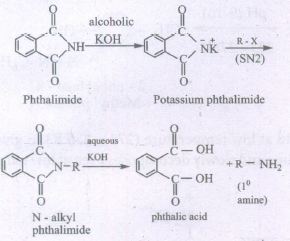
Gabriel phthalimide synthesis:
Gabriel synthesis is used for the preparation of Aliphatic primary amines. Phthalimide on treatment with ethanolic KOH forms potassium salt of phthalimide which on heating with alkyl halide followed by alkaline hydrolysis gives primary amine. Aniline cannot be prepared by this method because the arylhalides do not undergo nucleophilic substitution with the anion formed by phthalimide.
13.
(i) Doubles salts are those molecular or addition compounds which exist in a solid state but dissociate into constituents ions when dissolved in water. Ex: Mohr salt \(\mathrm{FeSO}_{4} .\left(\mathrm{NH}_{4}\right)_{2} \mathrm{SO}_{4} \cdot 6 \mathrm{H}_{2} \mathrm{O}\)
(ii) Coordination compounds are those molecular or addition compounds which retained their identity in aqueous solution and shows property entirely different from their constituent ions. Ex: Potassium ferrocyanide: \(\mathrm{K}_{4}\left[\mathrm{Fe}(\mathrm{CN})_{6}\right]\)
14.
(i) An organic compound (A) with molecular formula C6H7N is identified as Aniline C6H5NH2
(ii) Aniline on treatment with HNO2 / HCl at 273 K gives a clear solution of Benzene diazonium chloride C6H5N2CI the compound (B).
\({ C }_{ 6 }{ H }_{ 5 }{ NH }_{ 2 }+{ HNO }_{ 2 }\xrightarrow [ 273K ]{ NCl } \underset { Benzene \ diazonium \ chloride }{ { C }_{ 6 }{ H }_{ 5 }{ N }_{ 2 }Cl } \)
(iii) An aqueous solution of benzene diazonium chloride on heating gives phenol C6H5OH and it is compound (C).
\({ C }_{ 6 }{ H }_{ 5 }{ N }_{ 2 }Cl+{ HOH }\underrightarrow { \triangle } { C }_{ 6 }{ H }_{ 5 }OH-{ N }_{ 2 }+HCl\)
| A | C6H5NH2 | Aniline |
| B | C6H5N2Cl | Benzene diazonium chloride |
| C | C6H5OH | Phenol |
15.
(i) Certain substances when added to a catalysed reaction decreases or completely destroys the activity of catalyst and they are often known as catalytic poisons.
For example,
(ii) In the reaction, 2SO2 + O2 ⟶ 2SO3 with a Pt catalyst, the poison is As2O3
(iii) i.e., As2O3 destroys the activity of Pt. As2O3 blocks the activity of the catalyst. So, the activity is lost.
16.
(i) Purification of drinking water is activated by coagulation of suspended impurities in water by using alums containing \(\mathrm{Al}^{3+}\left(\mathrm{K}_{2} \mathrm{SO}_{4} \mathrm{Al}_{2}\left(\mathrm{SO}_{4}\right)_{3} \cdot 24 \mathrm{H}_{2} \mathrm{O}\right)\) Alum has a negative charge and tends to disperse in water very fast.
(ii) The increased size as well as the lack of repelling charges cause the alum particles to settle down at the bottom or rise up and float in water. After the particles are neutralized, they clump together because of the London dispersive force which are part of vander Waal's forces. The weak inter molecular force arising from quantum induced instantaneous polarisation multi poles in molecules causes even non polar particles to attract each other due to the corelated movements of the electrons in interacting molecules. Then they settle down.
17.
(i) Monomers :Ethylene glycol and terepathalic acid (or) dimethyl terephthalate.
(ii) Catalyst : Zinc acetate and antimony trioxide.
(iii) Temperature : 500 K
(iv) Product : Terylene

(v) Uses : blending with cotton or wool fibres and as glass reinforcing materials in safety helmets
18.
(i) Preservatives are chemicals added to food which are capable of inhibiting, retarding or arresting the process of fermentation, acidification or other decomposition of food by the growth of micro organisms (or)
(ii) Chemical substances which are added to food that prevents the spoilage of food materials by destroying the food - spoiling micro-organisms are called food preservatives.
(iii) Eg: sodium benzoate, NaCl, Acetic acid Sodium metabisulphite, potassium meta bisulphite etc.
19.
These two are ionisation isomers. [Co(NH3)5Cl]SO4 gives white precipitate with BaCl2 solution, but not with AgNO3 solution. [Co(NH3)5SO4]Cl gives curdy white precipitate with AgNO3 solution but not with BaCl2 solution.
20.
\(\text {(a) }\left[\mathrm{Cr}\left(\mathrm{NH}_{3}\right)_{6}\right]^{3+}:{ }_{24} \mathrm{Cr} \Rightarrow{ }_{18}[\mathrm{Ar}] 4 \mathrm{~s}^{2} 3 \mathrm{~d}^{4} \)
\({ }_{21} \mathrm{Cr}^{3+} \Rightarrow{ }_{18}[\mathrm{Ar}] 3 \mathrm{~d}^{3}\)
.JPG)
(i) d2sp3 hybridisation (octahedral)
(ii) It has three unpaired electrons (n = 3)
(iii) So it is paramagnetic
(iv) Magnetic moment \(\left(\mu_{\mathrm{s}}\right)=\sqrt{\mathrm{n}(\mathrm{n}+2)} \mathrm{BM}\)
\(=\sqrt{3(3+2)}=\sqrt{15}=3.87 \mathrm{BM}\)
\((b) \ \left[\mathrm{Ni}(\mathrm{CN})_{4}\right]^{2-:}{ }_{28} \mathrm{Ni} \Rightarrow[\mathrm{Ar}] 4 \mathrm{~s}^{2} 3 \mathrm{~d}^{8} ;{ }_{26} \mathrm{Ni}^{2+} \Rightarrow{ }_{18}[\mathrm{Ar}] 3 \mathrm{~d}^{8}\)
.JPG)
(i) dsp2 hybridisation
(ii) Geometry - square planar
(iii) No unpaired electrons- It is Diamagnetic
(iv) Magnetic moment (μs) = 0.
21.
(i) \(\left[\mathrm{Ni}(\mathrm{CO})_{4}\right]\)
.JPG)
Strong field ligand causes the pairing of 4s electron with 3d e- in the metal.
.JPG)
(i) sp3 hybridisation
(ii) n = 0
(iii) It is diamagnetic
(iv) Tetrahedral geometry
(v) Magnetic moment μs = 0
(ii) \(\left[\mathrm{Ni}(\mathrm{CN})_{4}\right]^{4-}\)
.JPG)
Strong field ligand causes the pairing of 3d electrons in their metal.
.JPG)
(i) Co-ordination number = 4
(ii) dsp2 hybridisation
(iii) Square planar complex
(iv) n = 0
(v) Hence diamagnetic
(vi) Magnetic moment \(\mu_{\mathrm{s}}=\sqrt{\mathrm{n}(\mathrm{n}+2)}=0\).
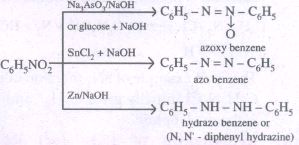
22.
(i) Strongly Acidic Medium: When reduced with tin and hydrochloric acid, aromatic nitro compounds are converted to aryl amines.
\({ C }_{ 6 }{ H }_{ 5 }{ NO }_{ 2 }+6[H]\xrightarrow [ or \ Fe/con.HCl ]{ Sn/con.HCl } \underset { Aniline }{ { C }_{ 6 }{ H }_{ 5 }{ NH }_{ 2 }+2 } { H }_{ 2 }Oor\)
(ii) Neutral Medium: When reduced with a neutral, reducing agents like zinc dust and aqueous ammonium chloride, aromatic nitro compounds form aryl hydroxylamines.
\({ C }_{ 6 }{ H }_{ 5 }{ NO }_{ 2 }+4[H]\xrightarrow [ ]{ Zn/{ NH }_{ 4 }Cl } \underset { Phenyl\quad hydroxylamine }{ { C }_{ 6 }{ H }_{ 5 }{ NH }OH+ } { H }_{ 2 }O\)
(iii) Alkaline Medium: In alkaline medium, Nitro benzene on reduction forms the intermediate products nitro so benzene (C6H5NO) and phenyl hydroxylamine (C6H5NHOH). These undergo bimolecular condensation reaction. According to the appropriate reducing agent in alkaline medium different products are obtained.
(iv) Catalytic Reduction: Lithium Aluminium hydride is a powerful hydride ion donor. So it reduces nitro benzene to Aniline. This reduction can also be carried out by H/Ni.
\({ C }_{ 6 }{ H }_{ 5 }{ NO }_{ 2 }\underrightarrow { LiAl{ H }_{ 4 } } { C }_{ 6 }{ H }_{ 5 }{ NH }_{ 2 }[Aniline]\)
\({ C }_{ 6 }{ H }_{ 5 }{ NO }_{ 2 }\frac { { N }_{ 2 }/Ni }{ Catalytic \ hydrognation } { C }_{ 6 }{ H }_{ 5 }{ NH }_{ 2 }\)
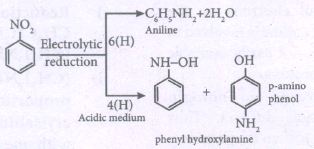
(v) Electrolytic Reduction: When nitro benzene is reduced electrolytically in presence of concentrated sulphuric acid, phenyl hydroxylamine is first produced which rearranges to give p-amino phenol.
23.
(i) For a chemical reaction, catalyst is needed in very small quantity.
(ii) There may be some physical changes, but the catalyst remains unchanged in mass and chemical composition in a chemical reaction.
(iii) A catalyst itself cannot initiate a reaction.
(iv) A solid catalyst will be more effective if it is taken in a finely divided form.
(v) A catalyst are specific in nature.
(vi) In an equilibrium reaction, presence of catalyst reduces the time for attainment of equilibrium and hence it does not affect the position of equilibrium and the value of equilibrium constant.
(vii) A catalyst is highly effective at a particular temperature called as optimum temperature.
(viii) Presence of a catalyst generally does not change the nature of products
24.
The intermediate compound formation theory :
A catalyst acts by providing a new path with low energy of activation. In homogeneous catalysed reactions a catalyst may combine with one or more reactant to form an intermediate which reacts with other reactant or decompose to give products and the catalyst is regenerated.
Consider the reactions :
A+B➝AB; C is the catalyst .............(1)
A + C ➝ AC (intermediate) ..........(2)
AC + B ⟶ AB + C ...............(3)
Example 1:
The mechanism of Fridel crafts reaction is given below
\({ C }_{ 6 }{ H }_{ 6 }+{ { CH }_{ 3 }Cl\overset { anhydrous\\ { AlCl }_{ 3 } }{ \longrightarrow } }{ C }_{ 6 }{ H }_{ 5 }{ CH }_{ 3 }+HCl\)
The action of catalyst is explained as follows
CH3Cl + AlCl3 ⟶ [CH3]+ [AlCl4]-
It is an intermediate.
\({ C }_{ 6 }{ H }_{ 6 }+\left[ { CH }_{ 3 }^{ + } \right] \left[ { AlCl }_{ 4 } \right] ^{ - }\longrightarrow { C }_{ 6 }{ H }_{ 5 }{ CH }_{ 3 }+{ AlCl }_{ 3 }+Hcl\)
Example 2:
\({ { 2KClO }_{ 3 }\overset {\\ { MnO }_{ 3 } }{ \longrightarrow } }{ 2KCl }+{ 3O }_{ 2 }\)
Thermal decomposition of KCIO3 in the presence of MnO2 proceeds as follows. Steps in the reaction
2KCIO3 ⟶ 2KCI + 3O2 Can be given as
2KClO3 + 6MnO2 → 6MnO3 + 2KCl
It is an intermediate
6MnO3 → 6MnO2 + 3O2
Example 3:
Formation of water due to the reaction of H2 and O2 in the presence of Cu can be given as
H2 + 1/2O2 → H2O
2Cu + \(\frac{1}{2}\)O2 → Cu2O
It is an intermediate.
Cu2O + H2 → H2O + 2Cu
Advantages:
This theory describes
(a) The specificity of a catalyst and
(b) The increase in the rate of the reaction with increasc inthe concentration of a catalyst
Limitations:
(a) The intermediate compound theory fails to explain the action of catalytic poison and activators (promoters).
(b) This theory is unable to explain the mechanism of heterogeneous catalysed reactions.
25.
| S.No | Physical adsorption or vander waals adsorption or Physisorption | Chemical adsorption or Chemisorption or Activated adsorption |
|---|---|---|
| 1. | It is instantaneous | It is very slow |
| 2. | It is non-specific | It is very specific depends on nature of adsorbent and adsorbate |
| 3. | In Physisorption, when pressure increases the amount of adsorption increases | Chemical adsorption is fast with increase pressure, it can not alter the amount. |
| 4. | Physisorption decreases with increase in temerature | When temperature is raised chemisorption first increases and then decreases |
| 5. | No transfer of electrons | Chemisorption involves transfer of electrons between the adsorbent and adsorbate |
| 6. | Heat of adsorption is low in the order of 40kJ/ mole. | Heat of adsorption is high i.e., from 40- 400kJ/mole. |
| 7. | Multilayer of the adsorbate is formed on the adsorbent. | Monolayer of the adsorbate is formed |
| 8. | It occurs on all sides | Adsorption occurs at fixed sites called active centres. It depends on surface area |
| 9 | Activation energy is insignificant. | Chemisorption involves the formation of activated complex with appreciable activation energy. |
26.
| S.No | Reagents or Reaction | Primary amine RNH2 | Secondary amine R2NH | Tertiary amine R3N |
|---|---|---|---|---|
|
1. |
Carbylamine reaction or with CHCl3/KOH |
Carbylamine is formed (unpleasant smell) |
- | - |
| 2. | Mustard oil reaction or CS2/HgCl2 (Hoffmann's mustard oil test) |
Alkyl isothiocyanate is formed (Mustard oil odour) |
- | - |
| 3. | HNO2 (or) NaNO2 / HCl |
Alcohol is formed +H2 | Yellow oily nitrosoamine is formed, insoluble in water. (Liberman's Test) |
Forms nitrite in cold, soluble in water. |
| 4. | CH3COCl | N-acetyl derivative is formed | N,N- diacetyl derivative is formed |
- |
| 5. | Diethyl oxalate Hoffmann's method |
Solid oxamide is formed | Liquid oxamic ester is formed |
- |
| 6. | Benzene sulphonyl chloride in presence of excess. KOH (Hinsberg's reaction) |
N- alkyl benzene sulphonamide is formed (soluble) |
N, N - dialkyl benzene sulphonamide is formed (Insoluble). |
- |
| 7. | With RX | 1 mol → 2o amine 2 mol → 3o amine 3 mol → Quarternary salt |
1 mol → 3o amine 2 mol → Quarternary salt |
1 mol → Quarternary salt |
27.
(i) Thermoplastic: They become soft on heating and hard on cooling. They can be remolded
E.g. polythene, PVC, polystrene
(ii) Thermo setting : Do not be come soft on heating set to an infusible mass upon heating.
E.g. bakelite, melamine, formaldehyde
28.
Narcotic drugs: [Opioids]
(i) These are narcotic analgesics. These relieve pain and produce sleep. These drugs are addictive. In poisonous dose, these produces coma and ultimately death.
(ii) They are used for either short-term or long term relief of severe pains. They are mainly used for post operative pain, pain of terminal cancer.
(iii) Eg: Morphine, Codeine
Non-narcotic drugs:
(i) These are non- narcotic analgesics. These reduce the pain without causing impairment of consciousness.
(ii) They alleviate pain by reducing local inflammatory responses.
(iii) These are used for short-term pain relief and for modest pain like headache, muscle strain, bruising or arthritis.
(iv) These drugs have many other effects such as reducing fever (antipyretic) and preventing platelet coagulation (eg. aspirin).
(v) These reduce fever by causing the hypothalamus to over ride a prostaglandin - induced increase in temperature.
(vi) Eg. Aspirin, Paracetamol, Ibuprofen. There are two types in it.
a) Anti inflammatory: eg: Aspirin, Paracetamol
b) Non steroidal anti -inflammatory drugs: (NSAIDs) eg: Ibuprofen
29.
[Ni (H2O)6]2+
.JPG)
It has two unpaired electrons. So there is d-d transition. Hence it is green coloured.
[Ni(CN)4]2-
.JPG)
There is no unpaired electrons. So it is colourless, as there is no d-d transition.
30.
Most of the elements exhibit, two types of valence namely primary valence and secondary valence and each element tend to satisfy both the valences.
The primary valence is referred the oxidation state of the metal atom.
The secondary valence as the coordination number. For example, according to Werner, the primary and secondary valences of cobalt are 3 and 6 respectively.
The primary valence of a metal ions ae always satisfied by negative ions.
For example in the complex CoCI3.6NH3. The primary valence of Co is +3 and is satisfied by 3CI- ions.
The secondary valence is satisfied by negative ions, neutral molecules, positive ions or the combination of these.
For example, in CoCl3.6NH3 complex primary valence of cobalt +3 and it is satisfied by 3 CI-.
The secondary valence of cobalt is 6 and is satisfied by six neutral ammonia molecules. where as in CoCI6.NH3.
Secondary valence of Co = 5{It is satisfied five neutral molecules and a Cl- ion}
According to Werner, there are two spheres of attraction around a metal atom/ion in a complex.
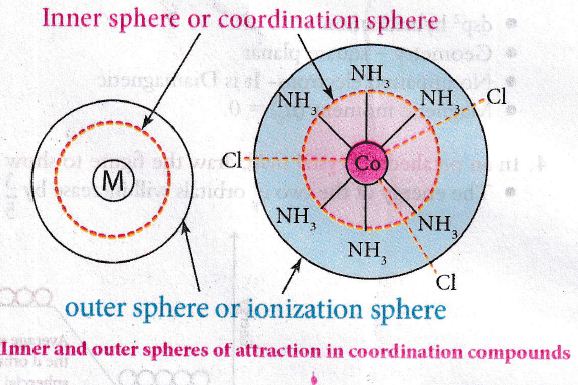
The inner /coordination sphere:
The groups present in this sphere are firmly attached to the metal.
The outer sphere / ionisation sphere:
The groups present in this sphere are loosely bound to the central metal ion and hence can be separated into ions upon dissolving the complex in a suitable solvent.
The primary valencies are non-directional. while the secondary valencies are directional.
The geometry of the complex is determined by the special arrangement of the groups which satisfy the secondary valence.
| Secondary valence | Geometry |
| 4 | Tetrahedral / Square planar |
| 6 | Octahedral |
31.
(b)
K[PtCI3(C2H4)]
32.
(a)
nitrobenzene
33.
(d)
They contain strong covalent bonds in their polymer chain
34.
(d)
35.
(a)
H3PO2 and H2O
36.
(d)
N(CH3)2H>N(CH3)H2> N(CH3)3> NH3
37.
(c)
schiff ’s base
38.
(d)
| A | B | C | D |
| iv | iii | ii | i |
39.
(d)
Hydrolysis of sucrose in presence of all HCl
40.
(b)
Gel - butter
41.
The incorrect statement is option (n)
Physisorption is an exothermic process. Hence increases in temperature decreases the Physisorption
42.
(a)
K2SO4AI2(SO4)324H2O
43.
(d)
crystal field stabilization energy of [V(H2O)6]2+ is higher than the crystal field stabilization of [Ti(H2O)6]2+
44.
(d)
chloridobis(ethane-1, 2-diamine)nitrito K-O Cobalt(III) chloride
45.
The complex is [M(H2O)5Cl]Cl2
1000 ml of 1 M solution of the complex gives 2 moles of Cl- ions 1000 ml of 0.01 M solution of the complex will give
\(\frac{100 ml \times 0.01M \times 2Cl^-}{1000 ml \times 1M}\)
= 0.002 moles of Cl- ions

12th Standard Syllabus & Materials
12th Standard
TN 12th Computer Applications களப்பெயர் முறைமை (DNS) Sample Question Papers Study Material - QB365 Set A
NEW12th Standard
TN 12th Computer Applications வலையமைப்பு எடுத்துக்காட்டுகள் மற்றும் நெறிமுறைகள் Sample Question Papers Study Material - QB365 Set A
NEW12th Standard
TN 12th Computer Applications கணினி வலையமைப்பு ஓர் அறிமுகம் Sample Question Papers Study Material - QB365 Set A
NEW12th Standard
TN 12th Computer Applications PHP-உடன் MySQL-ஐ இணைத்தல் Sample Question Papers Study Material - QB365 Set A



Tamilnadu Stateboard 12th Standard Subjects

Maths
Chemistry

Physics

Biology

Computer Science

Business Maths and Statistics

Economics

Commerce

Accountancy

History

Computer Applications
Biology
Computer Technology
Computer Applications
Computer Science
Business Maths and Statistics
Commerce
Economics
Maths
Chemistry
Physics
Computer Technology
History
Accountancy

Tamil

English

French
Tamilnadu Stateboard Standards


