
 100% FREE ACCESS
12th Standard Syllabus & Materials
12th Standard
TN 12th Computer Applications மின்னணு தரவு பரிமாற்றம் Sample Question Papers Study Material - QB365 Set A
NEW12th Standard
TN 12th Computer Applications மின் - வணிக பாதுகாப்பு அமைப்புகள் Sample Question Papers Study Material - QB365 Set A
NEW12th Standard
TN 12th Computer Applications மின்னணு செலுத்தல் முறைகள் Sample Question Papers Study Material - QB365 Set A
NEW12th Standard
TN 12th Computer Applications மின் - வணிகம் Sample Question Papers Study Material - QB365 Set A
NEW12th Standard
TN 12th Computer Applications திறந்த மூல கருத்துருக்கள் Sample Question Papers Study Material - QB365 Set A
NEW12th Standard
TN 12th Computer Applications வலையமைப்பு வடமிடல் Sample Question Papers Study Material - QB365 Set A

Published on: 22/08/2026
Download Tamil Nadu 12th Standard Chemistry question papers, model tests, one-mark questions, important questions, and public exam papers in PDF format. Free study materials and answer keys for TN State Board students.
Questions + Answers key
Take MCQ Chemistry Test
1.
Write the overall redox reaction which takes place in the galvanic cell,
Pt(s) | Fe2+(aq),Fe3+(aq) || MnO-4 (aq), H+ (aq),Mn2+ (aq) | Pt(s)
2.
What is Swern Oxidation?
3.
What is passivation?
4.
What is corrosion?
5.
What is meant by limiting molar conductivity?
6.
Explain Schotten - Baumann reaction.
7.
What happens when phenol is treated with diazonium chloride in presence of NaOH?
8.
A solution of silver nitrate is electrolysed for 20 minutes with a current of 2 amperes. Calculate the mass of silver deposited at the cathode.
9.
Define anode and cathode
10.
Explain about Galvanic cell notation.
11.
Write a note on Lucas test.
12.
How does glycerol react with KHSO4?
13.
Write a note on Friedel Crafts reaction of anisole.
14.
Explain the function of H2 - O2 fuel cell.
15.
Write Kolbe’s reaction.
16.
How is phenol prepared from
i) chloro benzene
ii) isopropyl benzene
17.
Can Fe3+ oxidises Bromide to bromine under standard conditions?
Given: \({ E }_{ { Fe }^{ 3+ }|{ Fe }^{ 2+ } }^{ 0 }=0.771V\); \(\\ { E }^{0}_{ { Br }_{ 2 }|{ Br }^{ - } }=1.09V\).
18.
State Faraday’s Laws of electrolysis
19.
Explain the electrophilic reactions of anisole.
20.
How will you distinguish the primary, secondary and tertiary alcohols by Victor Meyer's method?
21.
Explain SHE as a reference electrode.
22.
23.
Describe the construction of Daniel cell. Write the cell reaction.
1.
5Fe2+(aq) + MnO-4 (aq) + 8H+ (aq)
↓
5Fe2+(aq) + Mn2+(aq) + 4H2O (l)
2.
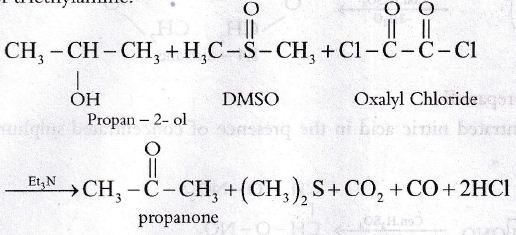
Swern Oxidation method, dimethyl sulfoxide (DMSO) is used as the oxidising agent, which converts alcohols to ketones / aldehydes. An alcohol is treated with DMSO and oxalyl chloride followed by the addition of triethylamine.
3.
The metal is treated with strong oxidising agents such as concentrated HNO3. As a result, protective oxide layer is formed on the surface of metal
4.
This redox process which causes the deterioration of metal is called corrosion.
5.
\({ { \Lambda }_{ m }^{ o } }\) is called the limiting molar conductivity. i.e., the molar conductance of a solution at infinite dilution.
6.
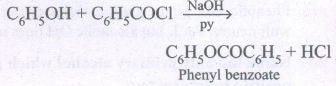
The reaction of phenols with benzoyl chloride in presence of sodium hydroxide to form benzoates is known as Schotten-Baumann reaction.
7.
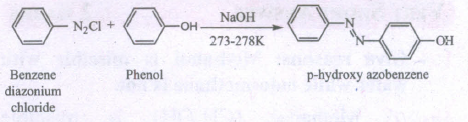
Phenol couples with benzene diazonium chloride in an alkaline solution to form p-hydroxy azobenzene (a red orange dye).
8.
Electrochemical reaction at cathode is Ag+ + e- → Ag (reduction)
m = ZIT
Z = \(\frac{\text {molar mass of Ag}}{(96500)}\) = \(\frac{108}{1 \times 96500} \)
I = 2A
t = 20 x 60S = 1200 S
It = 2A x 1200S = 2400C
m = \(\frac{108 gmol^{-1}}{96500 C mol^{-1}} \times\) 2400C
m = 2.68g
9.
(i) Anode: The electrode at which the oxidation occurs is called anode. (loss of electrons)
(ii) Cathode: The electrode at which the reduction occurs is called cathode. (gain of electrons)
10.
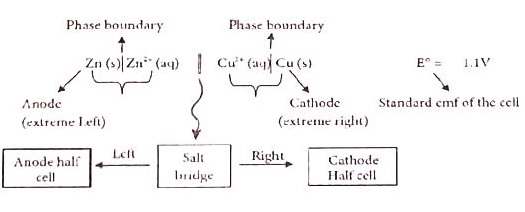
11.
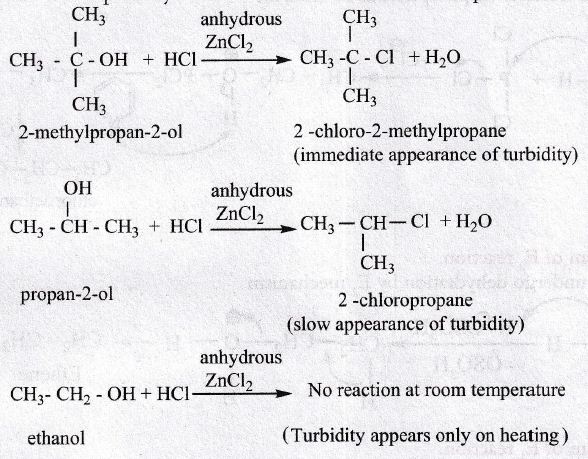
When alcohols are treated with Lucas agent (a mixture of concentrated HCl and anhydrous ZnCl2) at room temperature, tertiary alcohols react immediately to form a turbidity due to the formation of alkyl chloride which is insoluble in the medium. Secondary alcohols react within 10 minutes to form a turbidity of alkyl chloride where primary alcohols do not react at room temperature.
12.
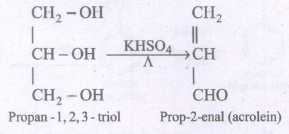
When glycerol is heated with dehydrating agents such as Con H2SO, KHSO4 etc .... , it undergoes dehydration to form acrolein.
13.
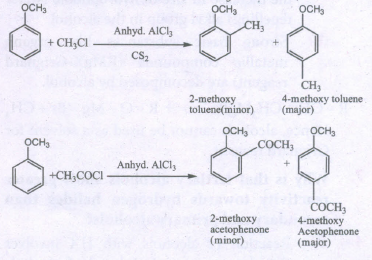
Anisole undergoes Friedel Craft's reaction in presence of anhydrous AlCl3 as a catalyst.
14.
(i) In this case, hydrogen act as a fuel and oxygen as an oxidant and the electrolyte is aqueous KOH maintained at 200oC and 20-40 atm. Porous graphite electrode containing Ni and NiO serves as the inert electrodes.
(ii) Hydrogen and oxygen gases are bubbled through the anode and cathode, respectively.
Oxidation occurs at the anode:
\(2 \mathrm{H}_{2(\mathrm{~g})}+4 \mathrm{OH}_{(a q)}^{-} \rightarrow 4 \mathrm{H}_{2} \mathrm{O}_{(l)}+4 \mathrm{e}^{-}\)
Reduction occurs at the cathode:
\(\mathrm{O}_{2(\mathrm{~g})}+2 \mathrm{H}_{2} \mathrm{O}_{(t)}+4 \mathrm{e}^{-} \rightarrow 4 \mathrm{OH}_{(\mathrm{aq})}^{-}\)
(iii) The overall reaction is \(2 \mathrm{H}_{2(\mathrm{~g})}+\mathrm{O}_{2(\mathrm{~g})} \rightarrow 2 \mathrm{H}_{2} \mathrm{O}_{(1)}\)
(iv) The above reaction is the same as the hydrogen combustion reaction, however, they do not react directly ie., the oxidation and reduction reactions take place separately at the anode and cathode respectively like H2-O2 fuel cell. Other fuel cells like propane -O2 and methane O2 have also been developed.
15.
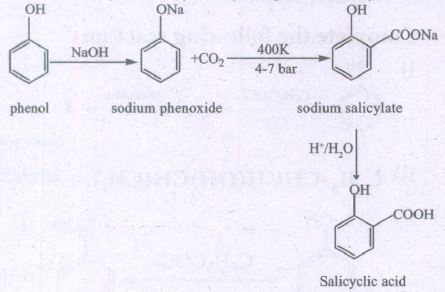
In this reaction, phenol is first converted into sodium phenoxide which is more reactive than phenol towards electrophilic substitution reaction with CO2, Treatment of sodium phenoxide with CO2 at 400 K, 4-7 bar pressure followed by acid hydrolysis gives salicylic acid.
16.
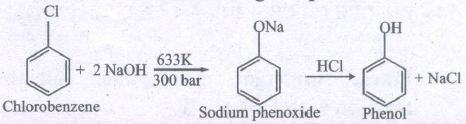
(i) Chloro benzene:
When Chlorobenzene is hydrolysed with 6-8% NaOH at 300 bar and 633K in a closed vessel, sodium phenoxide is formed which on treatment with dilute HCl gives phenol.
(ii) isopropyl benzene:
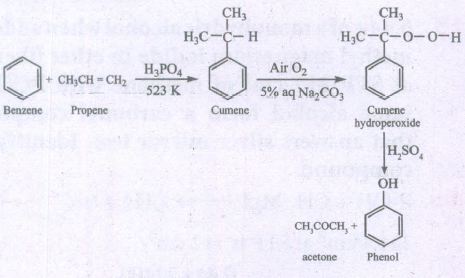
A mixture of benzene and propene is heated at 523K in a closed vessel in presence of H3PO4 catalyst gives cumene (isopropylbenzene). On passing air to a mixture of cumene and 5% aqueous sodium carbonate solution, cumene hydro peroxide is formed by oxidation. It is treated with dilute acid to get phenol and acetone. Acetone is also an important byproduct in this reaction.
17.
(i) The half cell reactions are :
\(2Br^{-} \rightarrow Br_{2}+2e^{-}\) \(E^{0}_{ox}=-1.09V\) ...(1)
\(2Fe^{3+}+2e^{-}\rightarrow2Fe^{2+}\) \(E_{\mathrm{Fe}^{3+} / \mathrm{Fe}^{2+}}^{0}=+0.771V\) ..(2)
(ii) Adding (1) of (2) :
\(2Fe^{3+}+2Br^{-}\rightarrow 2Fe^{2+}+Br_{2}\) \(E^{0}_{cell}=?\) ...(3)
\(E^{0}_{cell}=E^{0}_{ox}+E_{\mathrm{Fe}^{3+} / \mathrm{Fe}^{2+}}^{0}\)
= (-1.09 + 0.771)V
= -0.319V
(iii) E0cell is – ve; \(\Delta G\) is +ve and the cell reaction is non spontaneous.
(iv) Hence Fe3+ cannot oxidises Br- to Br2.
18.
First law:
The mass of the substance (m) liberated at an electrode during electrolysis is directly proportional to the quantity of charge (Q) passed through the cell.
m α Q \(\left[\because \mathrm{I}=\frac{\mathrm{Q}}{\mathrm{t}} \Rightarrow \mathrm{Q}=\mathrm{It}\right]\)
m α It
m = ZIt
Where Z = electro chemical equivalent of the substance
I = current
t = time of passage of current
Second law:
When the same quantity of charge is passed through the solutions of different electrolytes, the amount of substances liberated at the respective electrodes are directly proportional to their electrochemical equivalents.
m α Z
\(\frac{m_{1}}{Z_{1}}=\frac{m_{2}}{Z_{2}}\)
m = mass of the metal deposited
Z = electro chemical equivalent
19.
a) Bromination:
Anisole undergoes bromination with bromine in acetic acid even in the absence of a catalyst.
.JPG)
b) Nitration:
Anisole reacts with a mixture of Conc. H2SO4 /Conc.HNO3 to yield a mixture of ortho niro anisole and para nitro anisole.
.JPG)
c) Friedel Crafts reaction:
i) Friedel Crafts alkylation of anisole:
.JPG)
ii) Friedel Crafts acylation of anisole:
.JPG)
20.
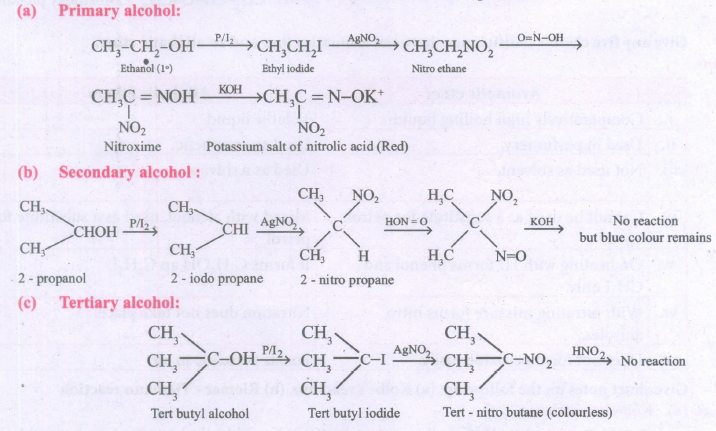
Victor Meyer's test:
This test is used to distinguish 1°, 2°, and 3° alcohols.
This test consists of the following steps:
(i) Alcohol is converted into alkyl iodide by treatment with P/I2.
(ii) The alkyl iodide is then converted into nitro alkane by silver nitrate (AgNO2).
(iii) The nitro alkane is treated with nitrous acid (HNO2) and then with aqueous KOH.
(iv) The 1°,2° and 3° alcohols are identified from the colour of the product.
21.
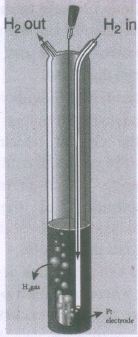
Standard Hydrogen Electrode (SHE) is used as the reference electrode. It has been assigned an arbitrarily emf of zero volt. It consists of a platinum electrode in contact with 1M HCI solution and 1atm hydrogen gas. The hydrogen gas is bubbled through the solution at 25°C. SHE can act as a cathode as well as an anode. The Half cell reactions are given below.
If SHE is used as a cathode, the reduction reactions is
2H+ (aq,1M) + 2e- ⟶ H2 (g, 1 atm) Eo= 0 volt
If SHE is used as an anode, the oxidation reaction is
H2 (g.1 atm) ⟶ 2H+ (aq, 1M) + 2e- Eo= volt
Illustration: Let us calculate the reduction potential of zinc electrode dipped in zinc sulphate solution using SHE.
Step 1: The following galvanic cell is constructed using SHE
Zn(s) | Zn2+ (aq,1M) || H+ (aq, 1M) | H2 (g, 1 atm)|pt(s)
Step 2: The emf of the above galvanic cell is measured using a volt meter. In this case, the measured emf of the above galvanic cell is 0.76V.
Calculation
We know that,
Eocell = (Eoox)Zn|Zn2+ + (Eored)SHE
Eocell = 0.79 and (Eored)SHE = 0V.
Substitute these values in the above equation
⇒ 0.76V = (Eoox) Zn|Zn2+ + 0V
⇒ (Eoox)Zn|Zn2+ = 0.76V
This oxidation potential corresponds to the below mentioned half cell reaction which takes place at the cathode.
Zn ⇾ Zn2+ + 2e- (Oxidation)
The emf for the reverse reaction will give the reduction potential
Zn2+ + 2e- ⇾ Zn; Eo= - 0.76V
∴ (Eoox)Zn2+|Zn = - 0.76V
22.
23.
1. Daniel cell is a galvanic cell. This is a voltaic cell also.
(a) The separation of half reaction is the basis for the construction of Daniel cell. It consists of two half cells.
(i) Oxidation half cell: A metallic zinc strip that dips into an aqueous solution of zinc sulphate taken in a beaker, as shown in Figure
(ii) Reduction half cell: A copper strip that dips into an aqueous solution of copper sulphate taken in a beaker, as shown in Figure
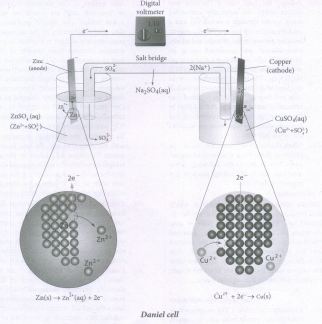
(iii) Joining the half cells:
(a) The zinc and copper strips are externally connected using a wire through a switch (k) and a load (example: volt meter). The electrolytic solution present in the cathodic and anodic compartment are connected using an inverted U tube containing a agar-agar gel mixed with an inert electrolyte such as KCI, Na2SO4 etc.,
(b) The ions of inert electrolyte do not react with other ions present in the half I cells and they are not either oxidised (or) reduced at the electrodes. The solution in the salt bridge cannot get poured out, but through which the ions can move into (or) out of the half cells.
(c) When the switch (k) closes the circuit, the electrons flows from zinc strip to copper strip. This is due to the following redox reactions which are taking place at the respective electrodes.
(iv) Anodic oxidation:
(i) zinc strip acts as the anode.
(ii) Here,oxidation occurs.
The electrode at which the oxidation occur is called the anode. In Daniel cell, the oxidation take place at zinc electrode, i.e., zinc is oxidised to Zn2+ ions and the electrons.
The Zn2+ ions enters the solution and the electrons enter the zinc metal, then flow through the external wire and then enter the copper strip.
Electrons are liberated at zinc electrode and hence it is negative (-ve).
\(Zn_{ (s) }\longrightarrow { { Zn }^{ 2+ }_{ (aq) }+{ 2e }^{ - } } \) (loss of electron-oxidation)
(v) Cathodic reduction:
As discussed earlier. the electrons flow through the circuit from zinc to copper, where the Cu2+ ions in the solution accept the electrons, get reduced to copper and the same get deposited on the electrode Here, the electrons are consumed and hence it is positive (+ve).
\({ Cu }_{ (aq) }^{ 2+ }+{ 2e }^{ - }\longrightarrow { { Cu }_{ (s) } } \)(gain of electron - reduction)
b) When a Zinc metal strip is placed in a copper sulphate solution, the blue colour of the solution fades and the copper is deposited on the zinc strip as red - brown crust due to the following spontaneous chemical reaction.
\(\mathrm{Zn}_{(\mathrm{s})}+\mathrm{CuSO}_{4(\mathrm{aq})} \rightarrow \mathrm{ZnSO}_{4(\mathrm{aq})}+\mathrm{Cu}_{(\mathrm{s})}\)
The energy produced in the above reaction is lost to the surroundings as heat.
In the above redox reaction, Zinc is oxidised to Zn2+ ions and the Cu2+ ions are reduced to metallic copper. The half reactions are represented as below.
\(\mathrm{Zn}_{(\mathrm{s})} \rightarrow \mathrm{Zn}^{2+}{ }_{(\mathrm{aq})}+2 \mathrm{e}^{-} \text {(oxidation) } \)
\(\mathrm{Cu}^{2+}{ }_{(\mathrm{aq})}+2 \mathrm{e}^{-} \rightarrow \mathrm{Cu}_{(\mathrm{s})} \text { (reduction) }\)
If we perform the above two half reactions separately in an apparatus as shown in figure, some of the energy produced in the reaction will be converted into electrical energy.

12th Standard Syllabus & Materials
12th Standard
TN 12th Computer Applications களப்பெயர் முறைமை (DNS) Sample Question Papers Study Material - QB365 Set A
NEW12th Standard
TN 12th Computer Applications வலையமைப்பு எடுத்துக்காட்டுகள் மற்றும் நெறிமுறைகள் Sample Question Papers Study Material - QB365 Set A
NEW12th Standard
TN 12th Computer Applications கணினி வலையமைப்பு ஓர் அறிமுகம் Sample Question Papers Study Material - QB365 Set A
NEW12th Standard
TN 12th Computer Applications PHP-உடன் MySQL-ஐ இணைத்தல் Sample Question Papers Study Material - QB365 Set A



Tamilnadu Stateboard 12th Standard Subjects

Maths
Chemistry

Physics

Biology

Computer Science

Business Maths and Statistics

Economics

Commerce

Accountancy

History

Computer Applications
Biology
Computer Technology
Computer Applications
Computer Science
Business Maths and Statistics
Commerce
Economics
Maths
Chemistry
Physics
Computer Technology
History
Accountancy

Tamil

English

French
Tamilnadu Stateboard Standards


