
 100% FREE ACCESS
12th Standard Syllabus & Materials
12th Standard
TN 12th Computer Applications மின்னணு தரவு பரிமாற்றம் Sample Question Papers Study Material - QB365 Set A
NEW12th Standard
TN 12th Computer Applications மின் - வணிக பாதுகாப்பு அமைப்புகள் Sample Question Papers Study Material - QB365 Set A
NEW12th Standard
TN 12th Computer Applications மின்னணு செலுத்தல் முறைகள் Sample Question Papers Study Material - QB365 Set A
NEW12th Standard
TN 12th Computer Applications மின் - வணிகம் Sample Question Papers Study Material - QB365 Set A
NEW12th Standard
TN 12th Computer Applications திறந்த மூல கருத்துருக்கள் Sample Question Papers Study Material - QB365 Set A
NEW12th Standard
TN 12th Computer Applications வலையமைப்பு வடமிடல் Sample Question Papers Study Material - QB365 Set A

Published on: 22/08/2026
Download Tamil Nadu 12th Standard Chemistry question papers, model tests, one-mark questions, important questions, and public exam papers in PDF format. Free study materials and answer keys for TN State Board students.
Questions + Answers key
Take MCQ Chemistry Test
1.
Write the expression for the solubility product of Ca3(PO4)2
2.
Derive integrated rate law for a zero order reaction A\(\longrightarrow \) product.
3.
Distinguish between hexagonal close packing and cubic close packing.
4.
Define ionic product of water. Give its value at room temperature.
5.
6.
Identify the order for the following reactions
(i) Rusting of Iron
(ii) Radioactive disintegration of 92U238
(iii) 2A+3B⟶ products ;rate = k[A]1/2[B]2
7.
Write the rate law for the following reactions.
(a) A reaction that is 3/2 order in x and zero order in y.
(b) A reaction that is second order in NO and first order in Br2.
8.
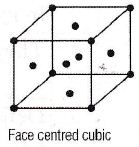
Calculate the number of atoms in a fcc unit cell.
9.
Derive an expression for Ostwald’s dilution law.
10.
Explain briefly the collision theory of bimolecular reactions.
11.
Calculate the percentage efficiency of packing in case of body centered cubic crystal.
12.
Which will make basic buffer?
50 mL of 0.1M NaOH+25mL of 0.1M CH3COOH
100 mL of 0.1M CH3COOH+100 mL of 0.1M NH4OH
100 mL of 0.1M HCl+200 mL of 0.1M NH4OH
100 mL of 0.1M HCl+100 mL of 0.1M NaOH
13.
The solubility of BaSO4 in water is 2.42 × 10⁻³gL-1 at 298K. The value of its solubility product(Ksp) will be (Given molar mass of BaSO4 =233g mol-1)
1.08 × 10⁻¹⁴mol2L-2
1.08 × 10⁻¹²mol2L-2
1.08 × 10⁻¹⁰mol2L-2
1.08 × 10⁻⁸mol2L-2
14.
Consider the following statements:
(i) increase in concentration of the reactant increases the rate of a zero order reaction.
(ii) rate constant k is equal to collision frequency A if Ea = 0
(iii) rate constant k is equal to collision frequency A if Ea = ∞
(iv) a plot of ln (k) vs T is a straight line.
(v) a plot of ln (k) vs \(\left( \frac { 1 }{ T } \right) \) is a straight line with a positive slope.
Correct statements are
(ii) only
(ii) and (iv)
(ii) and (v)
(i), (ii) and (v)
15.
Among the following graphs showing variation of rate constant with temperature (T) for a reaction, the one that exhibits Arrhenius behavior over the entire temperature range is _______.

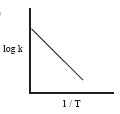
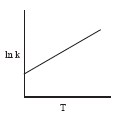
both (b) and (c)
16.
The number of unit cells in 8 gm of an element X (atomic mass 40) which crystallizes in bcc pattern is (NA is the Avogadro number)________.
6.023 x 10²³
6.023 x 10²²
60.23 x 10²³
\(\left( \frac { 6.023\times { 10 }^{ 23 } }{ 8\times 40 } \right) \)
17.
An ionic compound Ax By crystallizes in fcc type crystal structure with B ions at the centre of each face and A ion occupying corners of the cube the correct formula of Ax, By is ________.
AB
AB3
A3B
A8B6
1.
\(\mathrm{Ca}_{3}\left(\mathrm{PO}_{4}\right)_{2} \rightleftharpoons 3 \mathrm{Ca}^{2+}_{(aq)}+2 \mathrm{PO}_{4_{(aq)}}^{3-}\\\)
(s) (3s) (2s)
\(K_{sp}=[Ca^{2+}]^{3}[PO_{4}^{3-}]^{2}\)
\(K_{sp}=(3s)^{3}(2s)^{2}\)
\(K_{sp}=27s^{3}.4s^{2}\)
\(K_{sp}=108s^{5}\)
(or)
\(K_{s p} =m^{m} \cdot n^{n} \cdot(s)^{m+n} \)
\(K_{\text {sp }} =3^{3} \cdot 2^{2} \cdot(s)^{3+2} \)
\(K_{s p} =27 \times 4 \times(s)^{5} \)
\(=108(s)^{5}=108 s^{5}\)
2.
A reaction in which the rate is independent of the concentration of the reactant over a wide range of concentration is called a zero order reaction.
Let us consider the following by hypothetical zero order reaction.
A⟶ product
The rate law can be written as,
Rate = k[A]0
\(\frac { -d\left[ A \right] }{ dt } =k(1)\ \ \ \therefore \left( { \left[ A \right] }^{ 0 }=1 \right) \)
\(\Rightarrow -d\left[ A \right] =kdt\)
Integrate the above equation between the limits of [A0] at zero time and [A] at some later time 't',
\(-\int _{ \left[ { A }_{ 0 } \right] }^{ \left[ A \right] }{ d\left[ A \right] } =k\int _{ 0 }^{ t }{ dt } \)
\(-{ \left( \left[ A \right] \right) }_{ \left[ { A }_{ 0 } \right] }^{ \left[ A \right] }=k{ \left( t \right) }_{ 0 }^{ t }\)
[A0] - [A] = kt
\(k=\frac { \left[ { A }_{ 0 } \right] -\left[ A \right] }{ t } \)
Straight line equation y = mx + c
ie., \(\left[ A \right] =-kt+\left[ { A }_{ 0 } \right] \)
⇒ y = c + mx
A plot [A] vs time gives a straight line with a slope of -k and y intercept of [A0]
3.
| hcp structure | ccp structure | |
| 1. | This is 'aba' pattern of arrangement. | This is 'abc' pattern of arrangement. |
| 2. | The spheres can be arranged so as to fit into the depression in such a way that the third layer is directly over a first layer. | The third layer may be placed over the second layer in such a way that all the spheres of the third layer fit in octahedral voids. |
| 3. | The tetrahedral voids of the second layer are covered by the spheres of the third layer. | This arrangement of the third layer is different from other two layers and the stacking of layers continued. |
| 4. | 6 spheres are present | 4 spheres are present |
4.
(i) \(\mathrm{K}_{\mathrm{w}}=\left[\mathrm{H}_{3} \mathrm{O}^{+}\right]\left[\mathrm{OH}^{-}\right]=1 \times 10^{-14}\left(25^{\circ} \mathrm{C}\right)\)
(ii) Ionic product of water is defined as the product of the concentration of hydronium and hydroxide ions of pure water. Its value at 25oC is \(1 \times 10^{-14} \mathrm{~mol}^{2} \mathrm{dm}^{-2}\)
5.
6.
(i) First order reaction
(ii) First order reaction
(iii) \(\frac{1}{2}+2=2 \frac{1}{2}\); Pseudo first order reaction
7.
(a) Rate = \(k{ \left[ x \right] }^{ 3/2 }{ \left[ y \right] }^{ 0 }=k[x]^{3/2}\)
(b) 2NO + Br2 ⟶ 2NOBr
Rate = k[NO]2[Br2]
8.
Number of atoms in a fcc unit cell = \(\frac{N_{c}}{8}+\frac{N_{f}}{2}=\frac{8}{8}+\frac{6}{2}=1+3=4\)
9.
(i) Ostwald's dilution law relates the dissociation constant of the weak acid (Ka) with its degree of dissociation (α) and the concentration (c).
where \(\alpha=\frac{\text { Number of moles dissociated }}{\text { Total number of moles }}\)
(ii) The dissociation of acetic acid can be represented as
\(\mathrm{CH}_{3} \mathrm{COOH} \rightleftharpoons \mathrm{H}^{+}+\mathrm{CH}_{3} \mathrm{COO}^{-}\)
The dissociation constant of acetic acid is,
\({ K }_{ a }=\frac { \left[ { H }^{ + } \right] \left[ { CH }_{ 3 }COO^{ - } \right] }{ \left[ { CH }_{ 3 }COOH \right] } \) ........(1)
| CH3COOH | H+ | CH3COO- | |
| Initial number of moles | 1 | - | - |
| Degree of dissociation of CH3COOH | α | - | - |
| Number of moles at equilibrium | 1-α | α | α |
| Equilibrium concentration | (1-α)C | αC | αC |
Substituting the equilibrium concentration in equation (1)
\({ K }_{ a }=\cfrac { \left( \alpha C \right) \left( \alpha C \right) }{ \left( 1-\alpha \right) C } \)
\({ K }_{ a }=\cfrac { { \alpha }^{ 2 }C }{ 1-\alpha } \) .......(2)
(iii) We know that weak acid dissociates only to a very small extent compared to one, a is so small and hence in the denominator (1 - α) ⋍1. The above expression (2) now becomes,
ka =a2C \(\Rightarrow { \alpha }^{ 2 }=\cfrac { { k }_{ a } }{ C } \) ; \(\alpha =\sqrt { \cfrac { { K }_{ a } }{ C } } \)
(iv) When dilution increases, the degree of dissociation of weak electrolyte also increases. This is called Ostwald's dilution law
Also \(;\left[\mathrm{H}^{+}\right]=\alpha \mathrm{C}\) and \(\left[\mathrm{H}^{+}\right]=\left(\sqrt{\frac{\mathrm{K}_{\mathrm{a}}}{\mathrm{C}}}\right) \mathrm{C}=\sqrt{\frac{\mathrm{K}_{\mathrm{a}} \mathrm{C}^{2}}{\mathrm{C}}}=\sqrt{\mathrm{K}_{\mathrm{a}} \cdot \mathrm{C}}\)
Similarly for a weak base
\(\begin{aligned} & \mathrm{K}_{\mathrm{b}}=\alpha^2 \mathrm{C} ; \quad \therefore \alpha=\sqrt{\frac{\mathrm{k}_{\mathrm{b}}}{\mathrm{C}}}, \\ \end{aligned}\)
\(\begin{aligned} & {\left[\mathrm{OH}^{-}\right] \alpha \mathrm{C}=\sqrt{\frac{\mathrm{K}_{\mathrm{b}}}{\mathrm{C}}} \times \mathrm{C}=\sqrt{\frac{\mathrm{K}_{\mathrm{b}} \mathrm{C}^2}{\mathrm{C}}}=\sqrt{\mathrm{K}_{\mathrm{b}} \mathrm{C}}} \end{aligned}\)
10.
(i) Collision theory is based on the kinetic theory of gases. According to this theory, a chemical reaction occurs as a result of collisions between the reacting molecules.
(ii) Let us understand this theory by considering the following reaction.
A2(g) + B2(g) ⟶ 2AB(g)
(iii) If we consider that, the reaction between A2 and B2 molecules proceeds through collisions between them, then the rate would be proportional to the number of collisions per second.
(iv) Rate ∝ number of molecules colliding per litre per second (collision rate).
(v) The number of collisions is directly proportional to the concentration of both A2 and B2.
Collison rate ∝ [A2][B2]
Collision rate = Z [A2][B2]
(vi) Where, Z is a constant
(vii) A fraction of effective collisions (f) is given by the following expression
\(f={ e }^{ \frac { { -E }_{ a } }{ RT } }\)
(xiv) This fraction of collisions is further reduced due to orientation factor i.e., even if the reactant collides with sufficient energy, they will not react unless the orientation of the reactant molecules is suitable for the formation of the transition state.
(viii) The diagram illustrates the importance of proper alignment of molecules which leads to reaction.
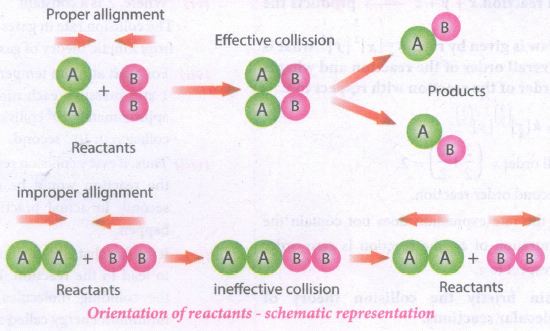
(ix) The fraction of effective collisions (f) having proper orientation is given by the steric factor p.
⇒ Rate = p x f x collision rate
\(\Rightarrow Rate=p\times { e }^{ \frac { -Ea }{ RT } }\times Z\left[ { A }_{ 2 } \right] \left[ { B }_{ 2 } \right] \quad ...(1)\)
As per the rate law,
Rate = \(k=\left[ { A }_{ 2 } \right] \left[ { B }_{ 2 } \right] \quad ...(2)\)
Where k is the rate constant
On comparing equation (1) and (2), the rate constant k is
\(k=pZ{ e }^{ \frac { -Ea }{ RT } }\)
11.
In bcc unit cell, ΔABC
AC2 = AB2 + BC2
\(AC=\sqrt { { AB }^{ 2 }+{ BC }^{ 2 } } \)
\(\\ AC=\sqrt { { a }^{ 2 }+{ a }^{ 2 } } =\sqrt { { 2a }^{ 2 } } =\sqrt { 2 } a\)

In ΔACG
AG2 = AC2 + CG2
\(AG=\sqrt { { AC }^{ 2 }+{ CG }^{ 2 } } \)
\(AG=\sqrt { { \left( \sqrt { 2a } \right) }^{ 2 }+{ a }^{ 2 } } \)
\(AG=\sqrt { { 2a }^{ 2 }+{ a }^{ 2 } } =\sqrt { { 3a }^{ 2 } } \)
\(AG=\sqrt { 3a } \)
\(\sqrt { 3 } a=4r\)
\(r=\frac { \sqrt { 3 } }{ 4 } a\)
∴ Volume of the sphere with radius 'r' \(=\frac { 4 }{ 3 } { \pi r }^{ 3 }\)
\(=\frac{4}{3}\pi { \left( \frac { \sqrt { 3 } }{ 4 } a \right) }^{ 3 }\)\(=\frac { \sqrt { 3 } }{ 16 } \pi { a }^{ 3 }\)
Number of spheres belong to a unit cell in BCC arrangement is equal to two and hence the total volume of all spheres.
(i) Packing fraction = \(=\frac{Total \quad volume \quad occupied \quad by \quad spheres \quad in \quad a \quad unit \quad cell}{volume \quad of \quad the \quad unit \quad cell}\times100\)
\(\therefore\)Volume of all spheres \(=2\times \left( \frac { \sqrt { 3 } \pi { a }^{ 3 } }{ 16 } \right) =\frac { \sqrt { 3 } \pi { a }^{ 3 } }{ 8 } \)
Packing fraction \(=\frac { \left( \frac { \sqrt { 3 } \pi { a }^{ 3 } }{ 8 } \right) }{ ({ a }^{ 3 }) } \times 100\)
\(=\frac { \sqrt { 3 } \pi }{ 8 } \times 100\)
\(\\ =\sqrt { 3 } \pi \times 12.5\)
= 1.732 x 3.14 x 12.5
= 68%
12.
Basic buffer is the solution which has weak base and its salt.
NH4OH + HCI → NH4CI +H2O + NH4OH
200 ml 100 ml salt 100 ml weak base
13.
BaSO4 ⇌ Ba2+ + SO42-
Ksp = (s) (s)
Ksp = (s)2
= (2.42 × 10⁻³gL-1)2
\(=\frac{2.42 \times 10^{-3} gL^{-1}}{233 \text{ g mol}^{-1}}\)
= (0.01038 x 10⁻³)2
= (1.038 x x 10-5)2
= 1.077 x 10-10
= 1.08 × 10⁻¹⁰mol2L-2
14.
(rate constant K is equal to collision frequency A if Ea = 0)
In zero order reactions, increase in the concentration of reactant does not alter the rate.
So statement (i) is wrong.
\(k=A{ e }^{ -\left( \frac { { E }_{ a } }{ RT } \right) }\)
if Ea = 0 so, statement (ii) is correct, and statement (iii) is wrong
k = Ae0
k = A
In k = In A - \({ \left( \frac { { E }_{ a } }{ R } \right) }\) \(\left( \frac { 1 }{ T } \right) \)
This equation is of the form of a straight line y = mx+c
A plot of In k Vs \(\left( \frac { 1 }{ T } \right) \) gives a straight line with a negative slope
So statement (iv) and (v) are wrong.
15.
\(k=A{ e }^{ -\left( \frac { { E }_{ a } }{ RT } \right) }\)
In k = In A - \({ \left( \frac { { E }_{ a } }{ R } \right) }\) \(\left( \frac { 1 }{ T } \right) \)
This equation is of the form of a straight line y = mx+c
A plot of In k Vs \(\left( \frac { 1 }{ T } \right) \) gives a straight line with a negative slope.
16.
In bcc unit cell,
2 atoms = 1 unit cell
Number of atoms in 8 g of element is, Number of moles = 8g / 40 g mol-1 = 0.2 mol
1 mole contains 6.023 x10²³ atoms
0.2 mole contains 0.2 x 6.023 x 1023 atoms
[1 unit cell / 2 atoms] x 0.2 x 6.023 x 1023
= 6.023 x 10²² unit cells.
17.
Number of A ions = Nc/8 = 8/8 = 1
Number of B ions = Nf/2 = 6/2 = 3
Simplest formula = AB3

12th Standard Syllabus & Materials
12th Standard
TN 12th Computer Applications களப்பெயர் முறைமை (DNS) Sample Question Papers Study Material - QB365 Set A
NEW12th Standard
TN 12th Computer Applications வலையமைப்பு எடுத்துக்காட்டுகள் மற்றும் நெறிமுறைகள் Sample Question Papers Study Material - QB365 Set A
NEW12th Standard
TN 12th Computer Applications கணினி வலையமைப்பு ஓர் அறிமுகம் Sample Question Papers Study Material - QB365 Set A
NEW12th Standard
TN 12th Computer Applications PHP-உடன் MySQL-ஐ இணைத்தல் Sample Question Papers Study Material - QB365 Set A



Tamilnadu Stateboard 12th Standard Subjects

Maths
Chemistry

Physics

Biology

Computer Science

Business Maths and Statistics

Economics

Commerce

Accountancy

History

Computer Applications
Biology
Computer Technology
Computer Applications
Computer Science
Business Maths and Statistics
Commerce
Economics
Maths
Chemistry
Physics
Computer Technology
History
Accountancy

Tamil

English

French
Tamilnadu Stateboard Standards


