
 100% FREE ACCESS
12th Standard Syllabus & Materials
12th Standard
TN 12th Computer Applications மின்னணு தரவு பரிமாற்றம் Sample Question Papers Study Material - QB365 Set A
NEW12th Standard
TN 12th Computer Applications மின் - வணிக பாதுகாப்பு அமைப்புகள் Sample Question Papers Study Material - QB365 Set A
NEW12th Standard
TN 12th Computer Applications மின்னணு செலுத்தல் முறைகள் Sample Question Papers Study Material - QB365 Set A
NEW12th Standard
TN 12th Computer Applications மின் - வணிகம் Sample Question Papers Study Material - QB365 Set A
NEW12th Standard
TN 12th Computer Applications திறந்த மூல கருத்துருக்கள் Sample Question Papers Study Material - QB365 Set A
NEW12th Standard
TN 12th Computer Applications வலையமைப்பு வடமிடல் Sample Question Papers Study Material - QB365 Set A

Published on: 28/11/2025
Download Tamil Nadu 12th Standard Chemistry question papers, model tests, one-mark questions, important questions, and public exam papers in PDF format. Free study materials and answer keys for TN State Board students.
Questions + Answers key
Take MCQ Chemistry Test
1.
What is Haber's process?
2.
What is the action of chromium on boron?
3.
Name the factors that affect adsorption.
4.
Give the empirical relationship between molar conductance and concentration of the electrolyte.
5.
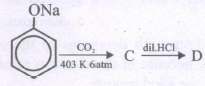
Identify the product C and D.
6.
Write a note on sacrificial protection.
7.
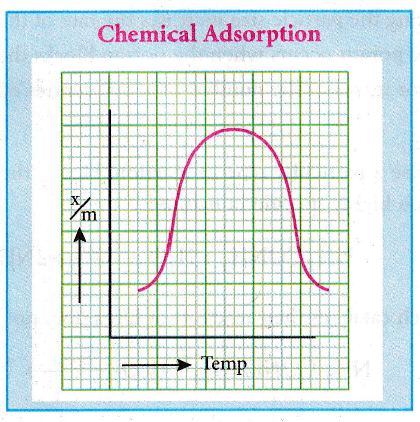
In case of chemisorption, why adsorption first increases and then decreases with temperature?
8.
Write the structure of all possible dipeptides which can be obtained form glycine and alanine
9.
What are Lewis acids and bases? Give two example for each.
10.
Rate constant k of a reaction varies with temperature T according to the following Arrhenius equation \(\log K=\log A-\frac { { E }_{ a } }{ 2.303R } \left( \frac { 1 }{ T } \right) \)Where Ea is the activation energy. When a graph is plotted for log k Vs \(\frac{1}{T}\) a straight line with a slope of -4000K is obtained. Calculate the activation energy.
11.
What are actinides? Give three examples.
12.
Write the IUPAC names for the following complexes.
13.
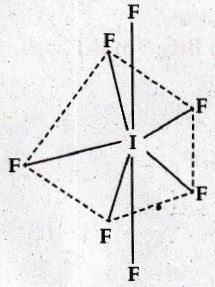
What is the hybridisation of iodine in IF7? Give its structure.
14.
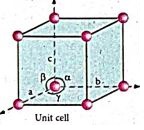
Define unit cell.
15.
16.
When acetaldehyde reacts with HCN followed by hydrolysis gives
acetic acid
formic acid
lactic acid
benzoic acid
17.
Conjugate acid of hydride ion is ________.
hydronium ion
hydroxide ion
hydrogen
water
18.
The correct corresponding order of names of four aldoses with configuration given below Respectively is ______.
L-Erythrose, L-Threose, L-Erythrose, D-Threose
D-Threose, D-Erythrose, L-Threose, L-Erythrose,
L-Erythrose, L-Threose, D-Erythrose, D-Threose
D-Erythrose, D-Threose, L-Erythrose, L-Threose
19.
C6H5NO2 \(\overset { Fe/Hel }{ \longrightarrow } A\overset { { NaNO }_{ 2 }/HCl }{ \underset { 273K }{ \longrightarrow } } B\overset { { H }_{ 2 }O }{ \underset { 283 }{ \longrightarrow } } C \) C' is _______.
C6H5 - OH
C6H5 - CH2OH
C6H5 - COH
C6H5NH2
20.
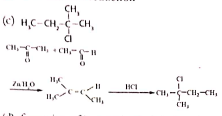
An alkene “A” on reaction with O3 and Zn - H2O gives propanone and ethanol in equimolar ratio. Addition of HCl to alkene “A” gives “B” as the major product. The structure of product “B” is ______.
\(Cl-{ CH }_{ 2 }-CH_{ 2 }-\overset { \overset { CH_{ 3 } }{ | } }{ \underset { \underset { CH_{ 3 } }{ | } }{ CH } } \)
\({ H }_{ 3 }C-{ CH }_{ 2 }-\overset { \overset { CH_{ 2 }Cl }{ | } }{ CH } -{ CH }_{ 3 }\)
\(\\ { H }_{ 3 }C-{ CH }_{ 2 }-\overset { \overset { CH_{ 3 } }{ | } }{ \underset { \underset { CL{ } }{ | } }{ C } } -{ CH }_{ 3 }\)
\({ H }_{ 3 }C-{ CH }-\overset { \overset { CH_{ 3 } }{ | } }{ \underset { \underset { Cl }{ | } }{ C } } \)
21.
On reacting with neutral ferric chloride, phenol gives ______.
red colour
violet colour
dark green colour
no colouration.
22.
Which one of the following characteristics are associated with adsorption?
\(\Delta\)G and \(\Delta\)H are negative but \(\Delta\)S is positive
\(\Delta\)G and \(\Delta\)S are negative but \(\Delta\)H is positive
\(\Delta\)G is negative but \(\Delta\)H and \(\Delta\)S are positive
\(\Delta\)G, \(\Delta\)H and \(\Delta\)S all are negative.
23.
Consider the following half cell reactions.
Mn2+ + 2e- ➝ Mn Eo = -1.18V
Mn2+ ➝ Mn3+ + e- Eo = -1.51V
The Eo for the reaction 3Mn2+➝ Mn + 2Mn3+, and the possibility of the forward reaction are respectively.
2.69V and spontaneous
-2.69 and non spontaneous
0.33V and Spontaneous
4.18V and non spontaneous
24.
Which of the following can act as Lowery – Bronsted acid well as base?
HCl
SO42−
HPO42−
Br-
25.
The crystal with a metal deficiency defect is ________.
NaCl
FeO
ZnO
KCl
26.
Formula of tris(ethane-1, 2-diamine)iron(II)phosphate _______.
[Fe(CH3-CH(NH2)2)3](PO4)3
[Fe(H2N-CH2-CH2-NH2)3](PO4)
[Fe(H2N-CH2-CH2-NH2)3](PO4)2
[Fe(H2N-CH2-CH2-NH2)3]3(PO4)2
27.
Which of the following oxidation states is most common among the lanthanoids?
+4
+2
+5
+3
28.
A white crystalline salt (A) react with dilute HCl to liberate a suffocating gas (B) and also forms a yellow precipitate. The gas (B) turns potassium dichromate acidified with dil H2SO4 to a green coloured solution(C). A, B and C are respectively ________.
Na2SO3, SO2, Cr2(SO4)3
Na2S2O3, SO2, Cr2(SO4)3
Na2S, SO2, Cr2(SO4)3
Na2SO4, SO2, Cr2(SO4)3
29.
Which of these is not a monomer for a high molecular mass silicone polymer?
Me3SiCl
PhSiCl3
MeSiCl3
Me2SiCl2
30.
P4O6 reacts with cold water to give _______.
H3PO3
H4P2O7
HPO3
H3PO4
31.
A metal complex having composition Co(en)2CI2Br has been isolated in two forms A and B. (B) reacted with silver nitrate to give a white precipitate readily soluble in ammonium hydroxide. Whereas A gives a pale yellow precipitate. Write the formula of A and B. State the hybridization of Co in each and calculate their spin only magnetic moment.
32.
Oxidation of ketones involves carbon – carbon bond cleavage. Name the product (s) is / are formed on oxidising 2,5 – dimethyhexan – 3- one using strong oxidising agent.
33.
How is glycerol obtained commercially? State its uses.
34.
The same amount of electricity was passed through two separate electrolytic cells containing solutions of nickel nitrate and chromium nitrate respectively. If 2.935 g of Ni was deposited in the first cell. The amount of Cr deposited in the another cell? Give : molar mass of Nickel and chromium are 58.74 and 52gm-1 respectively.
35.
Write Kolbe’s reaction.
36.
Solubility product of Ag2CrO4 is \(1\times10^{-12}\). What is the solubility of Ag2CrO4 in 0.01M AgNO3 solution?
37.
Classify the following as linear, branched or cross linked polymers
a) Bakelite
b) Nylon-6,6
c) polythene (HDPE)
d) polythene (LDPE)
38.
Account for the following:
(i) Cobalt (II) is stable in aqueous solution but in the presence of complexing reagents, it is easily oxidised.
(ii) The d1 configuration is very unstable in ions.
39.
An element A occupies group number 17 and period number 2 is the most electronegative element. Element A reacts with another element B) which occupies group number 17 and period number 4 to give a compound Compound C undergoes sp3d2 hybridisation and has octahedral structure. Identify the elements a and B and the compound C. Write the reactions.
40.
What is stability constant?
41.
How do concentrations of the reactant influence the rate of reaction?
42.
43.
Explain why Cr2+ is strongly reducing while Mn3+ is strongly oxidizing.
44.
Aluminium crystallizes in a cubic close packed structure. Its metallic radius is 125pm. calculate the edge length of unit cell.
45.
How will you convert boric acid to boron nitride?
46.
Give the observation of Ellingham Diagram
47.
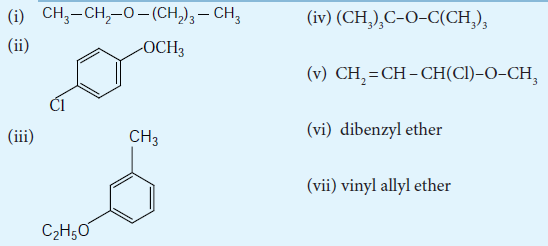
Give the IUPAC name for the following ethers and classify them as simple or mixed.
48.
Identify A, B, C and D
\(\text { ethanoic acid } \stackrel{\mathrm{SOCl}_{2}}{\longrightarrow} \mathrm{A} \stackrel{\mathrm{Pd} / \mathrm{BaSO}_{4}}{\longrightarrow} \mathrm{B} \stackrel{\mathrm{NaOH}}{\longrightarrow} \mathrm{C} \stackrel {\longrightarrow}{\triangle} \mathrm{D}\)
49.
Explain intermediate compound formation theory of catalysis with an example.
50.
How will you distinguish between primary secondary and tertiary alphatic amines.
51.
For the reaction R - P, the concentration of a reactant changes from 0.03 M to 0.02 M in 25 minutes. Calculate the average rate of reaction using units of time both in minutes and second.
52.
Give the difference between double salts and coordination compounds.
1.
Nitrogen on direct reaction with hydrogen gives ammonia. This reaction is favoured by high pressures and at optimum temperature in presence of iron catalyst.
\(\frac{1}{2} \mathrm{~N}_{2}+\frac{3}{2} \mathrm{H}_{2} \rightleftharpoons \mathrm{NH}_{3} \)
\( \Delta \mathrm{H}_{\mathrm{f}}=-46.2 \mathrm{~kJ} \mathrm{~mol}^{-1}\)
2.
\(\mathrm{Cr}+\mathrm{nB} \stackrel{150 \mathrm{~K}}{\longrightarrow} \mathrm{CrB}_{\mathrm{n}}\)
3.
(i) Temperature
(ii) Pressure
(iii) Nature of the gas and
(iv) Nature of the adsorbent
4.
Kohlrausch deduced the following empirical relationship between the molar conductance (\({ \Lambda }_{ m }\)) and the concentration of the electrolyte (C).
\({ \Lambda }_{ m }={ \Lambda }_{ m }^{ o }-k\sqrt { C } \)
5.
6.
Cathodic protection:
In this technique, unlike galvanising the entire surface of the metal to be protected need not be covered with a protecting metal. Instead, metals such as Mg or zinc which is corroded more easily than iron can be used as a sacrificial anode and the iron material acts as a cathode. So iron is protected, but Mg or Zn is corroded. This known as sacrificial protection. (or) Cathodic protection.
7.
In chemical adsorption, \(\frac { x }{ m } \) increases with rise in temperature and then decreases. The increase illustrates the requirement of activation of the surface for adsorption is due to fact that formation of activated complex requires certain energy. The decrease at high temperature is due to desorption, as the kinetic energy of the adsorbate increases.
8.
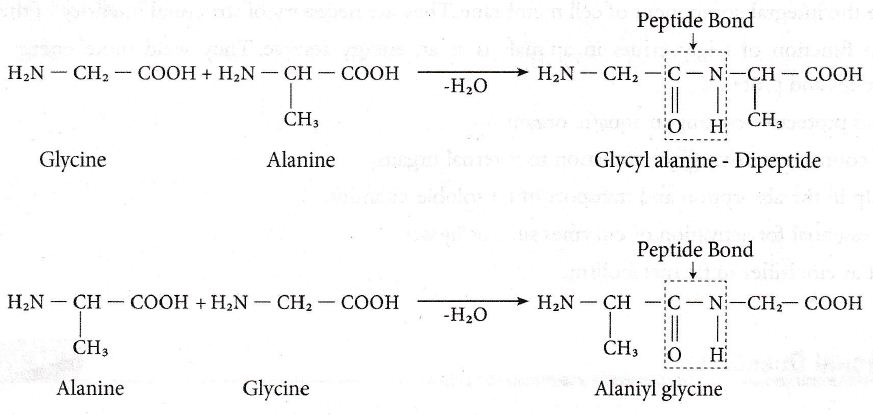
∴ Two dipeptides structures are possible from glycine and alanine. They are glycyl alanine and Alanyl glycine.
9.
(i) Lewis acid: It is a species that accepts an electron pair. Eg: \(\mathrm{Ag}^{+} ; \mathrm{BF}_{3} ; \mathrm{A} / \mathrm{Cl}_{3}\)
(ii) Lewis base: It is a species that donates an electron pair. Eg: \( \mathrm{Cl}^{-} ; \mathrm{NH}_{3} ; \mathrm{H}_{2} \mathrm{O}\)
10.
\(\log K=\log A-\frac { { E }_{ a } }{ 2.303R } \left( \frac { 1 }{ T } \right) \)
y = c + mx
\(m=-\frac { { E }_{ a } }{ 2.303R } \)
Ea = -2.303 Rm
Ea = -2.303 x 8.314 x (-4000)
Ea = 76,589J mol-1
Ea = 76.589 KJ mol-1
11.
The fourteen elements following actinoids is from thorium to lawrencium are called actinides.
Examples: Uranium, Thorium, Neptunium
12.
i) Na2[Ni(EDTA)] - Sodium 2, 2', 2",2'" - (ethane-1,2 diyldinitrilo tetraacetatonickelate)(II)
ii) [Ag(CN)2]- - Dicyanido-kC-argentate (I) ion
iii) [CO(en)3]2(SO4)3 - Tris (ethane 1, 2 diamine)cobalt (III) sulphate
iv) [CO(ONO)(NH3)5]2+ - Pentaamminenitrito - KO cobalt (III) ion
v) [Pt(NH3)2Cl(NO2)] - Diammainechloridonitro - kN - platinum (II)
13.
(i) sp3d3 hybridisation
(ii) Pentagonal bipyramidal structure.
14.
(i) A basic repeating structural unit of a crystalline solid is called a unit cell.
(ii) A crystal is consisted of large number of unit cells.
15.
16.
(c)
lactic acid
17.
(c)
hydrogen
18.
(d)
D-Erythrose, D-Threose, L-Erythrose, L-Threose
19.
(a)
C6H5 - OH
20.
21.
(b)
violet colour
22.
Adsorption leads to decrease in randomnes (entropy).i.e, ΔS < 0 for the adsorption to occur, ΔG slhould be -ve. We know that ΔG = ΔH - TΔS if ΔS is -ve, TΔS is +ve.It means that ΔG will become negative only when ΔH is -ve and ΔH > TΔS.
23.
Mn2+ + 2e- ➝ Mn Eo = -1.18V
Mn2+ ➝ Mn3+ + e- Eo = -1.51V
3Mn2+➝ Mn3+ + 2Mn3+ Eocell = ?
Eocell = (Eoox )+ (Eored)
= 1.51 - 1.18 and non spontaneous
= -2.69V
Since E°is ve ΔG is +ve and the given forward cell reaction is non- spontaneous
24.
HPO42− can have the ability to accept a proton to form H2PO4-
It can also have the ability to donate a proton to form PO4-3
25.
(b)
FeO
26.
[Fe(H2N-CH2-CH2-NH2)3]3(PO4)2
[Fe(en)3]2+(\(PO_{4}^{3-}\))
27.
(d)
+3
28.
(a)
Na2SO3, SO2, Cr2(SO4)3
29.
(a)
Me3SiCl
30.
(a)
H3PO3
31.
Co(en)2 Cl2Br
1. (B) Reacts with silver nitrate to give a white precipitate readily soluble in NH4OH. This shows (B) has Cl- "counterion". Hence (B) is [Co(en)2C/Br] Cl form.
2. (A) Reacts with silver nitrate to give a pale yellow precipitate. This shows (A) has Br- counterion. hence A is [Co(en)2Cl2]Br.
Therefore A: [Co(en)2Cl2]Br
B: [Co(en)2Cl Br]Cl
A - [Co(en)2 Cl2]Br
Oxidation state of Co atom:
1(Co) + 2(en) + 2(Cl-) = + 1
1(x) + 2(0) + 2(-1) = + 1
x = + 3
\(\therefore\) Co3+
Hybridisation and formation of [Co(en)2,CI2] Br complex
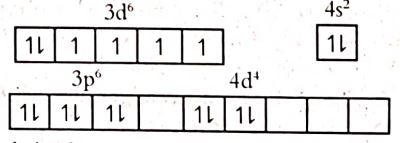
hybridisation = sp3d2
n = 4, ms = \(\sqrt{n(n+2)}=\sqrt{4(4+2)}=4.89 BM\)
32.

(i) This oxidation is governed by Popoff's rule.
(ii) It states that during the oxidation of an unsymmetrical ketone, a (C-CO) bond is cleaved in such a way that the keto group stays with the smaller alkyl group.
33.
(i) Glycerol is prepared in a large scale by the hydrolysis of oils or fats either by using alkali or by super heated steam.
(ii) During this process, soap is formed along with the byproduct glycerol and this process is called saponification.
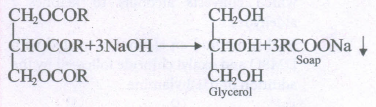
Uses of glycerol:
(i) Glycerol is used as a sweetening agent in confectionery and beverages.
(ii) It is used in the manufacture of cosmetics and transparent soaps.
(iii) It is used in making printing inks and stamp pad ink and lubricant for watches and clocks.
(iv) It is used in the manufacture of explosive like dynamite and cordite by mixing it with chaina clay.
34.
By Faraday II law of electrolysis:
\(\frac{\mathrm{m}_{\mathrm{Ni}}}{\mathrm{E}_{\mathrm{Ni}}}=\frac{\mathrm{m}_{\mathrm{cr}}}{\mathrm{E}_{\mathrm{cr}}} \)
\(\mathrm{Ni}_{(\mathrm{aq})}^{2+}+2 \mathrm{e}^{-} \rightarrow \mathrm{Ni}_{(\mathrm{s})} \)
\(\mathrm{Cr}_{(\mathrm{aq})}^{3+}+3 \mathrm{e}^{-} \rightarrow \mathrm{Cr}_{(\mathrm{s})}\)
| Ni | Cr |
| \(\mathrm{m}_{\mathrm{Ni}_{\mathrm{i}}} =2.935 \mathrm{~g} \) \(\mathrm{E}_{\mathrm{Ni}} =\frac{58.74}{2} \) \(=29.37 \mathrm{~g} \mathrm{eq}^{-1}\) |
\( \mathrm{m}_{\mathrm{cr}} =x \) \(\mathrm{E}_{\mathrm{cr}} =\frac{52}{3} \) \(=17.33 \mathrm{~g} \mathrm{eq}^{-1}\) |
\( \frac{2.935}{29.37}=\frac{\mathrm{x}}{17.33} \)
\(x =\frac{2.935 \times 17.33}{29.37} \)
=1.732 g
35.
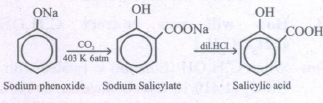
In this reaction, phenol is first converted into sodium phenoxide which is more reactive than phenol towards electrophilic substitution reaction with CO2, Treatment of sodium phenoxide with CO2 at 400 K, 4-7 bar pressure followed by acid hydrolysis gives salicylic acid.
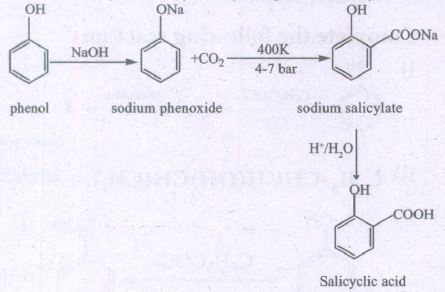
36.
\(\mathrm{Ag}_{2} \mathrm{CrO}_{4(\mathrm{~s})} \rightleftharpoons 2 \mathrm{Ag}_{(\mathrm{aq})}^{+}+\mathrm{CrO}_{4{(\mathrm{aq})}}^{2-}\\ \quad s \quad \quad \quad \quad \quad 2s \quad \quad \quad \quad s\)
\(\left[\mathrm{Ag}^{+}\right]=2 \mathrm{~s}+0.01 \)
\(\simeq 0.01 \)
\((\because 2 s<<0.01) \)
\(\left[\mathrm{CrO}_{4}^{2-}\right]=\mathrm{S} \)
\(\mathrm{AgNO}_{3(\mathrm{~s})} \rightleftharpoons \mathrm{Ag}_{(\mathrm{aq})}^{+}+\mathrm{NO}_{3_{(\mathrm{aq})}}^{-}\\ 0.01M \quad \quad 0.01M \quad \quad 0.01M \quad\)
\(\mathrm{K}_{\mathrm{sp}}=\left[\mathrm{Ag}^{+}\right]^{2}\left[\mathrm{CrO}_{4}^{2-}\right] \)
\(1 \times 10^{-12}=(0.01)^{2}(\mathrm{~s}) \)
\(\mathrm{S}=\frac{1 \times 10^{-12}}{10^{-4}}=1 \times 10^{-8} \mathrm{M}\)
37.
a) Bakelite - Cross linked polymer
b) Nylon - Linear polymer
c) polythene (HDPE) - Linear polymer
d) polythene (LDPE) - Branched polyner
38.
(i) Cobalt (III) ion has greater tendency to form complexes than cobalt (II) ion. Therefore, Co (II) ion being stable in aqueous solution, changes to Co (III) ion in the presence of complexing reagents and get oxidised.
(ii) Ions of transition metals with d1 configuration tend to lose one electron to acquire d0 configuration that is quite stable. Therefore, such ions (with d1) undergo either oxidation or disproportionation, hence unstable.
39.
(i) The element of group number 17 and period number 2 is fluorine (A).
(ii) The element of group number 17 and period number 4 is bromine (B).
(iii) (A) and (B) react to give an interhalogen compound (C) bromine pentafluoride
\(\underset { (A) }{ { Br }_{ 3 } } +\underset { (B) }{ { 5F }_{ 2 } } \longrightarrow \underset { (C) }{ { 2BrF }_{ 5 } } \)
(C) undergoes sp3d2 hybridisation and has octahedral structure
| A | F | Fluorine |
| B | Br | Bromine |
| C | BrF5 | Bromine pentafluoride |
40.
(i) The stability of a coordination complex is a measure of its resistance to the replacement of one ligand by another.
(ii) The stability of a complex refers to the degree of association between two species involved in an equilibrium.
(iii) Let us consider the following complex formation reaction
Cu2+ +4NH3 ⇌ [Cu(NH3)4]2+
\(\beta =\frac { { \left[ { Cu\left( { NH }_{ 3 } \right) }_{ 4 } \right] }^{ 2+ } }{ \left[ { Cu }^{ 2+ } \right] { { \left[ { NH }_{ 3 } \right] }^{ 4 } } } \)
(iv) So, as the concentration of [Cu (NH3)4]2+ increases the value of stability complexes also increases.
(v) Therefore the greater the value of stability constant greater is the stability of the complex.
41.
(i) The rate of a reaction increases with the increase in the concentration of the reactants.
(ii) The effect of concentration is explained on the basis of collision theory of reaction rates.
(iii) According to this theory, the rate of a reaction depends upon the number of collisions between the reacting molecules.
(iv) Higher the concentration, greater is the possibility for collision and hence increase the rate.
42.
43.
Mn3+ has large and negative standard electrode potential E0 (-1.18 V) than that of Cr2+ which has only -0.91 V. If the standard electrode potential of a metal is large and negative, the metal is a powerful reducing agent because it loses electrons easily. Hence Mn3+ is strongly oxidizing while Cr2+ is strongly reducing.
44.
For cubic closed packed structure
\(r =\frac{a \sqrt{2}}{4} \)
\(\therefore a =\frac{4 r}{\sqrt{2}} \)
\(=\frac{4 \times 1.25 \times 10^{-8}}{1.414}=3.53 \times 10^{-8} \mathrm{~cm} \)
= 353 pm
45.
Fusion of urea with B(OH)3' in an atmosphere of ammonia at 800 - 1200 K gives boron nitride.
B(OH)3 + NH3 \(\overset { \Delta }{ \longrightarrow } \) BN+ 3H2O
46.
47.
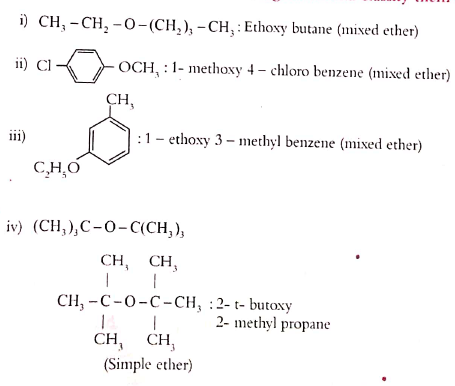
(v) CH2 = CH – CH(Cl)–O–CH3 : 3 - methoxy,3- choloro propene (mixed ether)
(vi) dibenzyl ether CH6CH5 -O-CH2-C6H5 : benzoxy toluene + Simple ether
(vii) vinyl allyl ether : ethoxy 2 - propene
CH2 = CH –O– CH2–CH–CH2(mixed ether)
48.
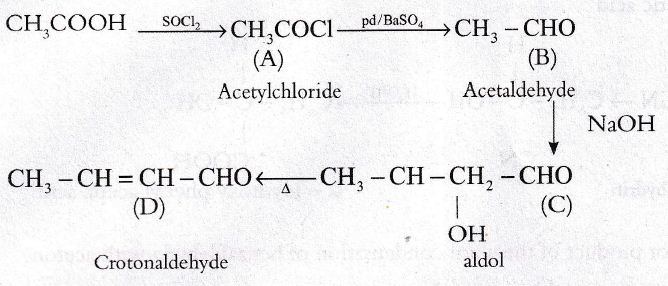
| Compound | Name |
| A | Acetylchloride |
| B | Acetaldehyde |
| C | 3 - Hydroxy butanal |
| D | Crotonaldehyde |
49.
The intermediate compound formation theory :
A catalyst acts by providing a new path with low energy of activation. In homogeneous catalysed reactions a catalyst may combine with one or more reactant to form an intermediate which reacts with other reactant or decompose to give products and the catalyst is regenerated.
Consider the reactions :
A+B➝AB; C is the catalyst .............(1)
A + C ➝ AC (intermediate) ..........(2)
AC + B ⟶ AB + C ...............(3)
Example 1:
The mechanism of Fridel crafts reaction is given below
\({ C }_{ 6 }{ H }_{ 6 }+{ { CH }_{ 3 }Cl\overset { anhydrous\\ { AlCl }_{ 3 } }{ \longrightarrow } }{ C }_{ 6 }{ H }_{ 5 }{ CH }_{ 3 }+HCl\)
The action of catalyst is explained as follows
CH3Cl + AlCl3 ⟶ [CH3]+ [AlCl4]-
It is an intermediate.
\({ C }_{ 6 }{ H }_{ 6 }+\left[ { CH }_{ 3 }^{ + } \right] \left[ { AlCl }_{ 4 } \right] ^{ - }\longrightarrow { C }_{ 6 }{ H }_{ 5 }{ CH }_{ 3 }+{ AlCl }_{ 3 }+Hcl\)
Example 2:
\({ { 2KClO }_{ 3 }\overset {\\ { MnO }_{ 3 } }{ \longrightarrow } }{ 2KCl }+{ 3O }_{ 2 }\)
Thermal decomposition of KCIO3 in the presence of MnO2 proceeds as follows. Steps in the reaction
2KCIO3 ⟶ 2KCI + 3O2 Can be given as
2KClO3 + 6MnO2 → 6MnO3 + 2KCl
It is an intermediate
6MnO3 → 6MnO2 + 3O2
Example 3:
Formation of water due to the reaction of H2 and O2 in the presence of Cu can be given as
H2 + 1/2O2 → H2O
2Cu + \(\frac{1}{2}\)O2 → Cu2O
It is an intermediate.
Cu2O + H2 → H2O + 2Cu
Advantages:
This theory describes
(a) The specificity of a catalyst and
(b) The increase in the rate of the reaction with increasc inthe concentration of a catalyst
Limitations:
(a) The intermediate compound theory fails to explain the action of catalytic poison and activators (promoters).
(b) This theory is unable to explain the mechanism of heterogeneous catalysed reactions.
50.
| S.No | Reagents or Reaction | Primary amine RNH2 | Secondary amine R2NH | Tertiary amine R3N |
|---|---|---|---|---|
|
1. |
Carbylamine reaction or with CHCl3/KOH |
Carbylamine is formed (unpleasant smell) |
- | - |
| 2. | Mustard oil reaction or CS2/HgCl2 (Hoffmann's mustard oil test) |
Alkyl isothiocyanate is formed (Mustard oil odour) |
- | - |
| 3. | HNO2 (or) NaNO2 / HCl |
Alcohol is formed +H2 | Yellow oily nitrosoamine is formed, insoluble in water. (Liberman's Test) |
Forms nitrite in cold, soluble in water. |
| 4. | CH3COCl | N-acetyl derivative is formed | N,N- diacetyl derivative is formed |
- |
| 5. | Diethyl oxalate Hoffmann's method |
Solid oxamide is formed | Liquid oxamic ester is formed |
- |
| 6. | Benzene sulphonyl chloride in presence of excess. KOH (Hinsberg's reaction) |
N- alkyl benzene sulphonamide is formed (soluble) |
N, N - dialkyl benzene sulphonamide is formed (Insoluble). |
- |
| 7. | With RX | 1 mol → 2o amine 2 mol → 3o amine 3 mol → Quarternary salt |
1 mol → 3o amine 2 mol → Quarternary salt |
1 mol → Quarternary salt |
51.
Average rate = \(-\frac { \triangle \left( R \right) }{ \triangle t } =-\frac { { \left[ R \right] }_{ 2 }-{ \left[ R \right] }_{ 1 } }{ { t }_{ 2 }-{ t }_{ 1 } } \)
\(=-\frac { 0.02M-0.03M }{ 25min } =\frac { -0.01M }{ 25min } \)
= 4 x 10⁻⁴ M min-1 and
= \(-\frac { -0.01m }{ 25\times 60 } \) = 6.66 x 10⁻⁶ Ms-1
52.
| S. No | Double salts | Co-ordination compound |
|---|---|---|
| 1. | They usually contain two simple salt in equimolar proportions | The simple salts from which they are formed may or may not be in equimolar proportion. |
| 2. | They exists only in the solid state. In aqueous solution they dissociate completely into ions. | They exist in the solid state as well as in aqueous solution. This is because even in solution, the complex ion does not dissociate into ions. |
| 3. | They are ionic compounds and do not contain any co-ordinate bond. | They may or may not be ion but the complex part always contain coordinate bonds |
| 4. | The properties of the double salts are same as those of its constituent compounds. | The properties of the coordination compounds are different for its constituent bonds. |
| 5. | In a double salt, the metal ion show their normal valency. | In a coordinate compound the metal ion satisfies its two types of valence called primary & secondary valenices. |
| 6. | A double salt loses its identity and dissociates into its constitute simple ions in solution. | The complex ion does not lose its identity and never dissociate to give simple ions. |
| Example: FeSO4 (NH4)2 SO4.6H2O | Example: K4[Fe(CN)6), K3[Fe(SCN)6) |

12th Standard Syllabus & Materials
12th Standard
TN 12th Computer Applications களப்பெயர் முறைமை (DNS) Sample Question Papers Study Material - QB365 Set A
NEW12th Standard
TN 12th Computer Applications வலையமைப்பு எடுத்துக்காட்டுகள் மற்றும் நெறிமுறைகள் Sample Question Papers Study Material - QB365 Set A
NEW12th Standard
TN 12th Computer Applications கணினி வலையமைப்பு ஓர் அறிமுகம் Sample Question Papers Study Material - QB365 Set A
NEW12th Standard
TN 12th Computer Applications PHP-உடன் MySQL-ஐ இணைத்தல் Sample Question Papers Study Material - QB365 Set A



Tamilnadu Stateboard 12th Standard Subjects

Maths
Chemistry

Physics

Biology

Computer Science

Business Maths and Statistics

Economics

Commerce

Accountancy

History

Computer Applications
Biology
Computer Technology
Computer Applications
Computer Science
Business Maths and Statistics
Commerce
Economics
Maths
Chemistry
Physics
Computer Technology
History
Accountancy

Tamil

English

French
Tamilnadu Stateboard Standards


