
 100% FREE ACCESS
12th Standard Syllabus & Materials
12th Standard
TN 12th Computer Applications மின்னணு தரவு பரிமாற்றம் Sample Question Papers Study Material - QB365 Set A
NEW12th Standard
TN 12th Computer Applications மின் - வணிக பாதுகாப்பு அமைப்புகள் Sample Question Papers Study Material - QB365 Set A
NEW12th Standard
TN 12th Computer Applications மின்னணு செலுத்தல் முறைகள் Sample Question Papers Study Material - QB365 Set A
NEW12th Standard
TN 12th Computer Applications மின் - வணிகம் Sample Question Papers Study Material - QB365 Set A
NEW12th Standard
TN 12th Computer Applications திறந்த மூல கருத்துருக்கள் Sample Question Papers Study Material - QB365 Set A
NEW12th Standard
TN 12th Computer Applications வலையமைப்பு வடமிடல் Sample Question Papers Study Material - QB365 Set A

Published on: 28/11/2025
Download Tamil Nadu 12th Standard Chemistry question papers, model tests, one-mark questions, important questions, and public exam papers in PDF format. Free study materials and answer keys for TN State Board students.
Questions + Answers key
Take MCQ Chemistry Test
1.
Which is slightly soluble in H2O?
Phenol
Alkanes
Alcohols
Alkenes
2.
IUPAC name of Picric acid is _______.
1,3,5 tri nitro phenol
2,4,6 - tri bromo phenol
2,4,6 - tri nitro phenol
2-nitro phenol
3.
Which one of the following nitro compounds does not react with nitrous acid.
CH3 -CH2 -CH2 -NO2
(CH3)2 CH - CH2NO2
(CH3)3 C NO2
\({ CH }_{ 3 }-\underset { \overset { || }{ O } }{ C } -\underset { \overset { || }{ { CH }_{ 3 } } }{ CH } -{ NO }_{ 2 }\)
4.
Isoprophylbenzene on air oxidation in the presence of dilute acid gives ______.
C6H5COOH
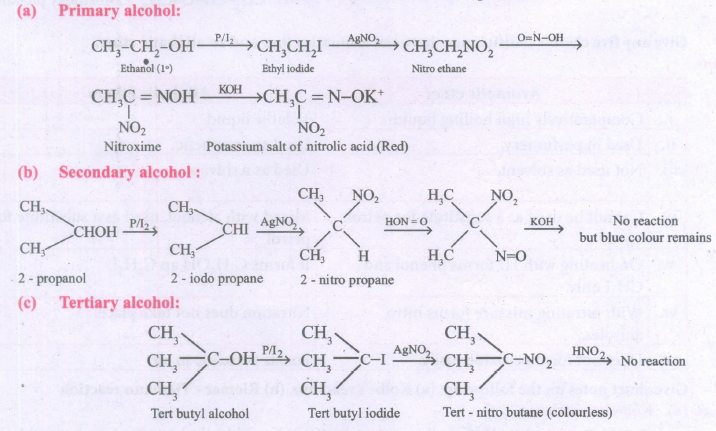
C6H5COCH3
C6H5COC6H5
C6H5- OH
5.
Carbolic acid is _____.
Phenol
Picri cacid
benzoic acid
phenylacetic acid
6.
In a first order reaction x ⟶ y; if k is the rate constant and the initial concentration of the reactant x is 0.1M, then, the half life is_____.
\(\left( \frac { \log2 }{ k } \right) \)
\(\left( \frac { 0.693 }{ (0.1)k } \right) \)
\(\left( \frac { In2 }{ k } \right) \)
none of these
7.
The addition of a catalyst during a chemical reaction alters which of the following quantities?
Enthalpy
Activation energy
Entropy
Internal energy
8.
The crystal with a metal deficiency defect is ________.
NaCl
FeO
ZnO
KCl
9.
An ionic compound Ax By crystallizes in fcc type crystal structure with B ions at the centre of each face and A ion occupying corners of the cube the correct formula of Ax, By is ________.
AB
AB3
A3B
A8B6
10.
Which of the following is not sp2 hybridised?
Graphite
graphene
Fullerene
dry ice
11.
Among the following, which is the strongest oxidizing agent?
Cl2
F2
Br2
l2
12.
An element belongs to group 15 and 3rd period of the periodic table, its electronic configuration would be_______.
1s2 2s2 2p4
1s2 2s2 2p3
1s2 2s2 2p6 3s2 3p2
1s2 2s2 2p6 3s2 3p3
13.
The basic structural unit of silicates is _______.
\(\left( SiO_{ 3 } \right) ^{ 2- }\)
\(\left( SiO_{ 4 } \right) ^{ 2- }\)
\(\left( Sio \right) ^{ - }\)
\(\left( SiO_{ 4 } \right) ^{ 4- }\)
14.
Which of the following plot gives Ellingham diagram
\(\Delta S \ \text{Vs} \ T\)
\(\Delta { G }^{ 0 }\ \text{Vs} \ T\)
\(\Delta { G }^{ 0 }\ \text{Vs} \ \frac { 1 }{ T } \)
\(\Delta { G }^{ 0 }\ \text{Vs} \ { T }^{ 2 }\)
15.
Considering Ellingham diagram, which of the following metals can be used to reduce alumina?
Fe
Cu
Mg
Zn
16.
Explain:
a) Thorpe nitrile condensation
b) Levine and Hauser acetylation (Cyanomethylation reaction)
17.
What is Dow's Process?
18.
Draw the structure of i) H2SO3 ii) H2S2O4
19.
What is chloropicrin?
20.
State Saytzeff's rule.
21.
Complete the following reactions
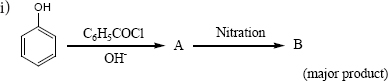
ii) \(C_6H_5-CH_{2}CH(OH)CH(CH_3)_2 \overset{ConH_2SO_4}\longrightarrow\)
22.
What is calcination? Give example.
23.
Write Arrhenius equation and explains the terms involved.
24.
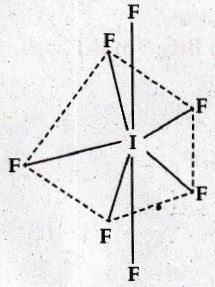
What is the hybridisation of iodine in IF7? Give its structure.
25.
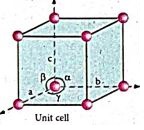
Define unit cell.
26.
What is catenation ? describe briefly the catenation property of carbon.
27.
What is the role of quick lime in the extraction of Iron from its oxide Fe2O3?
28.
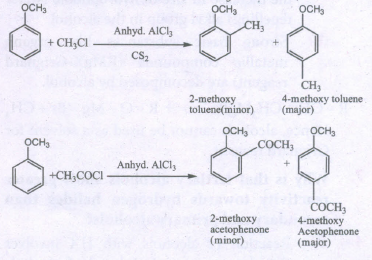
Write a note on Friedel Crafts reaction of anisole.
29.
Identify A,B and C
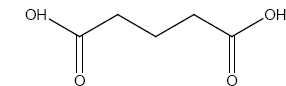 \(\overset{SOCl_2}\longrightarrow A \overset{NH_3}\longrightarrow B\overset{LiAlH_4}\longrightarrow (C)\)
30.
A first order reaction takes 8 hours for 90% completion. Calculate the time required for 80% completion. (log 5 = 0.6989 ; log10 = 1)
31.
Define half life of a reaction. Show that for a first order reaction half life is independent of initial concentration.
32.
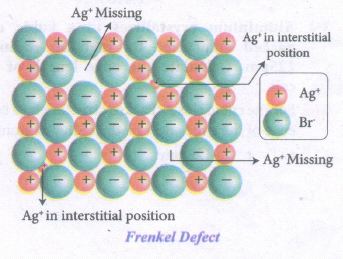
Write a note on Frenkel defect.
33.
Give any three characteristics of ionic crystals.
34.
Give the uses of silicones.
35.
What are interhalogen compounds? Give examples.
36.
37.
Derive the integrated rate law for a first order reaction.
38.
Derive Arrhenius equation to calculate activation energy from the rate constant k1 and k2 at temperature T1 and T2 respectively.
39.
How will you distinguish the primary, secondary and tertiary alcohols by Victor Meyer's method?
40.
Give short notes on the following: (a) Kolbe's reaction, (b) Riemer - Tiemann reaction
41.
How will you distinguish between primary secondary and tertiary alphatic amines.
42.
Explain the preparation, properties, structure and uses of Diborane.
43.
Explain briefly the collision theory of bimolecular reactions.
44.
What is an elementary reaction? Give the differences between order and molecularity of a reaction.
45.
Calculate the percentage efficiency of packing in case of body centered cubic crystal.
46.
Explain zone refining process with an example.
1.
(a)
Phenol
2.
(c)
2,4,6 - tri nitro phenol
3.
(c)
(CH3)3 C NO2
4.
phenol
5.
(a)
Phenol
6.
\(k=\frac { 1 }{ t } ln \frac { \left[ { A }_{ 0 } \right] }{ \left[ A \right] } \)
[A0] = 0.1: [A] = 0.05
\(k= \left[ \frac { 1 }{ t _{1/2}} \right] ln\left[ \frac { { 0.1 } }{ 0.05 }\right] \)
\(k= \left[ \frac { 1 }{ t _{1/2}} \right] ln (2)\)
t1/2 = In(2)/K
7.
A catalyst provides a new path to the reaction with low activation energy. i.e., it lowers the activation energy.
8.
(b)
FeO
9.
Number of A ions = Nc/8 = 8/8 = 1
Number of B ions = Nf/2 = 6/2 = 3
Simplest formula = AB3
10.
(d)
dry ice
11.
(b)
F2
12.
(d)
1s2 2s2 2p6 3s2 3p3
13.
(d)
\(\left( SiO_{ 4 } \right) ^{ 4- }\)
14.
(b)
\(\Delta { G }^{ 0 }\ \text{Vs} \ T\)
15.
(c)
Mg
16.
a) Thorpe nitrile condensation
(i) Self condensation of two molecules of alkyl nitrile (containing $\alpha-\mathrm{H}$ atom) in the presence of sodium to form iminonitrile.
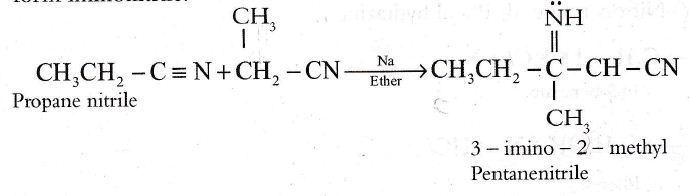
b) Levine and Hauser acetylation
(i) The nitriles containing α - hydrogen also undergo condensation with esters in the presence of sodamide in ether to form ketonitriles. This reaction is known as "Levine and Hauser" acetylation.
(ii) This reaction involves replacement of ethoxy (OC2H5) group by methylnitrile (-CH2CN) group and is called as cyanomethylation reaction.
.JPG)
17.
When Chlorobenzene is hydrolyzed with 6-8 % NaOH at 300 bar and 633 K, in a closed vessel. Sodium Phenoxide is formed which on treatment with dilute HCl gives phenol.

18.
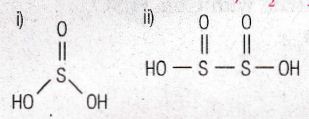
19.
CCl3 - NO2 (trichloronitro. methane) is Chloropicrin.
20.
During intramolecular dehydration, if there is a possibility to form a carbon-carbon double bond at different locations, the preferred location is the one that gives the more (highly) substituted alkene i.e., the stable alkene.
21.
(i) .JPG)
n-Nitro benzoate (Major Product)
(ii) .JPG)
22.
The conversion of ore into metal oxide (oxidation) is called calcination. It is the process in which the ore is subjected to the action of heat at high temperature in the absence of air below its melting point. Example
\({ CaCO }_{ 3 }(limestone)\longrightarrow CaO+{ CO }_{ 2 }\uparrow \)
\({ MgCO }_{ 3 }\left( Magnesite \right) \longrightarrow { MgO }+{ CO }_{ 2 }\uparrow \)
23.
Arrhenius equation is,
\(k=Ae^\left ({ \frac { -Ea }{ RT } } \right )\)
Here,
A \(\rightarrow\) Frequency factor
Ea \(\rightarrow\) Activation energy of the reaction
R \(\rightarrow\) Gas constant
T \(\rightarrow\) Absolute temperature (in K)
24.
(i) sp3d3 hybridisation
(ii) Pentagonal bipyramidal structure.
25.
(i) A basic repeating structural unit of a crystalline solid is called a unit cell.
(ii) A crystal is consisted of large number of unit cells.
26.
Catenation is an ability of an element to form chain of atoms.
The conditions for catenation.
(a) The valency of element is greater than or equal to two.
(b) Element should have an ability to bond with itself
(c) The self bond must be as strong as Its bond with other elements
(d) Kinetic inertness of catenated compound towards other molecules.
(e) Carbon possesses all the above properties and forms a wide range of compounds with itself and with other elements such as H, O, N, S and halogens.
27.
In this extraction, a basic flux, quick lime (CaO) is used, since the silica gangue present in the ore is acidic in nature. The quick lime combines with it to form calcium silicate (slag).
CaO(s) + Sio2(s) ⟶ CaSio3(s)
Flux Gangue Slag
28.
Anisole undergoes Friedel Craft's reaction in presence of anhydrous AlCl3 as a catalyst.
29.

30.
For a first order reaction
\(\\ \\ k=\frac { 2.303 }{ t } log\left( \frac { [{ A }_{ 0 }] }{ [A] } \right) \\ \) ..(1)
Let[A0] =100M
When
t = t90%; [A] = 10M (given that t90% = 8hours)
t = t80%; [A ] = 20M
\(k=\frac { 2.303 }{ { t }_{ 80\% } } \log\left( \frac { 100 }{ 20 } \right) \)
\({ t }_{ 80\% }=\frac { 2.303 }{ K } \log(5)\) ....(2)
Find the value of k using the given data
\(k=\frac { 2.303 }{ { t }_{ 90\% } } \log\left( \frac { 100 }{ 10 } \right) \)
\(k=\frac { 2.303 }{ 8 } \log10\)
\(k=\frac { 2.303 }{ 8 } ...(3)\)
Substitute the value of k in equation (2)
\({ t }_{ 80\% }\frac { 2.303 }{ 2.303/8hours } \log(5)\)
t80%= 8 hours x 0.6989
t80%= 5.59 hours
31.
(i) The half life of a reaction is defined as the time required for the reactant concentration to reach one half its initial value.
\(k=\frac { 2.303 }{ t } log\frac { \left[ { A }_{ 0 } \right] }{ \left[ A \right] } \)
\(at\quad t={ t }_{ \frac { 1 }{ 2 } };\left[ A \right] =\frac { \left[ { A }_{ 0 } \right] }{ 2 } \)
\(k=\frac { 2.303 }{ t_{ 1/2 } } log\frac { \left[ { A }_{ 0 } \right] }{ \frac { \left[ { A }_{ 0 } \right] }{ 2 } } \)
\(k=\frac { 2.303 }{ { t }_{ 1/2 } } log2\)
\(k=\frac { 2.303\times 0.3010 }{ { t }_{ 1/2 } } =\frac { 0.6932 }{ { t }_{ 1/2 } } \)
\({ t }_{ 1/2 }=\frac { 0.6932 }{ k } \)
This equation has no concentration term So, the half life of a first order reaction is independent of initial concentration.
32.
(i) Frenkel defect arises due to the dislocation of ions from its crystal lattice.
(ii) The ion which is missing from the lattice point occupies an interstitial position.
(iii) This defect is shown by ionic solids in which cation and anion differ in size.
(iv) Unlike Schottky defect, this defect does not affect the density of the crystal.
For example AgBr, in this case, small Ag+ ion leaves its normal site and occupies an interstitial position.
33.
(i) Ionic solids have high melting points.
(ii) These solids do not conduct electricity, because the ions are fixed in their lattice positions.
(iii) They are hard so strong external force can change the relative positions of ions.
34.
(i) Silicones are used for low temperature lubrication and in vacuum pumps, high temperature oil baths etc.
(ii) They are used for making water proofing clothes.
(iii) They are used as insulting material in electrical motor and other appliances.
(iv) They are mixed with paints and enamels to make them resistant towards high temperature, sunlight, dampness and chemicals.
35.
Each halogen combines with other halogens to form a series of compounds are called interhalogen compounds.
Example: AB type: BrF
AB3 type: ICI3
36.
37.
A reaction whose rate depends on the reactant concentration raised to the first power is called a first order reaction. Let us consider the following Cl2 first order reaction,
A → product
Rate law can be expressed as
Rate = k[A]1
Where, k is the first order rate constant
\(\frac{-\mathrm{d}[\mathrm{A}]}{\mathrm{dt}}=\mathrm{k}[\mathrm{A}]^{1} \)
\(\Rightarrow \frac{-\mathrm{d}[\mathrm{A}]}{[\mathrm{A}]}=\mathrm{kdt}\) .....(1)
Integrate the above equation between the limits of time t = 0 and time equal to t, while the concentration varies from the initial concentration [A0] to [A] at the later time.
\(\int_{\left[A_{0}\right]}^{[A]} \frac{-d[A]}{[A]}=k \int_{0}^{t} d t \)
\((-\ln [A])_{\left[A_{0}\right]}^{[A]}=k(t)_{0}^{t} \)
\(-\ln [A]-\left(-\ln \left[A_{0}\right]\right)=k(t-0) \)
\(-\ln [\mathrm{A}]+\ln \left[\mathrm{A}_{0}\right]=\mathrm{kt} \)
\(\ln \left(\frac{\left[\mathrm{A}_{0}\right]}{[\mathrm{A}]}\right)=\mathrm{kt}\) .....(2)
This equation is in natural logarithm. To convert it into usual logarithm with base 10, we have to multiply the term by 2.303.
\(2.303 \log \left(\frac{\left[A_{0}\right]}{[A]}\right)=k t \)
\(k=\frac{2.303}{t} \log \left(\frac{\left[A_{0}\right]}{[A]}\right)\) .....(3)
38.
According to Arrhenius, activation energy of the reaction is the minimum energy that a molecule must have to posses to react.
\(\mathrm{k}=\mathrm{A} e^{-\left(\frac{E_{a}}{R T}\right)}\)
Where A is the frequency factor
R is the gas constant
Ea is the activation energy of the reaction
T is the absolute temperature. (in k)
Taking logarithm on both side of the equation (1)
\(\ln \mathrm{k}=\ln \mathrm{A}+\ln \mathrm{e}^{-\left(\frac{E_{a}}{R T}\right)} \)
\(\ln \mathrm{k}=\ln \mathrm{A}-\left(\frac{\mathrm{E}_{\mathrm{a}}}{\mathrm{RT}}\right) \quad(\therefore \ln \mathrm{e}=1) \)
\(\ln \mathrm{k}=\ln \mathrm{A}-\left(\frac{\mathrm{E}_{\mathrm{a}}}{\mathrm{R}}\right)\left(\frac{1}{\mathrm{~T}}\right)\)
At temperature T = T1; the rate constant k = k1
\(\ln \mathrm{k}_{1}=\ln \mathrm{A}-\left(\frac{\mathrm{E}_{\mathrm{a}}}{\mathrm{RT}_{1}}\right)\)
At temperature T = T2; the rate constant k = k2
\(\ln \mathrm{k}_{2}=\ln \mathrm{A}-\left(\frac{\mathrm{E}_{\mathrm{a}}}{\mathrm{RT}_{2}}\right)\)
(4)-(3)
\(\ln \mathrm{k}_{2}-\ln \mathrm{k}_{1}=-\left(\frac{\mathrm{E}_{\mathrm{a}}}{\mathrm{RT}_{2}}\right)+\left(\frac{\mathrm{E}_{\mathrm{a}}}{\mathrm{RT}_{1}}\right) \)
\(\Rightarrow \ln \left(\frac{\mathrm{k}_{2}}{\mathrm{k}_{1}}\right)=\frac{\mathrm{E}_{\mathrm{a}}}{\mathrm{R}}\left(\frac{1}{\mathrm{~T}_{1}}-\frac{1}{\mathrm{~T}_{2}}\right) \)
\(2.303 \log \left(\frac{\mathrm{k}_{2}}{\mathrm{k}_{1}}\right)=\frac{\mathrm{E}_{\mathrm{a}}}{\mathrm{R}}\left(\frac{\mathrm{T}_{2}-\mathrm{T}_{1}}{\mathrm{~T}_{1} \mathrm{~T}_{2}}\right) \)
\(\log \left(\frac{\mathrm{k}_{2}}{\mathrm{k}_{1}}\right)=\frac{\mathrm{E}_{\mathrm{a}}}{2.303 \mathrm{R}}\left(\frac{\mathrm{T}_{2}-\mathrm{T}_{1}}{\mathrm{~T}_{1} \mathrm{~T}_{2}}\right) \)
\(\ln \mathrm{k}_{2}-\ln \mathrm{k}_{1}=-\left(\frac{\mathrm{E}_{\mathrm{a}}}{\mathrm{RT}_{2}}\right)+\left(\frac{\mathrm{E}_{\mathrm{a}}}{\mathrm{RT}_{1}}\right)\)
This equation can be used to calculate Ea from rate constants k1 and k2 at temperatures T1 and T2.
39.
Victor Meyer's test:
This test is used to distinguish 1°, 2°, and 3° alcohols.
This test consists of the following steps:
(i) Alcohol is converted into alkyl iodide by treatment with P/I2.
(ii) The alkyl iodide is then converted into nitro alkane by silver nitrate (AgNO2).
(iii) The nitro alkane is treated with nitrous acid (HNO2) and then with aqueous KOH.
(iv) The 1°,2° and 3° alcohols are identified from the colour of the product.
40.
(a) Kolbe's reaction:
In this reaction, phenol is first converted into sodium phenoxide which is more reactive than phenol towards electrophilic substitution reaction with CO2, Treatment of sodium phenoxide with CO2 at 400K, 4-7 bar pressure followed by acid hydrolysis gives salicylic acid.

(b) Riemer-Tiemann reaction:
On treating phenol with CHCI3/NaOH, a -CHO group is introduced at ortho position. This reaction proceeds through the formation of substituted benzal chloride intermediate.

41.
| S.No | Reagents or Reaction | Primary amine RNH2 | Secondary amine R2NH | Tertiary amine R3N |
|---|---|---|---|---|
|
1. |
Carbylamine reaction or with CHCl3/KOH |
Carbylamine is formed (unpleasant smell) |
- | - |
| 2. | Mustard oil reaction or CS2/HgCl2 (Hoffmann's mustard oil test) |
Alkyl isothiocyanate is formed (Mustard oil odour) |
- | - |
| 3. | HNO2 (or) NaNO2 / HCl |
Alcohol is formed +H2 | Yellow oily nitrosoamine is formed, insoluble in water. (Liberman's Test) |
Forms nitrite in cold, soluble in water. |
| 4. | CH3COCl | N-acetyl derivative is formed | N,N- diacetyl derivative is formed |
- |
| 5. | Diethyl oxalate Hoffmann's method |
Solid oxamide is formed | Liquid oxamic ester is formed |
- |
| 6. | Benzene sulphonyl chloride in presence of excess. KOH (Hinsberg's reaction) |
N- alkyl benzene sulphonamide is formed (soluble) |
N, N - dialkyl benzene sulphonamide is formed (Insoluble). |
- |
| 7. | With RX | 1 mol → 2o amine 2 mol → 3o amine 3 mol → Quarternary salt |
1 mol → 3o amine 2 mol → Quarternary salt |
1 mol → Quarternary salt |
42.
Preparation:
As discussed earlier diborane can be prepared by the action of metal hydride with boron. This method is used for the industrial production.
Diborane can also be obtained in small quantities by the reaction of iodine with sodium borohydride in diglyme.
2NaBH4 + I2 ⟶ B2H6 + 2NaI + H2
On heating magnesium boride with HCl a mixture of volatile boranes are obtained.
2Mg3B2 + 12HCl ⟶ 6MgCl2 + B4H10 + H2
B4H10 + H2 ⟶ 2B2H6
43.
(i) Collision theory is based on the kinetic theory of gases. According to this theory, a chemical reaction occurs as a result of collisions between the reacting molecules.
(ii) Let us understand this theory by considering the following reaction.
A2(g) + B2(g) ⟶ 2AB(g)
(iii) If we consider that, the reaction between A2 and B2 molecules proceeds through collisions between them, then the rate would be proportional to the number of collisions per second.
(iv) Rate ∝ number of molecules colliding per litre per second (collision rate).
(v) The number of collisions is directly proportional to the concentration of both A2 and B2.
Collison rate ∝ [A2][B2]
Collision rate = Z [A2][B2]
(vi) Where, Z is a constant
(vii) A fraction of effective collisions (f) is given by the following expression
\(f={ e }^{ \frac { { -E }_{ a } }{ RT } }\)
(xiv) This fraction of collisions is further reduced due to orientation factor i.e., even if the reactant collides with sufficient energy, they will not react unless the orientation of the reactant molecules is suitable for the formation of the transition state.
(viii) The diagram illustrates the importance of proper alignment of molecules which leads to reaction.
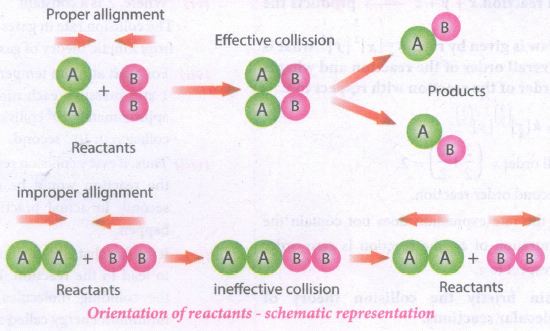
(ix) The fraction of effective collisions (f) having proper orientation is given by the steric factor p.
⇒ Rate = p x f x collision rate
\(\Rightarrow Rate=p\times { e }^{ \frac { -Ea }{ RT } }\times Z\left[ { A }_{ 2 } \right] \left[ { B }_{ 2 } \right] \quad ...(1)\)
As per the rate law,
Rate = \(k=\left[ { A }_{ 2 } \right] \left[ { B }_{ 2 } \right] \quad ...(2)\)
Where k is the rate constant
On comparing equation (1) and (2), the rate constant k is
\(k=pZ{ e }^{ \frac { -Ea }{ RT } }\)
44.
(a) Elementary reaction
Each and Every single step in a reaction mechanism is called an elementary reaction.
Rate = k[A] [B]
(b)
| Order of reaction | Molecularity of a reaction |
|---|---|
| Order of reaction is the sum of the powers of concentration terms involved in the experimentally determined rate law. | Molecularity of a reaction is the total number of reactant species that are involved in an elementary step. |
| It can be zero (or) fractional (or) integer | It is always a whole number, cannot be zero or a fractional number. |
| It is assigned for a overall reaction. | It is assigned for each elementary step of the mechanism. |
45.
In bcc unit cell, ΔABC
AC2 = AB2 + BC2
\(AC=\sqrt { { AB }^{ 2 }+{ BC }^{ 2 } } \)
\(\\ AC=\sqrt { { a }^{ 2 }+{ a }^{ 2 } } =\sqrt { { 2a }^{ 2 } } =\sqrt { 2 } a\)

In ΔACG
AG2 = AC2 + CG2
\(AG=\sqrt { { AC }^{ 2 }+{ CG }^{ 2 } } \)
\(AG=\sqrt { { \left( \sqrt { 2a } \right) }^{ 2 }+{ a }^{ 2 } } \)
\(AG=\sqrt { { 2a }^{ 2 }+{ a }^{ 2 } } =\sqrt { { 3a }^{ 2 } } \)
\(AG=\sqrt { 3a } \)
\(\sqrt { 3 } a=4r\)
\(r=\frac { \sqrt { 3 } }{ 4 } a\)
∴ Volume of the sphere with radius 'r' \(=\frac { 4 }{ 3 } { \pi r }^{ 3 }\)
\(=\frac{4}{3}\pi { \left( \frac { \sqrt { 3 } }{ 4 } a \right) }^{ 3 }\)\(=\frac { \sqrt { 3 } }{ 16 } \pi { a }^{ 3 }\)
Number of spheres belong to a unit cell in BCC arrangement is equal to two and hence the total volume of all spheres.
(i) Packing fraction = \(=\frac{Total \quad volume \quad occupied \quad by \quad spheres \quad in \quad a \quad unit \quad cell}{volume \quad of \quad the \quad unit \quad cell}\times100\)
\(\therefore\)Volume of all spheres \(=2\times \left( \frac { \sqrt { 3 } \pi { a }^{ 3 } }{ 16 } \right) =\frac { \sqrt { 3 } \pi { a }^{ 3 } }{ 8 } \)
Packing fraction \(=\frac { \left( \frac { \sqrt { 3 } \pi { a }^{ 3 } }{ 8 } \right) }{ ({ a }^{ 3 }) } \times 100\)
\(=\frac { \sqrt { 3 } \pi }{ 8 } \times 100\)
\(\\ =\sqrt { 3 } \pi \times 12.5\)
= 1.732 x 3.14 x 12.5
= 68%
46.
Zone refining :
1. Zone refining method is based on the principles of fractional crystallisation.
2. When an impure metal is melted and allowed to solidify, the impurities will prefer to be in the molten region. In this process the impure metal is taken in the form of a rod.
3. One end of the rod is heated using a mobile induction heater which results in melting of the metal on that portion of the rod.
4. When the heater is slowly moved to the other end the pure metal crystallises while the impurities will move on to the adjacent molten zone.
5. As the heater moves further away, the molten zone containing impurities also moves along with it.
6. The process is repeated several times by moving the heater in the same direction again and again to get pure metal.
7. This process is carried out in an inert gas atmosphere to prevent the oxidation of metals.
8. Elements such as germanium (Ge), silicon (Si) and galium (Ga) that are used as semiconductor are refined using this process.

12th Standard Syllabus & Materials
12th Standard
TN 12th Computer Applications களப்பெயர் முறைமை (DNS) Sample Question Papers Study Material - QB365 Set A
NEW12th Standard
TN 12th Computer Applications வலையமைப்பு எடுத்துக்காட்டுகள் மற்றும் நெறிமுறைகள் Sample Question Papers Study Material - QB365 Set A
NEW12th Standard
TN 12th Computer Applications கணினி வலையமைப்பு ஓர் அறிமுகம் Sample Question Papers Study Material - QB365 Set A
NEW12th Standard
TN 12th Computer Applications PHP-உடன் MySQL-ஐ இணைத்தல் Sample Question Papers Study Material - QB365 Set A



Tamilnadu Stateboard 12th Standard Subjects

Maths
Chemistry

Physics

Biology

Computer Science

Business Maths and Statistics

Economics

Commerce

Accountancy

History

Computer Applications
Biology
Computer Technology
Computer Applications
Computer Science
Business Maths and Statistics
Commerce
Economics
Maths
Chemistry
Physics
Computer Technology
History
Accountancy

Tamil

English

French
Tamilnadu Stateboard Standards


