
 100% FREE ACCESS
12th Standard Syllabus & Materials
12th Standard
TN 12th Computer Applications மின்னணு தரவு பரிமாற்றம் Sample Question Papers Study Material - QB365 Set A
NEW12th Standard
TN 12th Computer Applications மின் - வணிக பாதுகாப்பு அமைப்புகள் Sample Question Papers Study Material - QB365 Set A
NEW12th Standard
TN 12th Computer Applications மின்னணு செலுத்தல் முறைகள் Sample Question Papers Study Material - QB365 Set A
NEW12th Standard
TN 12th Computer Applications மின் - வணிகம் Sample Question Papers Study Material - QB365 Set A
NEW12th Standard
TN 12th Computer Applications திறந்த மூல கருத்துருக்கள் Sample Question Papers Study Material - QB365 Set A
NEW12th Standard
TN 12th Computer Applications வலையமைப்பு வடமிடல் Sample Question Papers Study Material - QB365 Set A

Published on: 28/11/2025
Download Tamil Nadu 12th Standard Chemistry question papers, model tests, one-mark questions, important questions, and public exam papers in PDF format. Free study materials and answer keys for TN State Board students.
Questions + Answers key
Take MCQ Chemistry Test
1.
The stability of +1 oxidation state increases in the sequence ________.
Al < Ga < In < Tl
Tl < In < Ga < Al
In < Tl < Ga < Al
Ga< In < Al < Tl
2.
Which of these is not a monomer for a high molecular mass silicone polymer?
Me3SiCl
PhSiCl3
MeSiCl3
Me2SiCl2
3.
When copper is heated with conc HNO3 it produces ________.
Cu(NO3)2, NO and NO2
Cu(NO3)2 and N2O
Cu(NO3)2 and NO2
Cu(NO3)2 and NO
4.
Among the following the correct order of acidity is ________.
HClO2 < HClO < HClO3 < HClO4
HClO4 < HClO2 < HClO < HClO3
HClO3 < HClO4 < HClO2 < HClO
HClO < HClO2 < HClO3 < HClO4
5.
Which of the following is strongest acid among all?
HI
HF
HBr
HCl
6.
XeF6 on complete hydrolysis produces________.
XeOF4
XeO2F2
XeO3
XeO2
7.
Most easily liquefiable gas is _______.
Ar
Ne
He
Kr
8.
The molarity of given orthophosphoric acid solution is 2M. Its normality is _______.
6N
4N
2N
none of these
9.
The basicity of pyrophosphorous acid ( H4P2O5) is _______.
4
2
3
5
10.
On hydrolysis, PCl3 gives________.
H3PO3
PH3
H3PO4
POCl3
11.
Solid (A) reacts with strong aqueous NaOH liberating a foul smelling gas(B) which spontaneously burn in air giving smoky rings. A and B are respectively_________.
P4(red) & PH3
P4(white) & PH3
S8 & H2S
P4(white) & H2S
12.
An element belongs to group 15 and 3rd period of the periodic table, its electronic configuration would be_______.
1s2 2s2 2p4
1s2 2s2 2p3
1s2 2s2 2p6 3s2 3p2
1s2 2s2 2p6 3s2 3p3
13.
Which is true regarding nitrogen?
least electronegative element
has low ionisation enthalpy than oxygen
d- orbitals available
ability to form pπ-pπ bonds with itself
14.
The basic structural unit of silicates is _______.
\(\left( SiO_{ 3 } \right) ^{ 2- }\)
\(\left( SiO_{ 4 } \right) ^{ 2- }\)
\(\left( Sio \right) ^{ - }\)
\(\left( SiO_{ 4 } \right) ^{ 4- }\)
15.
Oxidation state of carbon in its hydrides _______.
+4
-4
+3
+2
16.
Carbon atoms in fullerene with formula C60 have _______hybridisation.
sp3 hybridised
sp hybridised
sp2 hybridised
partially sp2 and partially sp3 hybridised
17.
The element that does not show catenation among the following p-block elements is ________.
Carbon
silicon
Lead
germanium
18.
In diborane, the number of electrons that accounts for banana bonds is ________.
six
two
four
three
19.
20.
An aqueous solution of borax is________.
neutral
acidic
basic
amphoteric
21.
Write the valence shell electronic configuration of group-15 elements.
22.
Explain why fluorine always exhibit an oxidation state of -1?
23.
What is inert pair effect?
24.
Give the structure of CO and CO2.
25.
Write a note on Fisher tropsch synthesis.
26.
What is catenation ? describe briefly the catenation property of carbon.
27.
Write a short note on anomalous properties of the first element of p-block.
28.
How does sulphuric acid react with metals at various conditions.
29.
An amorphous solid (A) burns in air to form a gas (B) which turns lime water milky. The gas is also produced as a byproduct during roasting of sulphide ore. This gas decolourises acidified aqueous KMnO4 solution and reduces Fe3+ to Fe2+. Identify the solid 'A' and the gas 'B' and write the reactions involved.
30.
Give the balanced equation for the reaction between chlorine with cold NaOH and hot NaOH.
31.
Describe briefly allotropism in p- block elements with specific reference to carbon.
32.
What is Haber's process?
33.
Write the reason for the anomalous behaviour of Nitrogen.
34.
A double salt which contains fourth period alkali metal (A) on heating at 500K gives (B). Aqueous solution of (B) gives white precipitate with BaCl2 and gives a red colour compound with alizarin. Identify A and B.
35.
A hydride of 2nd period alkali metal (A) on reaction with compound of Boron (B) to give a reducing agent (C). Identify A, B and C.
36.
How will you convert boric acid to boron nitride?
37.
What are interhalogen compounds? Give examples.
38.
1.
(a)
Al < Ga < In < Tl
2.
(a)
Me3SiCl
3.
(c)
Cu(NO3)2 and NO2
4.
(d)
HClO < HClO2 < HClO3 < HClO4
5.
(a)
HI
6.
(c)
XeO3
7.
(d)
Kr
8.
(a)
6N
9.
(b)
2
10.
(a)
H3PO3
11.
(b)
P4(white) & PH3
12.
(d)
1s2 2s2 2p6 3s2 3p3
13.
(d)
ability to form pπ-pπ bonds with itself
14.
(d)
\(\left( SiO_{ 4 } \right) ^{ 4- }\)
15.
(a)
+4
16.
(c)
sp2 hybridised
17.
(c)
Lead
18.
(c)
four
19.
(d)
20.
(c)
basic
21.
(i) The general electronic configuration of 15 group elements is ns2np3.
(ii) Nitrogen \(\Rightarrow 2 \mathrm{~s}^{2} 2 \mathrm{p}^{3}\) (Valence shell)
(iii) Phosphorus \(\Rightarrow 3 \mathrm{~s}^{2} 3 \mathrm{p}^{3}\)
(iv) Arsenic \(\Rightarrow 4 \mathrm{~s}^{2} 4 \mathrm{p}^{3}\)
(v) Antimony \(\Rightarrow 5 s^{2} 5 p^{3}\)
(vi) Bismuth \(\Rightarrow 6 \mathrm{~s}^{2} 6 \mathrm{p}^{3}\)
22.
(i) Fluorine is most electronegative atom.
(ii) It has only one unpaired electron.
23.
(i) In heavier post transition metals, the outers electrons (ns) have a tendency to remain inert and show reluctance to take part in the bonding, which is known as inert pair effect.
(ii) This effect is also observed in groups 14, 15 and 16.
24.
| Oxides of Carbon | Structure | Parameters |
| CO |  |
Three electron pairs are shared between carbon and oxygen. The C-O bond distance is 1.128\(\overset{o}{A}\). |
| CO2 |  |
Equal bond distance for the both C-O bonds. Two C-O sigma bond, It has 3c-4e bond. |
25.
The reaction of CO with hydrogen at a pressure of less than 50 atm using metal catalysts at 500 - 700 K yields saturated and unsaturated hydrocarbons.
\(nCO+(2n+1){ H_2 }\longrightarrow C_{ n }{ H }_{ (2n+2) }+{ nH }_{ 2 }O\)
\(nCO+2n{ H }_{ 2 }\longrightarrow { C }_{ n }{ H }_{ 2n }+{ nH }_{ 2 }O\)
26.
Catenation is an ability of an element to form chain of atoms.
The conditions for catenation.
(a) The valency of element is greater than or equal to two.
(b) Element should have an ability to bond with itself
(c) The self bond must be as strong as Its bond with other elements
(d) Kinetic inertness of catenated compound towards other molecules.
(e) Carbon possesses all the above properties and forms a wide range of compounds with itself and with other elements such as H, O, N, S and halogens.
27.
In p-block elements, the first member of each group differs from the other elements of the corresponding group. The following factors are responsible for this anomalous behaviour
(i) Small size of the first member.
(ii) High ionisation enthalpy and high electronegativity.
(iii) Absence of d-orbitals in their valance shell.
28.
Reaction with metals:
(i) Sulphuric acid reacts with metals and gives different product depending on the reactants and reacting condition
(ii) Dilute sulphuric acid reacts with metals like: tin, aluminium, zinc to give corresponding: sulphates.
Zn + H2SO4\(\longrightarrow \) ZnSO4 + H2 \(\uparrow \)
2AI + 3H2SO4 \(\longrightarrow \) Al2(SO4)3+ 3H2 \(\uparrow \)
(iii) Hot concentrated sulphuric acid reacts with copper and lead to give the respective sulphates as shown below
Cu + 2H2SO4 \(\longrightarrow \) CuSO4 + 2H2O + SO2\(\uparrow \)
Pb + 2H2SO4 \(\longrightarrow \) PbSO4 + 2H2O + SO2\(\uparrow \)
(iv) Sulphuric acid doesn't react with noble metals like gold, silver and platinum.
29.
(I) Since the byproduct of roasting to sulphide ore is SO2 It turns lime water milky.
Therefore, gas 'B' must be SO2
(ii) As the gas 'B' is obtained when amorphous solid 'A' burns in air therefore, amorphous solid 'A' must be sulphur S8
\(\underset { (A) }{ { S }_{ g } } +{ 8O }_{ 2 }\overset { \Delta }{ \longrightarrow } \underset { (B) }{ { 8SO }_{ 2 } } \)
(iii) Gas (B) reduces acidified aqueous KMnO4 solution and reduces Fe3+ to Fe2+ salts as shown below:
\(\underset { (yellow) }{ { 2MnO }_{ 4 } } ^{ - }+\underset { (b) }{ { SO }_{ 2 } } +2{ H }_{ 2 }O\longrightarrow { 2Fe }^{ 2+ }+\underset { (Green) }{ { SO }_{ 4 }^{ 2- } } +{ 4H }^{ + }\)
(iv) Thus, solid 'A' is S8 and gas 'B' is SO2
30.
Chlorine reacts with cold dilute alkali to give chloride and hypochlorite, while with hot concentrated alkali chlorides and chlorates are formed.
\(\mathrm{Cl}_{2}+\mathrm{H}_{2} \mathrm{O} \rightarrow \mathrm{HCl}+\underset{\text { Hypochlorous acid }}{\mathrm{HOCl}} \)
\(\mathrm{HCl}+\mathrm{NaOH} \rightarrow \mathrm{NaCl}+\mathrm{H}_{2} \mathrm{O} \)
\(\mathrm{HOCl}+\mathrm{NaOH} \rightarrow \mathrm{NaOCl}+\mathrm{H}_{2} \mathrm{O} \)
(Sodium hypo chlorite)
Overall Reaction
3Cl2 + 6NaOH \(\rightarrow\) NaClO3 + 5NaCl + 3H2O
(Sodium Chlorate)
31.
Allotropism:
1. Some elements exist in more than one crystalline or molecular forms in the same physical state
(a) In Greek "allos" means ⇒ Another
(b) "trope" means ⇒ Change
2. The different forms of an element are called allotropes.
Allotropy of carbon:
Carbon exists as diamond, graphite, fullerenes, carbon nanotubes and graphene.
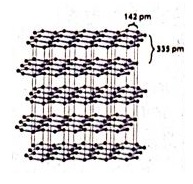
Graphite:
1. Graphite is the most stable allotropic form of carbon at normal temperature and pressure.
2. It is soft and conducts electricity.
3. It is composed of flat two dimensional sheets of carbon atoms.
4. Each sheet is a hexagonal.
5. It is "sp2" hybridised.
6. C-C bond length is 1.41 Å
7. Each C-atom forms three σ bonds with three neighbouring carbon atoms using three of its valence electrons and the fourth electron present in the unhybridised p-orbital form a π-bond.
8. The successive C-sheets are held together by weak Vander Waals forces.
9 The distance successive sheet is 3.40 Å.
10. It is used as a lubricant either on its own or as a graphited oil.
Diamond:
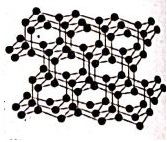
1. It is very hard.
2. It is "sp3" hybridised.
3. C-C bond length is 1.54 Å
4. It is used for sharpening hard tools, cutting glasses, making bores and rock drilling.
Fullerenes:
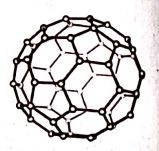
1. These allotropes are discrete molecules such as \(C_{32}, C_{50}, C_{60}, C_{70}, C_{76}\) etc.
2. It has cage like structure
3. The C60 molecules have a "soccer" ball like structure and is called buckminster fullerene or buckyballs.
4. It has a fused ring structure consists of 20 six membered rings and 12 five membered ring.
5. Each carbon atom is "sp2" hybridised.
6. It has three σ bonds and a delocalised π bond giving aromatic character to these molecules.
7. The C-C bond distance is 1.44 Å
8. The C=C bond distance is 1.38 Å.
Carbon nanotubes:
1. Carbon nanotubes, another recently discovered allotropes, have graphite like tubes with fullerene ends.
2. Along the axis, these nanotubes are stronger than steel and conduct electricity.
3. These have many applications in nanoscale electronics, catalysis, polymers and medicine.
Graphene:
It has a single planar sheet of "sp2" hybridised carbon atoms that are densely packed in a "honeycomb crystal" lattice.
32.
Direct reaction of nitrogen with hydrogen gives ammonia. This reaction is favored by high pressures and at optimum temperature in presence of iron catalyst.
\(\cfrac { 1 }{ 2 } { N }_{ 2 }+\cfrac { 3 }{ 2 } { H }_{ 2 }\rightleftharpoons { 2NH }_{ 3 }\)\(\Delta H_f { }_{ }=-46.2KJmol^{ -1 }\)
33.
(i) Its small size
(ii) Its high electronegativity
(iii) Its high ionisation energy
(iv) Non-availability of d-orbital in the valence shell.
(v) Rather inert
(vi) High bond energy
34.
1. A double salt which contains fourth-period alkali metal (A) is potash alum
K2SO4 Al2(SO4)3 - 24 H₂O
2. On heating potash alum (A) 500 k give anhydrous potash alum (or) burnt alum (B).
\(\mathrm{K}_{2} \mathrm{SO}_{4} \cdot \mathrm{Al}_{2}\left(\mathrm{SO}_{4}\right)_{3} \cdot 24 \mathrm{H}_{2} \mathrm{O} \stackrel{500 \mathrm{~K}}{\longrightarrow} \mathrm{K}_{2} \mathrm{SO}_{4} \cdot \mathrm{Al}_{2}\left(\mathrm{SO}_{4}\right)_{3}+24 \mathrm{H}_{2} \mathrm{O}\)
[Potash alum (A)] [Burnt alum (B)]
3. Aqueous solution of burnt alum, has sulphates ion, potassium ion and aluminium ion. Sulphate ion reacts with BaCl₂ to form a white precipitate of Barium Sulphate
(SO4)2 + BaCl2 → BaSO4 + 2 Cl¯
Aluminium ion reacts with alizarin solution to give a red colour compound.
35.
A hydride of 2nd period alkali metal (A) is lithium hydride (LiH).
Lithium hydride (A) reacts with diborane (B) to give lithium borohydride (C) which is acts as a reducing agent.
B2H6 + 2 LiH \(\xrightarrow[]{ether}\) 2 LiBH4
[Diborane (B)] [Lithium hydride (A)] [Lithium borohydride (C)]
Result:
| Compound | Formula | Name |
| A | LiH | Lithium hydride |
| B | B2H6 | Diborane |
| C | LiBH4 | Lithium borohydride |
36.
Fusion of urea with B(OH)3' in an atmosphere of ammonia at 800 - 1200 K gives boron nitride.
B(OH)3 + NH3 \(\overset { \Delta }{ \longrightarrow } \) BN+ 3H2O
37.
Each halogen combines with other halogens to form a series of compounds are called interhalogen compounds.
Example: AB type: BrF
AB3 type: ICI3
38.

12th Standard Syllabus & Materials
12th Standard
TN 12th Computer Applications களப்பெயர் முறைமை (DNS) Sample Question Papers Study Material - QB365 Set A
NEW12th Standard
TN 12th Computer Applications வலையமைப்பு எடுத்துக்காட்டுகள் மற்றும் நெறிமுறைகள் Sample Question Papers Study Material - QB365 Set A
NEW12th Standard
TN 12th Computer Applications கணினி வலையமைப்பு ஓர் அறிமுகம் Sample Question Papers Study Material - QB365 Set A
NEW12th Standard
TN 12th Computer Applications PHP-உடன் MySQL-ஐ இணைத்தல் Sample Question Papers Study Material - QB365 Set A



Tamilnadu Stateboard 12th Standard Subjects

Maths
Chemistry

Physics

Biology

Computer Science

Business Maths and Statistics

Economics

Commerce

Accountancy

History

Computer Applications
Biology
Computer Technology
Computer Applications
Computer Science
Business Maths and Statistics
Commerce
Economics
Maths
Chemistry
Physics
Computer Technology
History
Accountancy

Tamil

English

French
Tamilnadu Stateboard Standards


