
 100% FREE ACCESS
12th Standard Syllabus & Materials
12th Standard
TN 12th Computer Applications மின்னணு தரவு பரிமாற்றம் Sample Question Papers Study Material - QB365 Set A
NEW12th Standard
TN 12th Computer Applications மின் - வணிக பாதுகாப்பு அமைப்புகள் Sample Question Papers Study Material - QB365 Set A
NEW12th Standard
TN 12th Computer Applications மின்னணு செலுத்தல் முறைகள் Sample Question Papers Study Material - QB365 Set A
NEW12th Standard
TN 12th Computer Applications மின் - வணிகம் Sample Question Papers Study Material - QB365 Set A
NEW12th Standard
TN 12th Computer Applications திறந்த மூல கருத்துருக்கள் Sample Question Papers Study Material - QB365 Set A
NEW12th Standard
TN 12th Computer Applications வலையமைப்பு வடமிடல் Sample Question Papers Study Material - QB365 Set A

Published on: 28/11/2025
Download Tamil Nadu 12th Standard Chemistry question papers, model tests, one-mark questions, important questions, and public exam papers in PDF format. Free study materials and answer keys for TN State Board students.
Questions + Answers key
Take MCQ Chemistry Test
1.
Packing fraction of a simple cubic arrangement is _______.
68%
74%
52.38%
83%
2.
The compound that reacts faster with Lucas reagent is ________.
butan-l-ol
butan-2-ol
2-methyl propan-1-ol
2-methyl propan-2-ol
3.
Which one of the following is most basic?
2,4 – dichloroaniline
2,4 – dimethyl aniline
2,4 – dinitroaniline
2,4 – dibromoaniline
4.
Secondary nitro alkanes react with nitrous acid to form _______.
red solution
blue solution
green solution
yellow solution
5.
Aniline + benzoylchloride \(\overset { NaOH }{ \longrightarrow } \)C6H5 - NH - COC6 H5 this reaction is known as ______.
Friedel – crafts reaction
HVZ reaction
Schotten – Baumann reaction
none of these
6.
The method by which aniline cannot be prepared is _________.
degradation of benzamide with Br2 / NaOH
potassium salt of phthalimide treated with chlorobenzene followed by hydrolysis with aqueous NaOH solution.
reduction of Nitrobenzene with LiAlH4
reduction of nitrobenzene by Sn / HCl
7.
On reacting with neutral ferric chloride, phenol gives ______.
red colour
violet colour
dark green colour
no colouration.
8.
Among the following ethers which one will produce methyl alcohol on treatment with hot HI?
(H3C)3C-O-CH3
(CH3-)2-CH-CH2-O-CH3
CH3-(CH2)3-O-CH3
CH3-CH2-\(\underset { \overset { | }{ { CH }_{ 3 } } }{ CH } \)-O-CH3
9.
The reaction

Can be classified as ______.
dehydration
Williams on alcoholsynthesis
Williamson ether synthesis
dehydrogenation of alcohol
10.
(CH3)3-C-CH(OH) CH3 \(\overset { con{ H }_{ 2 }{ SO }_{ 4 } }{ \longrightarrow } \)X (major product)
(CH3)3 CCH = CH2
(CH3)2C = C (CH3)2
CH2= C(CH3)CH2-CH2- CH3
CH2= C (CH3) - CH2- CH2- CH3
11.
12.
An alcohol (x) gives blue colour in victormayer’s test and 3.7g of X when treated with metallic sodium liberates 560 mL of hydrogen at 273 K and 1 atm pressure what will be the possible structure of X?
CH3 CH (OH) CH2CH3
CH3 – CH (OH) – CH3
CH3 – C (OH) – (CH3)2
CH3- CH2 –CH (OH) – CH2 – CH3
13.
Chemical formula of phosgene is_______.
COCl2
CaOCl2
CaCO3
COCI
14.
Which of the following is commonly used to produce foam in froth floatation process?
Pine oil
Cresol
NaCN
Xanthate
15.
If 75% of a first order reaction was completed in 60 minutes, 50% of the same reaction under the same conditions would be completed in_______.
20 minutes
30 minutes
35 minutes
75 minutes
16.
17.
In a first order reaction x ⟶ y; if k is the rate constant and the initial concentration of the reactant x is 0.1M, then, the half life is_____.
\(\left( \frac { \log2 }{ k } \right) \)
\(\left( \frac { 0.693 }{ (0.1)k } \right) \)
\(\left( \frac { In2 }{ k } \right) \)
none of these
18.
What is the activation energy for a reaction if its rate doubles when the temperature is raised from 200K to 400K? (R = 8.314 JK-1 mol-1)
234.65 kJ mol-1
434.65 kJ mol-1
2.305 kJ mol-1
334.65 J mol-1
19.
In a reversible reaction, the enthalpy change and the activation energy in the forward direction are respectively −x kJ mol-1 and y kJ mol-1. Therefore, the energy of activation in the backward direction is _______.
(y-x) kJ mol-1
(x+y) J mol-1
(x-y) KJ mol-1
(x+y) x 103J mol-1
20.
The addition of a catalyst during a chemical reaction alters which of the following quantities?
Enthalpy
Activation energy
Entropy
Internal energy
21.
Schottky defect in a crystal is observed when ______.
unequal number of anions and anions are missing from the lattice
Equal number of cations and anions are missing from the lattice
an ion leaves its normal site and occupies an interstitial site
no ion is missing from its lattice
22.
If ‘a’ is the length of the side of the cube, the distance between the body centered atom and one corner atom in the cube will be_________.
\(\left( \cfrac { 2 }{ \sqrt { 3 } } \right) a\)
\(\left( \cfrac { 4 }{ \sqrt { 3 } } \right) a\)
\(\left( \cfrac { \sqrt { 3 } }{ 4 } \right) a\)
\(\left( \cfrac { \sqrt { 3 } }{ 2 } \right) a\)
23.
The radius of an atom is 300pm, if it crystallizes in a face centered cubic lattice, the length of the edge of the unit cell is ________.
488.5pm
848.5pm
884.5pm
484.5pm
24.
For a first order reaction A ⟶ product with initial concentration x mol L-1, has a half life period of 2.5 hours. For the same reaction with initial concentration \(\left( \frac { x }{ 2 } \right) \) mol L-1 the half life is
(2.5 x 2) hours
\(\left( \frac { 2.5 }{ 2 } \right) \) hours
2.5 hours
Without knowing the rate constant, t1/2 cannot be determined from the given data
25.
Among the following graphs showing variation of rate constant with temperature (T) for a reaction, the one that exhibits Arrhenius behavior over the entire temperature range is _______.

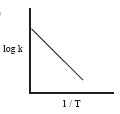
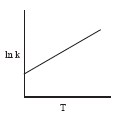
both (b) and (c)
26.
CsCl has bcc arrangement, its unit cell edge length is 400pm, its inter atomic distance is ________.
400pm
800pm
\(\sqrt { 3 } \times 100pm\)
\(\left( \frac { \sqrt { 3 } }{ 2 } \right) \times 400pm\)
27.
The number of unit cells in 8 gm of an element X (atomic mass 40) which crystallizes in bcc pattern is (NA is the Avogadro number)________.
6.023 x 10²³
6.023 x 10²²
60.23 x 10²³
\(\left( \frac { 6.023\times { 10 }^{ 23 } }{ 8\times 40 } \right) \)
28.
The ratio of close packed atoms to tetrahedral hole in cubic packing is ________.
1:1
1:2
2:1
1:4
29.
An ionic compound Ax By crystallizes in fcc type crystal structure with B ions at the centre of each face and A ion occupying corners of the cube the correct formula of Ax, By is ________.
AB
AB3
A3B
A8B6
30.
The stability of +1 oxidation state increases in the sequence ________.
Al < Ga < In < Tl
Tl < In < Ga < Al
In < Tl < Ga < Al
Ga< In < Al < Tl
31.
The geometry at which carbon atom in diamond are bonded to each other is _______.
Tetrahedral
hexagonal
Octahedral
none of these
32.
Which of these is not a monomer for a high molecular mass silicone polymer?
Me3SiCl
PhSiCl3
MeSiCl3
Me2SiCl2
33.
When copper is heated with conc HNO3 it produces ________.
Cu(NO3)2, NO and NO2
Cu(NO3)2 and N2O
Cu(NO3)2 and NO2
Cu(NO3)2 and NO
34.
Which one of the following orders is correct for the bond dissociation enthalpy of halogen molecules?
Br2 > I2 > F2 > Cl2
F2 > Cl2 > Br2 > l2
I2 > Br2 > Cl2 > F2
Cl2 > Br2 > F2 > I2
35.
XeF6 on complete hydrolysis produces________.
XeOF4
XeO2F2
XeO3
XeO2
36.
The molarity of given orthophosphoric acid solution is 2M. Its normality is _______.
6N
4N
2N
none of these
37.
P4O6 reacts with cold water to give _______.
H3PO3
H4P2O7
HPO3
H3PO4
38.
Solid (A) reacts with strong aqueous NaOH liberating a foul smelling gas(B) which spontaneously burn in air giving smoky rings. A and B are respectively_________.
P4(red) & PH3
P4(white) & PH3
S8 & H2S
P4(white) & H2S
39.
Which is true regarding nitrogen?
least electronegative element
has low ionisation enthalpy than oxygen
d- orbitals available
ability to form pπ-pπ bonds with itself
40.
The basic structural unit of silicates is _______.
\(\left( SiO_{ 3 } \right) ^{ 2- }\)
\(\left( SiO_{ 4 } \right) ^{ 2- }\)
\(\left( Sio \right) ^{ - }\)
\(\left( SiO_{ 4 } \right) ^{ 4- }\)
41.
Oxidation state of carbon in its hydrides _______.
+4
-4
+3
+2
42.
Carbon atoms in fullerene with formula C60 have _______hybridisation.
sp3 hybridised
sp hybridised
sp2 hybridised
partially sp2 and partially sp3 hybridised
43.
Which of the following metals has the largest abundance in the earth’s crust?
Aluminium
Calcium
Magnesium
Sodium
44.
Which of the following is not true with respect to Ellingham diagram?
Free energy changes follow a straight line. Deviation occurs when there is a phase change.
The graph for the formation of CO2 is a straight line almost parallel to free energy axis.
Negative slope of CO shows that it becomes more stable with increase in temperature.
Positive slope of metal oxides shows that their stabilities decrease with increase in temperature.
45.
The incorrect statement among the following is______.
Nickel is refined by Mond’s process
Titanium is refined by Van Arkel’s process
Zinc blende is concentrated by froth floatation
In the metallurgy of gold, the metal is leached with dilute sodium chloride solution
46.
47.
Which one of the following ores is best concentrated by froth – floatation method?
Magnetite
Haematite
Galena
Cassiterite
48.
Wolframite ore is separated from tinstone by the process of________.
Smelting
Calcination
Roasting
Electromagnetic separation
49.
The metal oxide which cannot be reduced to metal by carbon is ________.
PbO
Al2O3
ZnO
FeO
50.
Roasting of sulphide ore gives the gas (A).(A) is a colourless gas. Aqueous solution of (A) is acidic. The gas (A) is______.
CO2
SO3
SO2
H2S
1.
(c)
52.38%
2.
(d)
2-methyl propan-2-ol
3.
(b)
2,4 – dimethyl aniline
4.
(b)
blue solution
5.
(c)
Schotten – Baumann reaction
6.
(b)
potassium salt of phthalimide treated with chlorobenzene followed by hydrolysis with aqueous NaOH solution.
7.
(b)
violet colour
8.

9.
Cyclic alcolhol → sodium cyclic alkoxide- Williamson ether synthesis.
10.
(CH3)2C = C (CH3)2
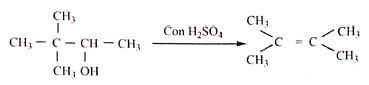
11.
(c)
12.
CH3 CH (OH) CH2CH3
2R-OH+ 2Na ⟶ 2RONa + H2 ↑
2 moles of alcohol gives 1 mole of H2 which occupies 22.4 L at 273 K and 1 atm number of moles of alcohol
= 2 moles of R -OH/22.4L of H2 x 560 ml
= 0.05 moles
No of moles = mass/molar mass = m/M
= 3.7/0.05 = 74 g mol-1
General formula for (R-OH) Cn H2n + 1OH
n(12) + (2n + 1) (1) + 16 + 1 = 74
14n = 74 - 18
14n = 56
n = 56/14 = 4
The "2" alcohol which contains 4 carbon is CH3 - CH (OH) CH2 - CH3
13.
(a)
COCl2
14.
(a)
Pine oil
15.
t75% = 2t50%
t50% = (t75%/2) = (60/2) = 30 minutes
16.
(d)
17.
\(k=\frac { 1 }{ t } ln \frac { \left[ { A }_{ 0 } \right] }{ \left[ A \right] } \)
[A0] = 0.1: [A] = 0.05
\(k= \left[ \frac { 1 }{ t _{1/2}} \right] ln\left[ \frac { { 0.1 } }{ 0.05 }\right] \)
\(k= \left[ \frac { 1 }{ t _{1/2}} \right] ln (2)\)
t1/2 = In(2)/K
18.
T1= 200 K ; k = k1
T2 =400 K ; k1 = k2 = 2k1
log\(\frac {{ k }_{ 2 } }{ { k }_{ 1 } } =\frac { { E }_{ a } }{ 2.303R } \left[ \frac { { T }_{ 2 }-{ T }_{ 1 } }{ { T }_{ 1 }{ T }_{ 2 } } \right] \)
log \( [\frac {{2 k }_{ 1 } }{ { k }_{ 1 } }]\)
\(= \left[ \frac { E_{a} }{ 2.303\times 8.314 JK^{-1} mol^{-1} } \right] \)
\(= \left[ \frac { 400 k - 200K }{200 k \times 400 k } \right] \)
\(E_{a} = \frac{ 0.3010 \times 2.303 \times 8.314 JK^{-1}mol^{-1} \times 200K \times 400 K}{200 K}\)
Ea = 2305 J mol-1
Ea = 2.305 kJ mol-1
19.
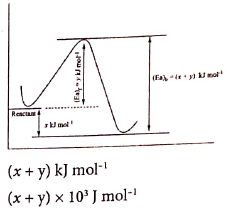
20.
A catalyst provides a new path to the reaction with low activation energy. i.e., it lowers the activation energy.
21.
(b)
Equal number of cations and anions are missing from the lattice
22.
If a is the length of the side, then the length of the leading diagonal passing through the body centered atom is \(\sqrt{3a} \)
Required distance = \(\left( \cfrac { \sqrt { 3 } }{ 2 } \right) a\)
23.
let edge length = a
\(\sqrt{2a} = 4r\)
\(a = \frac{4 \times 300}{\sqrt {2}}\)
a = 600 x 1.414
a = 848.4 pm
24.
For a first order reaction
t1/2 = \(\frac { 0.693 }{ { k }}\)
t1/2 does not depend on the initial concentration and it remains constant (whatever may be the initial concentration)
t1/2 = 2.5 hrs
25.
\(k=A{ e }^{ -\left( \frac { { E }_{ a } }{ RT } \right) }\)
In k = In A - \({ \left( \frac { { E }_{ a } }{ R } \right) }\) \(\left( \frac { 1 }{ T } \right) \)
This equation is of the form of a straight line y = mx+c
A plot of In k Vs \(\left( \frac { 1 }{ T } \right) \) gives a straight line with a negative slope.
26.
\(3 \sqrt{a} = r_{C_{s+}} + 2r_{C_{f-}} + r_{C_{s+}} \)
\(\left( \frac { \sqrt { 3 } }{ 2 } \right) a = r_{C_{s+}} + r_{C_{f-}} \)
\(\left( \frac { \sqrt { 3 } }{ 2 } \right) \times 400\)= inter ionic distance
27.
In bcc unit cell,
2 atoms = 1 unit cell
Number of atoms in 8 g of element is, Number of moles = 8g / 40 g mol-1 = 0.2 mol
1 mole contains 6.023 x10²³ atoms
0.2 mole contains 0.2 x 6.023 x 1023 atoms
[1 unit cell / 2 atoms] x 0.2 x 6.023 x 1023
= 6.023 x 10²² unit cells.
28.
If number of close packed atoms = N, then
The number of Tetrahedral holes formed = 2N
The number of Octahedral holes formed = N
Therefore, N:2N = 1:2
29.
Number of A ions = Nc/8 = 8/8 = 1
Number of B ions = Nf/2 = 6/2 = 3
Simplest formula = AB3
30.
(a)
Al < Ga < In < Tl
31.
(a)
Tetrahedral
32.
(a)
Me3SiCl
33.
(c)
Cu(NO3)2 and NO2
34.
(d)
Cl2 > Br2 > F2 > I2
35.
(c)
XeO3
36.
(a)
6N
37.
(a)
H3PO3
38.
(b)
P4(white) & PH3
39.
(d)
ability to form pπ-pπ bonds with itself
40.
(d)
\(\left( SiO_{ 4 } \right) ^{ 4- }\)
41.
(a)
+4
42.
(c)
sp2 hybridised
43.
(a)
Aluminium
44.
(b)
The graph for the formation of CO2 is a straight line almost parallel to free energy axis.
45.
(d)
In the metallurgy of gold, the metal is leached with dilute sodium chloride solution
46.
(c)
47.
(c)
Galena
48.
(d)
Electromagnetic separation
49.
(b)
Al2O3
50.
(c)
SO2

12th Standard Syllabus & Materials
12th Standard
TN 12th Computer Applications களப்பெயர் முறைமை (DNS) Sample Question Papers Study Material - QB365 Set A
NEW12th Standard
TN 12th Computer Applications வலையமைப்பு எடுத்துக்காட்டுகள் மற்றும் நெறிமுறைகள் Sample Question Papers Study Material - QB365 Set A
NEW12th Standard
TN 12th Computer Applications கணினி வலையமைப்பு ஓர் அறிமுகம் Sample Question Papers Study Material - QB365 Set A
NEW12th Standard
TN 12th Computer Applications PHP-உடன் MySQL-ஐ இணைத்தல் Sample Question Papers Study Material - QB365 Set A



Tamilnadu Stateboard 12th Standard Subjects

Maths
Chemistry

Physics

Biology

Computer Science

Business Maths and Statistics

Economics

Commerce

Accountancy

History

Computer Applications
Biology
Computer Technology
Computer Applications
Computer Science
Business Maths and Statistics
Commerce
Economics
Maths
Chemistry
Physics
Computer Technology
History
Accountancy

Tamil

English

French
Tamilnadu Stateboard Standards


