
 100% FREE ACCESS
12th Standard Syllabus & Materials
12th Standard
TN 12th Computer Applications மின்னணு தரவு பரிமாற்றம் Sample Question Papers Study Material - QB365 Set A
NEW12th Standard
TN 12th Computer Applications மின் - வணிக பாதுகாப்பு அமைப்புகள் Sample Question Papers Study Material - QB365 Set A
NEW12th Standard
TN 12th Computer Applications மின்னணு செலுத்தல் முறைகள் Sample Question Papers Study Material - QB365 Set A
NEW12th Standard
TN 12th Computer Applications மின் - வணிகம் Sample Question Papers Study Material - QB365 Set A
NEW12th Standard
TN 12th Computer Applications திறந்த மூல கருத்துருக்கள் Sample Question Papers Study Material - QB365 Set A
NEW12th Standard
TN 12th Computer Applications வலையமைப்பு வடமிடல் Sample Question Papers Study Material - QB365 Set A

Published on: 22/08/2026
Download Tamil Nadu 12th Standard Maths question papers, model tests, one-mark questions, important questions, and public exam papers in PDF format. Free study materials and answer keys for TN State Board students.
Questions + Answers key
Take MCQ Maths Test
1.
Explain why Rolle’s theorem is not applicable to the following functions in the respective intervals.
\(f(x)=tan x,x \in [0, \pi]\)
2.
A particle is fired straight up from the ground to reach a height of s feet in t seconds, where s(t) = 128t −16t2.
(1) Compute the maximum height of the particle reached.
(2) What is the velocity when the particle hits the ground?
3.
Evaluate the following limit, if necessary use l’Hôpital Rule
\(\underset { x\rightarrow { 0 }^{ + } }{ lim } { x }^{ x }\)
4.
Using the l’Hôpital Rule prove that, \(\underset{x\rightarrow 0^{+}}{lim}(1+x)^{\frac{1}{x}}=e\)
5.
Find the angle between the rectangular hyperbola xy = 2 and the parabola x2 + 4y = 0
6.
If the curves ax2+ by2 = 1 and cx2+ dy2 = 1 intersect each other orthogonally then, \(\frac{1}{a}-\frac{1}{b}=\frac{1}{c}-\frac{1}{d}\)
7.
A police jeep, approaching an orthogonal intersection from the northern direction, is chasing a speeding car that has turned and moving straight east. When the jeep is 0.6 km north of the intersection and the car is 0.8 km to the east. The police determine with a radar that the distance between them and the car is increasing at 20 km/hr. If the jeep is moving at 60 km/hr at the instant of measurement, what is the speed of the car?
8.
Salt is poured from a conveyer belt at a rate of 30 cubic metre per minute forming a conical pile with a circular base whose height and diameter of base are always equal. How fast is the height of the pile increasing when the pile is 10 metre high?
9.
Evaluate the following limit, if necessary use l ’Hôpital Rule
\(\underset { x\rightarrow \infty }{ lim } { e }^{ -x }\sqrt { x } \)
10.
Write the Maclaurin series expansion of the following function
log(1 - x); -1 ≤ x < 1
11.
Suppose that for a function f(x), f'(x) ≤ 1for all 1 ≤ x ≤ 4. Show that f(4) - f(1) ≤ 3.
12.
Find the point on the curve y = x2 − 5x + 4 at which the tangent is parallel to the line 3x + y = 7.
1.
Given f(x) = tan x, x ∈ [0, π]
Rolle's theorem is not applicable since tan x is not continuous at x = \(\frac{\pi}{2}\) [∵ tan \(\frac{\pi}{2}\) = ∞]
2.
(i) At the maximum height, the velocity v(t) of the particle is zero.
Now, we find the velocity of the particle at time t.
\(v(t)=\frac{ds}{dt}=128-32t\)
\(v(t)=0 \Rightarrow 128-32t=0 \Rightarrow t=4.\)
After 4 seconds, the particle reaches the maximum height.
The height at t = 4 is s(4) = 128(4) - 16(4)2 = 256 ft.
(ii) When the particle hits the ground then s = 0 .
s = 0 ⇒ 128t −16t2 = 0
⇒ t = 0, 8 seconds.
The particle hits the ground at t = 8 seconds. The velocity when it hits the ground v(8) = –128 ft /s.
3.
\(\underset { x\rightarrow { 0 }^{ + } }{ lim } { x }^{ x }\)
This is an indeterminate of the form 00
Let g(x) xx
Taking logarithm, we get
\(log \ g(x)=log({ x }^{ 2 })=xlogx=\frac { log\quad x }{ \frac { 1 }{ x } } \)
\(\therefore \underset { x\rightarrow { 0 }^{ + } }{ lim } log \ g(x)={ \left[ \frac { logx }{ \frac { 1 }{ x } } \right] }=\frac { \infty }{ \infty } \)
\(=\underset { x\rightarrow { 0 }^{ + } }{ lim } \left( \frac { \frac { 1 }{ x } }{ -\frac { 1 }{ { x }^{ 2 } } } \right) \) [by L' Hopital rule]
= \(\underset { x\rightarrow { 0 }^{ + } }{ lim } \frac { 1 }{ x } \times \frac { { x }^{ 2 } }{ 1 } =\underset { x\rightarrow { 0 }^{ + } }{ lim } -x\)
= 0
But \(\underset { x\rightarrow { 0 }^{ + } }{ lim } (log(g(x))=log(\underset { x\rightarrow { 0 }^{ + } }{ lim } (g(x))\)
ஃ \(\underset { x\rightarrow { 0 }^{ + } }{ lim } (log(g(x))=0\)
\(\Rightarrow { e }^{ log }(\underset { x\rightarrow { 0 }^{ + } }{ lim } log(g(x))={ e }^{ 0 }\)
\(\Rightarrow \underset { x\rightarrow { 0 }^{ + } }{ lim } g(x)=1\)
\(\therefore \underset { x\rightarrow { 0 }^{ + } }{ lim } { x }^{ x }=1\)
4.
This is an indeterminate of the form \(1^{\infty}\).
Let \(g(x)=(1+x)^{\frac{1}{x}}\). Taking the logarithm, we get
\(log \ g(x)=\frac{log(1+x)}{x}\)
\(\underset{x\rightarrow 0^{+}}{lim} log (g(x))=\underset{x\rightarrow 0^{+}}{lim}(\frac{log(1+x)}{x})\) \((\frac{0}{0})\)
=\(\underset{x\rightarrow0^{+}}{lim}(\frac{\frac{1}{1+x}}{1})\) (by 1’Hôpital Rule)
= 1.
But, \(\underset{x\rightarrow0^{+}}{lim}log g(x)=log(\underset{x\rightarrow 0^{+}}{lim} g(x))\)
Therefore, log\((\underset{x\rightarrow 0^{+}}{lim} g(x))=1\).
Hence by exponentiating, we get, \(\underset{x\rightarrow 0^{+}}{lim}g(x)=e.\)
5.
Equation of the rectangular hyperbola is xy = 2
⇒ y = \(\frac{2}{x}\)
⇒ x.\(\frac { dy }{ dx } \) + y(1) = 0
⇒ \(\frac { dy }{ dx } \) = \(\frac{-y}{x}\)
Slope of the tangent to the curve m1 =\(\frac{-y}{x}\)
Equation of the parabola is x2+ 4y = 0 ...(2)
⇒2x + 4\(\frac { dy }{ dx } \) = 0
\(\frac { dy }{ dx } \) = \(\frac{-2x}{4}=\frac{-x}{2}\)
Slope of the tangent to the curve m2 = \(\frac{-x}{2}\)
Substituting (1) in (2) we get,
x2 + 4 \((\frac{2}{x})\) = 0 ⇒ x2 + \(\frac{8}{x}\) = 0
⇒ x3 + 8 = 0
⇒ x3 = -8 = (-2)3 ⇒ x = -2
⇒ When x = -2, y = \(\frac{2}{-2}\) = -1
'∴ The point of intersection of RH and parabola is (-2, -2)
'∴ m1 = \(\frac { -y }{ x } =\frac { -(-1) }{ -2 } =\frac { -1 }{ 2 } \)
m2 = \(\frac { -x }{ 2 } =\frac { -(-2) }{ 2 } \) = 1
Let θ be the angle between rectangular hyperbola and parabola
tan \(\theta =\left| \frac { { m }_{ 1 }-{ m }_{ 2 } }{ 1+{ m }_{ 1 }{ m }_{ 2 } } \right| \left| \frac { -\frac { 1 }{ 2 } -1 }{ 1+\left( \frac { 1 }{ 2 } \right) (1) } \right| \)
= \(\left| \frac { -\frac { 3 }{ 2 } }{ 1-\frac { 1 }{ 2 } } \right| =\left| \frac { -\frac { 3 }{ 2 } }{ \frac { 1 }{ 2 } } \right| =\left| -3 \right| =3\)
∴ θ = tan-1 (3)
6.
Let the two curves intersect at a point (x0 , y0) This leads to (a-c)x02 + (b-d)y02 = 0
Let us now find the slope of the curves at the point of intersection (x0, y0). The slopes of the curves are as follows :
For the curve ax2 + by2 = 1, \(\frac{dy}{dx}= -\frac{ax}{by}\)
For the curve cx2 + dy2 = 1, \(\frac{dy}{dx}= -\frac{cx}{by}\)
Now, two curves cut orthogonally, if the product of their slopes intersection (x0, y0) is −1. Hence, for the above two curves to cut orthogonally at (x0, y0) if
\((-\frac{ax_{0}}{by_{0}})\times(-\frac{cx_{0}}{dy_{0}})=-1\)
That is, acx02 + bdy02 = 0,
together with \((a-c)x^{2}_{0}+(b-d)y_{0}^{2}=0\)
gives, \(\frac{a-c}{ac}=\frac{b-d}{bd}\)
That is, \(\frac{1}{c}-\frac{1}{a}=\frac{1}{d}-\frac{1}{b}\).
Hence, \(\frac{1}{a}-\frac{1}{b}=\frac{1}{c}-\frac{1}{d}\).
7.
Let x represent the distance covered by the car, y represent the distance covered by the police jeep, and s represent the distance between the car and jeep.
ஃ Given = x = 0.8 km, y = 0.6 km,
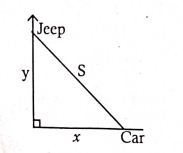
\(\frac { dy }{ dt } \) = -60km/hr,
\(\frac { ds }{ dt } \) = 20 km/hr,
In ΔABC, S2 = x2 + y2 ......(1)
⇒ S2 = (0.8)2 + (0.6)2
= 0.64 + 0.36
⇒ S2 = 1
⇒ s = 1 ....(2)
Differentiating (1) with respect to 't' we get,
\(2s\frac { ds }{ dt } =2x\frac { dx }{ dt } +2y\frac { dy }{ dt } \)
⇒ \(s\frac { ds }{ dt } =x\frac { dx }{ dt } +y\frac { dy }{ dt } \) [Divided by 2]
⇒\(1\left( \frac { ds }{ dt } \right) =(0.8)\left( \frac { dx }{ dt } \right) +(0.6)(-60)\)
⇒ 1(20) = (0.8) \(\left( \frac { dx }{ dt } \right) \) + (0.6)(-60)
⇒ 20 = (0.8) \(\left( \frac { dx }{ dt } \right) \) - 36
⇒ 20 + 36 = (0.8) \(\frac { dx }{ dt } \)
⇒ \(\frac { dx }{ dt } =\frac { 56 }{ 0.8 } \) = 70km/hr.
⇒Speed of the car is 70 km/hr.
8.
Let h and r be the height and the base radius. Therefore h = 2r. Let V be the volume of the salt cone.
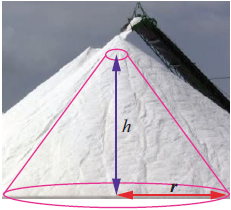
\(V=\frac{1}{3}\pi r^{2}h=\frac{1}{12}\pi h^{3}; \frac{dV}{dt}=30\) mtr3 / min.
Hence, \(\frac{dV}{dt}=\frac{1}{4}\pi h^{2}\frac{dh}{dt}\)
Therefore, \(\frac{dh}{dt}=4 \frac{dV}{dt}.\frac{1}{\pi h^{2}}\)
That is, \(\frac{dh}{dt}=4\times30\times \frac{1}{100 \pi}\)
=\(\frac{6}{5\pi}\) mtr / min.
9.
\(\underset { x\rightarrow \infty }{ lim } { e }^{ -x }\sqrt { x } =\underset { x\rightarrow \infty }{ lim } \frac { { \sqrt { x } } }{ { e }^{ x } } =\frac { \infty }{ \infty } \)
Which is in indeterminate form. Applying L' Hopital rule we get,
\(\underset { x\rightarrow \infty }{ lim } \frac { \frac { 1 }{ 2 } { x }^{ \frac { 1 }{ 2 } -1 } }{ { e }^{ x } } =\frac { 1 }{ 2 } \underset { x\rightarrow \infty }{ lim } \frac { { x }^{ \frac { 1 }{ 2 } -1 } }{ { e }^{ x } } =\frac { 1 }{ 2 } \underset { x\rightarrow \infty }{ lim } \frac { { e }^{ -x } }{ \sqrt { x } } \)
\(\frac { 1 }{ 2 } \underset { x\rightarrow \infty }{ lim } e^{ -x }\sqrt { \frac { 1 }{ x } } =\frac { 1 }{ 2 } { e }^{ -\infty }(0)=0\) [When x ➝ ∞, \(\frac1x\) ➝ 0 e-∞ = 0]
10.
| Function and its derivatives | log (1-x) cos x and its derivatives | Value at x = 0 |
| f(x) | log (1-x) | log 1 = 0 |
| fI(x) | \(\frac{-1}{1-x}\) = -1(1 - x)-1 | \(\frac{-1}{1}\) = -1 |
| fIl(x) | -1(1-x)-2 | -1 |
| fIIl(x) | -2(1-x)-3 | -2 |
| fIV(x) | -6 (1 - x)-4 | -6 |
| fV(x) | -24 (1 - x)-5 | -24 |
Meclaurin's expansion
\(f(x)=f(0)+\frac { { f }^{ 1 }(0) }{ 1! } x+\frac { { f }^{ II }(0) }{ 2! } { x }^{ 2 }+\frac { { f }^{ III }(0) }{ 3! } { x }^{ 3 }+\).................
log(1-x) = \(0-\frac { 1 }{ 1! } x-\frac { { x }^{ 2 } }{ 2! }- \frac { 2 }{ 3! } { x }^{ 3 }-\frac { { 6x }^{ 4 } }{ 4! } +.....\)
= \(-x-\frac { { x }^{ 2 } }{ 2 } +\frac { { x }^{ 3 } }{ 3 } +\frac { { x }^{ 4 } }{ 4 } \)+ .....
log(1 - x) = \(-\left( x+\frac { { x }^{ 2 } }{ 2 } +\frac { { x }^{ 3 } }{ 3 } +\frac { { x }^{ 4 } }{ 4 } +.... \right) \)
11.
f'(x) = ≤1 for all 1 ≤ x ≤ 4
Using Lagrange's mean value theorem,
f'(x) = \(\frac { f(b)-f(a) }{ b-a } \) [∵ f(x) is continuous in [1, 4] and differentiable in (1, 4)]
f'(x) = \(\frac{f(4)-f(1)}{4-1}\)
f'(x) = \(\frac { f(4)-f(1) }{ 3} \)
⇒ \(\frac { f(4)-f(1) }{ 3} \) = f'(s)
⇒ \(\frac { f(4)-f(1) }{ 3} \) ≤ 1[∵ f'(x) ≤ 1]
⇒ f(4) - f(1) ≤ 3
Hence proved
12.
Given curve is y = x2 − 5x + 4 and the line is 3x + y = 7
Slope of the tangent to the curve
\({ m }_{ 1 }=\frac { dx }{ dt } \) = 2x - 5
Slope of the line = \({ m }_{ 2}=\frac { dx }{ dt } \) = -3
\(\left[ \because m=\frac { co-efficient \ of \ x }{ co-efficient \ of \ y } \right] \)
Since the tangent of the curve and the lines are parallel, their slopes are equal.
∴ m1 = m2
⇒ 2x - 5 = -3
⇒ 2x = 2
⇒ x = 1
Substituting x = 1 in y = x2 - 5x + 4 we get
y = 12-5(1)+4 = 0
∴ The required point is (1, 0).

12th Standard Syllabus & Materials
12th Standard
TN 12th Computer Applications களப்பெயர் முறைமை (DNS) Sample Question Papers Study Material - QB365 Set A
NEW12th Standard
TN 12th Computer Applications வலையமைப்பு எடுத்துக்காட்டுகள் மற்றும் நெறிமுறைகள் Sample Question Papers Study Material - QB365 Set A
NEW12th Standard
TN 12th Computer Applications கணினி வலையமைப்பு ஓர் அறிமுகம் Sample Question Papers Study Material - QB365 Set A
NEW12th Standard
TN 12th Computer Applications PHP-உடன் MySQL-ஐ இணைத்தல் Sample Question Papers Study Material - QB365 Set A



Tamilnadu Stateboard 12th Standard Subjects
Maths

Chemistry

Physics

Biology

Computer Science

Business Maths and Statistics

Economics

Commerce

Accountancy

History

Computer Applications
Biology
Computer Technology
Computer Applications
Computer Science
Business Maths and Statistics
Commerce
Economics
Maths
Chemistry
Physics
Computer Technology
History
Accountancy

Tamil

English

French
Tamilnadu Stateboard Standards


